On this page
- How much does a mobile app cost in Saudi Arabia, the UAE and Egypt?
- What decides the price of an app?
- How much does a delivery app cost?
- How much does an app like Haraj cost?
- Why should Android and iOS be one price?
- What does a first quote often leave out?
- How do I get a quote I can compare?
- Frequently asked
A mobile app in Saudi Arabia, the UAE or Egypt costs whatever its scope adds up to: how many screens it has, how many kinds of user, whether it needs an admin panel and a back end, and how much it leans on maps, notifications and payments. The country matters much less than the scope. This article gives no figures, because any number quoted before someone has seen your feature list is a guess. It shows what decides the price, using the two apps people ask about most.
Those two come straight from search. People type كم تكلفة تطبيق توصيل (kam taklifat tatbiq tawsil, “how much does a delivery app cost”) and كم تكلفة تطبيق مثل حراج (kam taklifat tatbiq mithl Haraj, “how much does an app like Haraj cost”). The first is a delivery app. The second usually means a classifieds marketplace. Both look simple on a phone, and both are much bigger behind the screen.
How much does a mobile app cost in Saudi Arabia, the UAE and Egypt?
The price depends on what has to be built, and that is the same question in all three markets. Two apps that look alike on screen can differ several times over in work, because the expensive parts are the ones you never see: the server that stores the data, the rules that decide who may do what, the admin panel your team uses every day.
What changes by market is the scope you need. An app for Saudi and Emirati users usually needs full Arabic with right-to-left layouts, often alongside English. An app for Egypt may have to fit different login and payment habits. Each of those is work to build and test, and each shows up in the quote.
What decides the price of an app?
Most quotes come down to the same list of items. Here is what each one changes.
| What you decide | Why it moves the price |
|---|---|
| Number of screens and features | Every screen has to be designed, built and tested, and every feature adds states to handle: empty, loading, failed, offline. |
| Types of user | A customer, a seller, a driver and an administrator each need their own screens and permissions. Three user types is closer to three apps than to one. |
| Admin panel | The web dashboard where your team manages users, orders, listings and reports. Many first-time buyers forget to ask for it. |
| Back end | The server, database and rules behind the app. It decides how well the app copes as users grow. |
| Maps and location | Showing a place is simple. Live tracking, distance rules and delivery zones are not. |
| Notifications | Push messages, plus SMS or email where you need them, each with its own rules about when they fire. |
| Accounts and login | Phone number with a one-time code, email, social login, and what happens when someone loses access. |
| Languages | Arabic only, or Arabic and English. Right-to-left layouts need checking on every screen. |
| Payments and other integrations | Each outside service you connect is its own piece of work, and you usually pay that service separately too. |
| Custom design or a ready template | A designed-for-you interface takes longer than a standard one, and gives you something nobody else has. |
| Publishing | Preparing the app for Google Play and the App Store, filling in the listings, and dealing with review feedback. |
If you only remember one thing from the table, make it the admin panel and the back end. They are usually most of the work in a delivery or marketplace app, and a quote that doesn’t mention them is leaving something out. Details of the service are on my app development page.
How much does a delivery app cost?
A delivery app is rarely one app. A full one is three apps plus an admin panel, and the price follows that count.
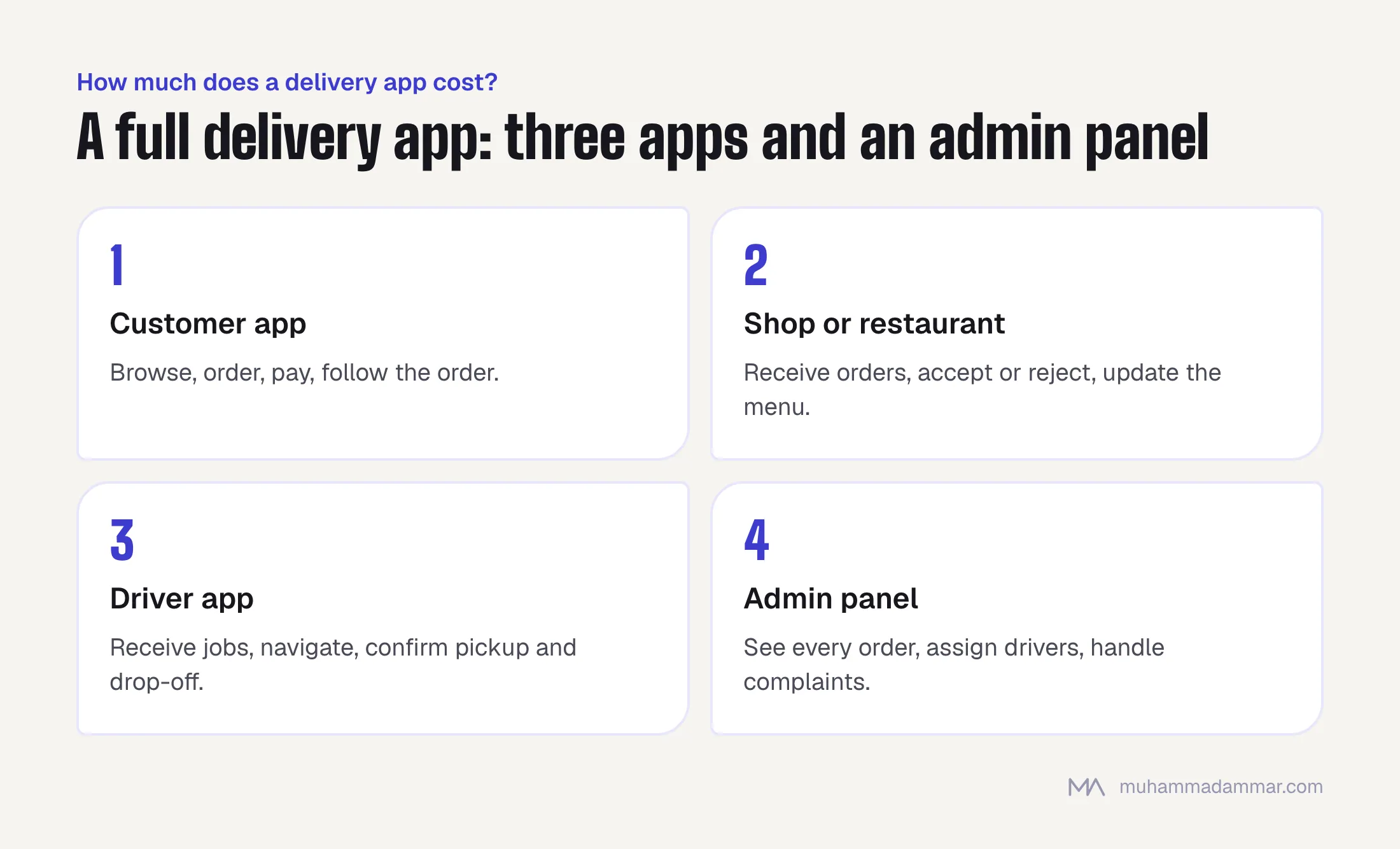
- The customer app: browsing, ordering, paying, following the order.
- The vendor side: the restaurant or shop receives orders, accepts or rejects them, updates stock or the menu.
- The driver app: receives jobs, navigates, confirms pickup and drop-off.
- The admin panel: your team sees every order, assigns drivers, handles complaints and reads reports.
Then come the pieces that make delivery work in practice. Maps with the customer’s address and the driver’s route. Live order status. Notifications at each step, to the right person. Payment, and what happens to an order that is paid and then cancelled. Ratings. Support for a driver who can’t find the address.
So when someone asks how much a delivery app costs, the useful answer is a question back: how many of those sides do you need on day one? A single shop with its own delivery staff needs far less than a platform that signs up many vendors and independent drivers. You can start with the smaller version and add sides later, as long as the first version is built so that adding them doesn’t mean starting again.
How much does an app like Haraj cost?
Here Haraj is just the name people type as an example. What they mean is a classifieds marketplace: an app where users post things for sale and other users find them. That is a different build from a delivery app, and the work sits in other places.
- Posting a listing: photos, description, category, location, and a form that is easy on a phone.
- Finding listings: categories, search, filters, sorting, and results that stay quick as the number of listings grows.
- Contact between buyer and seller: in-app chat, or a button that opens a call or WhatsApp.
- User profiles and the question of whether to verify them.
- Reporting and moderation: a way to flag fake or banned listings and a way for your team to remove them.
- Notifications for new messages and for listings that match a saved search.
- If you want revenue, promoted listings or paid plans, with the payment and admin side that comes with them.
Moderation is the item people underestimate. A marketplace without admin tools fills up with spam quickly, so the admin panel is not optional here. The search side matters too: it is what makes the app feel fast or slow once there are many thousands of listings. Both sit in the back end, not on the screens you would see in a design.
Why should Android and iOS be one price?
I deliver every app for Android and iOS together, as one package. That is how I have handled the three client apps I have built. Buying them separately means two quotes, two timelines and two sets of testing, and the two versions can drift apart in features and behaviour. One package keeps them the same.
When you compare quotes, check this first. Some quotes cover one platform and leave the other for later, which makes them look cheaper than they are. Ask directly whether Android, iOS, the admin panel and publishing to both stores are all inside the quote.
What does a first quote often leave out?
These are not hidden fees. They are costs that belong to running an app and that nobody mentions until late.
- Developer accounts with Google Play and the App Store. They should be opened in your name, so you own the app.
- Hosting for the back end, which keeps running after launch.
- Outside services such as maps, SMS codes and payment providers, which usually bill you for use.
- Updates after launch. Phone systems change every year, and an app that nobody updates eventually stops working properly.
- Content: category lists, product photos, terms and privacy text.
Ask for each of these to be listed, even if the line says “not included”. A line that says so is more useful than silence.
How do I get a quote I can compare?
Bring a short description. It doesn’t need to be technical.
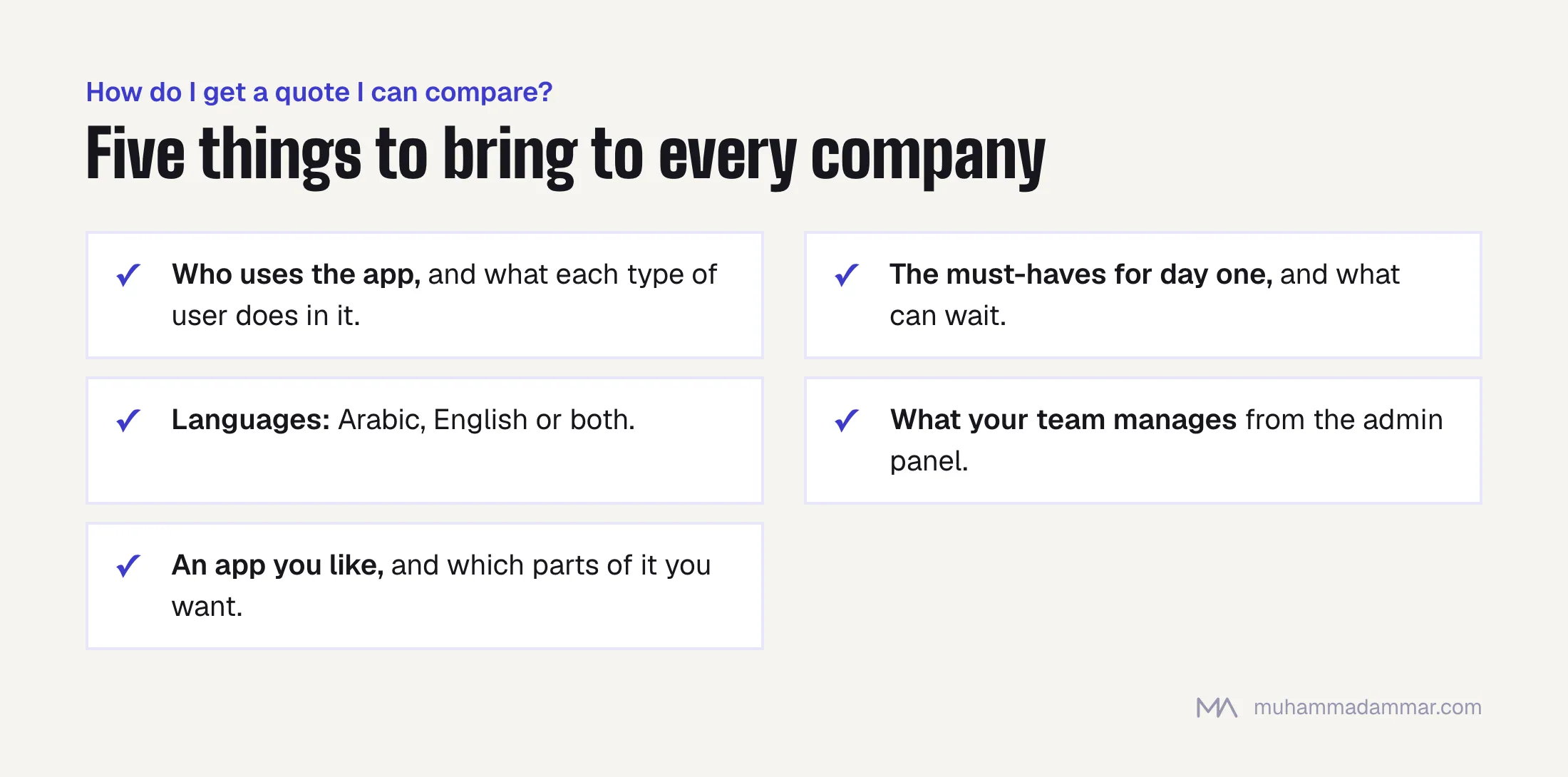
- Who uses the app, and what each type of user does in it.
- The five things the app must do on day one, and what can wait.
- Whether you need Arabic, English or both.
- What your team needs to manage from the admin panel.
- Any app you like, and which parts of it you want. A reference helps more than an adjective.
With that, two companies can quote the same thing and you can compare them. Without it you get two numbers for two different apps. If you’re still choosing who to ask, how to choose a mobile app development company has a checklist. If the app’s interface is the part you’re unsure about, app design covers that stage.
Frequently asked
Why don’t you publish an app price?
Because the same two words, “delivery app”, can mean a one-shop app or a platform with many vendors and drivers. Any single figure would be wrong for most people who read it.
Is an app cheaper in Egypt than in Saudi Arabia or the UAE?
Rates for developers do differ between markets, so quotes from different countries are hard to compare. Compare the scope first. A cheaper quote that leaves out the admin panel or iOS is not cheaper.
Can I start with a smaller version?
Yes, and for most first apps it is the sensible way. Pick the features that prove people want it, build those, and add the rest from real use. Ask whoever builds it how the first version will be structured so that adding features later doesn’t mean rebuilding.
Do I need a website as well as an app?
Usually yes, even a simple one. Search engines find websites far more easily than apps, and you need a page for your privacy policy and support contact, which the app stores ask for.
Who should own the code and the store accounts?
You. Get this in writing before work starts, along with access to the design files and the back end.
Message me with a short description of the app, and I’ll tell you what it involves. The price is set when you get in touch, based on what you need.

SEO and digital marketing consultant since 2015, working with businesses in Egypt, Saudi Arabia and the UAE.
About the author and editorial standards