On this page
To choose a mobile app development company, check five things before you compare prices: whether they can show you finished apps you can install, who will actually write the code, what the quote lists, who will own the app and its accounts, and what happens after launch. A company that answers all five clearly is a safer bet than one with the best portfolio page or the lowest number.
This is a checklist you can use with any company in Saudi Arabia, the UAE, Egypt or abroad, including me. I’ll say where I fit at the end, so you can judge that too.
Can they show you apps that are live?
Slides and mock-ups prove that someone can design. They don’t prove that someone can ship. Ask for apps that are in the stores today, and then do the following.
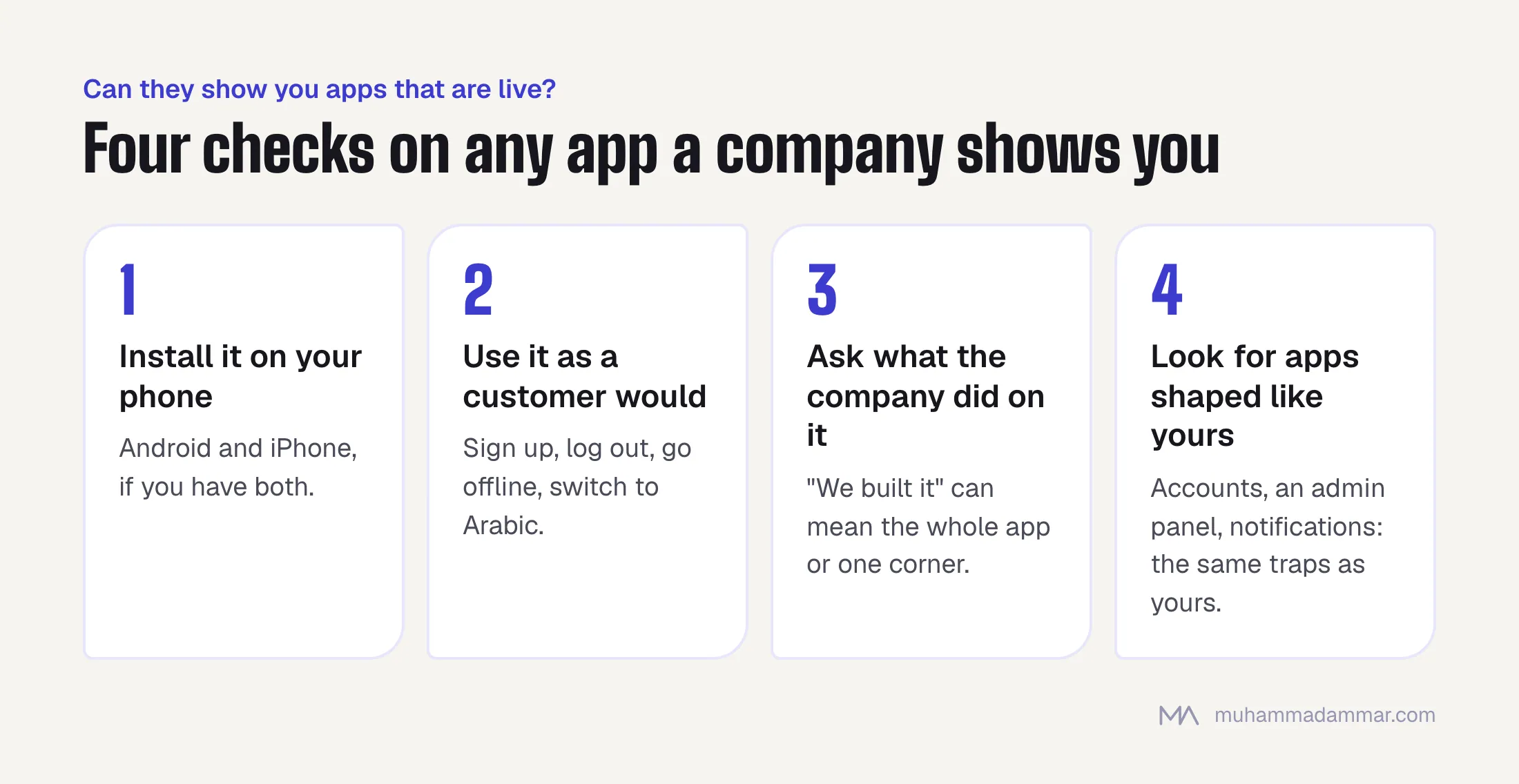
- Install them on your own phone. If you have both an Android and an iPhone, try both.
- Use them as a customer would: sign up, log out, go offline, switch the language to Arabic and see whether the layout flips properly.
- Ask what the company itself did on each one. “We built it” can mean the whole thing or one corner of it.
Pay more attention to apps with the same shape as yours than to the biggest names in the list. A company that has built an app with accounts, an admin panel and notifications knows the traps in all three.
Who actually builds it?
Ask for the names and roles of the people who will work on your app, not just the person who sells it. Companies in this region range from one freelancer to a studio with its own designers and developers, and plenty of them pass part of the work to others. That is not wrong in itself. Not telling you is.
Three questions settle it. Who is my single contact? Who writes the code, and is that person on the team or hired for my project only? What happens to my project if that person leaves? A small team with a clear answer to the third question is safer than a big agency with a vague one.
What should the quote list?
A quote that says “mobile app” and a figure is a quote you can’t compare. These are the lines a useful one contains.
| Line in the quote | What goes wrong if it is missing |
|---|---|
| Platforms: Android, iOS, or both | You find out later that one of them is a separate job. |
| List of screens and features | Arguments about whether something was included. |
| Admin panel | The app launches and your team can’t manage anything in it. |
| Back end and hosting | Nobody has decided where the data lives or who pays for it. |
| Languages and right-to-left support | Arabic is treated as a translation added at the end. |
| Outside services (maps, SMS, payments) | Running costs you didn’t expect, billed by other companies. |
| Publishing to both stores | The app is finished and sitting on a laptop. |
| Support and updates after launch | The first operating system update breaks something and no one is responsible. |
| What is not included | Everything you assumed was. |
Send the same short description to every company you ask, so the quotes cover the same thing. What decides the price of an app explains each of these lines in more detail.
Who owns the app?
This is the part people skip, and it is the hardest to fix afterwards. Before work starts, get these in writing.
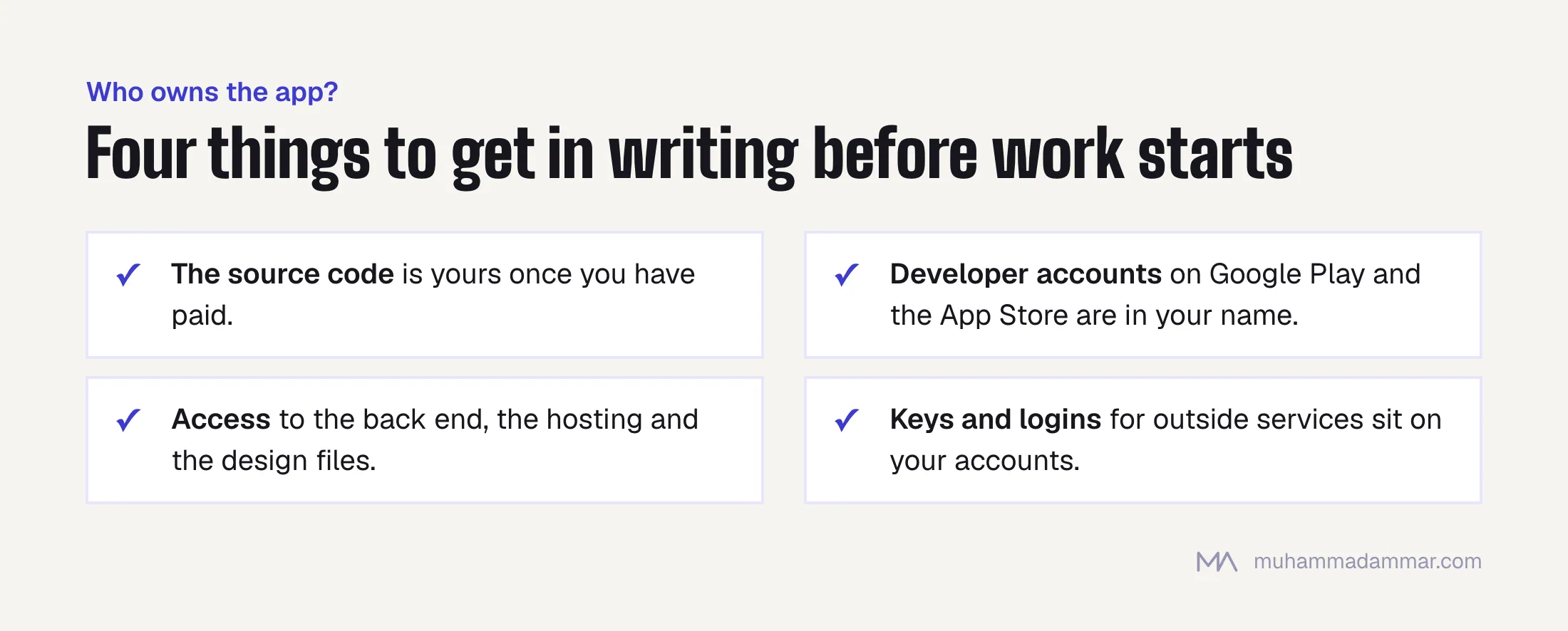
- The source code is yours once you have paid for it.
- The Google Play and App Store developer accounts are in your name, not the company’s.
- You have access to the back end, the hosting and the design files.
- Keys and logins for outside services belong to your accounts.
If an app lives only under the supplier’s accounts, you can’t move to another company without asking permission, and in a dispute that is leverage against you. A good company doesn’t mind putting this on paper.
How do they work while building?
You don’t need to understand the code to judge this. You need to see progress that you can touch.
- Is there a milestone plan, with something you can try at the end of each one?
- Do you get test builds on your own phone before launch, not only screenshots?
- Who tests, and on which phones? Arabic layouts and older devices are where problems hide.
- How are changes handled once work has started? Every project has some. A clear way to price and schedule them avoids arguments.
- How do they communicate: a shared chat, scheduled calls, written updates? Pick a company whose habits match yours, especially if you are in a different country and meet online.
What happens after launch?
An app is not finished when it goes live. Phones get new system versions every year, stores change their rules, and real users find bugs that testing didn’t. Ask what support the quote covers, how long a bug fix period lasts, who handles updates, and what that costs when the included period ends.
Also ask how the company handles store review. Both Google Play and the App Store review the apps and updates you submit, and a first submission can come back with requests for changes. The company should expect that and tell you what the process looks like.
What are the warning signs?
- A price without a scope, or a scope without a list.
- A figure far below the others, with no explanation of what is left out.
- No live apps to install, or only ones they can’t say anything specific about.
- Reluctance to put ownership of code and accounts in writing.
- “We’ll sort it out later” as the answer to hosting, updates or the admin panel.
- Pressure to sign today.
- Promising everything you asked for in an unusually short time.
Where do I fit?
I’ve built three client apps, each delivered for Android and iOS together as one package. I don’t publish client names, but I can show you the apps on a call. If you want to judge my work, ask me the questions above, the same as you would ask any other company. The details are on my app development page, and app design covers the interface stage. If another company answers these questions better than I do, hire them.
Frequently asked
Should I pick the cheapest company?
Not on price alone. A low figure is only a saving if it covers the same scope as the others. Compare what each quote lists first, then compare what it costs.
Agency or freelancer?
Either can work. A freelancer or a small team gives you one clear contact and usually less overhead. A larger agency gives you more people, but you should ask which of them will touch your project. The answers to the questions in this article matter more than the size of the company.
Do I need to be technical to choose?
No. You need a clear description of what the app should do, a list of questions like the ones above, and the willingness to ask for things in writing.
Does the company need to be in my country?
Not necessarily. Many projects run entirely online. What matters is that you can reach them in your working hours, that they understand Arabic users, and that the contract is clear about currency and who is responsible for what.
What if I’m already unhappy with a company?
Ask for the code, the accounts and the documentation first, then decide. This is why ownership terms belong in the first contract.
If you’d like to talk through an app idea, message me. The price is set when you get in touch, based on what you need.

SEO and digital marketing consultant since 2015, working with businesses in Egypt, Saudi Arabia and the UAE.
About the author and editorial standards