On this page
What a website costs depends on how many pages it has, whether it’s in Arabic, English or both, whether the design is custom or built on a template, whether people pay on it, who writes the content and what it has to connect to. That holds in Egypt, Saudi Arabia and the UAE. I don’t publish a number, because any figure I printed would be wrong for most of the people reading it. The price is set when you get in touch, based on what you need.
What I can do is show you what moves the price, where the three countries really differ, and what a quote should list so you can compare two offers fairly.
What decides the price of a website?
Seven things decide it.
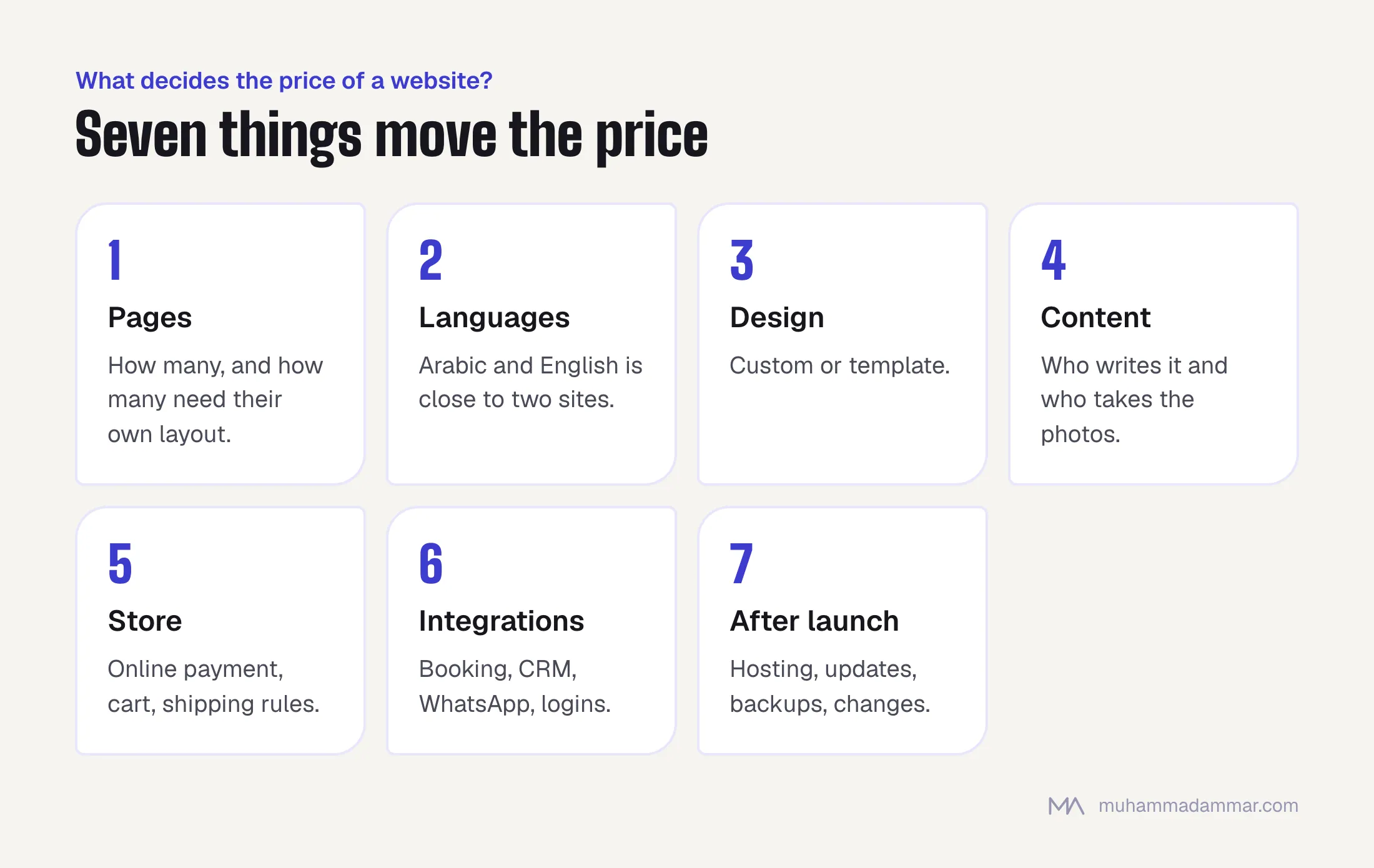
- Number and type of pages. A five-page company site and a site with a service page for each of forty services are different jobs. Pages that need their own layout cost more than pages that reuse one.
- One language or two. Arabic and English is close to two sites. Every page is written twice, laid out right to left and left to right, and linked to its twin so Google can tell which is which. Google’s own guidance on localized versions of a page shows how much structure that takes. A two-language quote at a one-language price usually means the Arabic won’t be designed properly.
- Custom design or a template. A template is faster and cheaper to start. Custom design costs more and fits your brand and your customers’ path better. The section on templates below covers when each is worth it.
- Content. Who writes the text, who takes the photos, and whether either is in the quote at all. It is often the biggest hidden cost, and a common reason a site launches late.
- Online payment and a store. Selling on the site adds product pages, a cart, a checkout, shipping rules and a payment provider. A store is a larger project than a company site, even with the same number of pages.
- Integrations. Booking, a CRM, WhatsApp buttons, a customer login, an existing system you want to read from. Each one is its own piece of work and its own thing to test.
- What happens after launch. Hosting, security updates, backups and small changes. Some quotes include a few months, some include nothing, and the difference shows up later.
Does a website cost something different in Egypt, Saudi Arabia and the UAE?
The work is mostly the same in the three countries. What changes is the specification around it: the currency of the proposal, the languages, the platforms available and how payment is set up. When the same pages get very different quotes in two countries, one of the rows below is usually the reason.
| Egypt | Saudi Arabia | UAE | |
|---|---|---|---|
| Proposal currency | Egyptian pounds or US dollars. Write which one into the contract; the pound moves enough that it matters. | Saudi riyals or US dollars. | Dirhams or US dollars. |
| Languages | Usually Arabic first. English where your audience or partners need it. | Usually Arabic first, often with English too. Both need to be designed, not translated. | Often Arabic and English, because the audience is mixed. Check which language your customers search in. |
| Store platforms | Shopify, WooCommerce or a custom store, depending on size. | Salla and Zid are Saudi hosted store platforms, alongside Shopify and WooCommerce. Ask the platform what its plans and fees are, because choosing one changes both the build and the running cost. | Shopify, WooCommerce or a custom store, depending on size. |
| Online payment | You connect a provider that operates in Egypt. Its fees and approval are separate from the build. | On Salla or Zid, ask the platform which payment options it offers inside the store and what they cost. On other platforms, you connect a provider that serves Saudi merchants. | You connect a provider that serves UAE merchants. Its fees and approval are separate from the build, so ask the provider how long approval takes. |
If you’re deciding between Salla, Zid and the other platforms, how they compare for SEO is worth reading before you sign for a store. Everything in the list above applies the same way in all three countries.
Is a template or a custom design the better buy?
A template suits a business that needs to be online soon, has a simple offer and no unusual path for customers. It’s quicker to launch and cheaper to start. You pay for that in flexibility: when the business changes, you work around the template instead of changing it.
Custom design is worth it when the site is a main way you get customers, when the path from first visit to enquiry or purchase is specific to your business, or when the brand has to look like nothing else in the category. It takes longer and costs more.
Be careful with a quote that says “custom” and delivers a template with your logo on it. Ask to see the design before it’s built, not after. A custom design starts from your customers and your content. A template starts from a layout someone else made.
Company website or online store?
A company site explains what you do and gets people to contact you. A store also has to show products, take payment and handle orders, and those parts add the most work. Count the number of products, the variations (size, colour), the shipping rules and the payment methods you need before you ask anyone for a price. Those four answers move a store quote more than the visual design does.
A common middle route is to start with a company site that has a few products or a request form, and move to a full store once orders justify it. That avoids paying for a catalogue nobody has bought from yet.
What should a quote list?
Two quotes can look similar and cover very different amounts of work. Before you compare them, check that each one says:
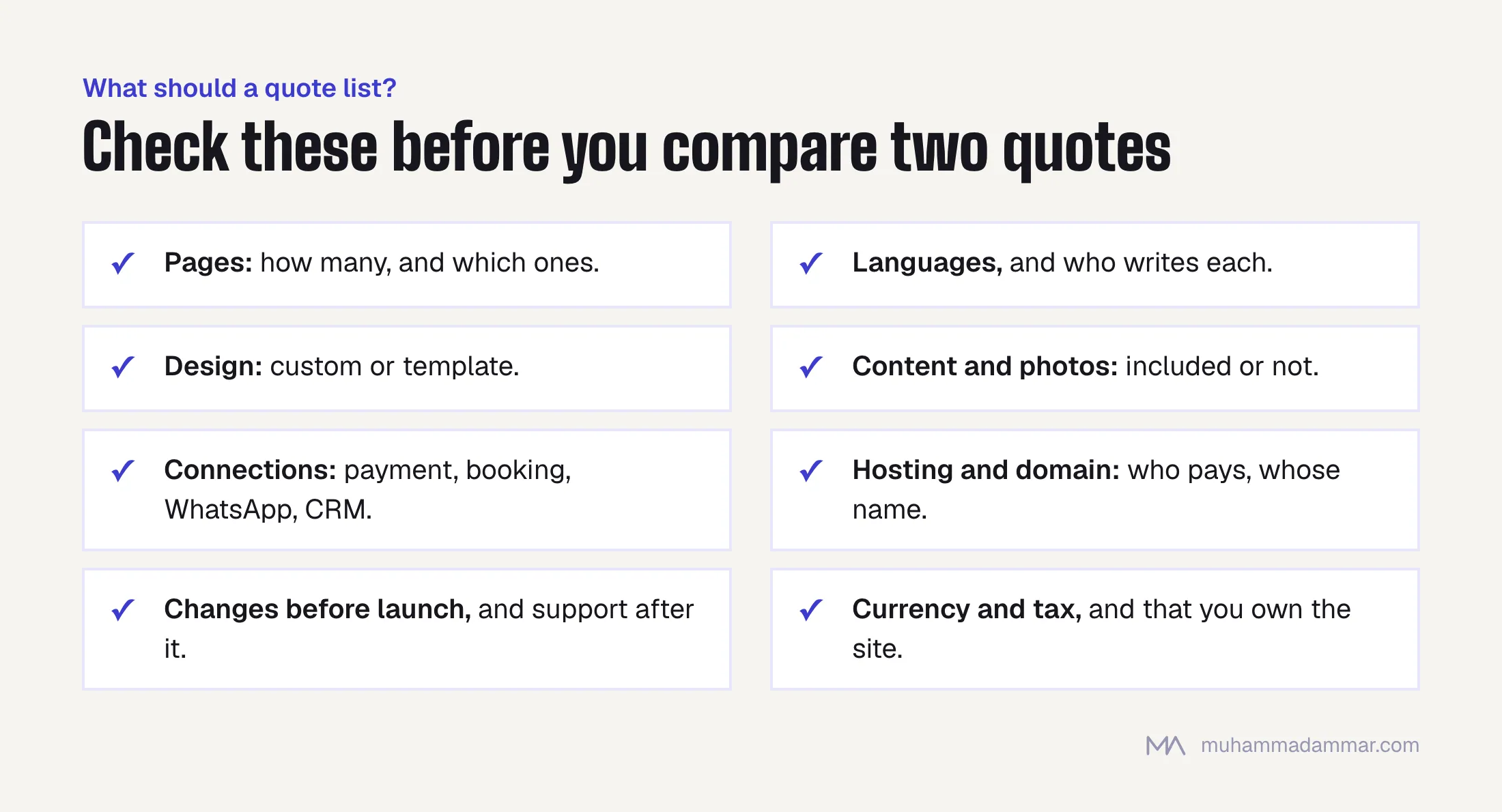
- The number of pages, and which ones.
- The languages, and who writes each one.
- Whether the design is custom or from a template.
- Whether content and photos are included.
- What is connected: payment, booking, WhatsApp, a CRM.
- Hosting and domain: who pays, whose name they’re registered in, and for how long.
- How many rounds of changes are included before launch.
- What happens after launch, and what it costs.
- The currency, and whether tax is included.
- That you own the site, the domain and the accounts when it’s finished.
Anything a quote leaves out is still part of the project, and it usually comes back later as an extra charge. How to choose a web design company goes through the questions to ask the company itself.
Why is one quote far below the others?
Usually a line in the list above is missing from it. The common gaps are content that you’re expected to supply, a single language when you asked for two, a template presented as custom work, no support after launch, and a domain or hosting registered in the supplier’s name. Each can be fine if the supplier says so up front. The problem starts when nobody mentions it.
Ask the cheap supplier to confirm each line in writing. If the answers match the other quotes, the low price may be real. If they don’t, you’ve found where the difference is.
What is this list based on?
I’ve designed 17 client websites, a law firm’s site, 3 online stores on Shopify, and my own site. I mention it so you know the list above comes from doing the work. You can read what I do on the web design page, and the build side on web development.
Frequently asked
How much does a simple company website cost?
It depends on the pages, the languages and the content, so I’d rather not give a number you’d then measure every quote against. Send me what you need and I’ll tell you the price for that, not for an average site.
Is it cheaper to build a website in Egypt than in Saudi Arabia or the UAE?
The work is the same. What changes is the currency the proposal is in and, for stores, the platform and payment set-up. Compare quotes line by line instead of by country.
Do I pay once, or every month?
Both exist. The build is usually a one-off payment. Hosting, domain renewal, a store platform subscription and maintenance are recurring. A good quote separates the two so you can see which is which.
Can I start with a few pages and add more later?
Yes, and it’s often the sensible way to start. Ask the supplier to build the site so that adding a page or a language later doesn’t mean rebuilding it.
Does a bilingual site cost double?
Not exactly double, because the structure and design are shared. But the content, the right-to-left layout and the testing are done twice, so it costs clearly more than one language.
If you’d like a price for your website, message me with what it needs to do, the languages and whether you’re selling on it. The price is set when you get in touch, based on what you need.

SEO and digital marketing consultant since 2015, working with businesses in Egypt, Saudi Arabia and the UAE.
About the author and editorial standards