On this page
Merchants usually ask this the wrong way round. “Which platform is best for SEO?” has no answer, because platforms don’t do SEO. What they decide is which parts of it you’re allowed to touch.
The useful question is narrower: on each platform, which of the things that move organic revenue are in your hands, which are partly in your hands, and which belong to the vendor? I checked Salla and Zid for this in October 2026, from their own help centres, Salla’s official theme code, and the page source of live stores on each platform.
The eight capabilities that matter
- URL structure. Can you set the path, or does the platform force its own? Fixed segments like
/products/are fine. Unpredictable or duplicated paths aren’t. - Category page content. Can you put real text on a category page (a short buying guide, internal links, an FAQ) above or below the products? Category pages are where most store search traffic lands, and a page with only a name on it has a low ceiling.
- Filters. Does filtering create crawlable URLs, and can you control which ones get indexed? This is the biggest technical risk on any catalogue above a few thousand products.
- Structured data. What does the platform output by default, and can you add to it?
- Two languages and hreflang. Does each language get its own crawlable URL, with hreflang that points both ways?
- Server-level control. Redirects, robots.txt, headers, canonical rules. Matters most during migrations and when something breaks.
- Speed. Theme code, images, scripts, and how many apps you end up installing.
- Data access. Server logs, bulk export, API. It decides whether you can diagnose a problem or only guess.
The comparison
Platforms change, so treat this as a snapshot from October 2026 and recheck anything your decision depends on. The pattern holds regardless: the more convenient the platform, the less you control.
| Capability | WooCommerce | Shopify | Salla | Zid |
|---|---|---|---|---|
| URL structure | Full control | Fixed segments (/products/, /collections/), editable handle | /name/p123 for products, /name/c123 for categories; custom link field per product, category and brand | /products/name and /categories/123/name; editable URL field |
| Category page content | Full control | Depends on theme, editable | SEO title and description fields; the official Raed theme shows only the category name on the page | SEO title and description fields; any visible text depends on the theme |
| Filters | Full, with work | Partial | Filters and the product grid load by JavaScript in the official theme; the category page’s HTML had no product links on the store I checked | Filter form with URL parameters; filtered URLs point their canonical at the clean category; products linked in the HTML |
| Structured data | Full control | Theme plus apps | Generated by the platform: Product with price, rating and reviews; GTIN and MPN fields available | Generated by the platform: Product with price, GTIN, SKU and brand; breadcrumbs and item lists on categories |
| Two languages + hreflang | Full (Polylang, WPML) | Through Shopify’s translation and markets settings | Languages built in (Raed and Nmu themes; machine or manual translation). The store I checked was Arabic only, so test hreflang on yours | /en/ URLs with hreflang both ways and a canonical per language; English URLs keep the Arabic slug |
| Server-level control | Full | Minimal | Editable robots.txt; no server access | Platform robots.txt (I found no setting to edit it); no server access |
| Speed | Full, and your problem | Good baseline, apps slow it down | Hosted; you control images, theme and apps | Hosted; you control images, theme and apps |
| Server logs | Yes | No | No (hosted) | No (hosted) |
A few things in that table matter more than the rest.
Salla’s category pages. In Salla’s official theme, the product grid on a category page is filled in by JavaScript after the page loads. On the live store I checked, the HTML of a category page contained no product links at all. Google can render JavaScript and products still reach it through the sitemap, but a category page whose products only appear after rendering is a weaker internal-linking hub than one where they’re in the HTML. Open the page source of one of your category pages and search for a product name to see what yours does. The same store’s product pages pointed their canonical at a short link (like /qGERwBb) instead of the full product URL, which is worth checking in your own store settings too.
Zid’s defaults are sensible. Filtered URLs point their canonical at the clean category, pagination has its own canonical, product links are in the HTML, and the bilingual store I checked had correct reciprocal hreflang. The odd detail is that English URLs keep the Arabic slug, so an English page lives at an address with Arabic words in it. That doesn’t break anything, but it’s ugly when shared.
WooCommerce and Shopify. WooCommerce gives you everything because it’s self-hosted, which also means speed, security and updates are yours. A badly run WooCommerce store loses to a well-run hosted one. Shopify’s limits are real but narrow: no server access and fixed path segments. Stores rarely fail because of either. They fail on thin category pages and uncontrolled filter URLs, and both of those are yours to fix.
Arabic and right-to-left checks
Regional platforms should have the advantage here, and it’s where you should test hardest, because the failures don’t show on the page.
- Does each language have its own stable URL? If switching language doesn’t change the URL, search engines only see one language.
- Is hreflang there, and does it point both ways? View the source of both versions of the same page and read the tags. Don’t trust a settings screen.
- Are
lang="ar"anddir="rtl"set on the page? - Can you set the Arabic slug, and does the English version get its own?
- Does the Arabic page have its own title and description, or does it inherit the English ones?
The first two are pass or fail. A platform that can’t serve two languages on two indexable URLs with correct hreflang isn’t bilingual for search, whatever its marketing says. What correct looks like is in seven ways two-language Arabic sites break hreflang.
Filters: the one that costs money
If you check nothing else, check this. Apply three filters on a category page and look at the address bar.
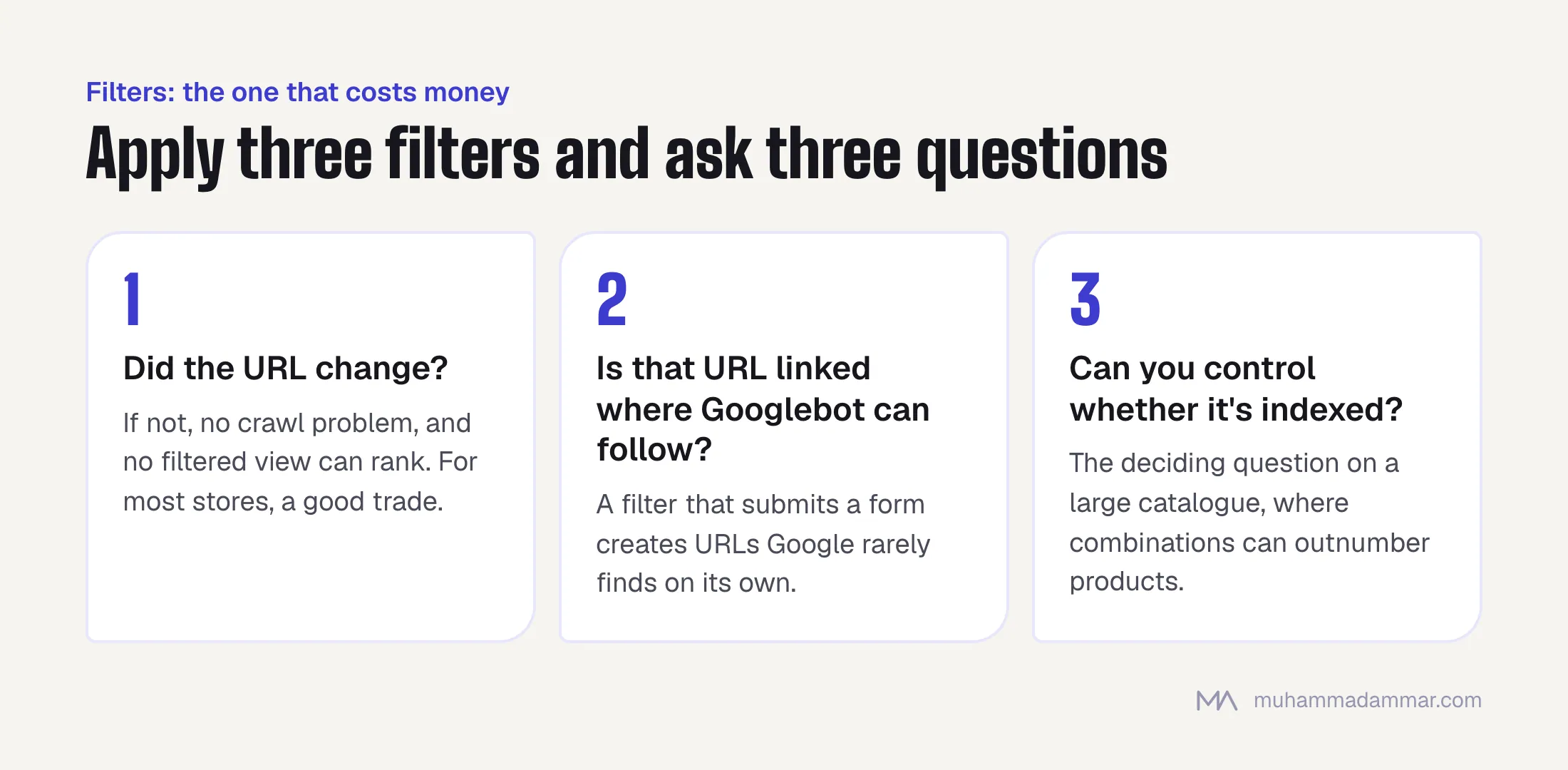
- Did the URL change? If not, you have no crawl problem, and also no way to make a filtered view rank. For most stores that’s a good trade.
- If it changed, is that URL linked anywhere Googlebot can follow? A filter that submits a form creates URLs Google rarely finds on its own.
- Can you control whether those URLs get indexed? This is the deciding question on a large catalogue, where filter combinations can outnumber products many times over.
How this goes wrong is in faceted navigation and crawl budget, and how to see it in your own data is in server logs: what Googlebot really did. A catalogue under a thousand products can mostly ignore this. Above ten thousand it decides the outcome.
What moving platform really costs
Most merchants asking this already have a store and are really asking whether to move. Usually the answer is no.
Changing platform changes every URL. That means a complete old-to-new redirect map, single-step 301s, rebuilt internal links, new sitemaps, hreflang set up again, and months of monitoring afterwards. Done well, you keep most of your traffic and win back the rest. Done badly, usually because the SEO work was scoped after the platform was chosen, you can lose more in a weekend than a year of good work would have added.
Move when you’ve really hit the platform’s limit and can point to the cost: filter URLs eating crawling on a large catalogue, a second language the platform can’t serve properly, or an operational reason that has nothing to do with SEO. Don’t move because someone said the platform is limited, or because a checklist gave it a low score.
A store on Salla or Zid that’s held back by thin category pages and copied manufacturer descriptions can fix both where it is. That’s what the Salla and Zid SEO page works through.
What I’d pick, by type of business
Small Saudi retailer, under about a thousand products, local payment and shipping essential. A regional hosted platform is the right operational choice, and its SEO limits won’t hold you back yet. Put the effort into category pages and original Arabic product descriptions.
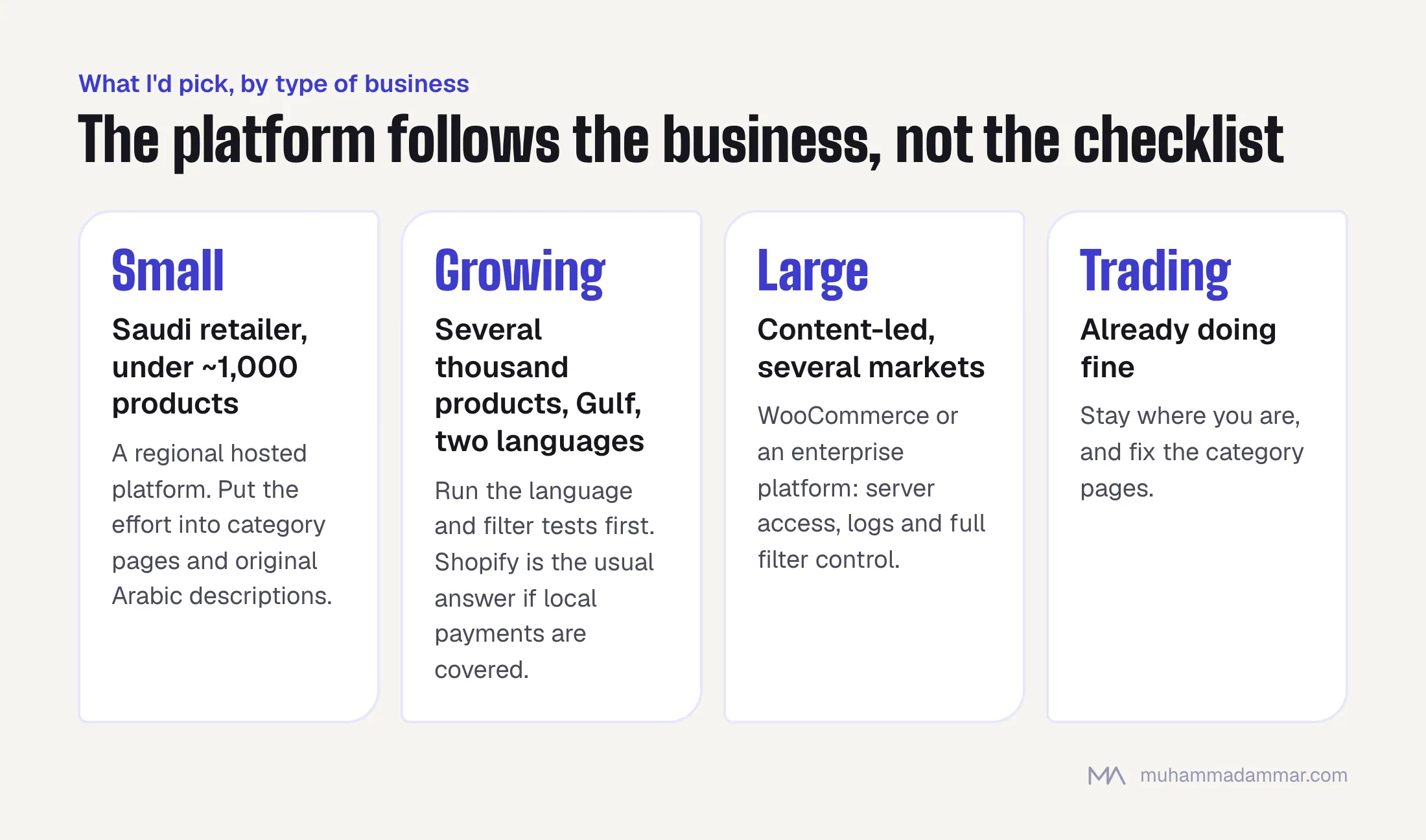
Growing store, several thousand products, selling across the Gulf in two languages. This is where the choice starts to matter. Run the language and filter tests above before committing. Shopify is the usual answer if your local payment methods are covered.
Large catalogue, content-led, several markets. WooCommerce or an enterprise platform. You’ll need server access, logs and full filter control, and at that size the maintenance is worth paying for.
Already trading and doing fine. Stay where you are, and fix the category pages.
Frequently asked
Which platform ranks best?
None of them. Google doesn’t know or care what your store runs on. The platform decides how much of the work you’re allowed to do, and a well-run store on a limited platform beats a neglected store on a flexible one.
Is Salla or Zid better for SEO?
On what I checked, Zid’s defaults are cleaner for filters, category pages and bilingual hreflang, and Salla gives you an editable robots.txt and custom links for products, categories and brands. The difference between a well-run and a neglected store on either is bigger than the difference between them.
Can I do serious SEO on a hosted platform?
Yes. Most of what matters (category pages, Arabic wording, product descriptions, internal links, reviews) is content and merchandising work that no platform takes away from you.
Does WooCommerce really win on flexibility?
On what it lets you do, yes. On results, only if someone looks after it. Self-hosted means speed, security and updates are your job.
How often does this comparison go out of date?
All four platforms ship changes all the time. Recheck anything specific every six months, and treat any platform comparison older than that, including this one, as a starting point.
If you’d like your own store checked against this list, message me with the address.

SEO and digital marketing consultant since 2015, working with businesses in Egypt, Saudi Arabia and the UAE.
About the author and editorial standards