On this page
Look at almost any e-commerce SEO project and you’ll find the effort spent on product pages: descriptions rewritten, schema added, images optimised. Meanwhile the category pages, where most of the buying searches actually land, carry a title copied from the supplier’s catalogue and no content at all.
That’s backwards, and on Arabic stores it’s backwards twice, because the naming decisions nobody makes on purpose are the ones that decide what you can rank for.
Why categories win buying searches
Look at how people search when they’re ready to buy. They search a category plus a feature, such as a product type with a qualifier, not a specific product name. Searches for a specific product come at the end of the journey, and by then the buyer often knows where they’ll buy.
A category page matches that intent by design. It answers “show me the options” with options. A product page answers with one option, which is why Google usually prefers the category for the broader search.
Three practical results:
- Category pages last. Products sell out and get discontinued. The category stays, collecting links and authority for years.
- There are fewer of them, so effort goes further. Twenty good category pages is a manageable project. Twenty thousand good product pages isn’t.
- They convert. A visitor who lands on a category can choose. A visitor who lands on one product that isn’t quite right leaves.
Building the category tree from demand, not from the warehouse
Most category trees are inherited from the supplier’s catalogue, the ERP or the way the stockroom is organised. All of those reflect how the business thinks about products, not how customers look for them.
Rebuilding it is simple in principle and awkward in practice, because it means telling the merchandising team their structure is wrong.
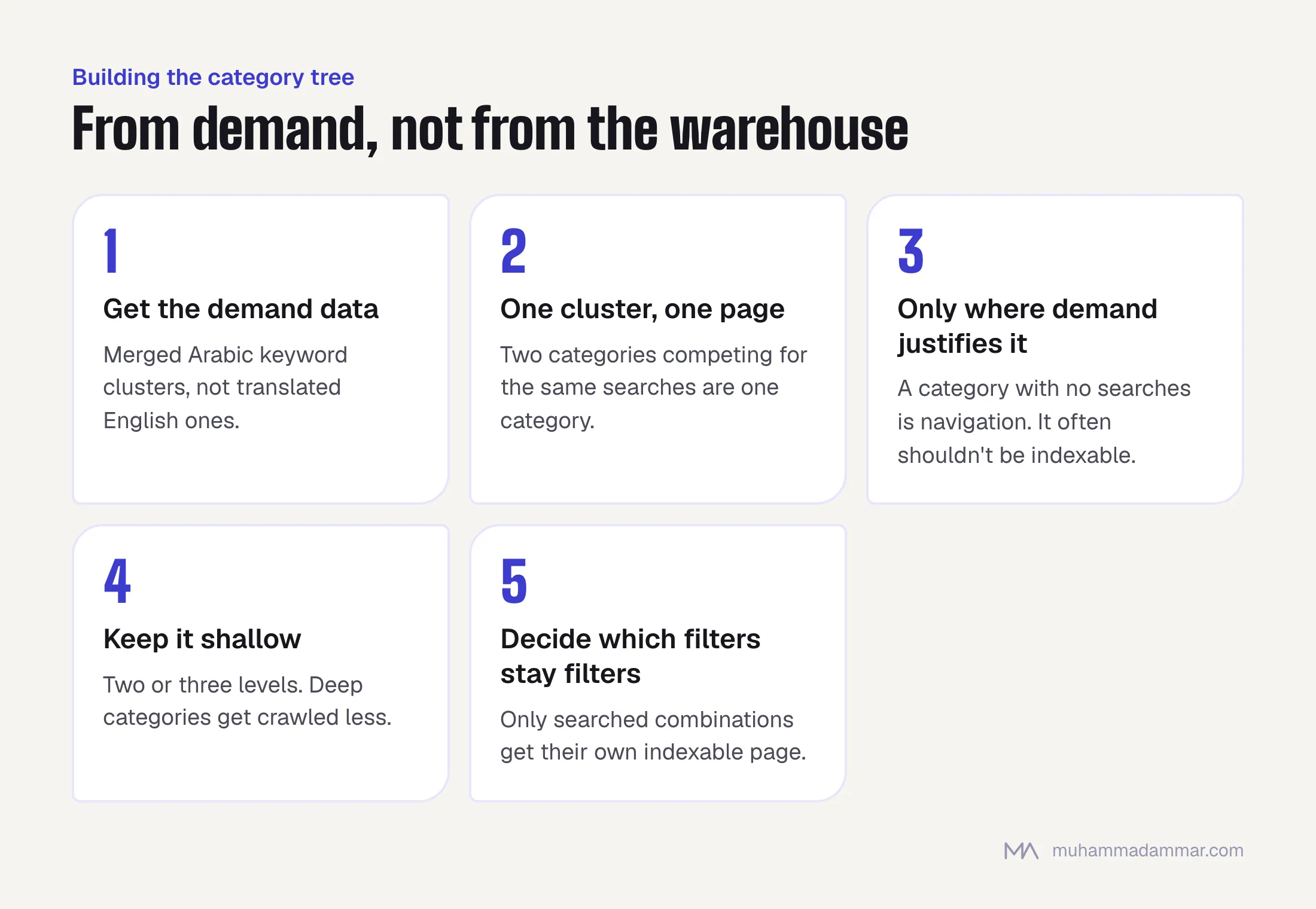
- Get the demand data first: merged Arabic keyword clusters for your products, not translated English ones. The merging method is in Arabic keyword research, and it matters here because a category whose demand looks tiny before merging often isn’t.
- Give each meaningful cluster one page. One cluster, one URL. If two categories would compete for the same searches, they’re one category.
- Create categories only where demand justifies a page. A category with no searches behind it is navigation, not SEO. That’s fine to have, but don’t expect it to rank, and often it shouldn’t be indexable.
- Keep the tree shallow, two or three levels. Every extra level puts distance between your homepage’s authority and the page that needs it, and deep categories get crawled less.
- Decide which filters stay filters. Some combinations of attributes deserve their own indexable page because people search for them. Most don’t. That’s the faceted navigation problem, covered in faceted navigation and crawl budget, and getting it wrong is the most expensive mistake you can make on a large catalogue.
Naming Arabic categories, and the plural problem
English guides don’t cover this, and it’s where Arabic stores lose most often.
Call the category what customers call it. Not what the supplier calls it, and not a translation of the English category name. Supplier catalogues in this region are often in English or in Arabic written in Latin letters, and the translated result is correct on paper and invisible in search.
Singular or plural is a real decision. Arabic category names are usually plural, and Arabic plurals are often irregular: the plural doesn’t look like the singular the way adding an “s” does in English. So the two forms are different strings. Google’s Arabic stemming handles much of this, but your keyword tool lists them separately, and the demand can sit clearly on one side. Check which form people search before you name the category.
Decide on the definite article and use it consistently. The name with and without the article al- are two strings. Pick the natural one, use it in the H1 and title, and don’t switch between templates.
Watch the grammar. Arabic adjectives agree with their noun, and plurals of things take feminine singular agreement, which trips up anyone building category names by joining strings in a template. A category name assembled by code reads wrong to a native speaker, and that’s a trust problem before it’s a ranking problem.
Handle the Gulf and Egyptian split on purpose. If the word for your category differs between markets, one category page can’t win both sets of searches. That’s a decision about site structure, and a synonym list won’t fix it. I explain why in Egyptian and Gulf search behaviour.
Where the text goes, and how much
The usual pattern is a block of keyword-stuffed text dumped under the product grid where nobody reads it. It’s there to tick a box, and it doesn’t work.
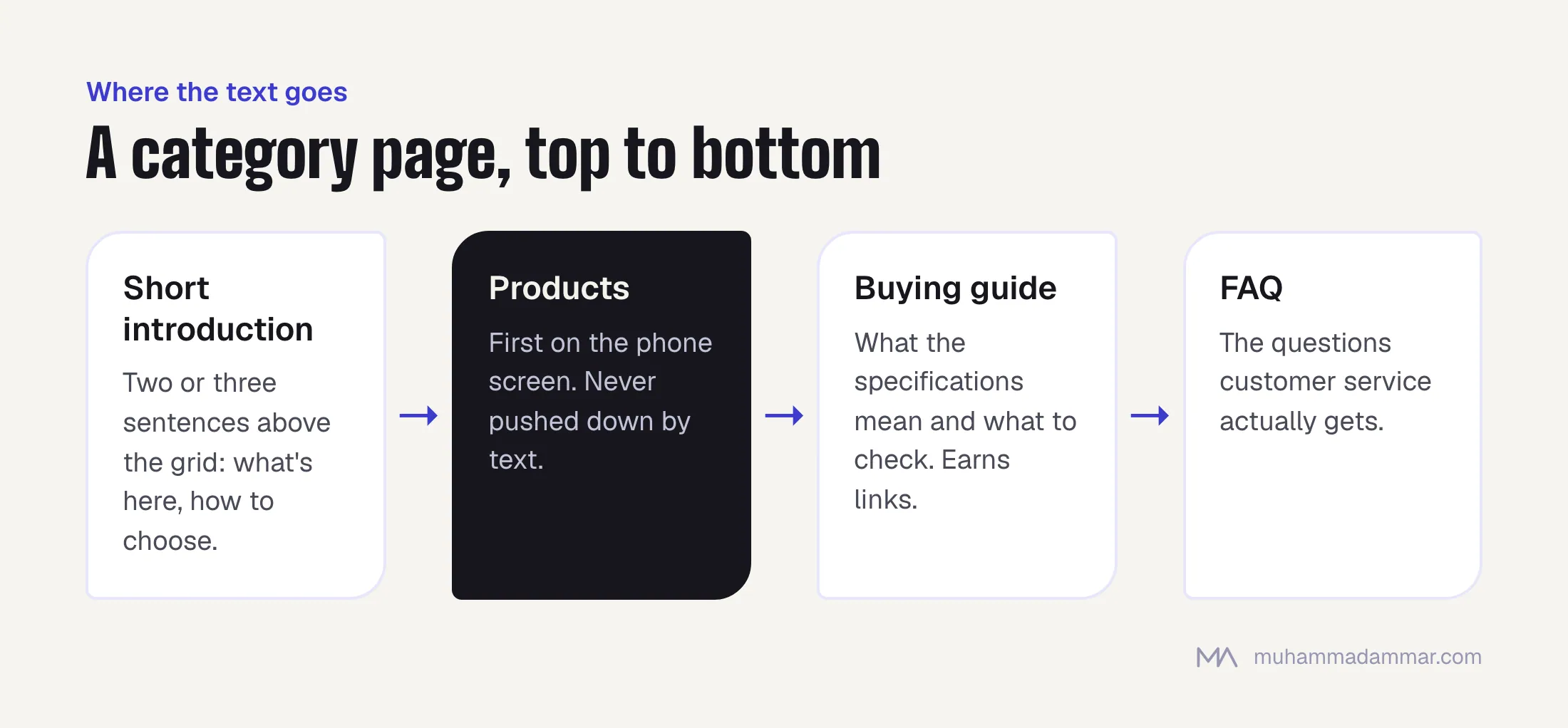
What works:
- A short, real introduction above the grid: two or three sentences telling a buyer what’s in this category and how to choose. Long enough to help, short enough not to push the products off the first screen on a phone.
- A proper buying guide under the grid, for categories that need one: what the differences in specification mean, what to check, what the price ranges represent. This is the part that earns links and gets quoted, and almost nobody writes it in Arabic.
- A FAQ section answering the questions your customer service team actually gets about this category. It’s cheap to write, genuinely useful, and covers different phrasings naturally.
- No word-count target. A category with four products doesn’t need eight hundred words. Judge it by whether it helps someone choose.
One rule for mobile, which is nearly all your traffic: products first. A buyer who has to scroll past four paragraphs to reach the products leaves.
Internal links between categories
This is the cheapest win on most catalogues, and the one most often skipped.
Most stores link categories only through the menu. That treats every category the same, whatever its commercial value, and hides how categories relate to each other.
- Link from the page text, not only the menu. A link in the introduction or buying guide carries more weight than a menu item repeated on every page.
- Link between related categories with descriptive Arabic anchor text. Someone browsing one category often wants the one next to it.
- Link from child categories up to the parent, in the text as well as the breadcrumb.
- Link from blog posts to categories, not to products. That’s the main reason for a store to have a blog at all, and content that never links to a sales page is just a cost.
- Give your priority categories more internal links than the rest. Internal linking is the strongest signal you fully control, and treating every category equally wastes it.
Pagination and sorting
Two mechanical problems that quietly undo good category work.
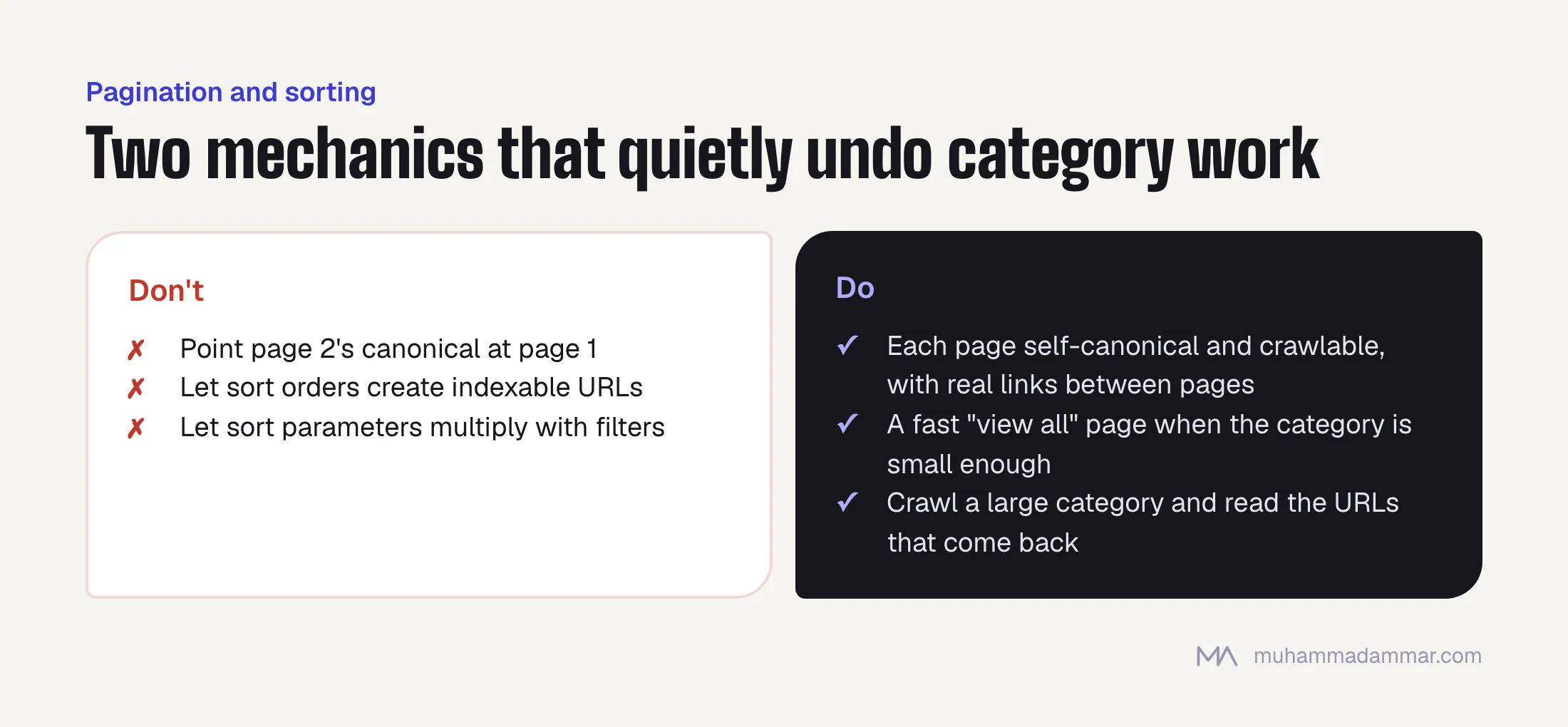
Pagination. Each page in the series should have a canonical pointing to itself and be crawlable, with real links between the pages. Don’t point page two’s canonical at page one. That tells Google the products on page two don’t need indexing, which is rarely what you meant. There’s no longer an official markup for declaring the series, so the crawlable links do the work. If the category is small enough for a “view all” page to load fast, that’s often the cleaner answer.
Sorting. Sort order should never create its own indexable URL. The same products in a different order is the definition of duplicate content, and on a big catalogue sort parameters multiply with filter parameters into a huge number of URLs nobody wants.
Check both by crawling a large category and looking at the URLs that come back. It takes ten minutes and it’s a standard part of an SEO audit.
Frequently asked
How much text does a category page need?
Enough to help someone choose: a short introduction above the products and a buying guide below for categories that need one. No word count makes a category page rank.
Should the text go above or below the products?
A short introduction above, a longer guide below. On mobile, anything that pushes the first product off the screen costs more than the text earns.
Can a category page outrank a product page for a product search?
For a specific named product, usually not, and it shouldn’t. For anything broader the category should win. If it doesn’t, the category page is usually thin or has too few internal links.
Should Arabic category names be singular or plural?
Usually plural, but check the demand data first. Irregular Arabic plurals mean the two forms are different strings, and sometimes the searches sit clearly on one side.
How many products should a category have?
Enough to make the page worth landing on. A category with two products is usually better merged into its parent. The test is whether a buyer arriving from search would feel they have options.
For the product pages underneath, see product structured data and what to do with products that are gone. Related: e-commerce SEO. If your category pages aren’t ranking, send me your store.

SEO and digital marketing consultant since 2015, working with businesses in Egypt, Saudi Arabia and the UAE.
About the author and editorial standards