On this page
“We have an Arabic version” gets treated as one decision. It’s at least two, because a buyer in Cairo and a buyer in Riyadh will search for the same product with words that don’t overlap.
Google’s Arabic normalisation absorbs spelling differences. It doesn’t absorb vocabulary. A different word is a different word, and no amount of stemming connects the two, so this is a question about how your site is built as much as how it’s written.
Where the words actually differ
Not everywhere. Formal and technical language is close enough that a business, finance or medical term usually works in both markets. The differences cluster exactly where consumer searches happen: everyday objects, words for wanting and buying, and question words.
| Meaning | Egypt | Gulf / Saudi |
|---|---|---|
| Mobile phone | موبايل (mobile) | جوال (jawwal) |
| Car (everyday) | عربية (arabiyya) | سيارة (sayyara) |
| Air conditioner | تكييف (takyif) | مكيف (mukayyif) |
| “I want” | عايز (ayez) | أبغى / أبي (abgha, abi) |
| “How much” | بكام (bekam) | كم سعر (kam si’r) |
| Good / nice | كويس (kwayyes) | زين (zein) |
| Delivery | دليفري / توصيل (delivery, tawsil) | توصيل (tawsil) |
Two more points beyond the words themselves.
First, the difference runs one way more than the other. Some Gulf words are understood in Egypt but never typed there, and some Egyptian words aren’t recognised in the Gulf at all. Because Egyptian TV and film travel so widely, Gulf audiences understand Egyptian words more often than the reverse. But understanding a word isn’t searching with it, and only searching counts.
Second, borrowed English words behave differently in each market. In some categories Egyptians use English-derived words written in Arabic letters more freely, while Gulf users often prefer the Arabic term. That’s a third version of the same idea, and your keyword tool will show it as yet another small number. The method for merging them is in Arabic keyword research.
The extra words say more than the product name
The product name tells you what someone wants. The words around it tell you what kind of buyer they are, and this is where the two markets differ most.
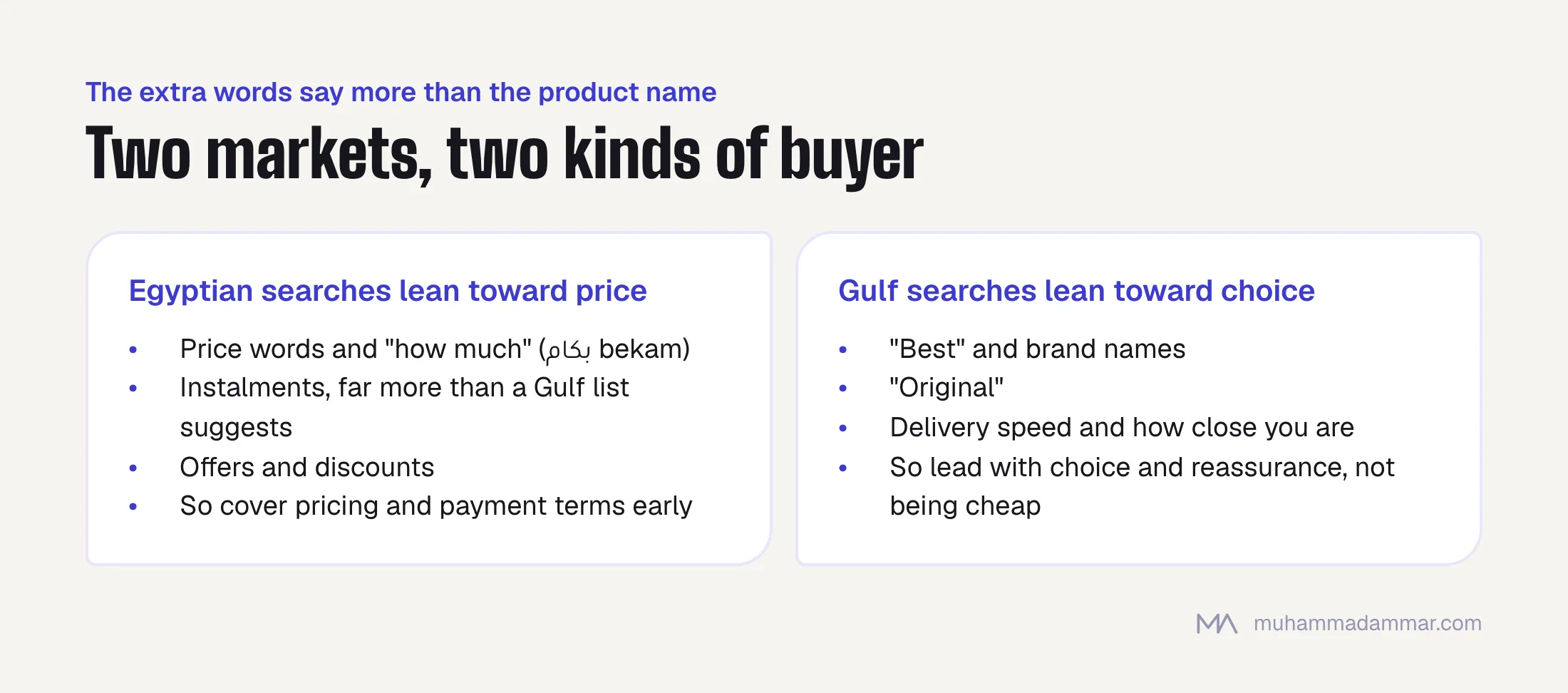
Egyptian searches lean toward price and payment. Price words, “how much”, instalments, offers and discounts attach themselves to a large share of buying searches. Instalment words in particular show up far more than a Gulf keyword list would suggest, and a page that doesn’t cover payment terms is answering a different question from the one being asked.
Gulf searches lean toward choice and reassurance: “best”, brand names, “original”, delivery speed and how close you are. Price comes up, but less often as the first filter. The buyer is more often choosing between options than asking whether they can afford one.
That difference shapes your page, not just your keywords. An Egyptian-facing sales page that hides pricing far down the page loses people who came looking for it. A Gulf-facing page that leads with being cheap is competing on the wrong thing.
Device, connection and timing
Three differences in the environment your page has to cope with.
Device and connection. Both markets are overwhelmingly mobile. The difference is the kind of phone and network. Saudi users generally have newer phones and fast networks, while in Egypt a mid-range Android on a patchy connection is the normal case. A page that tests well from Europe can be slow for a visitor in Giza, and only field data from real Egyptian users settles it.
How people find you. In many Egyptian consumer categories the business lives on Facebook first and the website second, and buyers act accordingly: they arrive already half-informed, ready to compare. Gulf buyers more often start in search or on Snapchat and TikTok. Same category, different starting point, different job for the page.
Timing. Both markets work Sunday to Thursday, and both shift heavily toward late-night activity in Ramadan. The shift is big enough that any report comparing across Ramadan is comparing two different markets, and ad schedules built on daytime hours miss the peak entirely.
One Arabic site, or separate ar-EG and ar-SA versions?
Everyone gets to this decision eventually, usually after the single Arabic site underperforms in one of the two markets.
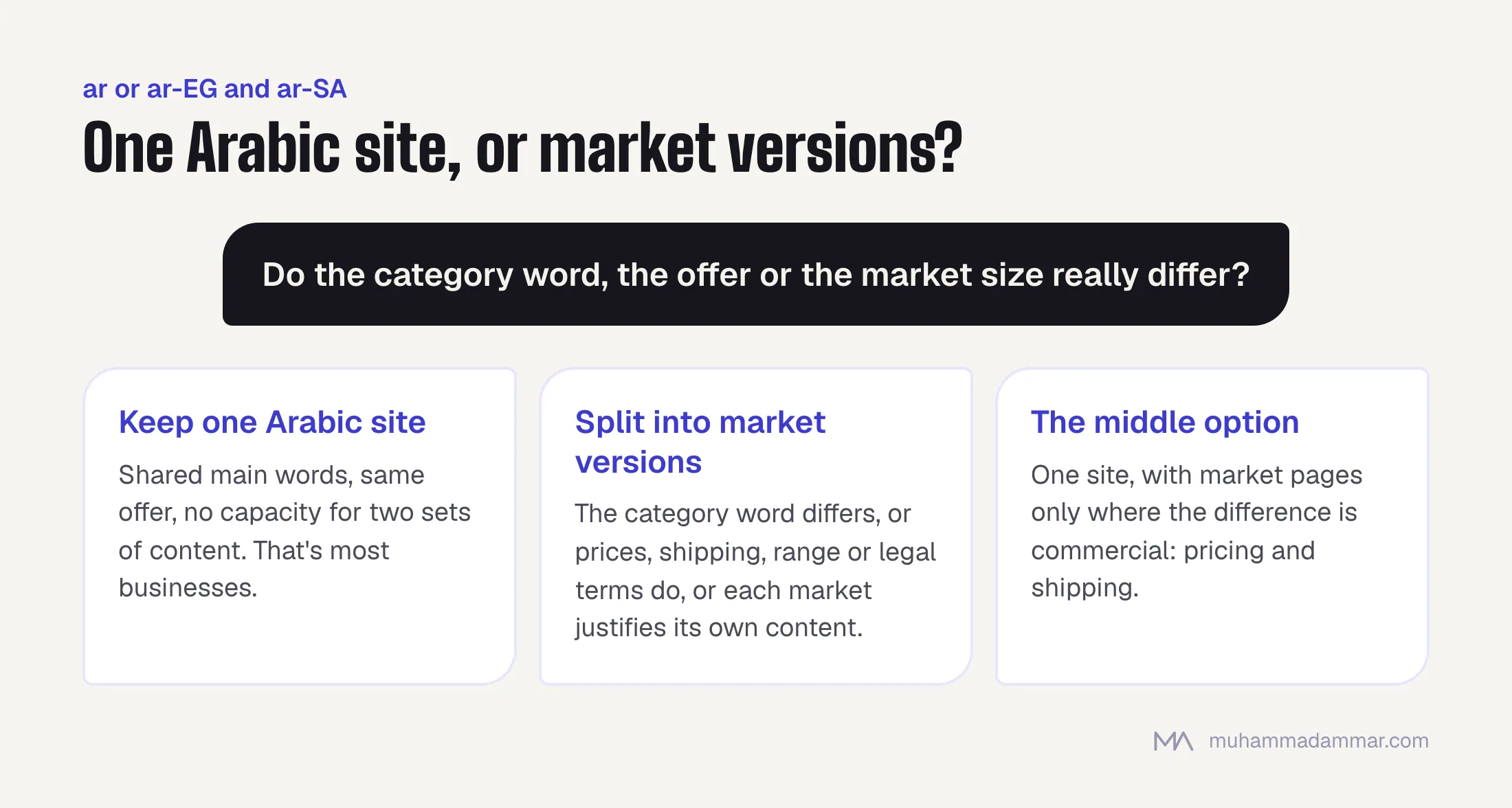
Keep one Arabic version when the main words for your category are shared, your offer is the same in both markets, and you don’t have the capacity to maintain two sets of content. That’s most businesses. One well-kept Arabic site beats two neglected ones every time, and splitting costs you every month from then on.
Split into market versions when at least one of these is true: the word for your product category really differs, so one page can’t win both sets of searches; your prices, shipping, product range or legal terms differ by country; or each market is big enough on its own to justify separate content work.
If you split, the technical requirements are strict, and this is where it usually goes wrong. Each version needs its own stable URL, hreflang that points both ways and to itself with the right country codes, no IP-based redirect between them, and genuinely different content, not two near-copies with a word swapped. Near-copies for each country look like doorway pages. I list the usual failures in seven ways two-language Arabic sites break hreflang.
There’s a middle option that deserves more thought than it gets: one Arabic site, with market-specific pages only where the difference is commercial. Shared articles and guides, separate pricing and shipping pages. You get most of the benefit for a fraction of the upkeep.
Writing for both markets on one site
If you’re staying with one Arabic version, and most should, the writing has to do the work the site structure isn’t doing.
- Put the most-searched word across both markets combined in the title and H1. Merge the volumes first, then decide. Often the winner isn’t the one the client expected.
- Use the other word naturally in the text, in a subheading or an FAQ question. Not a keyword list, but a sentence a person would write.
- Write in clear, easy Arabic, without leaning heavily on one market’s dialect. Copy loaded with one market’s slang puts off the other. That’s the strongest argument against writing consumer pages in heavy Egyptian slang if Gulf buyers matter to you, and the same goes the other way.
- Answer both intents. Cover pricing and payment terms early for Egyptian readers, and choice, authenticity and delivery speed for Gulf readers. Both audiences skim to the part they came for.
- Say clearly where you operate. If you only deliver to one country, say so near the top, not at checkout.
The mistake to avoid: a page written to offend nobody that appeals to nobody. “Middle ground” Arabic, with neutral words, universal examples and no prices so nothing is country-specific, reads like a translation and ranks for neither market’s searches.
Frequently asked
Can one Arabic page rank in both markets?
Yes, where the words overlap. Where the main word differs, one page will win one market’s searches and be mostly invisible in the other, however good it is.
Should I write in Egyptian or Gulf dialect?
Write in clear, easy Arabic that both markets read comfortably, and use each market’s own words where people search with them. Heavy dialect ties the content to one country for good.
Will an Egyptian writer produce content that works in Saudi Arabia?
Grammatically, yes. Commercially, often not, and the same is true the other way round. The text reads correctly and misses the words buyers search with. A review by someone from the target market is cheap compared with what it fixes.
How do I find the paired words for my category?
Search Console filtered by country is the most reliable source, and Google Ads search terms from campaigns in each market are the best way to discover them. Keyword tools will show you one word and hide the other.
Does this apply to B2B?
Much less. Professional and technical words are mostly shared, and B2B buyers in both markets often search in English anyway. It’s mainly a consumer-category problem.
Related: Arabic SEO, local SEO, and SEO consulting in Saudi Arabia and Egypt. If you sell in both markets and one is lagging, message me.

SEO and digital marketing consultant since 2015, working with businesses in Egypt, Saudi Arabia and the UAE.
About the author and editorial standards