On this page
A global brand decides to enter the Gulf. It sends its site to a translation agency, gets back clean, correct Modern Standard Arabic, publishes it under /ar/ and waits. Six months later the Arabic pages have a handful of impressions and no rankings, and someone decides that “Arabic SEO is hard” or, worse, that the market is small.
The Arabic was fine. The problem is that translation and search visibility are different jobs, and doing one doesn’t get you the other. A translated page answers, in Arabic, the question the English page was written for. It doesn’t answer the question an Arabic speaker actually typed.
The translation trap: correct Arabic, no searches
Translators aim to stay faithful to the source. That’s their job, and doing it well produces exactly what fails in search. There are four specific failures:
- The formal term nobody searches. The technically correct MSA word for a product category often isn’t the word buyers use. People search with the word they say out loud, which is often a borrowed word, a dialect word, or the English word written in Arabic letters.
- The original structure survives. An English page built around a marketing framework gets translated heading by heading, so the Arabic page inherits a structure that matches no Arabic search.
- Brand and feature names get translated when they shouldn’t. If customers search for the product by its English name, translating it removes the only term people actually search.
- One Arabic version for every market. Egypt, Saudi Arabia and the UAE have different words, currencies, trust expectations and competitors. One translated set serves none of them well.
You can check this quickly. Take your five most important Arabic pages, find the main term each one targets, and check whether that exact term gets any searches. If most don’t, the site was translated, not localised.
Localising from keywords instead of translating page by page
The order you work in is the whole difference. Localisation starts with demand and works back to pages. Translation starts with pages and works forward to words.
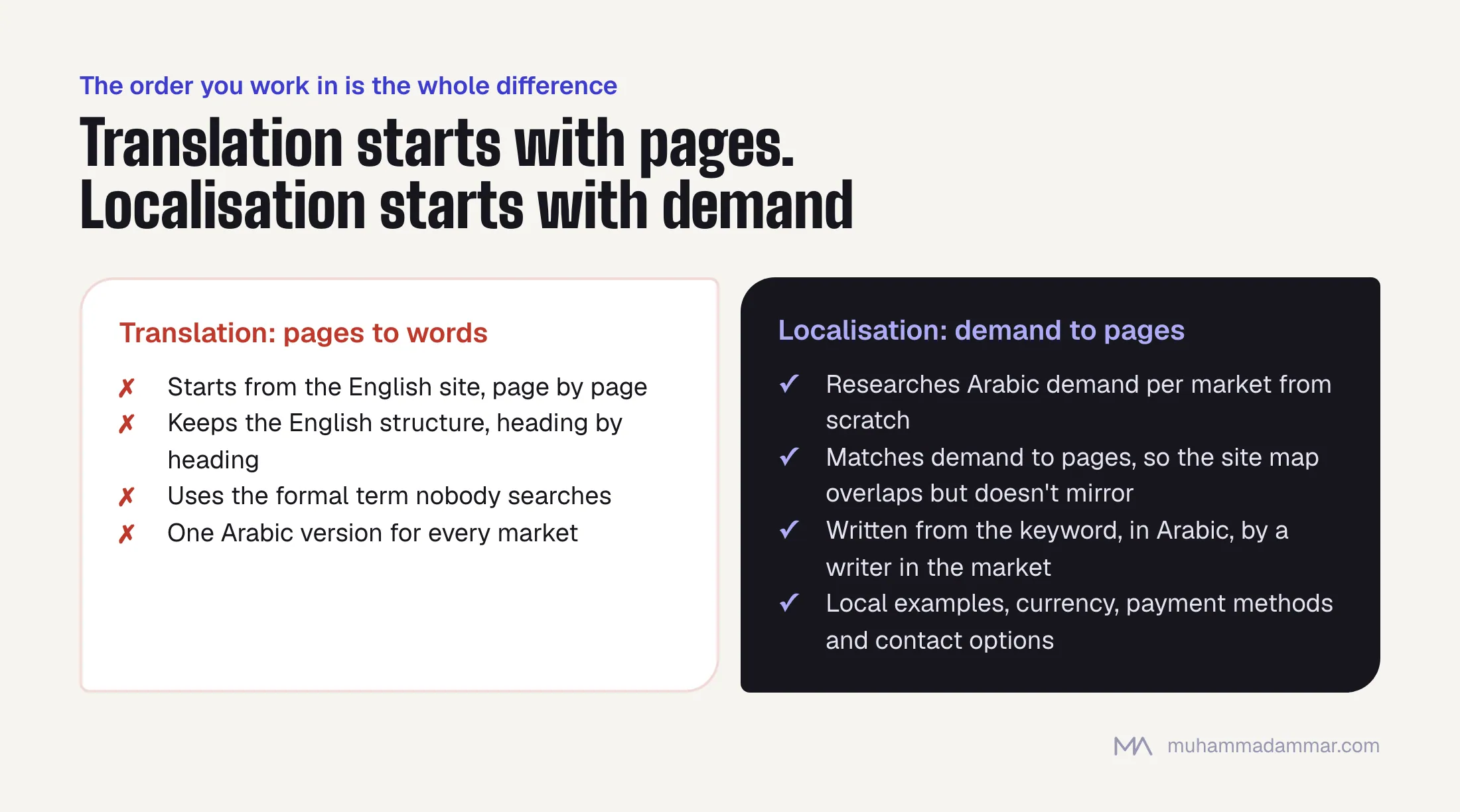
- Research Arabic demand from scratch, for each market, as if the English site didn’t exist. You’ll find terms with real volume and no matching English page, and English pages nobody wants in Arabic.
- Match demand to pages, not pages to pages. The result is an Arabic site map that overlaps with the English one but doesn’t mirror it.
- Write from the keyword, in Arabic, with a writer who works in the target market. Translating first and optimising afterwards gives you stiff text with keywords pushed into it.
- Localise the examples, currency, payment methods, legal notes and contact options. A page with prices in dollars and only a form, in a market that closes deals on WhatsApp, isn’t localised however good the Arabic is.
I cover the research step in detail in Arabic keyword research. It’s the step most brands skip, because they assume their English keyword list will translate.
Pages you shouldn’t translate at all
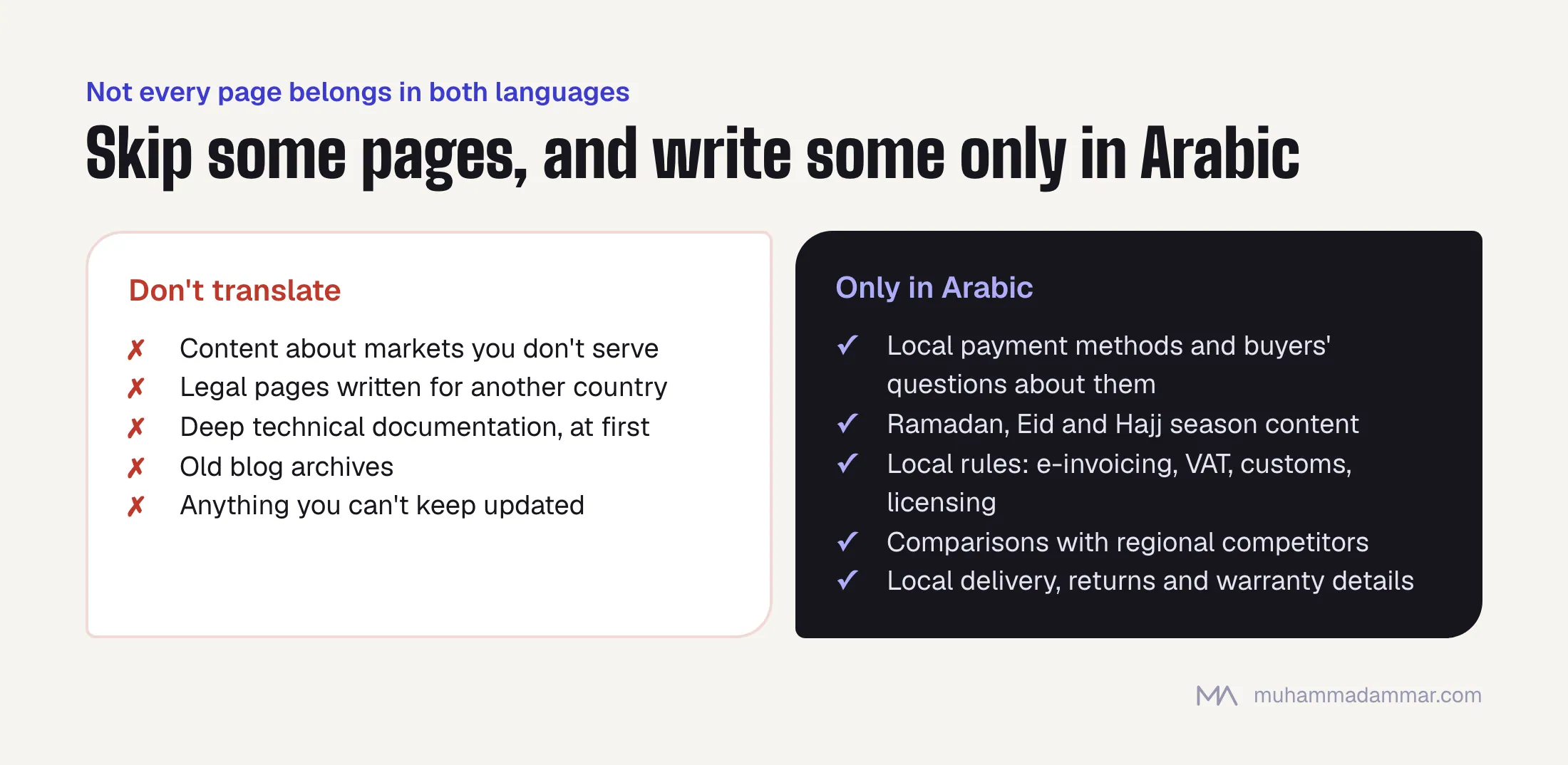
- Content about markets you don’t serve. A localised page for a country you can’t ship to creates support work and no revenue.
- Legal and compliance pages written for another country. These need rewriting by someone who knows local law, not translating.
- Deep technical documentation, at first. In many technical fields people search and read in English even when Arabic is their first language. A bad translation is worse than none.
- Old blog archives. Translating five years of posts to fill the Arabic site creates a big, thin, unvisited section that drags down the rest.
- Anything you can’t keep updated. An Arabic page that goes stale while the English one changes becomes a wrong answer with your name on it.
Pages that should exist only in Arabic
Almost nobody does this half, and it’s where the real advantage is. Some demand exists only in this market, so there’s no English page to translate from:
- Payment methods used here and not elsewhere, and the questions buyers have about them.
- Ramadan, Eid and Hajj season content. For retail, travel, food and finance this is a big yearly spike with no English equivalent.
- Local rules: e-invoicing, VAT registration, customs and import questions, licensing.
- Comparisons with regional competitors the global brand has never heard of, but the buyer is also considering.
- Local delivery, returns and warranty details, which are the real reasons people hesitate to buy in this market.
Local trust signals Arabic readers look for
To a local reader, a translated page from a global brand often feels like it doesn’t know where they are. What closes the gap:
- A local phone number and a WhatsApp option, not just an email form.
- Prices in local currency including local tax, with the tax shown.
- A real address in the country, written the way that country writes addresses.
- Commercial registration or licence numbers where they apply, and the local trust badges buyers recognise.
- Delivery times for actual local cities, not a generic range.
- Arabic support hours in local time, with the local working week, which isn’t Monday to Friday everywhere in the region.
Who owns the Arabic site
This fails for organisational reasons more often than technical ones. The English site has an owner, a roadmap and a publishing rhythm. The Arabic site has a translation budget. So it launches and then decays, because nobody is responsible for it after launch.
Settle three things before you start: who decides what gets published in Arabic and when; who reviews Arabic copy for tone as well as accuracy; and how the Arabic site stays in step when the English one changes a price, product or policy. If the answer to any of these is “the translation agency”, the site will drift within two quarters.
If you’re planning to enter the region and want the demand research done before anything is written, that’s where my Arabic SEO work starts, and the research itself is keyword research.
Frequently asked
Is machine translation ever acceptable?
Sometimes, as a first draft for a human editor who works in the target market. As published content, no. Grammar isn’t the problem anymore. The problem is that it copies the original structure and misses local demand completely.
Should the Arabic site be a subfolder, a subdomain or a separate domain?
A subfolder in almost every case. It inherits the domain’s existing authority, while separate domains split an effort that’s usually already short of resources.
Do we need separate pages for Saudi Arabia, Egypt and the UAE?
Only where the offer really differs: price, shipping, availability or legal terms. Copying the same content for each country without real differences creates pages that compete with each other and helps nobody.
How do we handle hreflang with all this?
Both ways, and only between pages that truly match. Pages that exist only in Arabic have no English partner, and that’s fine. See the common hreflang mistakes.
How long before a localised Arabic section performs?
On a domain that already has authority, faster than people expect, often a few months for less competitive terms, because Arabic results are usually less crowded than the English ones.
Entering the region and want to know what your Arabic site should contain before you commission a single word? Message me.

SEO and digital marketing consultant since 2015, working with businesses in Egypt, Saudi Arabia and the UAE.
About the author and editorial standards