On this page
Type an Arabic phrase into any popular keyword tool and the number you get back will be too small, often by a wide margin once you see what the tool is doing.
This one fact shapes Arabic SEO more than any other. It’s why so many brands in the region publish in English first and decide that Arabic search demand is small. The demand exists. The tools split it into pieces too small to notice.
Below is how the splitting happens, and a workflow to put the pieces back together.
The problem in one paragraph
Google’s Arabic processing smooths over a lot. It handles word forms, strips diacritics and treats several spelling variants as the same word, which is why your page often ranks for spellings you never wrote. Your keyword tool does none of this. It reports exact strings, so every spelling is a separate row with its own volume, and nobody adds them up. The search engine sees one keyword while your research tool shows you twelve small ones, and every conclusion you draw from the raw tool data is wrong in the same direction.
Five ways Arabic splits one keyword
1. Spelling variants: alef, hamza, ta marbuta, alef maqsura
Several Arabic letters get typed interchangeably, usually because the “correct” form takes an extra keystroke and nobody bothers in a search box.
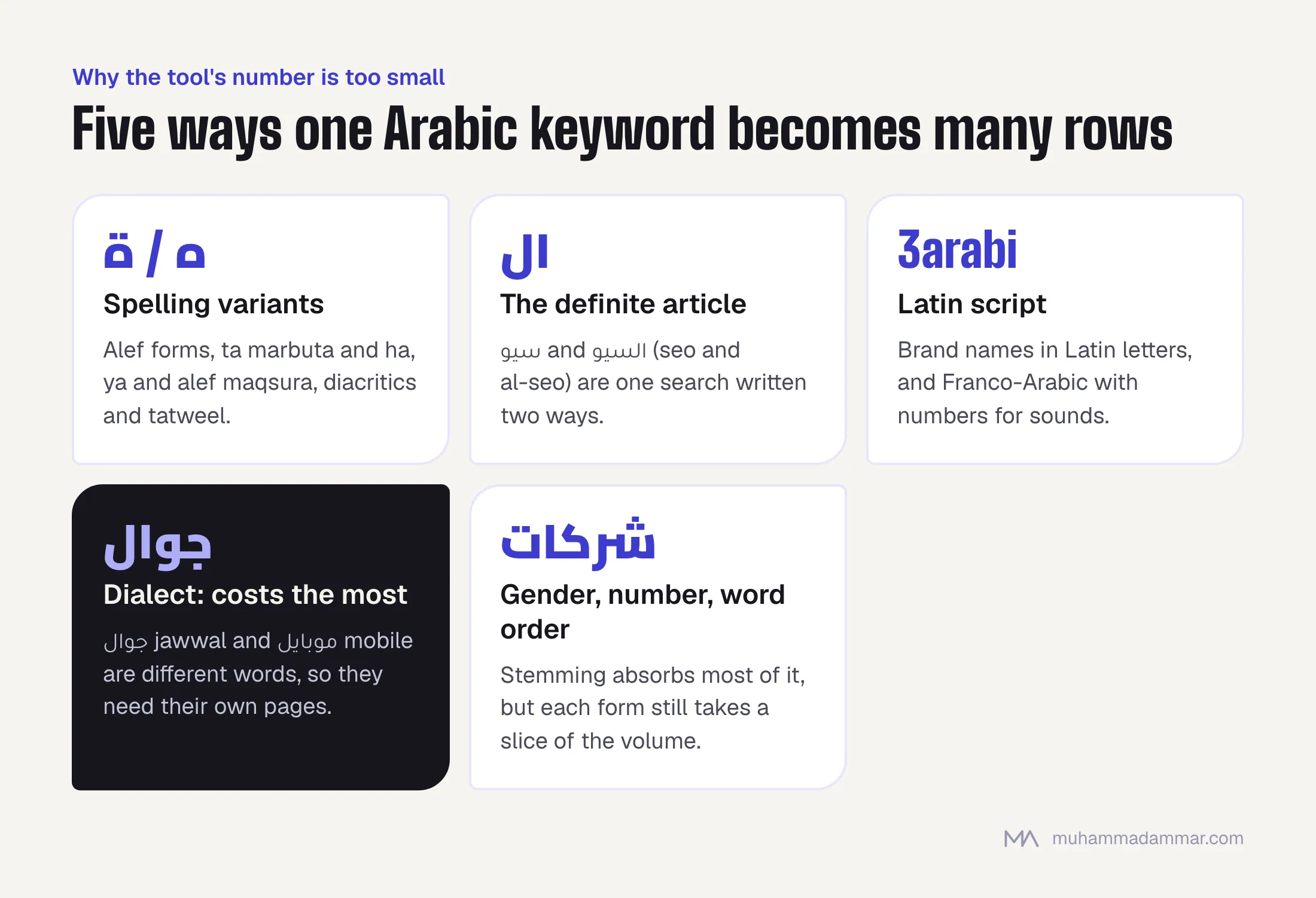
- Alef forms: the letter alef has four written forms (ا, أ, إ, آ). Most people type the plain ا whatever the word needs, so a phrase that should start with أ has a big share of its real demand sitting on the plain spelling.
- Ta marbuta and ha: two letters (ة and ه) that look almost the same at the end of a word. شركة and شركه (sharika, company) are the same word to the person searching and two strings to the tool. The ه spelling is very common, especially on phone keyboards.
- Ya and alef maqsura: the final letters ي and ى. Egyptian users in particular type ى where the standard form is ي, so a lot of searches for محامي (muhami, lawyer) show up as محامى.
- Diacritics and tatweel: almost nobody types diacritics into a search box, but they turn up in content and in scraped keyword lists. The elongation character (tatweel, a stretched line between letters) appears in copied text and creates strings that match nothing.
These four alone can spread one idea across six or eight rows in your tool.
2. The definite article
Arabic attaches the definite article (al-, written ال) to the front of the word. سيو and السيو (seo and al-seo), or تسويق and التسويق (taswiq and al-taswiq, marketing), are the same search written two ways, and the tools list them separately.
Add the alef problem and a two-word phrase can easily produce a dozen variants before you’ve even looked at different wording.
3. Transliteration and Franco-Arabic
Two separate habits, both outside Arabic script.
Latin spellings of brand and product names. People search for a brand the way it’s written on the packaging, which is often in Latin letters. This matters most in beauty, tech and fashion.
Franco-Arabic, also called Arabizi. This is Arabic written in Latin letters, with numbers standing in for sounds Latin doesn’t have: 3 for ain, 7 for a hard h, 2 for the glottal stop, 5 for kh, 9 for an emphatic s. So “3arabi” means Arabic. It’s still common in Egypt and the Levant, especially among younger people on their phones.
Franco-Arabic searches almost never show up in keyword tools at any real volume, but you’ll usually find them in Search Console if you look. Whether they’re worth targeting depends on your category: in most B2B categories they aren’t, and in some youth consumer categories they’re a real share.
4. Dialect
This split costs the most money, because Google does not treat dialect words as variants of each other. They’re different words.
A Saudi searcher calls a mobile phone جوال (jawwal), and an Egyptian one says موبايل (mobile) or محمول (mahmoul). That’s one product category, three strings and three separate pools of demand, and your keyword tool will show you whichever one you happened to start from.
People also search closer to how they speak than how they write. Your press release is in Modern Standard Arabic, but the search sounds like conversation. Research built from MSA translations gives you a list of grammatically perfect phrases nobody searches, and that’s the most common way Arabic keyword research fails completely.
The rule I use: dialect variants are a site-structure decision. If Gulf and Egyptian audiences use different words for your category, that’s a reason for separate pages, and two headings on one page won’t cover it. Spelling variants, on the other hand, belong on the same page.
5. Gender, number and word order
Arabic words change a lot by form. A consultant is mustashar or mustashara (male and female), a company is sharika and companies are sharikat, and the order of nouns and adjectives gives you several correct ways to say the same two-word idea.
Google’s stemming absorbs most of this, so it affects rankings far less than dialect does. It does inflate the number of rows in your tool, and each row carries a slice of the volume.
A workflow that gives you real numbers
There are five steps. People usually skip the first one, and it’s the one that matters most.
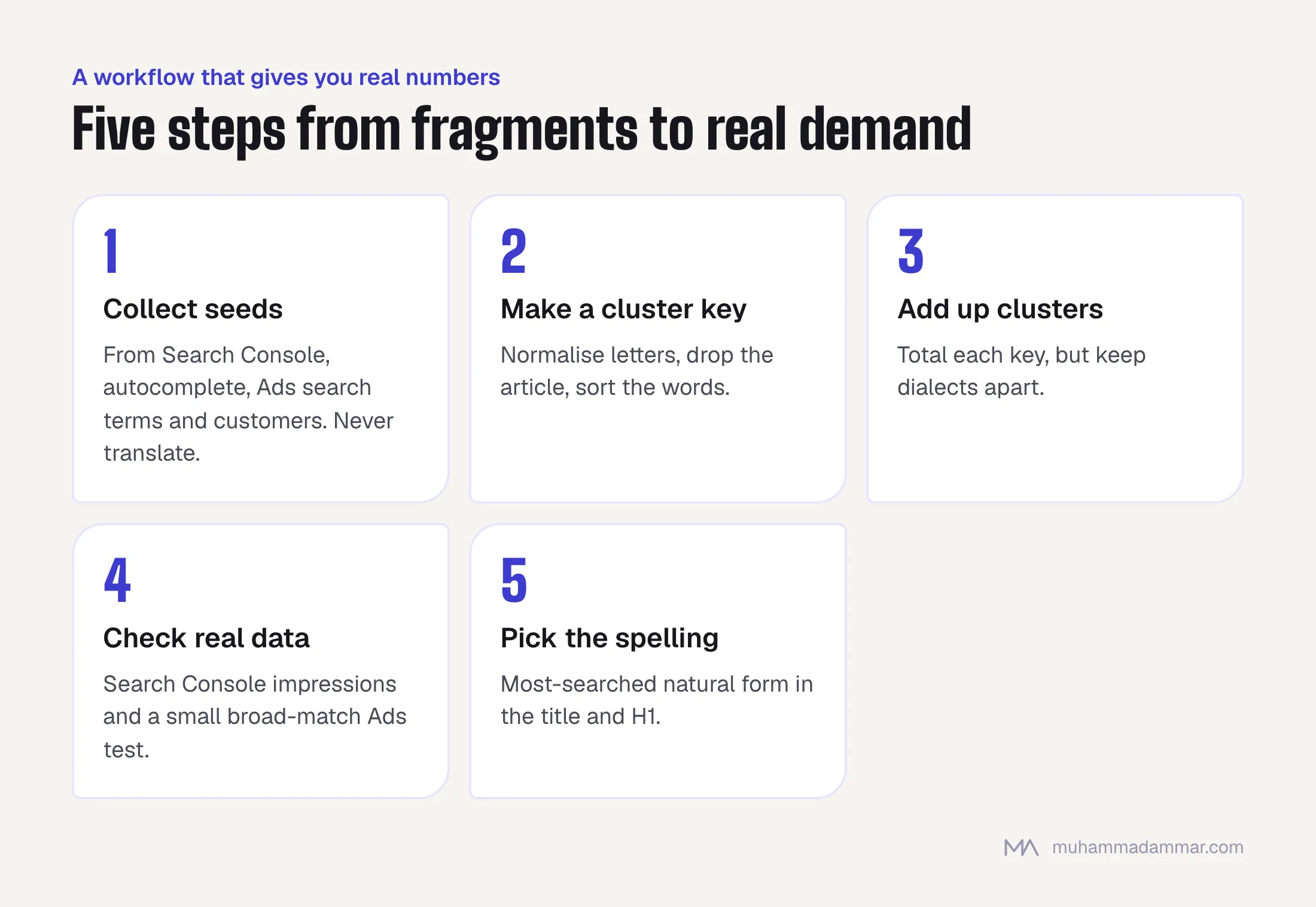
Step 1: collect seed keywords, never translate them
Take seeds from places where real people typed real Arabic:
- Your own Search Console query report, filtered to the target country. It’s free and it’s the most reliable source you have.
- Google autocomplete and related searches, checked from the target country, not from wherever you are.
- The Google Ads search terms report, if you run ads. It shows exactly what people typed, which makes it the best source of variants there is.
- Competitor pages that already rank in Arabic. Look at their headings.
- Your sales team and your WhatsApp inbox, where customers use their everyday words.
Use translation at the end, to check you haven’t missed a topic. Never use it at the start to build the list.
Step 2: reduce every keyword to a cluster key
Turn each keyword into one standard form so that variants fall into the same group. It’s mechanical and takes about fifteen lines of code:
import re
def normalise(text):
    # strip diacritics (harakat) and tatweel
    text = re.sub(r'[ً-ْـ]', '', text)
    # unify alef forms
    text = re.sub(r'[آأإ]', 'ا', text)
    # ta marbuta -> ha
    text = text.replace('ة', 'ه')
    # alef maqsura -> ya
    text = text.replace('ى', 'ي')
    # drop the definite article at the start of a word
    text = re.sub(r'\bال(?=\w{2,})', '', text)
    return ' '.join(sorted(text.split()))   # word-order-insensitive key
Sorting the words at the end means word order doesn’t matter, which catches the rephrased variants too. Keep the original keywords next to the key, because you’ll need them later to choose what goes in the title.
Step 3: add up each cluster, but keep dialects apart
Add the reported volumes of every keyword that shares a key. The total is much closer to reality than any single row.
Don’t merge dialect variants into one total, because they aren’t competing for the same page. Keep jawwal and mobile as two clusters so the page decision is made on purpose.
Step 4: check against real data
Even merged, tool volumes are estimates. Two sources let you check them.
Search Console impressions. If a cluster your tool puts at 40 searches a month already brings several hundred impressions to a page you barely optimised, the tool is wrong, and now you can show it.
Google Ads search terms. Run a small broad-match campaign on the cluster for two weeks. The search terms report gives you the exact words people typed, including variants no tool showed. It’s the cheapest Arabic keyword research available, and hardly anyone uses it this way. I cover the paid side in Google Ads in Saudi Arabia.
Step 5: choose the main spelling for the page
Within each cluster, use the most-searched natural spelling in the title and H1. Put the other variants in subheadings, the FAQ and the body where they read naturally.
Don’t list variants at the bottom of the page. Google’s normalisation already covers most spelling differences, so stuffing them in only hurts readability.
What changes once the numbers are merged
Topics that looked too small become worth doing, which is the point of the exercise. Your priorities change too, because merging doesn’t lift every cluster equally: topics with many word forms gain the most.
And the Arabic-versus-English budget discussion changes completely, because for the first time you’re comparing like with like. Before, it was a complete English figure against a fragmented Arabic one. Most two-language content budgets in this region were set by that unfair comparison, and it’s the most expensive mistake on this page.
Frequently asked
Which keyword tool is best for Arabic?
None of them on its own. They all report strings instead of ideas, and they all under-sample Arabic markets. Use the one you already pay for as a rough guide, and treat Search Console and Ads search terms as the real evidence.
Should I write in dialect or Modern Standard Arabic?
Write clear Arabic that reads naturally to your audience, and use dialect terms where the searches are: in headings, and in the body where they fit. A page in heavy dialect is hard to reuse across markets, and a page in formal MSA misses the searches you want.
Does Google really treat ta marbuta and ha as the same letter?
Its Arabic processing normalises most variation of this kind, which is why pages rank for spellings they don’t contain. Don’t count on it to cover a dialect difference, though. Normalisation handles spelling, not vocabulary.
Is Franco-Arabic worth targeting?
Check Search Console first. In most B2B and professional categories it’s negligible. In youth consumer categories in Egypt and the Levant it can be a real share, and a page can’t rank for it without containing it, because normalisation doesn’t cross from one script to another.
How long does proper Arabic keyword research take?
One to two weeks for one market. Longer for two-language sites, because the Arabic and English keyword maps have to be matched up so the two versions of the site don’t compete for the same searches.
Related: Arabic SEO, keyword research, and my full Arabic SEO guide. If you want your own keyword map built this way, tell me about your market.
SEO and digital marketing consultant since 2015, working with businesses in Egypt, Saudi Arabia and the UAE.
About the author and editorial standards