On this page
Most Google Ads advice assumes English keywords. Arabic breaks several of the assumptions behind it: match types behave differently, one brand name can have two common spellings that don’t share a keyword, and the seasons follow a calendar the platform doesn’t know about.
This is what I check and change when I take over a Saudi account.
Arabic keywords, match types and word forms
Google’s close-variant matching absorbs a lot of Arabic variation: alef forms, ta marbuta and ha, missing diacritics and some word endings. That’s useful, and it’s also why account structures built for English behave oddly here.
Two things you can act on:
Exact match is less exact than you’d expect. Adding every spelling as its own exact keyword usually just makes your keywords compete with each other in the same auction. Pick the most common natural spelling, let close variants do the rest, and then check the search terms report instead of assuming.
Broad match is more useful in Arabic than in English, for one reason: it finds search phrasings that no keyword tool reports. Run a small broad-match campaign with tight negatives purely as research, read the search terms every week and move the winners into your main campaigns. It’s the cheapest Arabic keyword research there is. I describe the full method in Arabic keyword research.
What close variants don’t bridge is vocabulary. A Gulf word and an Egyptian word for the same product are different keywords and always will be.
Spelling splits that quietly cost money
Foreign names written in Arabic have no single correct spelling, and the split matters: each spelling is its own keyword with its own volume and its own auction.
The best-known example is Google itself. Its Arabic name is written both as jujul and as qooqal, and the second spelling is common in Saudi Arabia. The same thing happens with almost every brand and product name written in Arabic: social platforms, phone makers, software, car models, medicines.
What to do:
- Find the variants in your own search terms report, not in a keyword tool. The report shows what people actually typed, including spellings no tool lists.
- Add the variants that have real volume. Close-variant matching doesn’t reliably connect two genuinely different spellings.
- Check the Latin spelling too. In tech, beauty and cars, many Arabic speakers type the brand in Latin letters inside an otherwise Arabic search.
- Check this every quarter. Spelling habits shift, and a variant that was minor last year can become the main one.
Account structure for two languages
The usual instinct is one campaign with Arabic and English ad groups. It’s the wrong structure, and it costs you control.
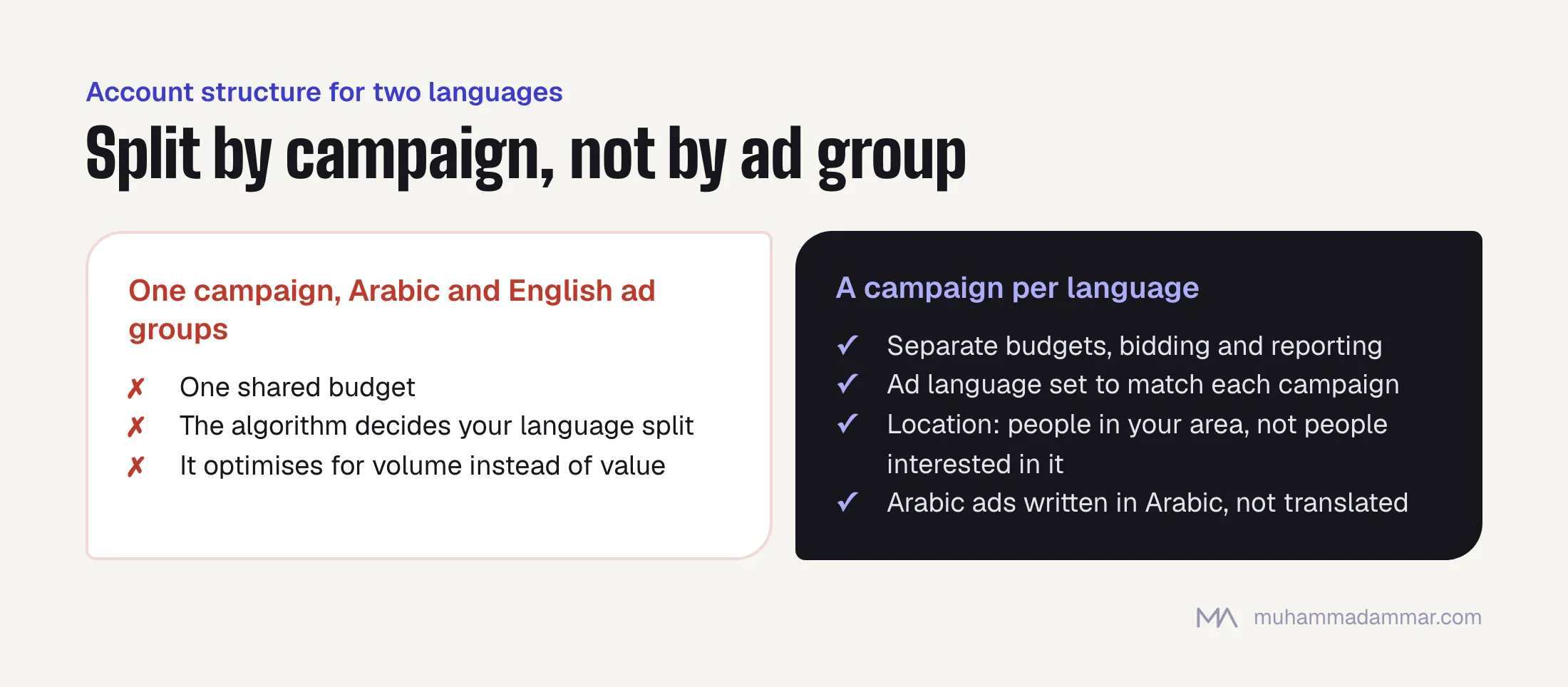
Use separate campaigns per language, not ad groups. Arabic and English searches in the same market have different costs, different conversion rates and often different buyers. In Saudi Arabia, English searches often lean toward expatriate and B2B audiences. Separate campaigns give you separate budgets, bidding and reporting. If they share a budget, the algorithm decides your language split for you and optimises for volume instead of value.
Set the ad language to match. People leave this targeting setting on its default, and it affects who sees what.
Keep location targeting tight. Target people in your location, not people interested in it, unless you have a specific reason. Regional accounts pick up a surprising amount of out-of-market spend by leaving this on the default.
Write Arabic ads in Arabic. Translated headlines read like translations, and when several competitors run translated ads, natural Arabic stands out on the results page itself. Lengths behave differently too: Arabic says more per character, so a headline that fills the space in English may leave room in Arabic, or the other way round.
Matching the landing page language
An Arabic ad that sends people to an English landing page is the most common structural mistake I find in Saudi accounts, and it costs you twice: your relevance drops, and the visitor leaves.
The rule has no exceptions: Arabic ad, Arabic landing page, Arabic form, Arabic confirmation. A page with an Arabic headline and an English form underneath doesn’t count.
If the Arabic landing page doesn’t exist yet, build it before you spend. Don’t point the campaign at the English page and plan to fix it later. What an Arabic page needs that an English one doesn’t is in Arabic landing pages that convert.
Ramadan, Eid and the bidding cycle
The Hijri calendar moves about eleven days earlier each Gregorian year, so year-on-year comparisons in your reports compare different seasons. Automated bidding doesn’t see it coming.
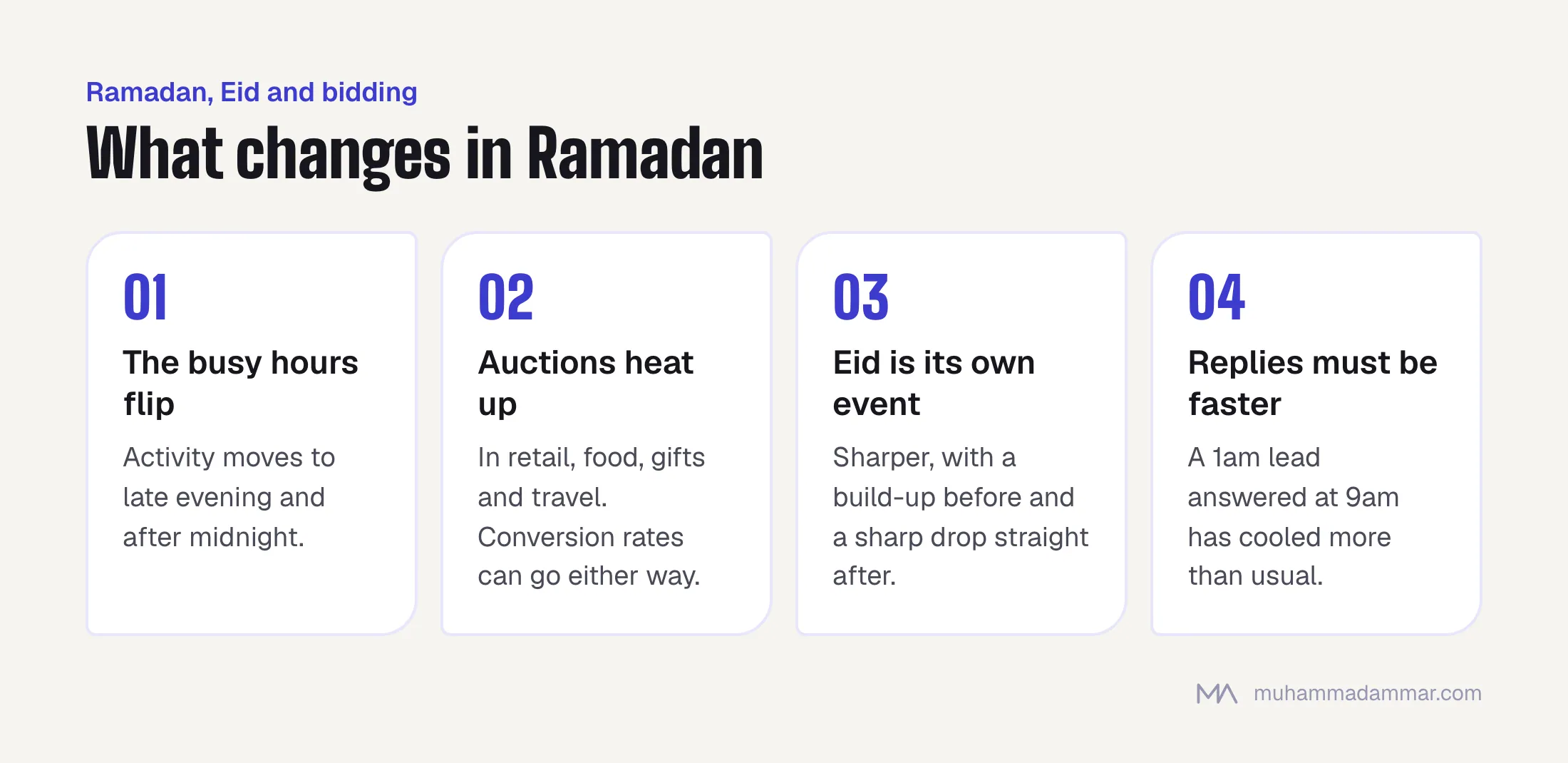
What changes in Ramadan:
- The busy hours flip. Activity moves heavily to late evening and after midnight. A schedule built on daytime office hours misses the peak entirely.
- Auctions get more competitive in retail, food, gifts and travel, and conversion rates can go either way depending on the category.
- Eid is a separate, sharper event, with its own build-up before and a sharp drop straight after.
- People expect faster replies. A lead that comes in at 1am and gets a reply at 9am has cooled more than it would in a normal week.
How to handle it: put the dates into the media plan at the start of the year, set budgets and schedules manually around them instead of trusting automated bidding to adapt, give smart bidding a couple of weeks to relearn afterwards, and mark the dates in your analytics so next year’s comparison isn’t thrown off.
Negative keywords for Arabic accounts
Arabic accounts waste more on irrelevant searches than English ones, because broad match has more room to wander and fewer people read the search terms report.
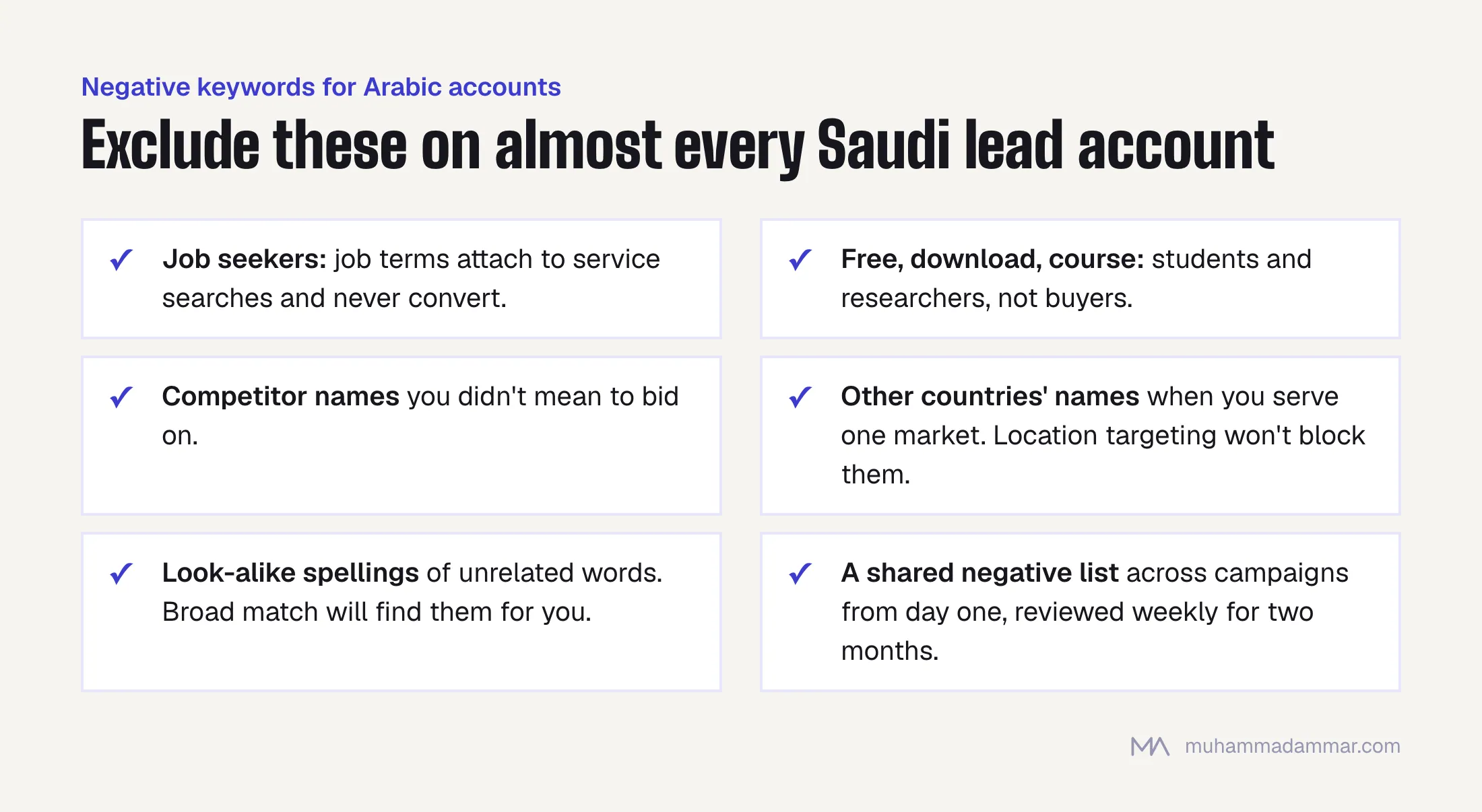
Categories worth excluding on almost every Saudi lead-generation account:
- Job seekers. Job-related terms attach themselves to service searches all the time and never convert.
- Free, download and course searches: students and researchers, not buyers.
- Competitor brand names you didn’t mean to bid on, unless that’s a deliberate strategy.
- Other countries’ names when you serve only one market. Location targeting doesn’t block a search that names a different country.
- Spellings that mean something else. Arabic has near-identical spellings for unrelated words, and broad match will find them for you.
Build the list from your own search terms report every week for the first two months, then monthly. Set up a shared negative list across campaigns on day one.
Frequently asked
How much does a click cost in Saudi Arabia?
It varies hugely by sector, and any single number would mislead you. Saudi clicks are often expensive compared with nearby markets, which is a good reason to build organic search alongside paid ads.
Should I advertise in Arabic or English?
Both, in separate campaigns, with the split decided by your own search terms data. Most consumer categories in Saudi Arabia lean heavily Arabic. Some B2B and expatriate-facing categories don’t.
Does Performance Max work in this market?
It works, and it hides where your money went, which matters more in a market where lead quality varies so much between types of search. Give it a qualified-lead conversion instead of a form fill, or it will very efficiently find you cheap volume. I cover the controls in getting control back inside Performance Max.
Why is my cost per lead low but nothing closes?
It’s almost always a tracking problem before it’s an advertising one. The platform optimises for the only event you gave it, which is usually a form fill. And if most of your real enquiries come through WhatsApp, the account can’t see them at all. That’s the subject of tracking WhatsApp leads.
How long does a new Saudi account take to settle?
Four to six weeks for smart bidding to have enough conversion data to be useful, and longer for low-volume B2B. Don’t restructure in week two, or you’ll just reset the learning.
Related: Google Ads, paid media and SEO consultant in Saudi Arabia. If you’d like a second opinion on your account, message me.

SEO and digital marketing consultant since 2015, working with businesses in Egypt, Saudi Arabia and the UAE.
About the author and editorial standards