On this page
Most Arabic landing pages in this region are English landing pages that were translated and flipped. They work, in the sense that they load and the text is Arabic. They convert badly, and the reasons are specific enough to fix.
Right-to-left details beyond flipping the CSS
Mirroring the layout is the easy part, and most teams get it right. The problems are in the details that survive the flip.
- Mixed-direction text. An Arabic sentence with a Latin brand name, model number or price is where the layout breaks: punctuation jumps to the wrong end of the line and the sentence looks damaged. Wrap the Latin part in
<bdi>and the browser keeps it separate. This one fix cleans up more visual problems than any other. - Icons that shouldn’t flip. Navigation arrows and progress bars flip. Clocks, video controls, logos and anything with a built-in direction don’t. A flipped play button looks broken.
- Fonts. Arabic web fonts are heavier than Latin ones, and browsers can’t fake a convincing Arabic bold, so load the real weight or don’t use bold. Two weights are almost always enough, and it’s one of the biggest speed gains on an Arabic page. More in the WordPress speed fixes that show up in real-user data.
- Line height and paragraph length. Arabic needs more vertical space than the Latin default, and long blocks of dense Arabic are hard to scan. Write shorter paragraphs than you would in English.
- Use CSS logical properties so one stylesheet serves both directions. Keeping a mirrored copy guarantees the two drift apart.
Numbers, dates and currency
Small details that quietly show whether the page was made for this market or translated into it.
Numerals. Both Western digits (0-9) and Arabic-Indic digits (٠–٩) are used. Arabic-Indic is more common in the Gulf, and Western digits dominate in North Africa. Pick per market and stay consistent. Mixing them on one page is the real mistake, and it happens all the time when prices come from a database and the text is written by hand.
Currency. Show the local currency in the local format, with the symbol where readers expect it. A price in the wrong format makes the site look foreign, which is exactly the impression you’re trying to avoid.
Dates. Gregorian dates are standard for business. Where the Hijri date matters, such as deadlines around Ramadan, religious occasions or government processes, show both. Watch the month names too: Egyptian, Levantine and Gulf usage differ, and the wrong set looks foreign.
Phone fields and the WhatsApp habit
The phone field causes more drop-off than anything else on most Arabic lead forms, and it’s usually built for an audience that doesn’t exist.
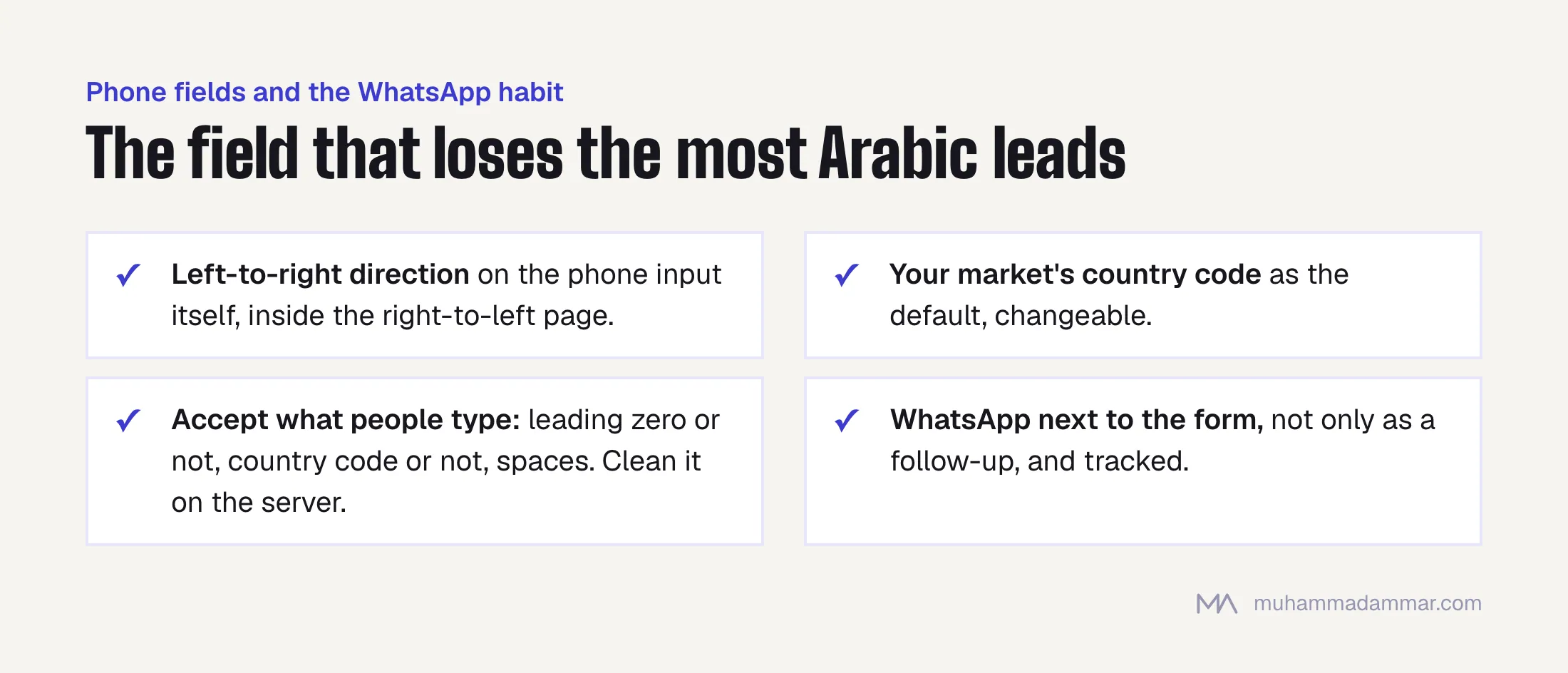
- Set the field’s direction to left-to-right. Phone numbers are typed left to right inside a right-to-left page. If the field inherits the page direction, the cursor behaves strangely and people give up without being able to say why.
- Default the country code to your target market, and let people change it. A dropdown that starts the country list at Afghanistan adds friction to every single submission.
- Accept the formats people actually type: with or without the leading zero, with or without the country code, with spaces. Clean the number up on the server instead of rejecting it in the browser.
- Offer WhatsApp next to the form, not only as a follow-up. In most of this region many buyers would rather start a conversation than fill in fields, and forcing them through the form loses them. Make sure that button is tracked. I explain how in tracking WhatsApp leads.
Form length and lead quality
The usual advice is to cut fields. That advice optimises for volume, and in this market volume is rarely the problem.
When lead quality is the problem, and in a market where cheap leads are easy to buy it usually is, one extra qualifying field earns its place. A question that makes people think and type filters out many low-intent submissions, and the leads that remain are worth more of your sales team’s time.
My default is name, phone and one qualifying question relevant to the offer. Email is optional in most consumer categories here, because the follow-up happens by phone anyway, and asking for a field you won’t use costs you submissions for nothing.
Measure both numbers whenever you change the form. A shorter form that raises submissions by thirty per cent and halves the qualification rate has made the business worse while making the dashboard look better.
Trust signals that matter here
This is the part of Western conversion advice that travels worst, and it’s the part that moves Arabic conversion rates most.
The trust signals Western buyers rely on, like long-running review sites, industry bodies and familiar payment badges, are thin here. What works instead is more concrete and more local.
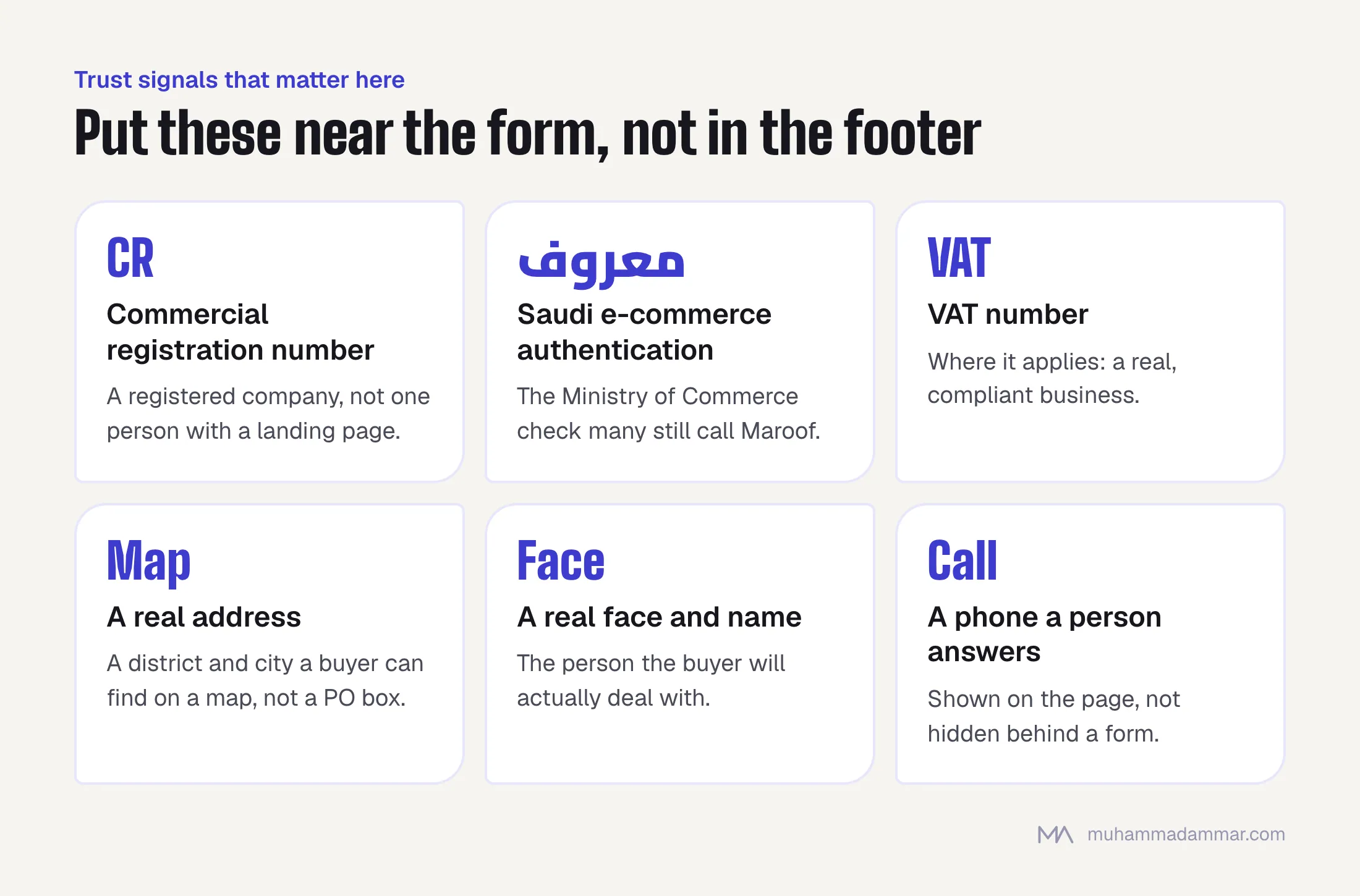
- Commercial registration number. Showing your CR number tells a Saudi or Gulf buyer you’re a registered company, not one person with a landing page. It’s the cheapest credibility on the page.
- Saudi e-commerce authentication. Saudi buyers know the Ministry of Commerce’s business check (many still call it Maroof). If your store is authenticated, show it.
- VAT number, where it applies: another sign of a real, compliant business.
- A real address. Not a PO box, but a district and city a buyer can find on a map.
- A real face and name. Personal credibility counts for more in this region than corporate branding. A photo of the person the buyer will actually deal with works far better than a stock photo of a team.
- A phone number a person answers, shown on the page, not hidden behind a form.
Put these near the form. In the footer, nobody sees them.
Social proof in Arabic
Three rules.
Testimonials in Arabic, in the customer’s own words. A translated testimonial reads as translated, and a reader who notices discounts the whole page.
Specific beats glowing. “They fixed our checkout in three weeks and orders went up” works better than “excellent service, highly recommended”, in any language, and especially where readers are used to fake praise.
Google reviews count for a lot. With few other review platforms in the market, the Maps rating is the reputation check for many buyers. A link to a real profile with real reviews beats a carousel of quotes with no source.
And never invent testimonials. The region’s markets are smaller and better connected than they look, and getting caught costs more than the page ever earned.
Testing when you’ll never reach significance
Most pages in this region don’t get enough traffic for a clean A/B test, and pretending otherwise gives you confident nonsense. The full process is in a CRO process for sites that will never reach significance.
What works instead:
- Test in sequence over a long enough window. Change one thing, run it for four weeks and compare with the four weeks before. It’s crude and seasonal, and still better than guessing, as long as you change only one thing.
- Fix the obvious problems without testing. A broken phone field, an English form on an Arabic page or a missing CR number doesn’t need a test. It needs fixing.
- Test big changes, not button colours. With little traffic, only big effects are detectable at all.
- Use qualitative evidence. Five session recordings and three conversations with your sales team will tell you more than a test without enough traffic, and cost less.
The full approach for low-traffic sites is part of my CRO and landing pages work.
Frequently asked
Can I just mirror my English landing page?
You can, and it will underperform. The layout flips fine, but the trust signals, form, phone field and social proof all need rebuilding for this audience.
Should the page be in Modern Standard Arabic or dialect?
Clear, current Arabic that reads naturally, not formal MSA, with dialect in headlines where it matches how buyers talk about the problem. A formal tone on a landing page feels distant, which is the opposite of what you want next to a form.
Is WhatsApp better than a form?
For most consumer categories in this region, yes, offered next to the form rather than replacing it. It converts better and it’s harder to measure, so fix the tracking before you make it the main call to action.
How many fields should the form have?
Usually three: name, phone and one qualifying question. Add a field when lead quality is the problem, and remove one when volume is.
Do Arabic pages convert worse than English ones?
Badly built ones do, and that’s most of them. A properly built Arabic page aimed at Arabic speakers beats the English version, because it meets buyers in their own language with the trust signals they actually check.
Related: CRO and landing pages, Arabic SEO and Meta ads. If your Arabic page gets traffic but few enquiries, send me the link.

SEO and digital marketing consultant since 2015, working with businesses in Egypt, Saudi Arabia and the UAE.
About the author and editorial standards