On this page
X is the platform most media plans in this region skip without discussion, and most of the time that’s right. But there’s a narrow case where it’s the best channel available, and it barely exists anywhere else: the Gulf, where the platform kept an unusual concentration of professionals, journalists and government-linked users long after it faded elsewhere.
This article is about that narrow case, and about being honest that it’s narrow.
Who is actually still there
Saudi Arabia in particular has long been one of the platform’s most active markets per head, and people use it differently from the West in ways that matter for business.
- A culture of announcements. Ministries, regulators, big employers and executives post there first, so people who need to follow policy and market news are still there every day.
- Professional discussion in Arabic. Sector conversations about construction, energy, healthcare purchasing and government contracts happen in Arabic threads that have no equivalent on other platforms.
- Journalists and analysts. The people who write about your sector can be reached here in a way they can’t elsewhere, which matters for coverage as much as for ads.
- Attention around events and seasons. Conferences, national days, budget announcements and regulation changes create sharp, predictable spikes in attention.
None of this makes it a volume channel. The audience is narrow, and the platform’s advertising tools are thinner than they used to be.
Targeting that survived the platform’s changes
The targeting that still works is the kind that doesn’t depend on detailed profile data:
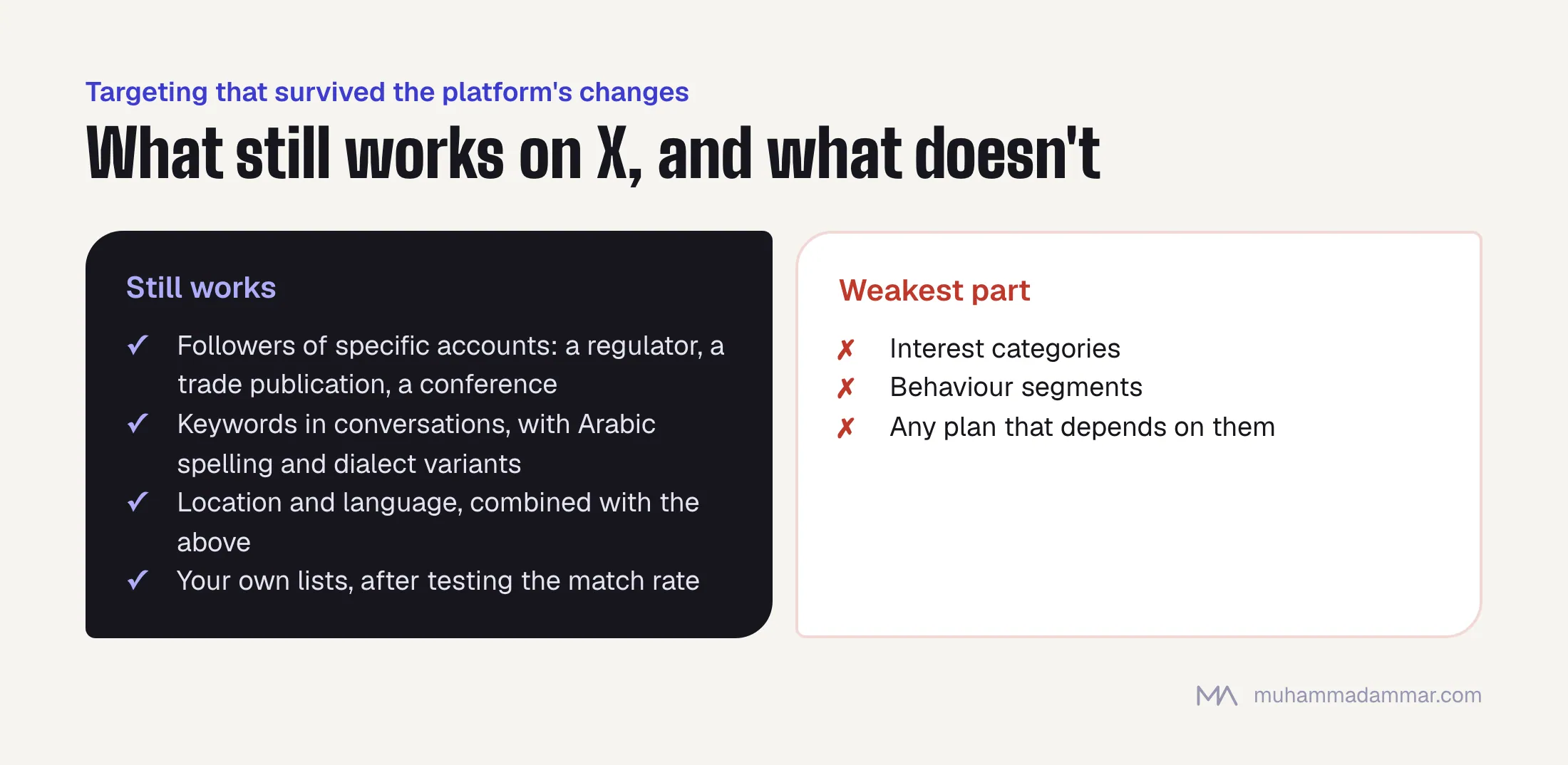
- Followers of specific accounts. Targeting people who follow a regulator, a trade publication, a conference or a competitor is still the most precise option, and the reason to use the platform at all.
- Keywords in conversations. Reaching people who post or engage with certain terms. In Arabic that means listing the spelling and dialect variants, not one standard spelling.
- Location and language. Reliable, and best combined with the options above instead of used alone.
- Custom audiences from your own lists. Match rates vary, so test with a list you know before planning around it.
Interest categories and behaviour segments are the weakest part of what’s on offer here. If your plan depends on them, it won’t work.
Formats worth testing
- Promoted posts from a real, active account. Ads from an account that only posts ads do badly. The account has to look like it takes part.
- The executive’s account, not the brand’s. In B2B here, a named person with a title beats a logo, and that account keeps working organically between campaigns.
- Threads that give something useful, such as a summary of a new regulation, a breakdown of a tender process or some original data. Promoted, these behave like content instead of advertising.
- Promotion timed to events, around a conference or announcement, when the audience is concentrated and looking for commentary.
The usual Arabic creative rules apply: write in Arabic instead of translating, watch how character limits behave with Arabic text, and keep Latin product names as they are instead of spelling them in Arabic letters. The details are in Arabic ad copy.
Realistic expectations on volume and cost
Set these before you start, or the campaign will be judged by the wrong standard and killed for the wrong reason.
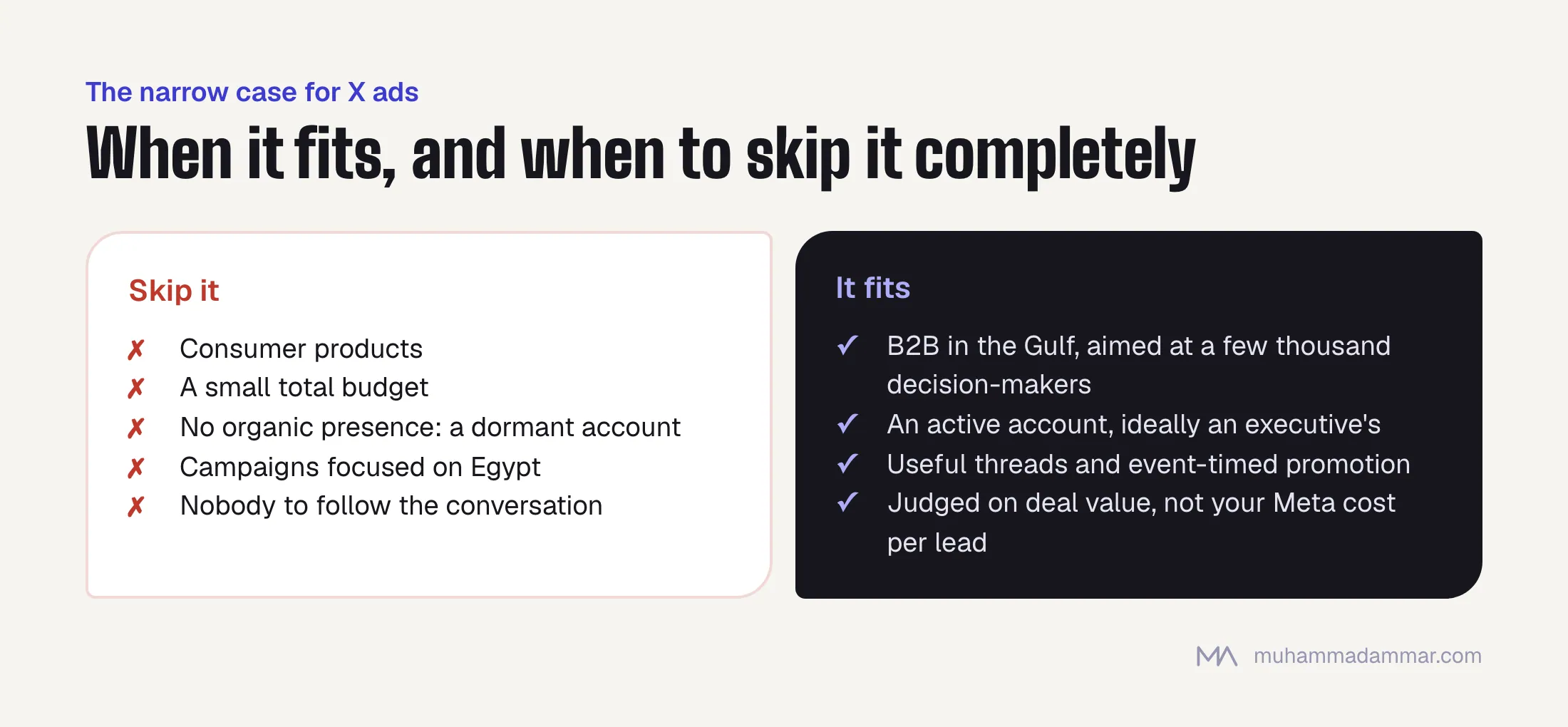
- Low volume is the point, not a failure. If the people you can reach are a few thousand decision-makers, a handful of qualified conversations is a good month.
- Cost per lead will look bad next to other channels. Compare it with the value of the deal, not your Meta cost per lead.
- The path to a sale is long. A B2B lead from here usually involves several touches and a period of following you before they get in touch at all.
- Much of the value can’t be clicked. Being seen by the right twenty people can lead to an approach that never shows up as a campaign conversion. That’s the attribution problem in why attribution breaks in the Gulf and Egypt.
When to skip it completely
- Consumer products. Almost always the wrong platform. The audience and the intent aren’t there.
- A small total budget. If the whole budget is modest, spend it where the volume is and come back to this later.
- No organic presence. Advertising from a dormant account is paying to be ignored. Post properly for three months first, or don’t start.
- Campaigns focused on Egypt. The platform carries much less weight in Egypt than in the Gulf, and other channels serve that market far better.
- Nobody to look after it. This channel needs someone who follows the conversation. Without that person, it’s an ad placement in a room you can’t read.
If it fits, setting it up and running it is part of my X ads work, and whether it deserves budget at all belongs in the wider paid media plan.
Frequently asked
Is it still worth being on X without ads?
In the Gulf, for B2B and for anyone whose sector is affected by policy, yes, as a place to listen and build relationships more than to distribute content.
Brand account or personal account?
Personal, in almost every B2B case here. Keep the brand account for announcements and support.
What budget should I test with?
Enough to run for six weeks, and little enough that it doesn’t matter if it fails. Treat it as an experiment with a set end date and written expectations.
How do I measure it when the value is indirect?
Ask on the enquiry form, watch searches for your brand, and count real conversations instead of clicks. For a channel this narrow, a list of named companies that engaged is better evidence than a dashboard.
Does the platform’s instability matter?
Yes, in practice. Features, policies and ad tools change with little warning, so don’t build a process that only works there, and check your targeting still exists before each campaign.
Want a straight answer on whether your B2B offer fits this channel? Message me.

SEO and digital marketing consultant since 2015, working with businesses in Egypt, Saudi Arabia and the UAE.
About the author and editorial standards