On this page
Most marketing teams put their energy into optimising inside each channel and almost none into deciding how much each channel gets. Yet the budget split affects results far more than anything you’ll do to a campaign, and it’s usually decided once, informally, by whoever was in the room.
Here’s how to decide it on purpose, and why a split that works in Dubai fails in Cairo.
The three inputs
Everything else is fine-tuning.
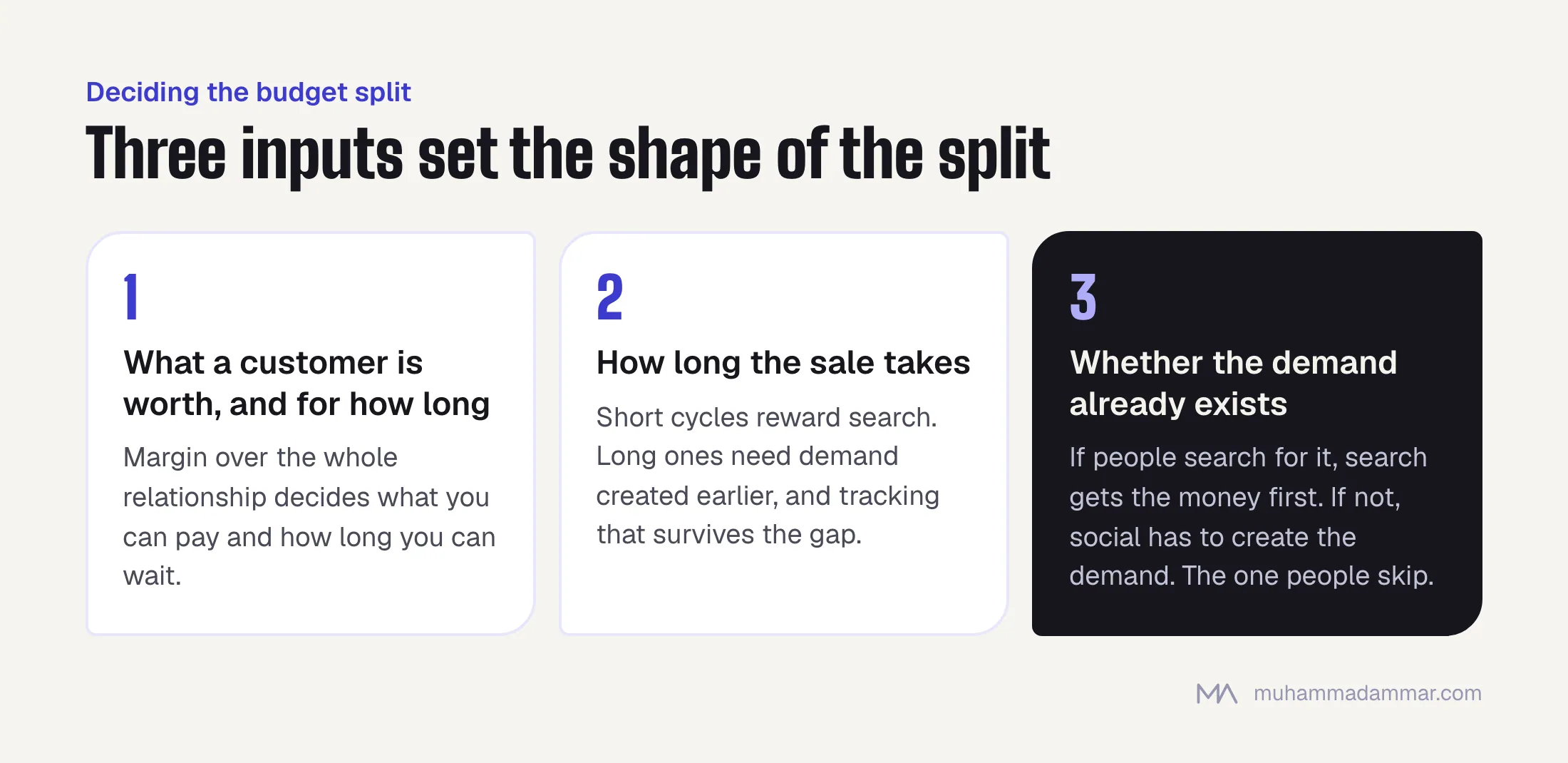
1. What a customer is worth, and for how long. Not the first order, but the margin over the whole relationship. A business with high lifetime value can pay more to win a customer and can afford channels that take longer to pay back. A one-off, thin-margin business can’t, and should focus on the cheapest channel that works instead of spreading across five.
2. How long the sale takes. A same-day purchase and a three-month B2B cycle need different mixes. Short cycles reward channels that capture existing demand, mainly search. Long cycles need you to create demand earlier, which means social and content, and they need tracking that survives the gap between first contact and the sale.
3. Whether the demand already exists. This is the one people skip. If people already search for what you sell, search gets the money first, because you’re collecting demand, not persuading. If nobody searches, because it’s a new category or a product people don’t know they want, search can’t work and social has to create the demand. Check this properly before you allocate, using merged Arabic search volumes, not a translated keyword list, for the reasons in Arabic keyword research.
Answer those three and the rough shape of the split is already decided. The rest is adjustment.
Why the same split fails across markets
The most common mistake in the region is running one budget split across Egypt, Saudi Arabia and the UAE because it’s one business. They’re three media markets with different economics.
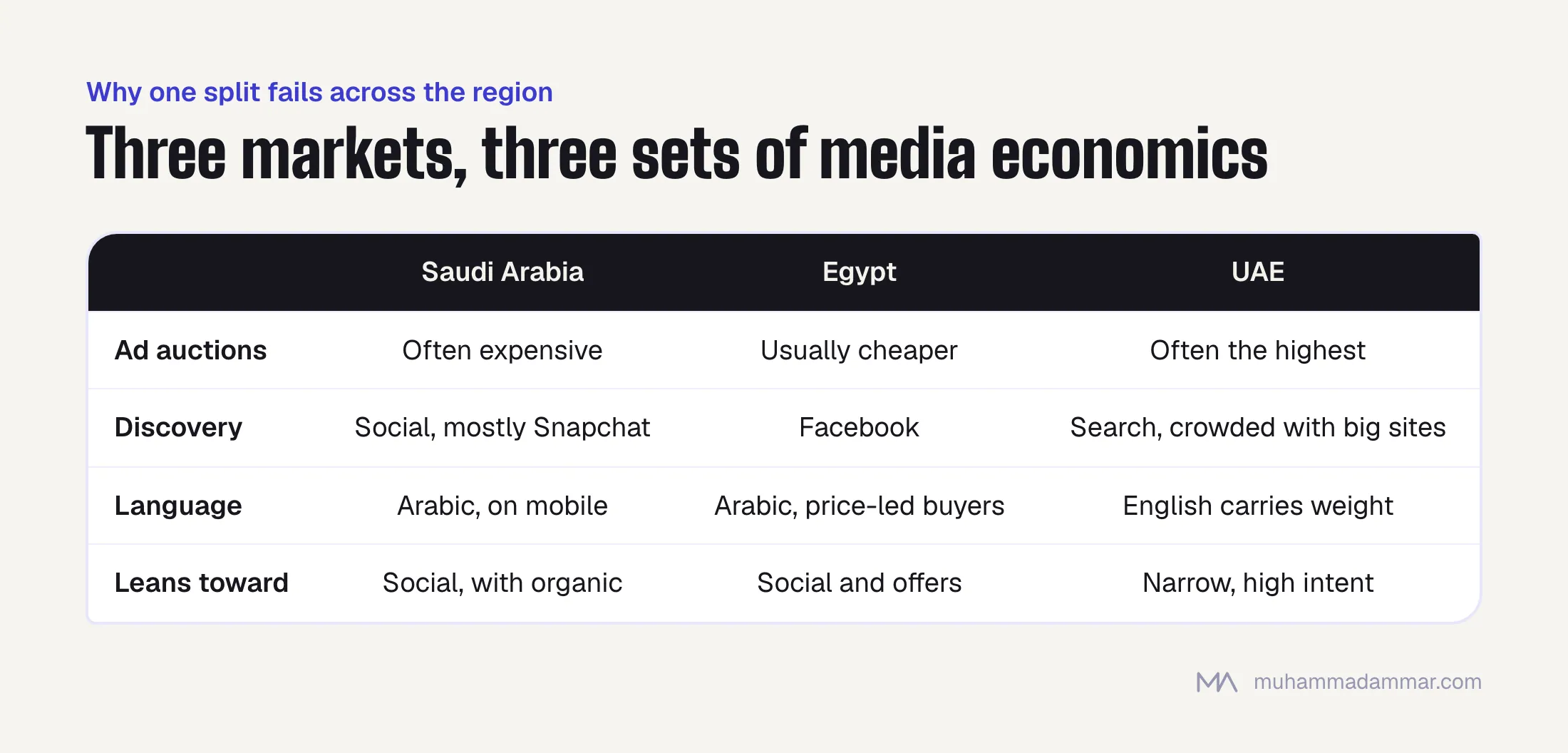
Saudi Arabia. Ad auctions are often expensive. Social platforms take a share of discovery that search would own elsewhere, and Snapchat in particular reaches enough people to change the maths, as I explain in Snapchat ads in Saudi Arabia. Demand is overwhelmingly Arabic and on mobile. The high cost of paid ads is itself the argument for building organic search alongside them.
Egypt. Winning customers through ads is usually cheaper than elsewhere in the region, which changes the calculation completely. When paid ads really are cheap, the case for organic has to rest on long-term growth and margin, not on the immediate cost of a customer. Facebook takes a share of discovery that search takes elsewhere, so a search-heavy split often underperforms. And buyers are price-sensitive, which shifts weight toward channels where you can lead with an offer.
The UAE. Auction prices are often among the highest in the region, and search results are crowded with well-funded aggregators. English carries far more commercial weight than in the other two. That pushes the mix toward narrower, high-intent targeting and away from broad reach, and it makes organic harder to win but more valuable when you do.
Narrower channels have their place too. For B2B in the Gulf, see the narrow case for X ads.
One practical rule: allocate per market, report per market, and resist the pull toward one regional number. A blended figure across three markets with different costs tells you nothing you can act on.
Adjusting for margin and sales cycle
Two adjustments to the starting shape.
Thin margin, short cycle: concentrate. One or two channels, run well, optimising for the cheapest qualified customer. Spreading a small budget across five platforms means none of them gets through its learning phase, and five underfed campaigns lose to two properly funded ones every time.
High margin, long cycle: diversify, and accept that some channels won’t show up cleanly in attribution. Spending on awareness in a long cycle looks wasteful in any last-click report, which is exactly why it gets cut, and why cutting it shows up as a problem two quarters later.
A third case is common here: seasonal and event-driven businesses. Ramadan, Eid, back-to-school and national days pack a big share of the year’s demand into short windows. The right split during a peak isn’t the right split in a normal month, and a fixed annual split wastes money in both.
How much belongs in organic
An awkward question for a consultant who sells SEO, so here’s the straight answer.
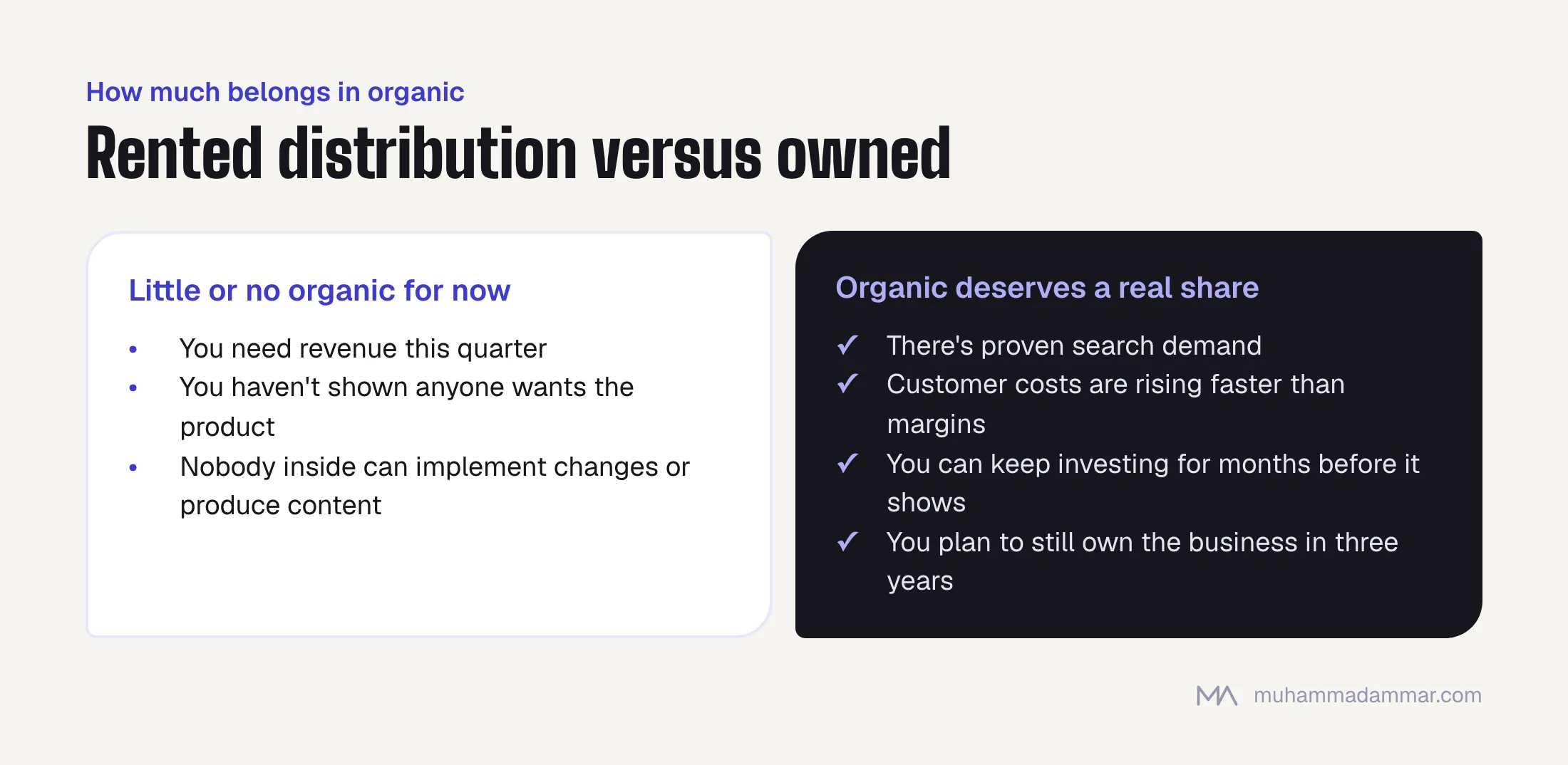
Organic deserves little or nothing when you need revenue this quarter, when you haven’t yet shown that anyone wants the product, or when nobody inside the business can implement changes or produce content. In those cases paid ads are the right answer, and an SEO retainer is a bad purchase.
Organic deserves a real share when there’s proven search demand, when your customer costs are rising faster than your margins, when you can keep investing through the four to nine months before it shows in your accounts, and when you plan to still own the business in three years.
The framing that works with finance teams: paid media is rented distribution and organic is owned. Rented is faster and controllable, and it stops the day you stop paying. Owned is slower, it builds on itself, and you can’t switch it on when you suddenly need it. Most businesses in this region rent too much, because renting is easier to justify quarter by quarter.
A practical test instead of a percentage: if your paid cost per customer has risen steadily for four quarters and your margins haven’t, that trend is the argument for organic, and it won’t reverse by itself.
Starting splits by type of business
These are starting points, not answers. Every one should move within a quarter once real data comes in.
| Type of business | Starting emphasis | Why |
|---|---|---|
| Local service with existing demand | Search and local, a little social | Collect the demand that exists; the map results do the rest |
| Saudi consumer e-commerce | Social-led, search in support | Discovery happens on social; search catches the comparison stage |
| Egyptian consumer e-commerce | Mostly social | Cheap reach, discovery on Facebook, price-driven buying |
| B2B with a long cycle | Search and content, narrow social | Low volume, high intent, long gap before the sale |
| New category with no demand yet | Social only, at first | Nothing to collect until people know about it |
| Highly competitive UAE sector | Narrow paid plus an organic build | Aggregators own the big terms; being specific is the opening |
Two rules apply to every row. Keep a deliberate test budget, a small fixed share for channels you’re not yet sure about, because a split with no room for experiments sets like concrete. And don’t start a channel you can’t fund past its learning phase. A starved test that fails tells you nothing about the channel.
Rebalancing on real signals
This is where most splits go wrong, because people rebalance from platform dashboards and every platform claims the same conversions.
Rebalance on blended cost per qualified lead from your CRM, not on each platform’s reported cost per lead. Add up the conversions on four dashboards and they routinely come to more than the CRM has. Every budget decision made from those numbers is based on a total that doesn’t exist. I explain why in why attribution breaks in the Gulf and Egypt.
Fix the tracking before the split. If many of your leads come through WhatsApp, every platform misses them, and the channel that brings them in looks weak. Moving money on that data takes it away from what’s working. See tracking WhatsApp leads.
Move slowly, one channel at a time. Big changes everywhere at once reset every learning phase and make the result impossible to read. Shift ten to twenty per cent, then wait for the algorithms to settle before you judge.
Watch brand searches as your awareness gauge. Searches for your brand name are an honest, delayed sign of whether awareness spending works. If you cut a channel and brand searches fall a month later, you know what it was doing.
Review quarterly, not weekly. Weekly rebalancing chases noise. The exception is seasonal peaks, which you plan in advance instead of reacting to.
Frequently asked
What percentage should go to each channel?
There’s no universal answer, and anyone who gives you one is selling a template. Start from the three inputs, use the table as a rough shape, and let blended cost per qualified lead move it from there.
How many channels should a small budget use?
One or two, properly funded. The most common small-budget mistake is spreading across four platforms so that none of them gets through its learning phase.
Should organic be a set percentage of the marketing budget?
It’s better to size it from the work needed and the time you can give it. A fixed percentage tends to produce underfunded SEO programmes that never reach the point of paying back.
Can I use one split across Egypt, Saudi Arabia and the UAE?
No. Different auction prices, different discovery channels, different language economics. One split for all three fits none of them.
How do I justify awareness spending to finance?
With brand search volume and blended cost per customer over several quarters, not platform-reported ROAS. And by agreeing in advance what evidence would justify cutting it, so the discussion happens on agreed criteria and not in the middle of a bad month.
Related: paid media and digital marketing consultant. If you want a second opinion on how your budget is split, message me.

SEO and digital marketing consultant since 2015, working with businesses in Egypt, Saudi Arabia and the UAE.
About the author and editorial standards