On this page
Most media plans I review for Saudi accounts put Google first, then Meta, then TikTok, and then Snapchat if there’s anything left. That order comes from markets where Snapchat is a niche platform for teenagers.
Saudi Arabia isn’t one of those markets. Snapchat reaches a very large share of people here, the age range is much wider than the Western stereotype, and people use it for everyday communication, not as an occasional toy. Planning it as an afterthought means copying a template from somewhere else. Reach figures change, so check the current numbers for your own targeting in Snapchat’s audience tools before you plan.
Why the reach here changes the audience
The point isn’t just that reach is high. It’s what high reach does to who you’re talking to.
Where a platform reaches a small slice of the population, that slice picks itself: early adopters, one age group, one subculture. Where it reaches most of a generation and a good part of the one above it, the audience is close to the whole population. The platform stops being a stand-in for “young” and becomes a general reach channel.
That has three consequences, and they’re the whole argument:
- Categories that seem wrong for Snapchat often aren’t. Home services, cars, healthcare, financial products and education work here in a way they wouldn’t in a market with a narrower user base.
- You can’t judge the audience from how the platform works elsewhere. Check the reach estimate for your actual targeting instead of assuming.
- Frequency builds faster than you’d expect. With that much reach in one country, a modest budget can show ads to the same people again and again, and creative fatigue comes sooner than Western benchmarks suggest.
Who you reach, and who you don’t
Being honest about the limits is what makes the rest believable.
You do reach: a broad Saudi consumer audience across a wide age range, including people you wouldn’t find on Snapchat in other markets; a mobile-first audience in a mobile-first country; and people in a personal setting, since the app is mainly for talking to friends and family, not a broadcast feed.
You don’t reach: B2B decision-makers in a work mindset. They’re on the app, but not to evaluate enterprise software. Nor do you reach audiences outside the Gulf as efficiently, which matters if your campaign covers several markets.
The B2B point needs care. A high-value B2B service whose buyer behaves like a consumer, such as a clinic owner, restaurant operator or small shop owner, is reachable here. An enterprise purchasing cycle isn’t. The question is whether the buyer is one person making a personal decision or a committee following a process.
Creative: why reused TikTok videos underperform
The most common shortcut is running the same vertical video on TikTok and Snapchat. Both are 9:16 and both play with sound, so it looks like a free win. It usually isn’t, and the reason is context, not format.
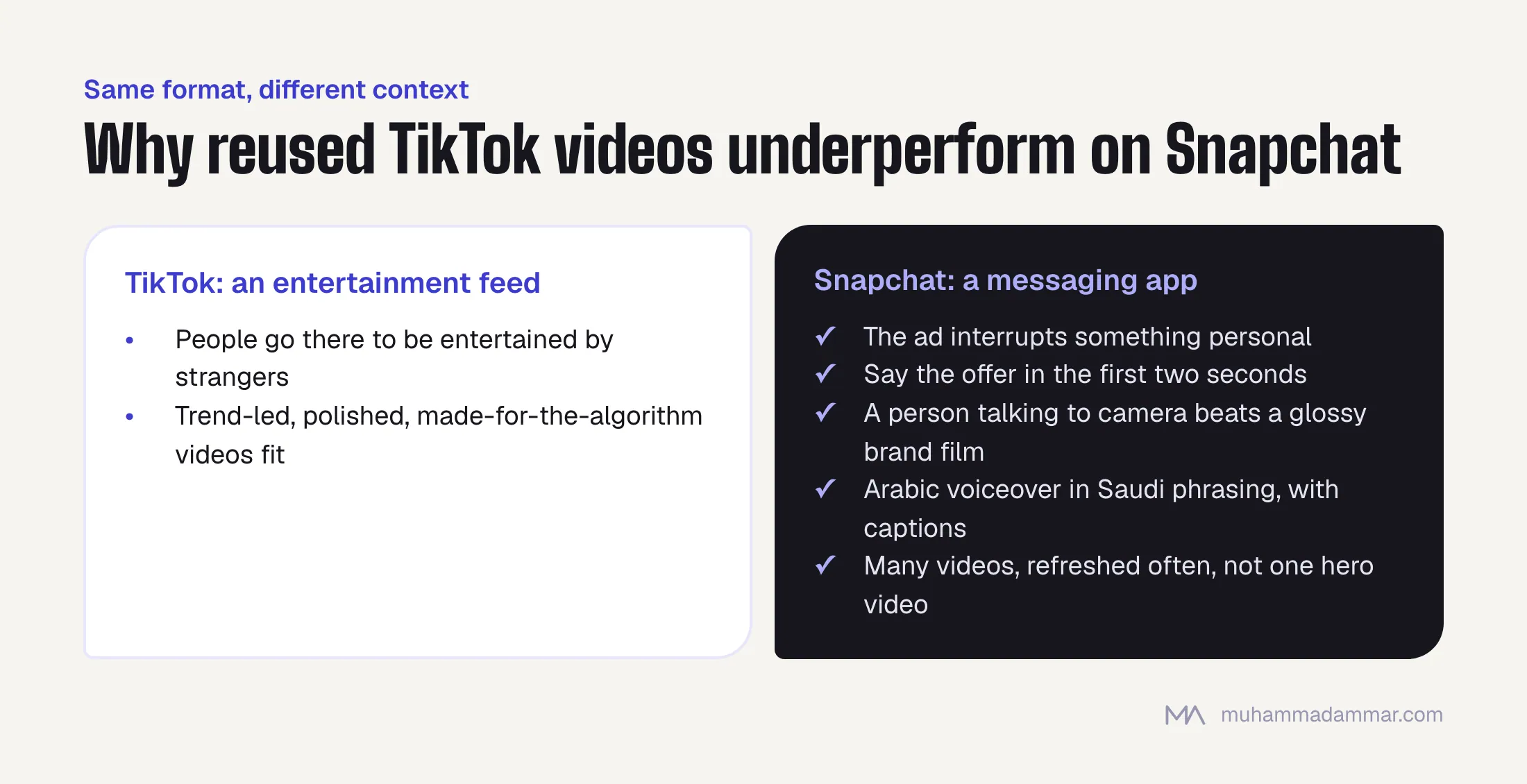
TikTok is an entertainment feed. People go there to be entertained by strangers, so trend-led, polished, made-for-the-algorithm videos fit. Snapchat is mainly a messaging app. People go there to talk to people they know, and the ad interrupts something personal.
What follows:
- Direct beats clever. Say what the offer is in the first two seconds. People decide to skip faster here than almost anywhere.
- Personal beats polished. A person talking to the camera beats a glossy brand film more reliably here than on other platforms. It’s one of the few channels where a smaller production budget can actually help.
- Plan for sound on, but work with sound off. Most people watch with sound, and you still need captions.
- Arabic voiceover with Saudi phrasing. Gulf viewers notice non-Saudi Arabic straight away, and for a single-market campaign it’s worth getting right. I explain why in Arabic ad copy.
- Refresh creative more often than you planned. High reach and high frequency mean fatigue comes early. Budget for many videos, not one hero video.
Snapchat’s own formats, like AR lenses and filters, can set you apart here, and they cost real money to produce. They’re worth it for brand campaigns with the budget to do them well, and a distraction for a lead-generation account that hasn’t got its tracking working yet.
Measurement: pixel, Conversions API and the WhatsApp gap
Snapchat accounts in this region are more often badly measured than badly targeted, and the fix is the same as on every other platform.
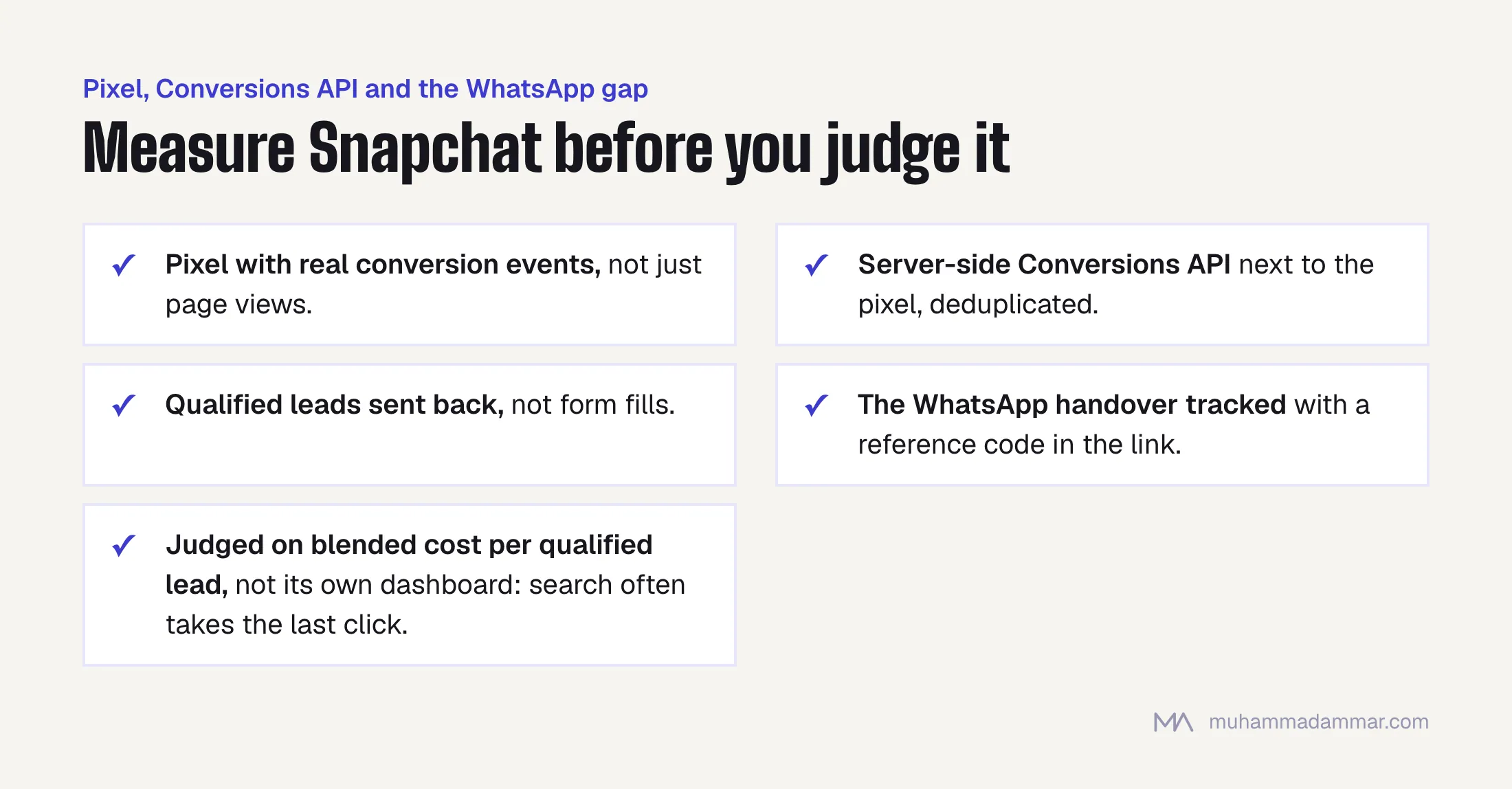
- Install the pixel properly and fire real conversion events, not just page views. The platform optimises for whatever you give it, and a page view isn’t a lead.
- Add the server-side Conversions API next to the pixel, with deduplication. Browser-only data gets weaker over time, and on a platform already fighting for credit you can’t afford weak data.
- Send back qualified leads, not form fills. It’s the most powerful change in the account, for the same reason as everywhere else.
- Track the WhatsApp handover. If your Snapchat traffic lands on a page whose main button is WhatsApp, the platform can’t see the conversation unless you add a reference code to the link and send the result back. The method is in tracking WhatsApp leads.
- Expect attribution to undercount it. Snapchat often creates the first interest, and then search gets the last-click credit. Judge it by the blended cost per qualified lead across the whole account, not by its own dashboard.
That last point is why Snapchat gets cut from media plans. It isn’t underperforming, it’s under-credited, and the two look identical in a last-click report.
When it beats Meta, and when it doesn’t
Snapchat tends to win on cost per thousand impressions for broad Saudi consumer reach, in categories aimed at younger people or families, when the creative edge is authenticity rather than polish, and when Meta’s auction has got expensive because everyone in your category bids there.
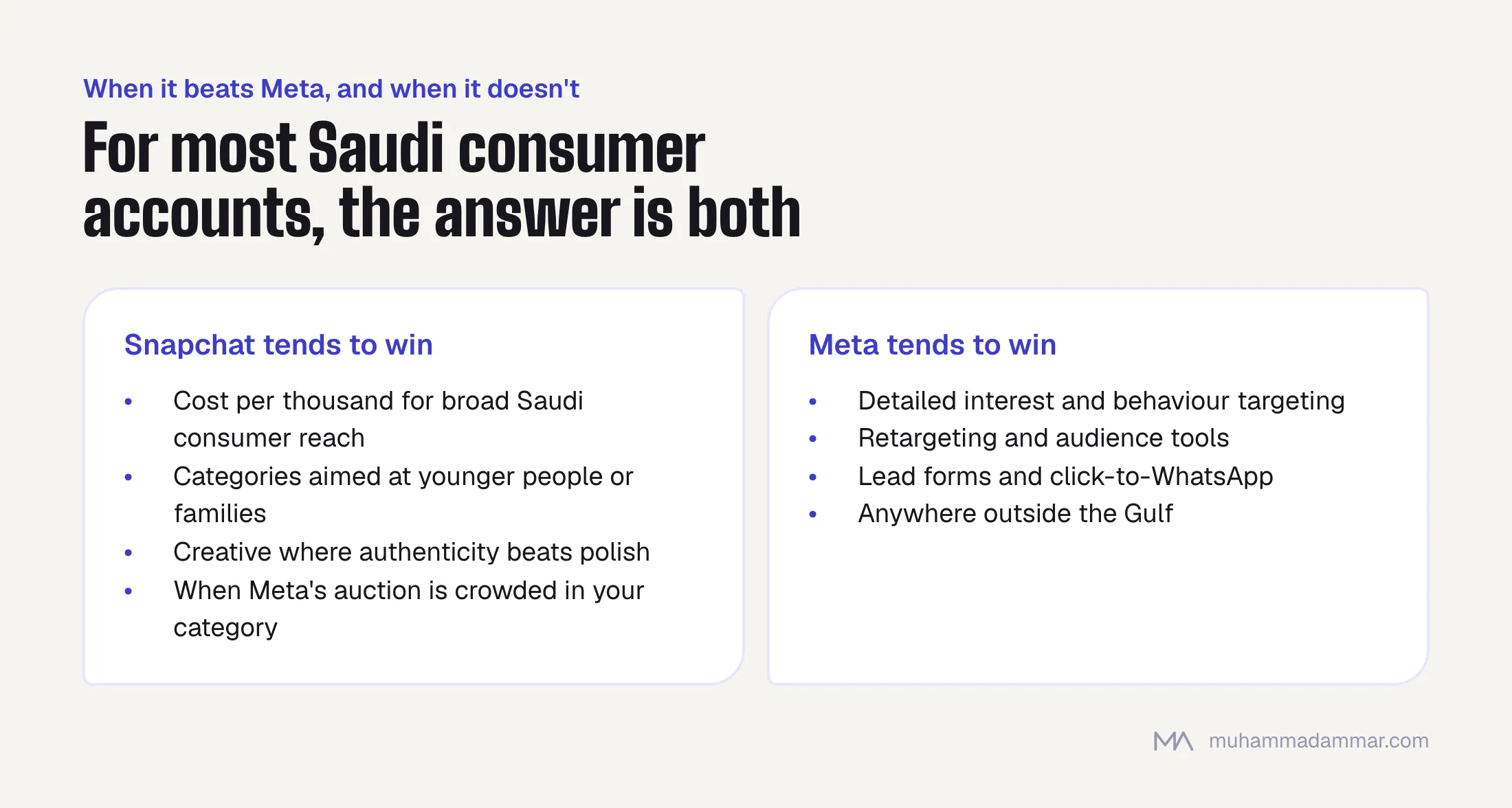
Meta tends to win on detailed interest and behaviour targeting, retargeting and audience tools, lead forms and the click-to-WhatsApp integration, and anywhere outside the Gulf, where Snapchat’s reach advantage disappears.
For most Saudi consumer accounts the answer is both, with Snapchat taking a bigger share than the imported template suggests, and with the split decided by blended cost per qualified lead, not by each platform’s own reports. How to set that split on purpose is in deciding the budget split before you optimise the channels.
Frequently asked
Is Snapchat only for teenagers in Saudi Arabia?
No, and that assumption costs advertisers the most. Reach is broad enough that the audience covers a wide age range. Check the reach estimate for your own targeting instead of bringing in an assumption from another market.
Can I reuse my TikTok videos?
As a starting point, not as a strategy. The format carries over, the context doesn’t. Test reused videos against something made for Snapchat before you decide Snapchat doesn’t work. What TikTok itself needs is in TikTok creative for Gulf audiences.
Does Snapchat work for lead generation?
Yes, with tracking in place. Without the Conversions API and a qualified-lead signal it will look expensive, because you’ll be counting its cheapest interactions and giving its best results to other channels.
How much budget does a fair test need?
Enough to get through the learning phase on a real conversion and to run at least three creative versions for a few weeks. Less than that and you’re measuring noise. A starved test that fails proves nothing.
Does this apply to the UAE and Egypt?
Less so. The Saudi case rests on unusually high reach. In other markets in the region Snapchat is a reasonable channel among several, not one that’s being overlooked. Check the reach estimate for each market before assuming the Saudi argument applies.
Related: Snapchat ads, paid media and SEO consultant in Saudi Arabia. If Snapchat is missing from your Saudi plan, let’s talk about it.

SEO and digital marketing consultant since 2015, working with businesses in Egypt, Saudi Arabia and the UAE.
About the author and editorial standards