On this page
Ad platforms support Arabic, just not well. Character counters treat a script that says more per character as if it were English, previews show right-to-left text differently from the live ad, and automation that works fine in English produces broken Arabic grammar.
None of it is fatal. All of it is worth knowing before you write the ad.
Arabic says more per character, so use the room
Arabic packs more meaning into fewer characters than English: short words, vowels left out, and prepositions and articles attached straight to the word instead of spaced out.
Ad platforms count characters, not meaning, so an Arabic headline in a 30-character field can say noticeably more than an English one in the same space. Most advertisers don’t use that room. They translate the English headline, land well under the limit and leave the extra space empty.
Write the Arabic ad from scratch and fill the field. A headline with the product, a qualifier and the offer beats a translated headline with the product alone.
Two things to balance against that. Arabic script looks denser, so a headline within the character limit can still look crowded on a small screen. Check it on a phone, not in the editor. And the same field might contain a Latin brand name that uses characters at English density, so the real space varies from ad to ad.
Where right-to-left display breaks
The recurring problem is mixed-direction text: Arabic with a Latin brand name, a model number, a price or a percentage in it. The browser’s direction rules decide where each part goes, and punctuation at the boundary often lands at the wrong end of the line.
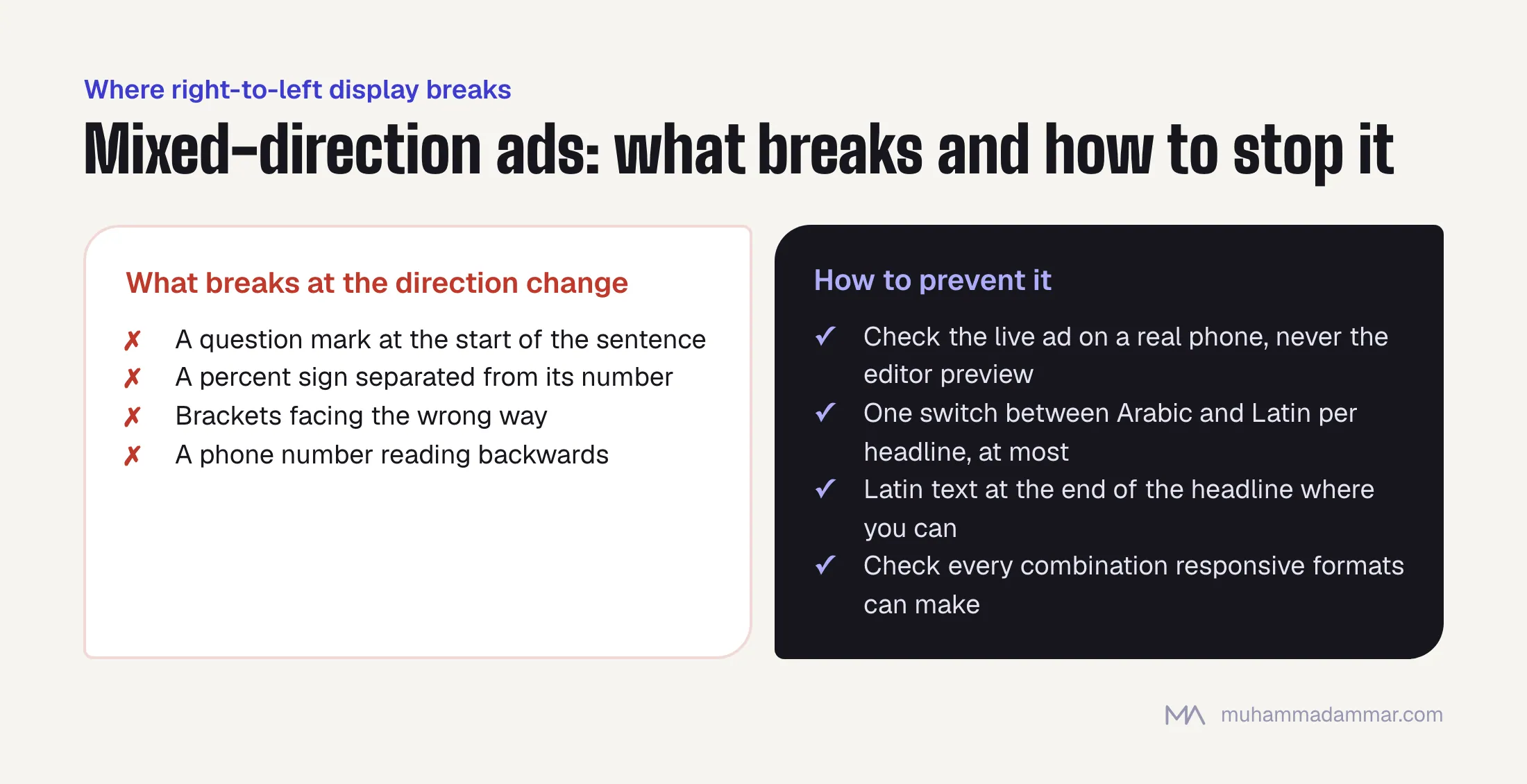
In practice that means a question mark at the start of the sentence, a percent sign separated from its number, brackets facing the wrong way, or a phone number reading backwards.
- Never trust the editor preview. The platform’s preview isn’t where your ad actually runs. Publish it, then look at the live ad on a real phone.
- Switch direction as little as possible. Every switch between Arabic and Latin text in one headline is a place it can break. One switch is usually fine. Three in a 30-character headline is asking for trouble.
- Put Latin text at the end where you can. A headline that ends with the brand name breaks less often than one with the name in the middle.
- Check every combination. With responsive formats the platform mixes headlines and descriptions, so the combination that breaks is often one nobody previewed.
Test display paths, extensions and business names separately too. These fields sometimes handle non-Latin characters differently from headlines, and the behaviour changes over time. Check in your own account instead of assuming.
Numbers, currency and phone formats
Small choices that look trivial and change how professional the ad looks.
Numerals. Both Western and Arabic-Indic digits are used, and Arabic-Indic is more common in the Gulf. Western digits display more predictably across platforms and devices and avoid the problems above. My default is Western digits in ads, matched to the landing page. A mismatch between the two is what jars, more than the choice itself.
Currency. Use the local format, and keep it the same in the ad, the extensions and the landing page. A price written one way in the ad and another way on the page looks like a different offer.
Phone numbers. Always left to right, and test them in the live ad. A reversed phone number is the most damaging display failure there is, because it fails silently: the ad looks fine to anyone who doesn’t try to call.
Percentages and discounts. Check how they look live. The percent sign is one of the characters most likely to come loose from its number at a direction change.
Standard Arabic or dialect in ads
Long articles should be in clear, current standard Arabic. Ads are different: thirty characters leave no room to set a tone, and the copy has one job, which is to sound written for the person reading it.
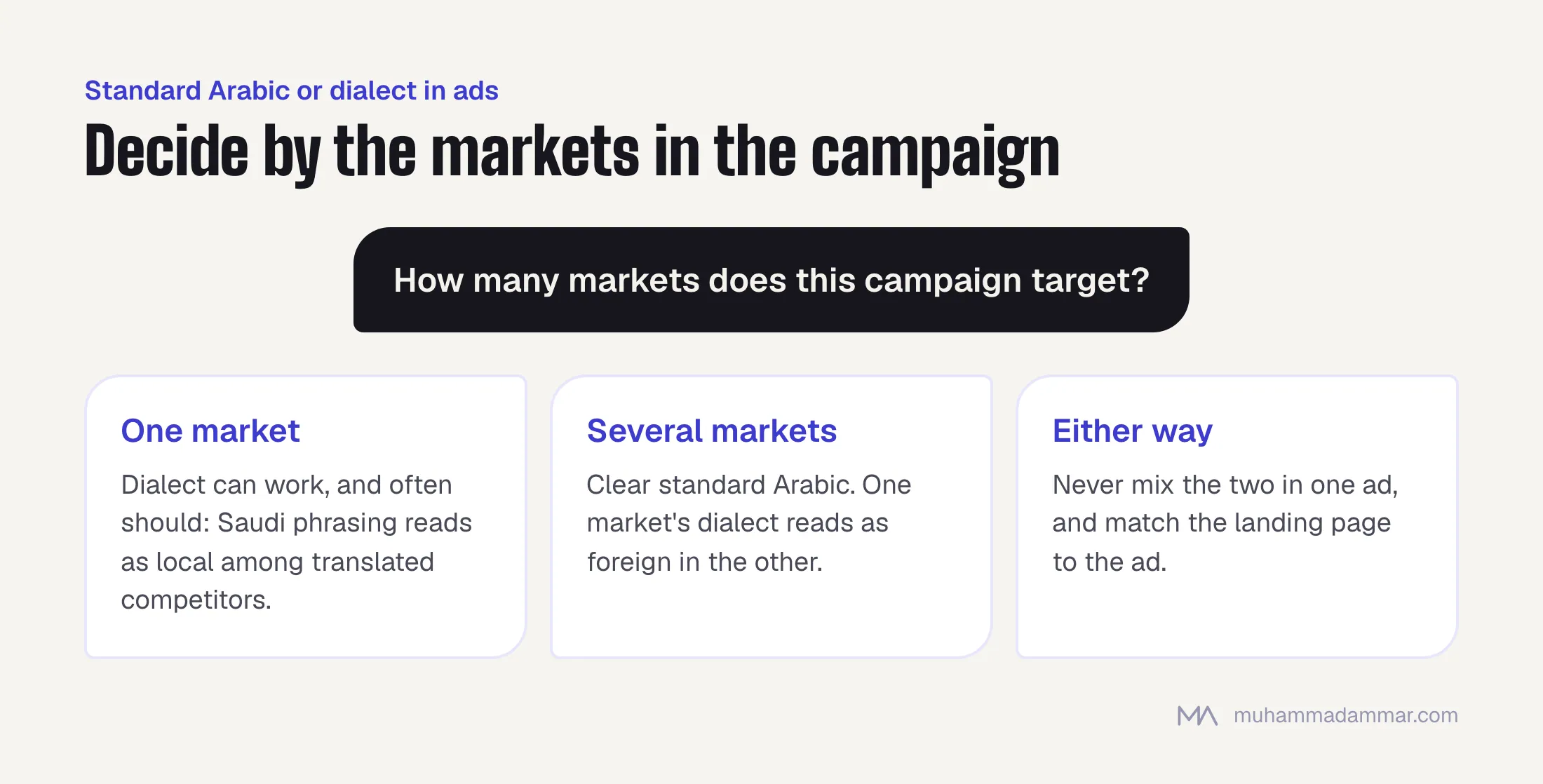
How I approach it:
- Single-market campaigns can use dialect, and often should. A Saudi-only campaign in Saudi phrasing reads as local on a results page full of translated competitors, and that contrast sets you apart.
- Campaigns across several markets stay in clear standard Arabic. One market’s dialect reads as foreign in the other, and the negative reaction there is stronger than the positive one at home.
- Never mix the two in one ad. A formal headline with a casual call to action reads as if two different people wrote it.
- The landing page must match. A dialect ad that leads to a formal page is a jarring switch at the exact moment the visitor decides whether to trust you. That page needs building properly. See Arabic landing pages that convert.
Split your campaigns by market before you make this decision, because you can’t write market-specific copy in a campaign aimed at three countries. The account structure is covered in Google Ads in Saudi Arabia.
Writing the call to action
Arabic commands are short and direct, which suits ads well. Four things to get right.
Use a command, not a noun. A direct instruction works better than a noun phrase. It’s the most common weakness in translated Arabic ads, because English calls to action are often noun phrases and the translation keeps that structure.
Match the call to action to where the click goes. If it opens WhatsApp, say so. “Message us on WhatsApp” sets the right expectation, and in this region it often beats a generic call to action because people prefer that channel.
Mind the gender. Arabic commands are gendered. For a mixed audience the masculine form is the accepted convention. For a category with a mostly female audience, matching the audience feels noticeably warmer. Test it instead of assuming.
Specific beats urgent. “Get the price in a minute” tends to beat “Hurry, limited offer” in this market, especially in B2B and considered purchases, where fake urgency looks cheap.
Dynamic insertion and Arabic grammar
If you read only one section, read this one. It’s the one that produces publicly embarrassing ads.
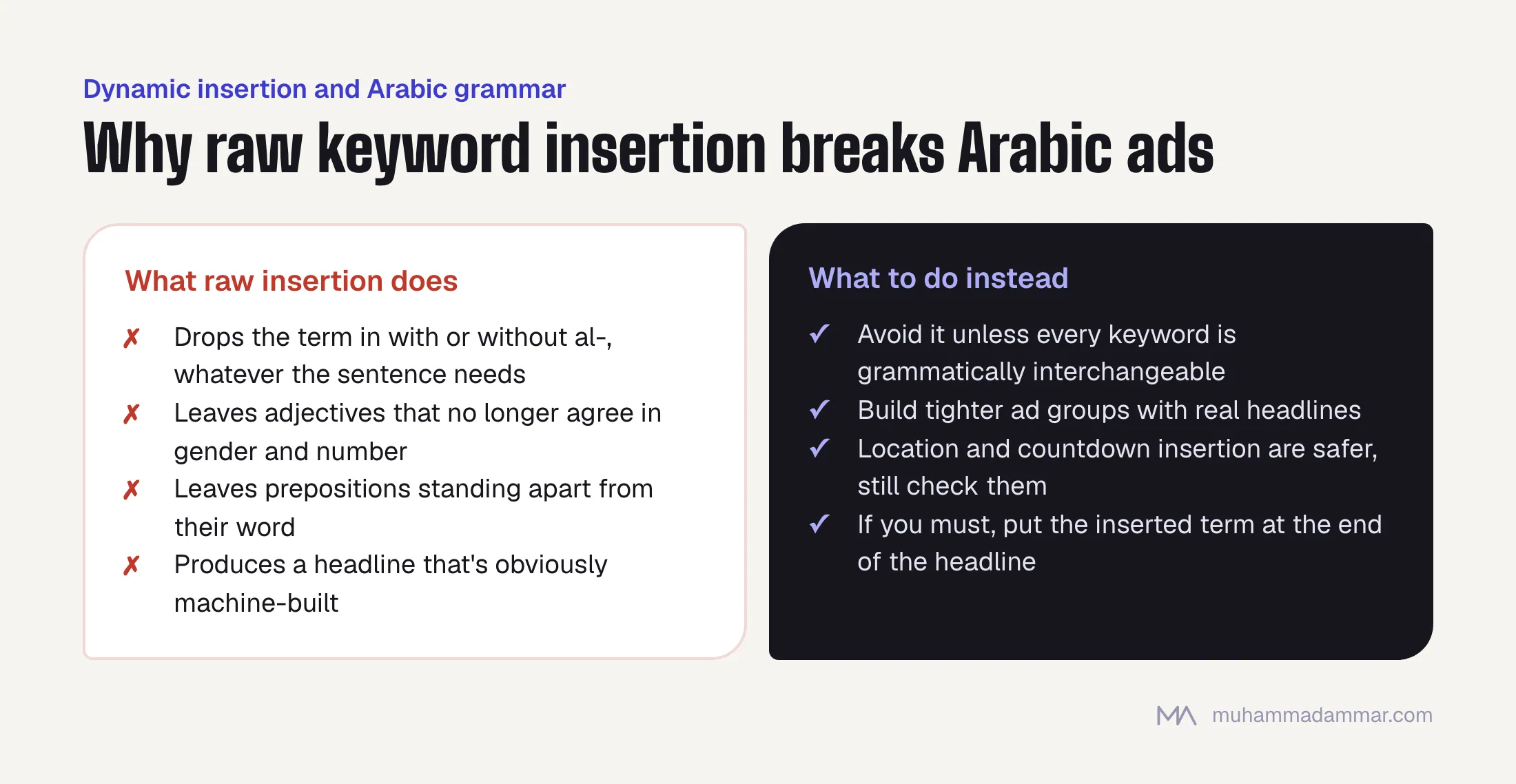
Dynamic keyword insertion drops the matched search term into your headline as raw text. In English that mostly works, because English nouns barely change form and the sentence survives.
Arabic words change form a lot, and raw insertion ignores all of it. The inserted term arrives with or without the article al- whatever the sentence needs. Adjectives stop agreeing, because the template was written for one gender and number. Prepositions that should attach to the next word stand apart. The result is a headline that’s obviously machine-built, in a market where that looks cheap.
What to do instead:
- Avoid keyword insertion in Arabic unless every keyword in the ad group is grammatically interchangeable, which is rare and defeats most of the reason to use it.
- Build tighter ad groups with real headlines. More work, better ads, and the difference shows on the results page.
- Location and countdown insertion are safer, because place names and numbers are less tangled up in grammar. Still check how they look.
- If you must use insertion, build the template around it. Put the inserted term at the end of the headline, where nothing after it has to agree with it.
The same goes for automatically generated assets. Have someone who’d notice review every one in Arabic before it runs.
Frequently asked
Should I translate my English ads or write new ones?
Write new ones. Translation keeps the English sentence structure and wastes the extra room, and translated calls to action are always the weakest part of translated ads.
Do Arabic ads get better click-through rates?
For an Arabic search, an Arabic ad almost always beats an English one. For an English search in a Gulf market, test it, because many people there are comfortable in both languages.
Which numerals should I use?
Western digits by default, because they display reliably, matched to your landing page. The inconsistency between ad and page costs you more than the choice.
Can I run one ad set across Egypt and Saudi Arabia?
You can, and the copy will be generic enough to underperform in both. Separate campaigns let you write for each market and control the budget per market, which is worth more than the extra management time.
How do I test Arabic ad copy properly?
One change at a time, over a long enough period to cover weekly ups and downs, and never with Ramadan on only one side of the comparison. Test the tone first, standard Arabic against dialect, because it’s the biggest single lever and the one nobody tests.
Related: Google Ads, Meta ads and CRO and landing pages. If you want your Arabic ads reviewed, send them over.

SEO and digital marketing consultant since 2015, working with businesses in Egypt, Saudi Arabia and the UAE.
About the author and editorial standards