On this page
Performance Max frustrates lead-generation advertisers because it takes away the controls they’re used to, like keywords, placements and per-channel bids, and replaces them with a box. The usual conclusion is that you have no control. That’s wrong. You have fewer levers, and the ones left are more powerful than the ones you lost, because they work on what the system optimises for, not where it looks.
What PMax decides, and what you still decide
| Google decides | You decide |
|---|---|
| Which channel each impression runs on | What counts as a conversion, and what it’s worth |
| Who sees the ad | Which audiences to suggest and which to exclude |
| Which combination of creative to show | Every asset it has to combine |
| The bid in each auction | Target CPA or ROAS, and the budget |
| Which searches to match on Search | Including or excluding your brand, and negative keywords at account level |
Look at the right-hand column again. Everything there comes before the left-hand column. You’re not steering the car, you’re choosing the destination, and for a machine-learning system that’s the more important job.
The quality of your conversion signal is everything
PMax gets you more of whatever you tell it is a conversion. If your conversion is “form submitted”, it finds the people most likely to submit forms, and in lead generation those aren’t the same people as your customers.
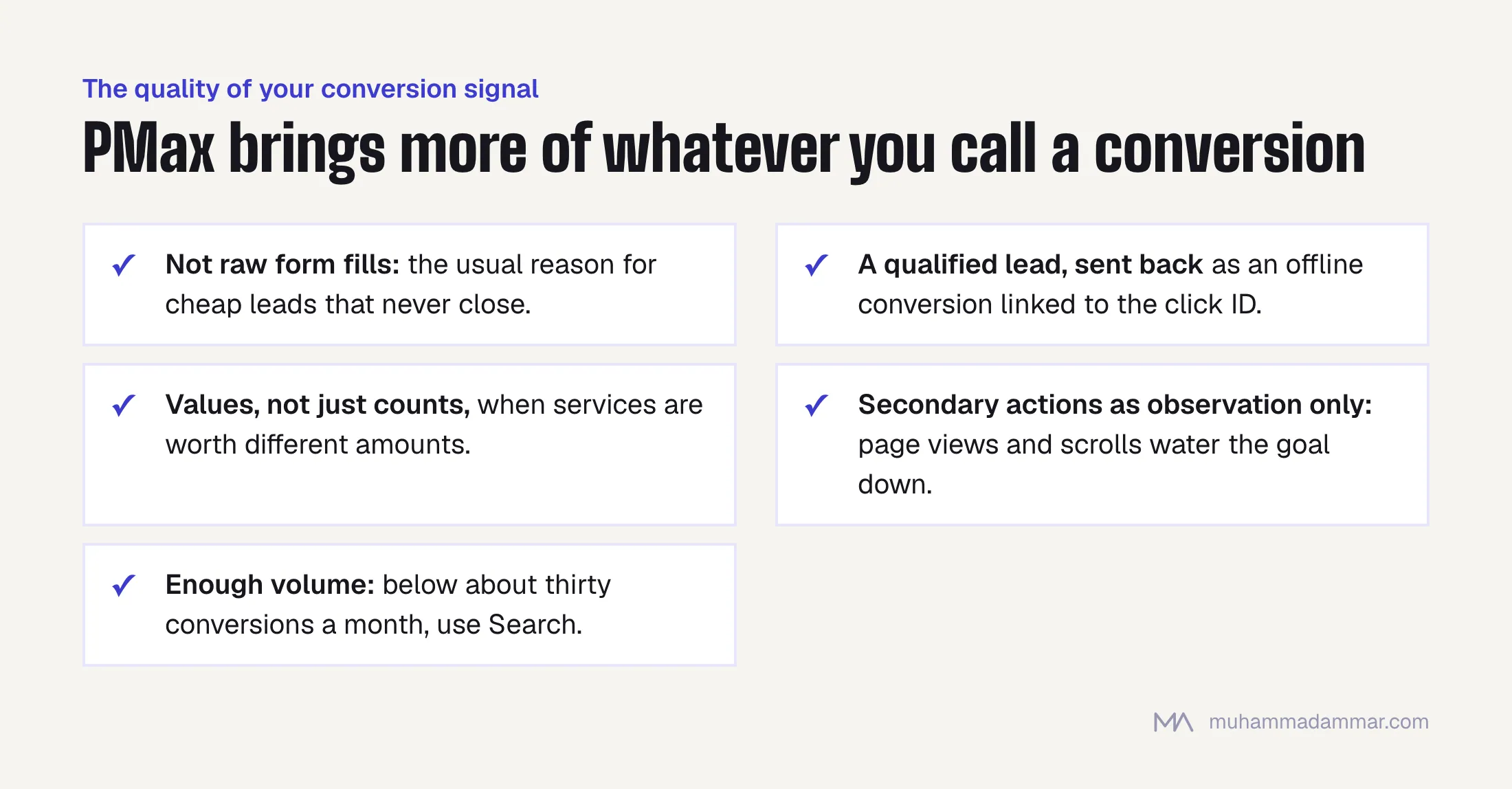
- Don’t optimise on raw form fills. It’s the most common reason a PMax campaign “brings cheap leads that never close”.
- Define a qualified lead and send that back. Whatever your sales team calls a real lead, such as answered the phone, met the budget or booked a meeting, import it as an offline conversion linked to the click ID.
- Use values, not just counts. If a lead for one service is worth five times another, say so. The system will shift toward the valuable one without you touching anything else.
- Take secondary conversions out of the goal. Page views, scroll depth and “visited the contact page” belong as observation-only actions, not targets. Every weak signal you add waters down the strong one.
- Give it enough volume. Below roughly thirty conversions a month the system has too little to learn from, and you’d do better with standard Search.
Audience signals, exclusions and brand searches
Audience signals are suggestions, not targeting. The system uses them as a starting point and then expands beyond them. A good signal speeds up learning, but it won’t contain the campaign.
- Build signals from your own data first: customer lists, past converters, high-value segments. Your own data consistently beats interest-based signals.
- Exclude existing customers if the campaign’s job is winning new ones. Otherwise you pay to win back people who already bought, and the reported results look excellent.
- Decide what to do about brand searches. Left alone, PMax takes your brand searches and reports them as cheap conversions, which makes the campaign look much better than it is. Either exclude brand terms at account level or accept that your reported CPA is flattered, but decide; don’t drift.
- Exclude irrelevant placements and content categories where the platform lets you, especially if brand safety matters to the client.
- Use account-level negatives for obvious waste: job seekers, people looking for free options, competitor names and, in this region, terms that show someone researching a do-it-yourself solution instead of hiring.
Asset groups for a business with several services
The usual instinct is one asset group per service. Often that’s wrong, because it spreads thin conversion data across several groups and none of them learns.
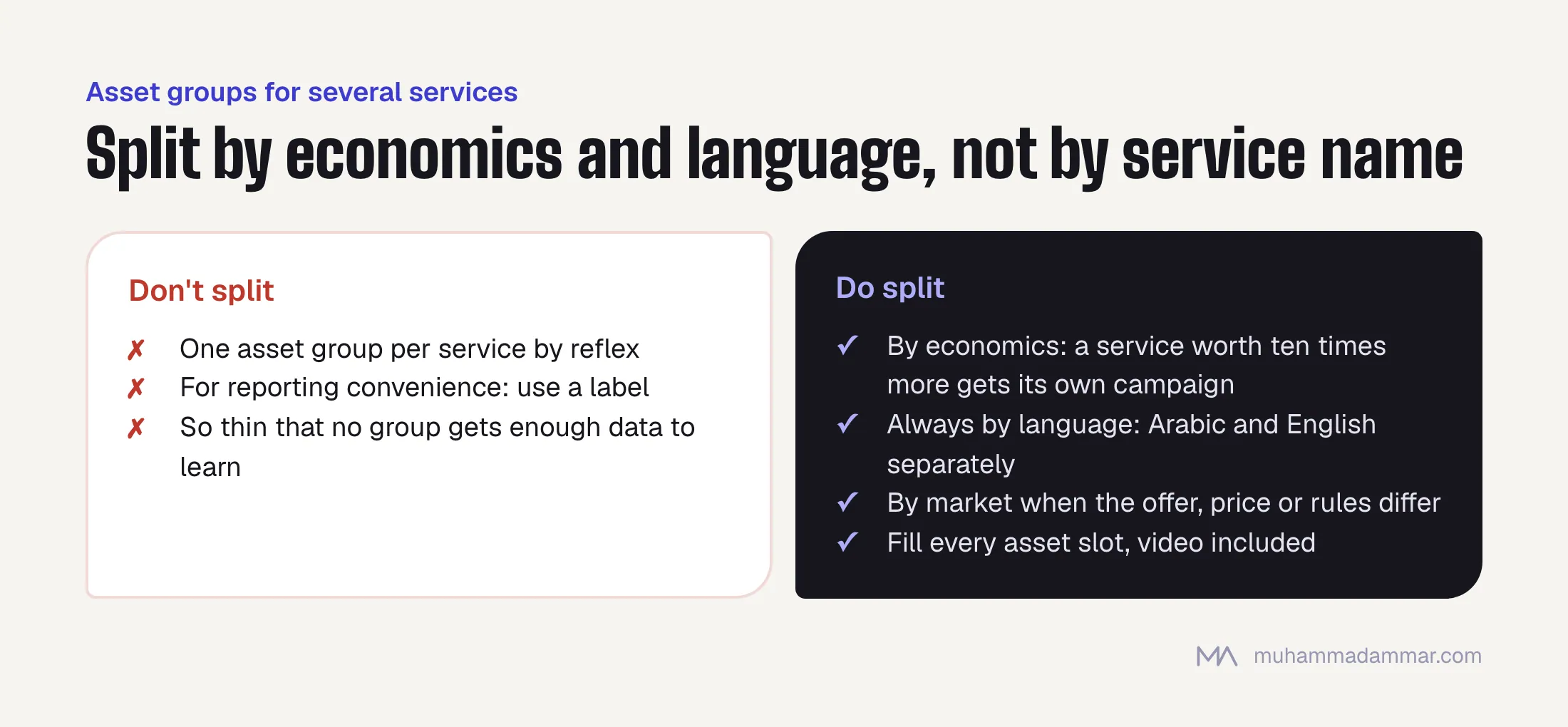
- Split by economics, not service name. Services with similar lead value and buying cycle belong together. A service worth ten times more deserves its own campaign with its own target.
- Always split by language. Arabic and English asset groups need separate headlines, landing pages and performance figures. Mixing them gives you averages you can’t act on.
- Split by market when the offer differs: different prices, rules or lead handling.
- Don’t split for reporting convenience. If the only reason for a second asset group is that someone wants another row in a spreadsheet, use a label.
Inside each group, fill every asset slot. The system can only combine what you give it, and an incomplete asset group competes with half its ammunition. That includes video: if you don’t supply one, Google may generate one automatically, and it will be worse than anything you’d approve. For Arabic assets, character limits behave differently from English, as I explain in Arabic ad copy.
Sending lead quality back so it optimises for revenue
This is what separates a PMax campaign that works from one that quietly wastes money, and it’s a process problem before it’s a technical one.
- Capture the click ID with the lead and store it in your CRM. If it isn’t stored when the lead comes in, nothing after it is possible.
- Have sales record each lead’s outcome (qualified, meeting held, closed, value) as part of their normal work, not as a favour to marketing.
- Upload those outcomes as offline conversions on a schedule, at least weekly.
- Set the optimisation goal to the qualified stage, and keep raw submissions as observation only.
- Give it four to six weeks after the switch before you judge. The system has to relearn, and results often dip first.
For businesses whose leads come through WhatsApp instead of a form, the same loop works. The reference-code method in tracking WhatsApp leads is what carries the click ID into a conversation.
When to run Search instead
PMax isn’t always the right campaign type, and using it by default is how budgets get quietly wasted.
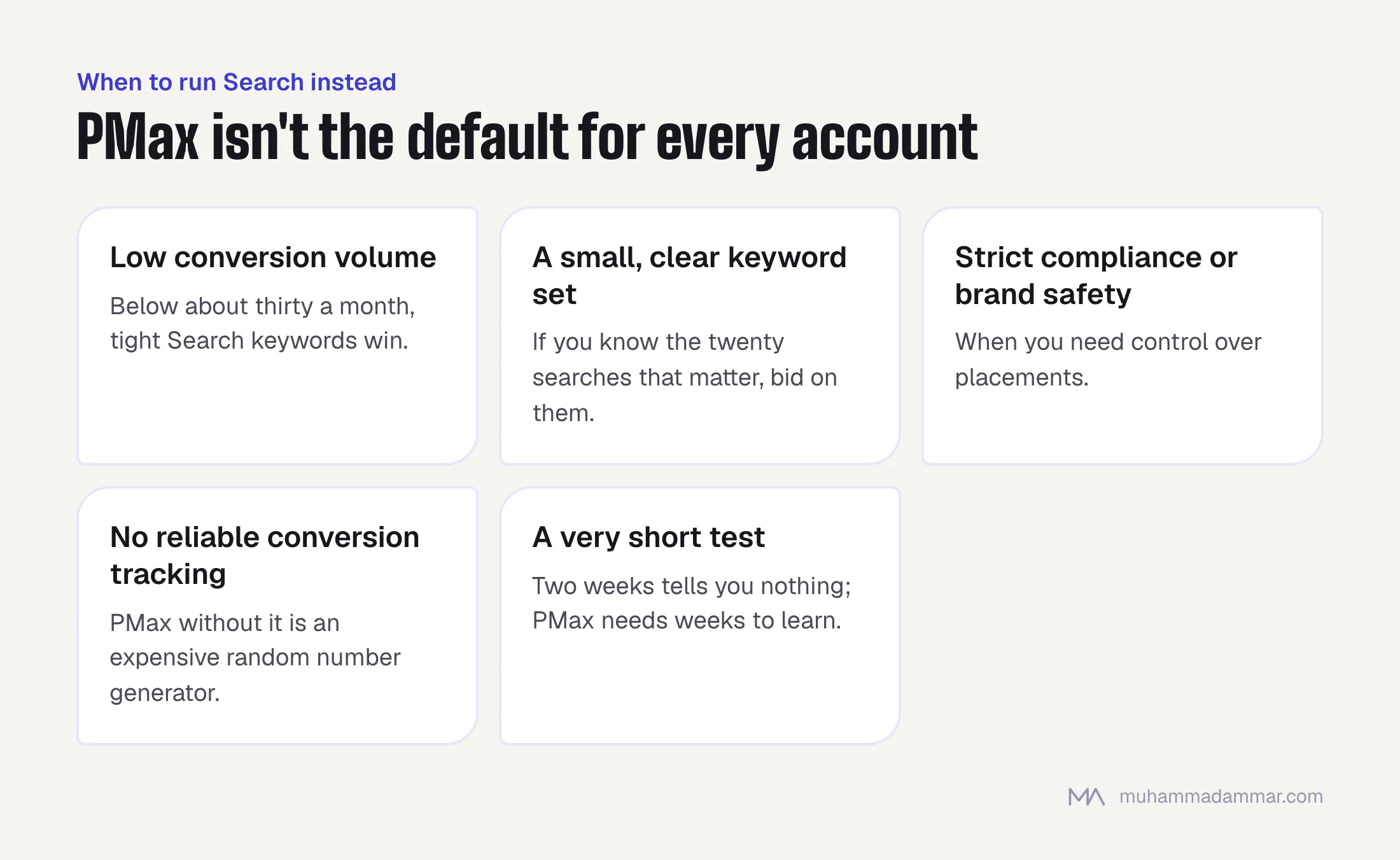
- Low conversion volume. Below about thirty a month, Search with tight keywords gives you more control and better results.
- A small, clear set of keywords. If you know exactly which twenty searches matter, bidding on them directly beats letting a system find them.
- Strict compliance or brand-safety rules that need control over placements.
- No conversion tracking worth the name. PMax without reliable conversion data is an expensive random number generator. Fix tracking first.
- A very short test. PMax needs weeks to learn. A two-week trial will tell you nothing useful.
Running both is usually right: Search for the searches you know, PMax to find more, with your brand handled in exactly one of them so the reports stay honest. Campaign work is Google Ads, and the measurement behind it is analytics and tracking.
Frequently asked
Can I see which channel my conversions came from?
Partly, through asset group and placement reports, and never in the detail you want. Judge the campaign on total qualified leads and their cost instead of trying to rebuild the channel split.
Does PMax take traffic from my Search campaigns?
It can, especially on brand searches. Search usually wins on exact matches, but the safest approach is to decide clearly which campaign owns brand and exclude it from the other.
How long before it settles?
Expect two to four weeks of learning, and don’t make changes during it. Editing assets or targets mid-learning restarts the process.
Should I use automatically created assets?
Turn them off wherever exact wording matters, and in Arabic exact wording always matters, because generated Arabic is often stiff or subtly wrong.
What budget does it need?
Enough for thirty or more conversions a month at your current cost per lead. Work back from that, not from a round number.
Getting cheap leads from PMax that never close? That’s a signal problem, and it can be fixed. Message me.

SEO and digital marketing consultant since 2015, working with businesses in Egypt, Saudi Arabia and the UAE.
About the author and editorial standards