On this page
TikTok is the platform where a beautifully produced brand film loses to a phone video shot in someone’s car. That’s not a matter of taste. The feed serves whatever holds attention, and polished corporate creative says “advert” within the first half-second, which is exactly when people decide to scroll.
For Gulf advertisers this hurts more than elsewhere, because the usual shortcut, taking the English video and adding Arabic subtitles, produces exactly what the feed punishes.
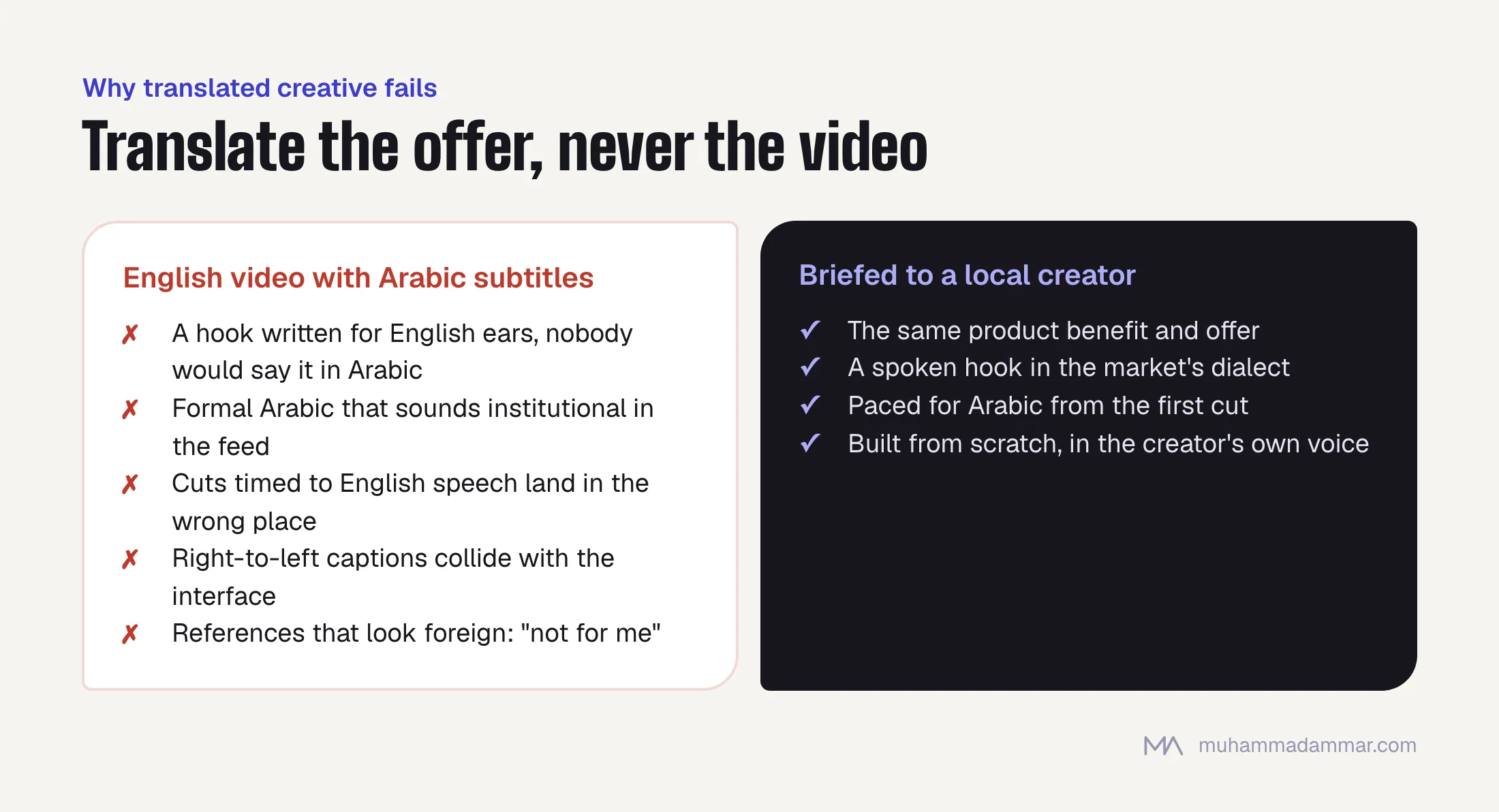
Why translated creative fails here
- The hook is spoken, not written. Subtitling a video whose first line was written for English ears gives you an Arabic sentence nobody would say out loud. Viewers hear something that sounds dubbed and leave.
- Dialect builds trust. An ad in formal Arabic, in a feed full of Gulf dialect, sounds institutional. Formal Arabic has its place, and for a bank or a government service it signals seriousness, but in the feed it usually signals distance.
- The pace is different. Saying the same idea in Arabic takes a different number of seconds than the English original, so cuts timed to English speech land in the wrong place.
- On-screen text breaks. Right-to-left captions collide with interface elements placed for left-to-right layouts, and automatic Arabic captions often show disconnected letters.
- References don’t travel. A visual joke, setting or social situation that’s instantly clear in one market looks foreign in another, and on TikTok “foreign” means “not for me”.
The practical rule: translate the offer, never the video. Brief the same product benefit to a local creator and let them build the video from scratch in their own voice.
Finding creators, and Spark Ads in the Gulf
Running a creator’s own post as an ad, with its existing engagement and their name on it, consistently beats creative from the brand’s account, because it arrives as content, not as an advert.
- Favour mid-sized creators. Fifty thousand engaged followers in your actual market beat a million scattered across the Arab world. Check where the audience is, not just how big it is.
- Check that the dialect matches. A creator with a strong Egyptian dialect is great for an Egyptian campaign and wrong for a Saudi one, and the other way round. Audiences notice straight away.
- Brief the result, not the script. Give them the benefit, the offer, the one thing that must be said and any compliance limits, then step back. Creator content scripted by the brand is the worst of both worlds.
- Agree usage rights at the start, including permission to run their post as an ad, for how long, and whether you can cut it for other placements.
- Order several short pieces instead of one polished one. The number of different hooks matters more than production value.
- Respect local norms in casting and settings. That isn’t a limitation, it’s understanding your audience, and getting it wrong damages more than the campaign.
Hooks that work in Arabic
The first two seconds decide everything. Patterns that hold up in this market:
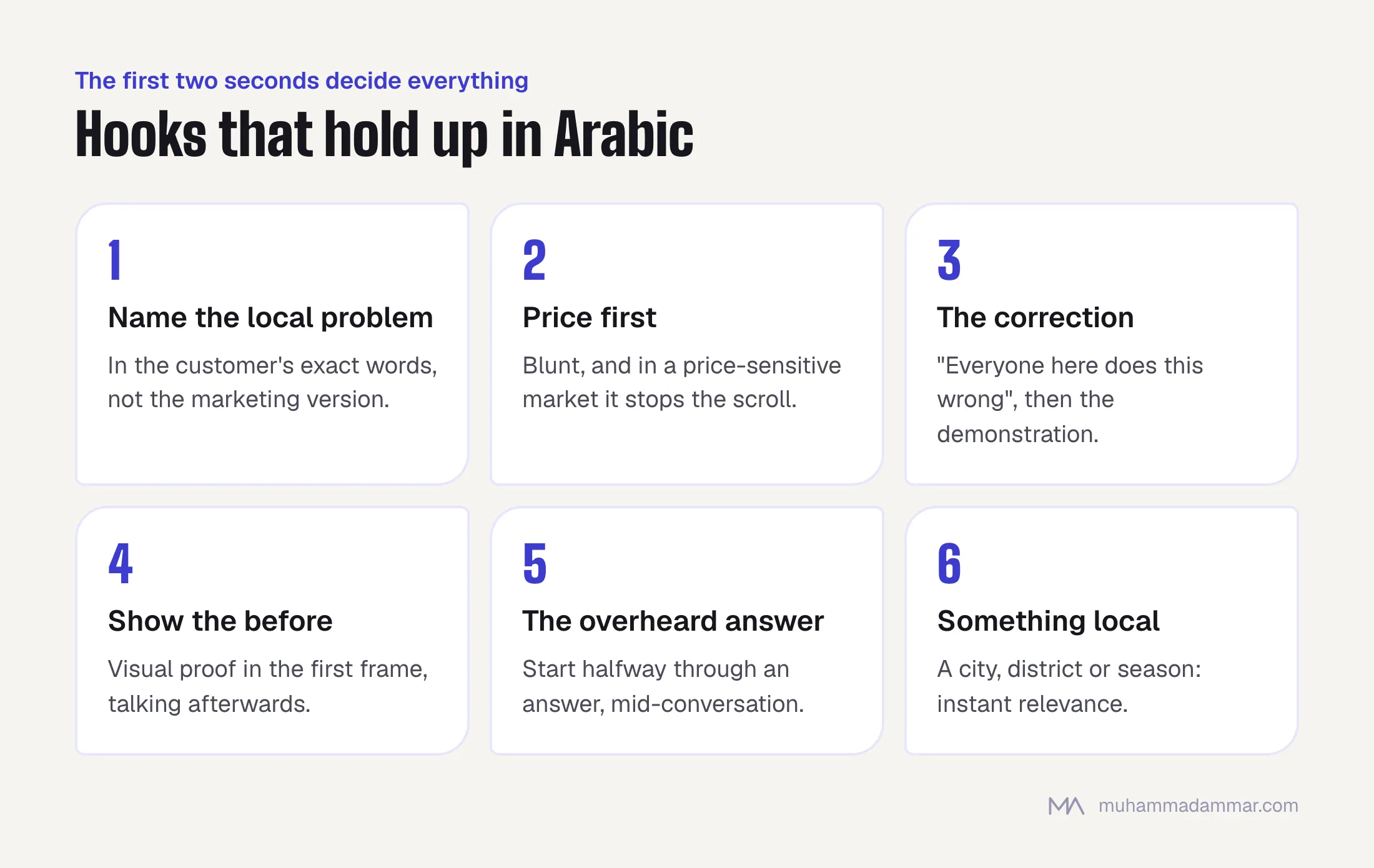
- Naming the local problem in the exact words your customer uses, not the marketing version.
- Revealing the price first. It’s blunt, and in a price-sensitive market it stops the scroll.
- The correction: “Everyone here does this wrong.” Provocative enough to hold attention, and it sets up the demonstration.
- Showing the “before”, not describing it: visual proof in the first frame, the talking afterwards.
- The overheard answer: starting halfway through an answer, as if the viewer walked into a conversation.
- Something local: naming a city, district or season. It signals relevance instantly and filters for the audience you want.
What fails again and again: a logo in the first frame, a slow opening shot, a voiceover that starts with a greeting, and any hook you have to read to understand.
Testing on a realistic budget
Most advice assumes budgets that advertisers in the region don’t have. A setup that works with modest spend:
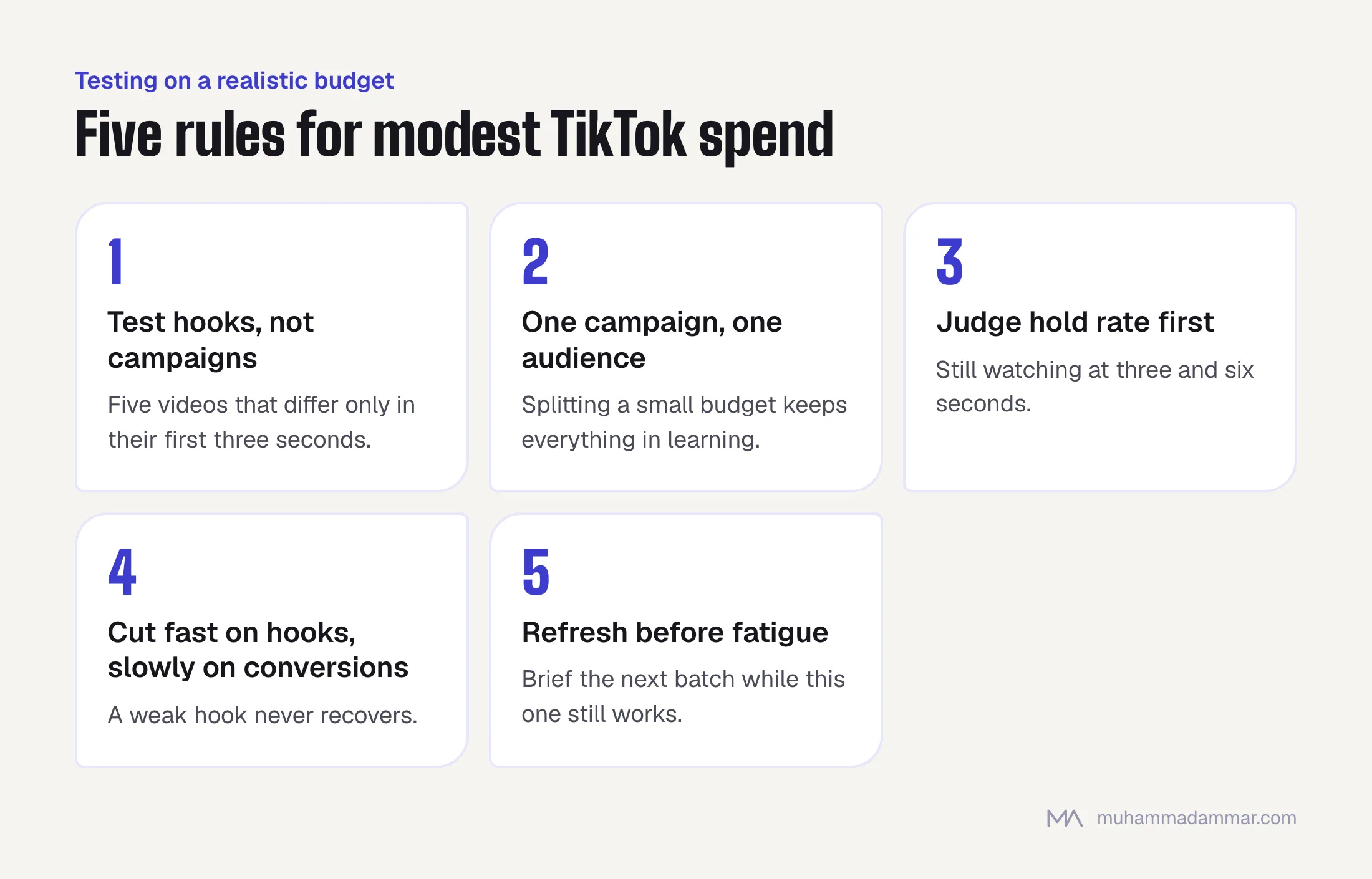
- Test hooks, not campaigns. Five videos that differ only in their first three seconds tell you more than five completely different ideas.
- One campaign, one audience, several videos. Splitting a small budget across audiences guarantees nothing gets out of the learning phase.
- Judge on hold rate first. The share of people still watching at three and six seconds tells you whether the hook works long before you have enough conversions to judge anything else.
- Cut fast on hold rate, slowly on conversions. A video with a weak hook never recovers. A video with a good hook and no conversions yet might.
- Refresh before fatigue sets in, not after. Have the next batch briefed while the current one is still working. Creative fatigue comes faster here than on other platforms.
Cultural lines and brand safety
Settle these before production, not during the review:
- Agree in writing with the client what’s acceptable in casting, clothing, music and humour, and get that agreement from the person who’ll approve the final cut.
- Religious seasons change what’s appropriate in both directions. Ramadan brings huge attention and a different tone, and people remember the wrong tone.
- Comparisons with named competitors carry more legal risk in some Gulf countries than advertisers expect.
- Regulated categories such as health, finance, supplements and cosmetics have local advertising rules on top of the platform’s own policies.
- Look at a creator’s other content before tying your brand to them. It’s a brand-safety question, not a moral one.
Benchmarks and attribution warnings
Two honest warnings. First, the TikTok benchmarks published for this region are mostly unsourced and out of date. Treat your own first month as the benchmark and compare against yourself after that.
Second, last-click reporting always undercounts TikTok, because much of its effect comes from views without clicks: someone watches the video, doesn’t click, and searches for your brand two days later. Judge it by whether brand searches and total revenue move while it runs, and use the pause test from why attribution breaks in the Gulf and Egypt before you decide it doesn’t work.
Building the campaigns and directing the creative is part of my TikTok ads work, ongoing creator and channel work falls under social media marketing, and the budget across all channels is paid media.
Frequently asked
Does TikTok work for B2B in the Gulf?
Sometimes, for awareness among owners of smaller businesses. For enterprise purchasing, no. Be honest about which one you’re selling to.
Can I reuse my Instagram Reels?
Technically yes, and it usually underperforms. The hook conventions are different, and another platform’s watermark gets penalised.
How many videos do I need a month?
More than feels reasonable. Plan for a steady weekly flow of short pieces instead of one production day a quarter.
Formal Arabic or dialect?
Dialect for anything conversational, which is most of the feed. Formal Arabic for categories where authority is the selling point, and even then keep it spoken, not written.
Should the landing page be different?
Yes. The visitors arrive fast, on mobile, with little patience and no context. A page built for people coming from search won’t hold them.
Thinking about TikTok and not sure your category suits it? Message me.

SEO and digital marketing consultant since 2015, working with businesses in Egypt, Saudi Arabia and the UAE.
About the author and editorial standards