On this page
- 1. How Google splits and stems Arabic
- 2. Diacritics, normalisation and what gets indexed
- 3. Dialect or Modern Standard Arabic
- 4. Right-to-left technical requirements
- 5. Content structure and readability
- 6. Internal links with Arabic anchors
- 7. Two-language site structure
- 8. Schema and naming your brand in Arabic
- 9. Local signals across the region
- 10. Reading Arabic data in Search Console
- 11. The mistakes I see most
- Frequently asked
Most Arabic SEO guides are English SEO guides with “and do it in Arabic” added at the end. They skip the decisions that actually differ in Arabic, which are about the language itself and how the site is built.
This guide starts with how Google reads Arabic and works out from there to the decisions that follow from it.
1. How Google splits and stems Arabic
Arabic words are built by fitting a three-letter root into a pattern, so one root produces dozens of related words. From the root k-t-b (writing) you get kitab (book), katib (writer), maktaba (library), maktub (written) and kitaba (writing).
Search engines handle this with stemming: they reduce each inflected form to a shared base, so a query can match a page that used a different form of the same word. Arabic is harder to stem than English because prefixes and suffixes attach straight onto the word. The definite article (al-), prepositions, conjunctions and possessive endings all fuse onto the stem with no space.
In practice this means three things:
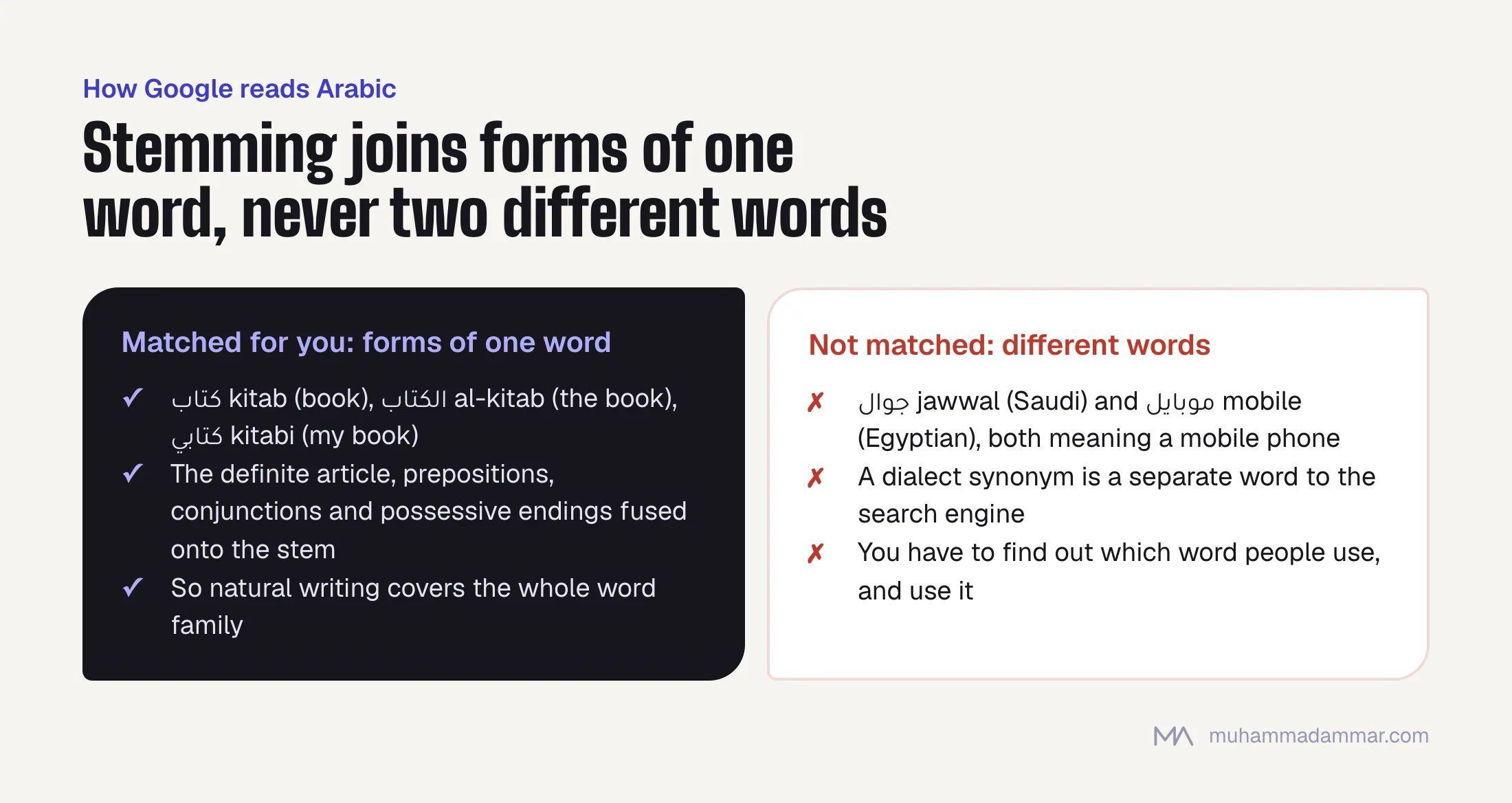
- You don’t need to repeat every inflected form of a keyword. Natural writing covers the whole word family.
- Chasing exact-match keyword density is a worse idea in Arabic than in English. The engine already generalises across forms, so forcing a count only hurts readability.
- Stemming does not connect different words. A dialect synonym is a separate word, and no amount of stemming links jawwal to mobile, the Saudi and Egyptian words for a mobile phone.
Keep that last point in mind for the rest of this guide: stemming handles different forms of one word, but it can’t tell you which word people use.
2. Diacritics, normalisation and what gets indexed
Everyday Arabic writing leaves out the short vowels. Diacritics exist, but outside the Quran, poetry and children’s books nobody writes them, and nobody types them into a search box.
Search engines normalise them away, along with spelling variants people type interchangeably: the four forms of alef, ta marbuta and ha at the end of a word, ya and alef maqsura, and the elongation character.
So don’t add diacritics to your content hoping for a match. You’d be optimising for a form nobody types. The bigger problem is that your keyword tool does not normalise. It lists every spelling as its own row with its own volume, which is why Arabic demand always looks smaller than it is. I explain how this happens, and how to merge the variants, in why Arabic keyword volume is under-reported. Fix that first; the rest of this guide depends on having the real numbers.
3. Dialect or Modern Standard Arabic
Arabic has a formal written standard used across the region and spoken dialects that can differ so much that a Moroccan and a Kuwaiti may not follow each other’s everyday speech.
Search queries sit between the two, closer to speech. Long articles sit closer to the written standard. Getting this balance wrong in either direction is the most common content failure I see in Arabic SEO.
The rules I work by:
- Write the body in clear, current standard Arabic that reads naturally, without the stiffness of a government circular.
- Use dialect terms where the searches are: in headings, in the FAQ, and wherever they sit naturally in the text.
- Don’t write a whole page in heavy dialect unless you serve exactly one market and will never reuse the content.
- If the dialect changes the actual name of your product category, build separate pages. That’s an architecture decision, and adding synonyms won’t solve it.
I compare Egyptian and Gulf searches in detail in one Arabic site, two very different audiences, and explain why translated sites fall behind in translation versus localisation.
4. Right-to-left technical requirements
Flipping the CSS doesn’t make a site right-to-left, and the gaps show up in the places that hurt conversions most.
- Declare the direction properly:
<html lang="ar" dir="rtl">, both attributes on the root element. Browsers and screen readers use this to lay out mixed text. - Use CSS logical properties:
margin-inline-startinstead ofmargin-left,padding-inline-endinstead ofpadding-right,text-align: startinstead ofleft. One stylesheet then serves both directions, and you stop maintaining a mirrored copy that drifts out of date. - Handle mixed-direction text on purpose. Arabic sentences that contain Latin brand names, model numbers, prices or URLs are where layouts break, with punctuation jumping to the wrong end of the line. Wrap the Latin part in
<bdi>and the browser keeps it separate. - Pick your numerals. Both Western digits (0-9) and Arabic-Indic digits (٠–٩) are in use. Arabic-Indic is more common in the Gulf and Western digits dominate in North Africa. Choose per market and stay consistent, especially in prices and phone numbers.
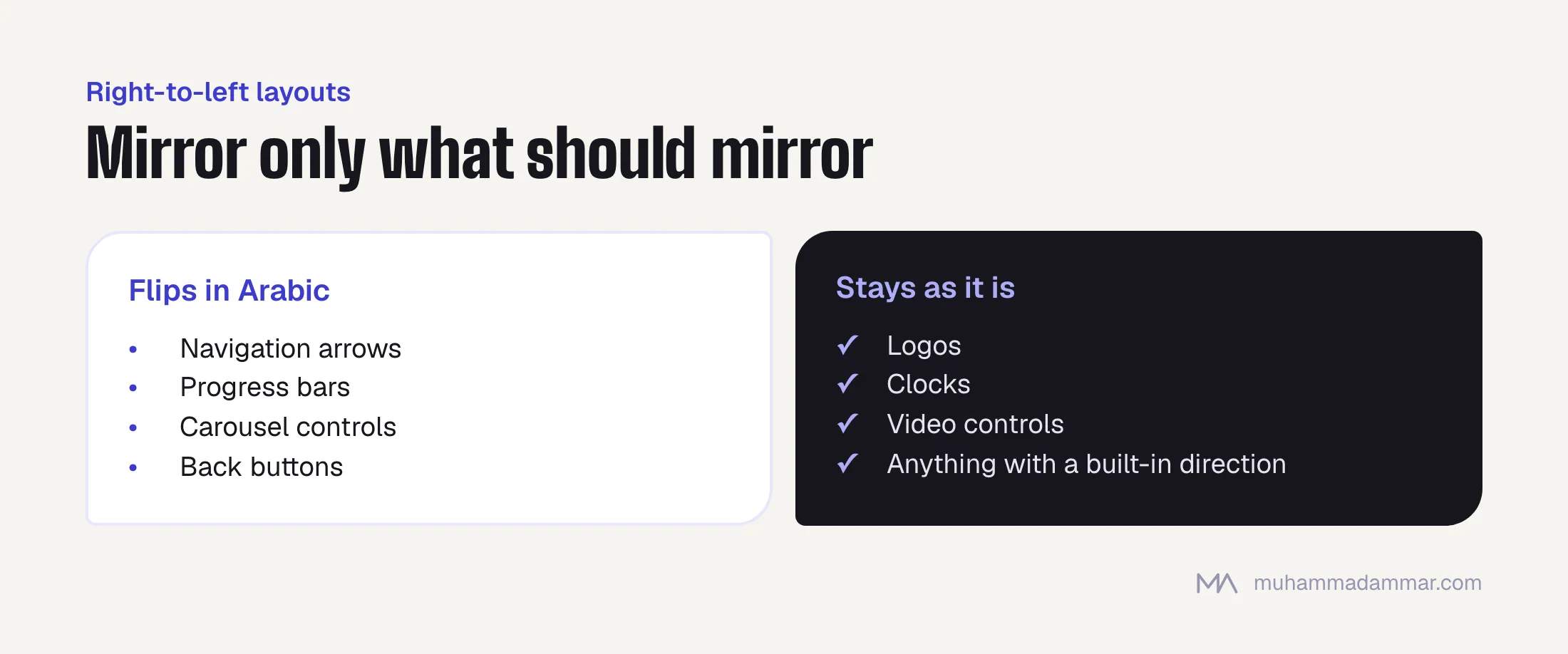
- Mirror only what should mirror. Navigation arrows, progress bars, carousel controls and back buttons flip. Logos, clocks, video controls and anything with a built-in direction stay as they are.
- Load real font weights. Arabic web fonts are heavier than Latin ones, and browsers can’t fake a convincing Arabic bold, so load the real weight or skip bold. Two weights are usually enough, and cutting the rest is one of the biggest speed gains on an Arabic site.
- Set direction on form fields. Phone and email inputs should be left-to-right inside a right-to-left page, set on the input itself. When this is wrong the form feels broken, and nobody can say why.
5. Content structure and readability
Arabic packs more into each word than English. A faithful Arabic translation usually has fewer words but takes up about the same space on the page, because the script is denser.
So don’t set Arabic word-count targets by converting English ones, or you’ll end up padding. And don’t treat a shorter Arabic page as thin. Judge it on what it covers.
Use shorter paragraphs than you would in English, because long blocks of dense Arabic are harder to scan. Write headings that describe the topic and include the query instead of clever ones. Give the text slightly more line height than the Latin default, since Arabic letters extend further above and below the line.
6. Internal links with Arabic anchors
This is the rule that matters most on a two-language site, and almost nobody follows it: Arabic pages link to Arabic pages, and English pages link to English pages. Visitors move between languages through the language switcher and hreflang, never through links in the text.
Arabic articles often link to English service pages, usually because the English page was built first. When they do, the Arabic section passes its internal authority to the English side and never builds up enough of its own to rank.
For the anchor text, use descriptive Arabic phrases, with the definite article where it reads naturally. Don’t force an exact-match keyword into an anchor that reads awkwardly. Stemming means you don’t need to, and Arabic readers notice awkward Arabic quickly.
7. Two-language site structure
There are four decisions, and this is the order to make them in.
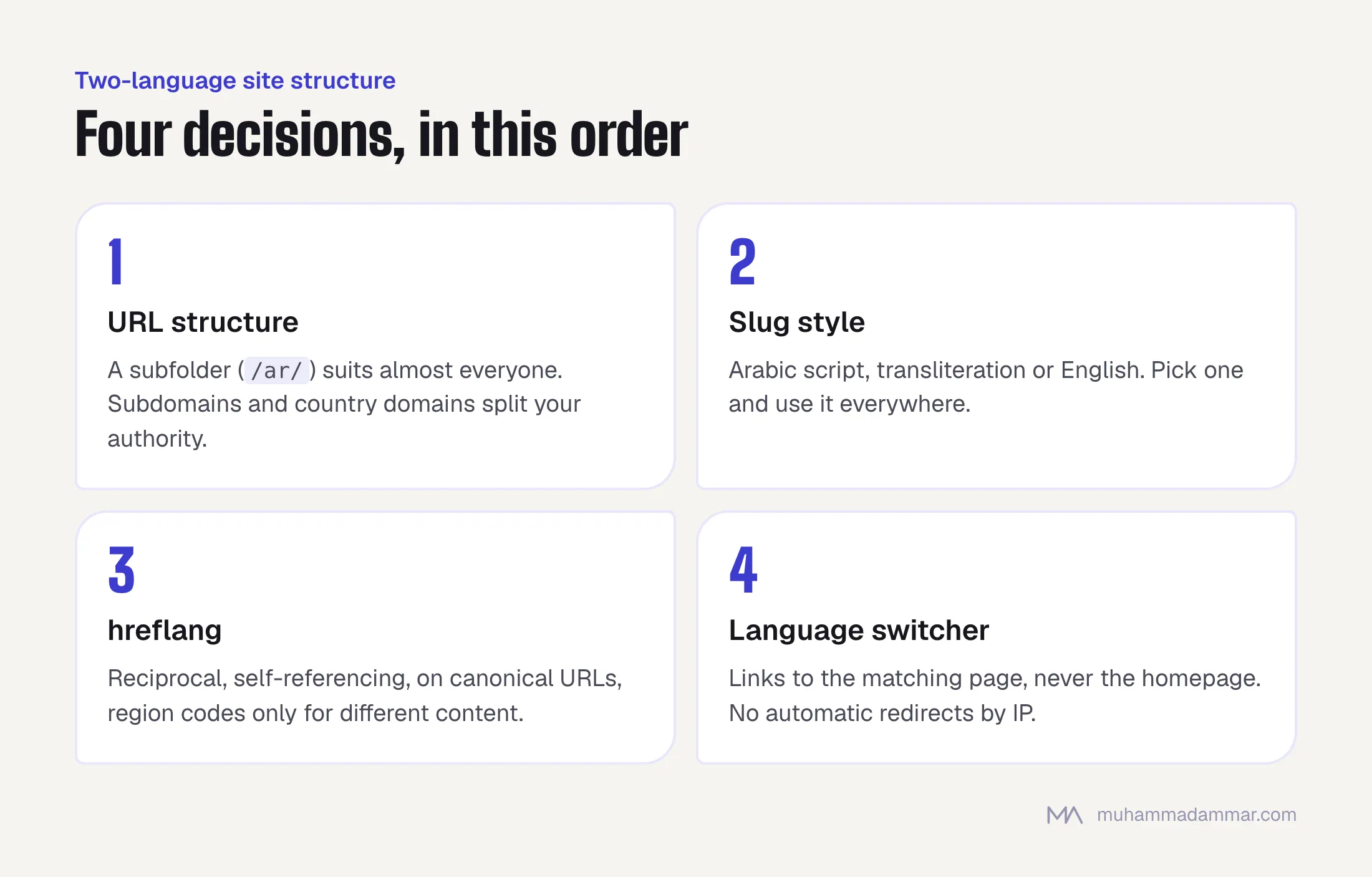
URL structure. A subfolder (/ar/) suits almost everyone. Subdomains and separate country domains both split your authority, and the extra running cost only pays off when each market is run as a separate business.
Slug style. Arabic script, transliteration or English: each has real trade-offs, which I go through in choosing URL slugs for an Arabic site. Whatever you pick, use it everywhere.
hreflang. It must be reciprocal, include a self-reference, point at canonical URLs, and use region codes only where the content really differs by country. It’s the part of the setup that breaks most often, and I list the seven usual failures in hreflang mistakes on Arabic-English sites.
Language switcher. It has to link to the matching page, not the homepage, and it must never redirect people automatically based on their IP address. IP redirects are one of the surest ways to get a whole language version dropped from the index. Googlebot crawls from a small set of locations, so if it’s always redirected away from your Arabic pages, it never sees them.
8. Schema and naming your brand in Arabic
Structured data lets you tell search engines and AI tools who you are instead of leaving them to guess. Most Arabic brands don’t use it.
- Set
inLanguagetoaron Arabic pages. It costs nothing and is often missing. - Use
nameandalternateNametogether: the Arabic name on the Arabic page with the Latin spelling as alternateName, and the reverse on the English page. That’s how you tell a machine both names belong to one brand. - Spell your brand in Arabic exactly the same way everywhere: on the site, social profiles, directories and in the press. A brand written three ways looks like three weak brands, and AI assistants are as affected by this as search engines.
- Fill
sameAswith your Arabic social profiles and any Arabic Wikipedia or knowledge-base entry, as well as the English ones. - Match what’s on the page. Schema that contradicts what visitors see does more harm than having none.
9. Local signals across the region
“Arabic SEO” covers markets that behave very differently, and local tactics don’t carry over well from one to another.
Local SEO in Europe and North America leans on directory listings. Across most of this region there are far fewer credible directories, and the ones that exist carry little weight. What works instead is getting the basics right in one place: a complete Google Business Profile in the right category, the same Arabic name everywhere, a steady flow of reviews, and accurate map data. Map data is wrong more often here, because addresses themselves are less standardised.
Saudi Arabia is the most Arabic-first market and the most mobile-heavy. The UAE has far more English-language commercial searches because most of its residents are expatriates. Egypt has the largest search population, the most distinct dialect and the most price-sensitive buyers. North African markets add French as a third language, which changes the site-structure question completely.
A single Arabic strategy for all of these markets ends up fitting none of them.
10. Reading Arabic data in Search Console
Search Console is your most reliable source of Arabic search data, and it has the same fragmentation problem as your keyword tool.
It shows queries exactly as people typed them, so one idea is spread across many rows. The average position across those rows means very little: you might rank third for the common spelling and thirtieth for a rare one, and the average describes neither.
Instead, export the queries, apply the same normalisation you use for keyword research, then group and re-total them. Always filter by country, because the same Arabic words can carry different intent in different markets. And use the query report to find variants. It contains spellings, dialect forms and Franco-Arabic searches that no keyword tool will show you.
11. The mistakes I see most
- Translated keyword lists: grammatically perfect phrases that nobody searches. This is the most expensive mistake in Arabic SEO.
- Half-Arabic pages: Arabic headings with English navigation, English product names and an English footer. The language signals are muddled and the page is unpleasant to use.
- Arabic content linking to English pages: covered above. It quietly caps how far the Arabic side can grow.
- Broken hreflang: usually a missing return tag, sometimes a translation that was never linked in the multilingual plugin.
- Gulf content written by Egyptian writers, or the reverse, with no localisation check: it reads correctly but misses the words customers actually search.
- IP-based redirects between language versions: they reliably remove one version from the index.
- Judging Arabic pages by English word counts: it produces padded content that readers leave.
- Trusting the keyword tool’s numbers: you can recover from everything else on this list. This one makes companies skip the Arabic market altogether.
Frequently asked
Is Arabic SEO harder than English SEO?
It’s more involved technically and easier commercially. The language and structure decisions are harder, but the competition is much weaker. Most Arabic pages ranking today are translations, and a page written properly in Arabic beats them without much trouble.
Should I translate my English site or write new Arabic content?
Write new content from an Arabic keyword map. A translation copies the shape of English demand, and Arabic demand has a different shape. If a topic matters in both languages, cover it in both, the way each audience asks about it.
Do I need a .sa or .ae domain?
No, and it’s often the wrong choice. A country domain ties you to one market, which hurts if you sell across the Gulf. A .com with the right local signals serves a regional business better.
How long does Arabic SEO take to work?
Technical fixes can change indexing within weeks. New content in a competitive Arabic category usually takes four to nine months to settle into a stable position. That’s faster than the English equivalent, because there’s less competition.
Can I use AI to write Arabic content?
Yes, for first drafts written to a brief and then edited by a native speaker. Unedited, no. The problem isn’t grammar, it’s tone. AI-written Arabic tends toward a formal standard that reads like a translation and misses the dialect words people search with, which is the exact mistake this guide is about.
If you’d rather have this done for you, that’s what my Arabic SEO service covers, as part of a wider SEO engagement. Tell me about your site and I’ll tell you where I’d start.

SEO and digital marketing consultant since 2015, working with businesses in Egypt, Saudi Arabia and the UAE.
About the author and editorial standards