On this page
Every Arabic site makes this decision once, usually in a hurry, and then lives with it for years: should the URL be in Arabic script, in Latin transliteration, or in English?
Most answers you’ll find are opinions presented as best practice. Below is the real trade-off and a way to decide, because the right answer depends on the kind of site you run.
The three options
Take a services page. The same page can live at:
- Arabic script:
/خدمات/سيو/ - Transliteration:
/khadamat/seo/ - English:
/services/seo/
All three work, and Google handles all three. Anyone who says one of them is broken is wrong, and anyone who calls one of them a ranking factor is overstating a small effect.
What actually happens with Arabic URLs
This part is worth understanding before you choose, because the behaviour isn’t obvious.
URLs can only contain a limited set of ASCII characters, so Arabic is stored percent-encoded as UTF-8. /خدمات/ is sent as:
/%D8%AE%D8%AF%D9%85%D8%A7%D8%AA/A six-word Arabic slug turns into a long string of hex. Which version you see depends on where you’re looking:
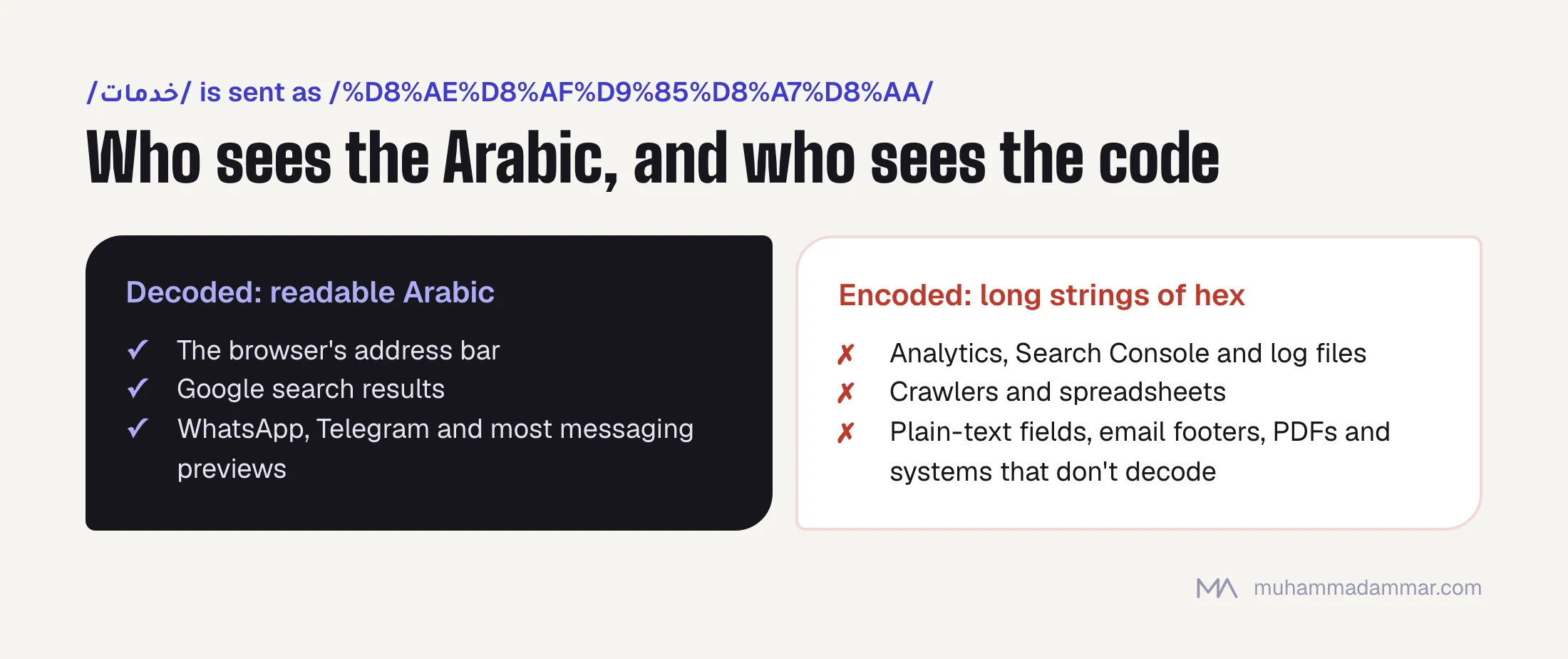
- Browser address bar: decoded, so the visitor sees clean Arabic.
- Google search results: decoded, so the URL shows in Arabic.
- WhatsApp, Telegram and most messaging apps: usually decoded in the preview. This is where Arabic slugs are most readable, and it matters because that’s how links mostly travel in this region.
- Analytics, Search Console, log files, crawlers and spreadsheets: encoded. Every internal report gets harder to read, and matching URLs by eye becomes painful.
- Plain-text fields, email footers, PDFs, and any CMS that doesn’t decode: encoded, and very long.
So your visitors rarely pay the cost of Arabic slugs. Everyone who works on the site pays it, in every report, every day.
The backlink anchor problem
This is the strongest technical argument against Arabic slugs, and most people miss it.
A lot of natural links in this region are created by pasting the bare URL into a forum, a comment or an article that cites a source. The anchor text then becomes the URL itself. With a transliterated or English slug, that anchor contains readable, relevant words. With an Arabic slug, it’s often a wall of percent-encoded hex.
For any single link the effect is small. Across a few hundred links built up over the years it adds up, and you can avoid it completely.
Do Arabic URLs get more clicks?
The argument for Arabic slugs is that an Arabic URL in Arabic search results looks more relevant, and looking relevant earns clicks. Google also bolds words in the displayed URL that match the query, so an Arabic slug that matches an Arabic search gets highlighted and a transliterated one doesn’t.
The reasoning holds up. The evidence is thin. I haven’t seen a controlled study on Arabic search results, and the tests people quote usually changed the title at the same time. Treat it as a possible small effect, not a proven one. If you want to know for your own site, test titles and URLs separately, or the result won’t tell you anything.
What I’m more confident about: readable URLs help most where people share links with each other in Arabic, and least on sites whose visitors come from search and never forward anything.
How I decide
By type of site, starting with the ones I see most often.
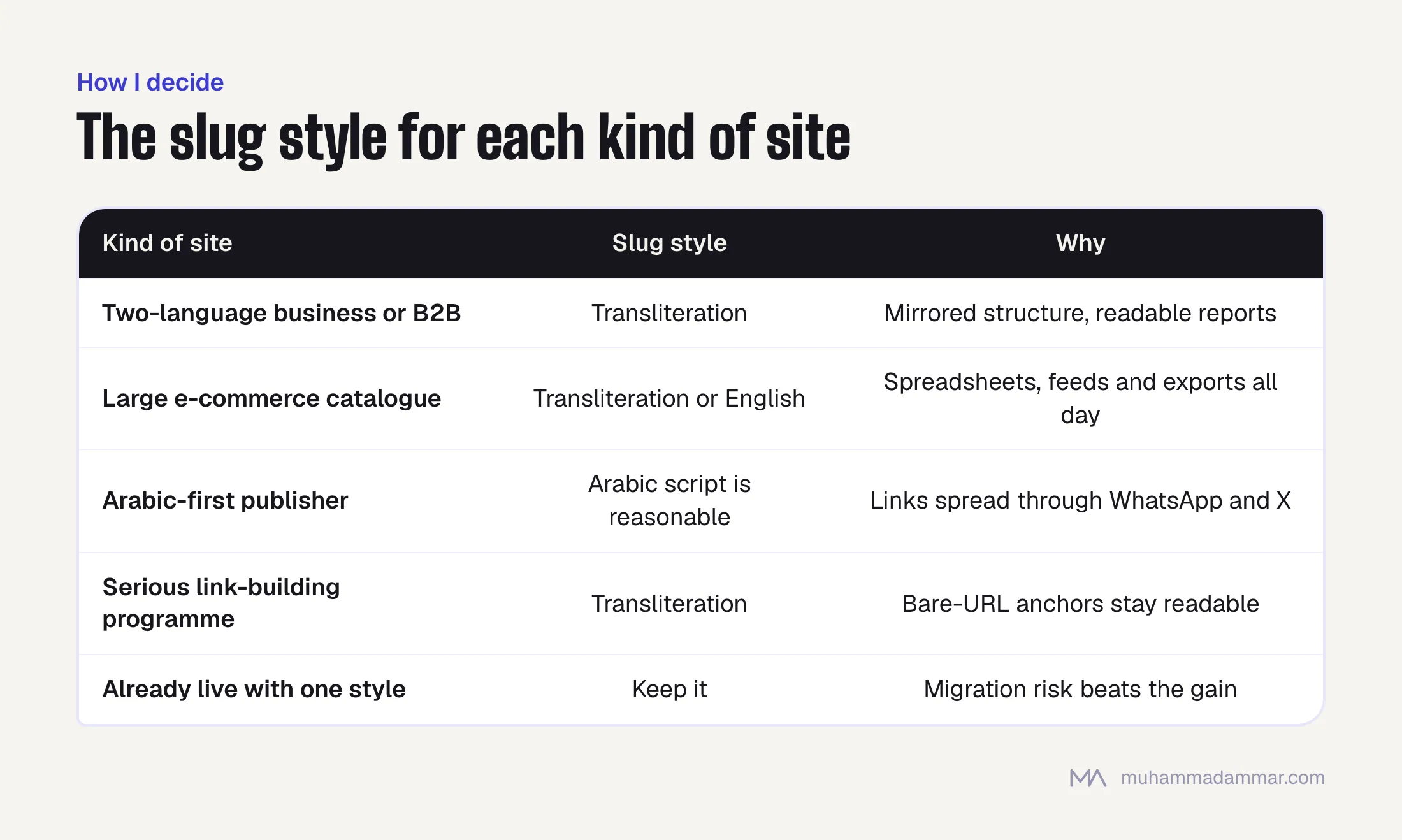
A two-language business or B2B site: transliteration. The Arabic and English structures mirror each other, reports stay readable, link anchors stay meaningful, and Arabic readers barely notice the URL because the page itself is fully Arabic. This is what I recommend most often. This site goes one step further and uses the same English slug in both languages, under /ar/ for Arabic.
A large e-commerce catalogue: transliteration or English. At scale there’s no real choice. You’ll be matching URLs in spreadsheets, product feeds, log files and platform exports all the time, and encoded Arabic makes every one of those jobs harder. Put the Arabic category name in the H1 and the breadcrumb, where it does its job.
An Arabic-first publisher or content site: Arabic script is a reasonable choice. If your audience is entirely Arabic-speaking, your links spread through WhatsApp and X, and you don’t run a complex measurement setup, the readability gain is real, and most of the cost falls on you, not your readers.
A site with a serious link-building programme: transliteration. The anchor problem grows with every link, and this is the one case where I’d push back on a client who wants Arabic slugs.
Any site that’s already live with one style: keep it. The risk of migrating is almost always bigger than the gain, which brings me to the last section.
Changing slugs without losing what you have
Don’t do this because the URLs would look nicer. A slug migration is a real risk for a small gain. Do it when you’re rebuilding the site anyway, or when the current structure is causing real operational problems.
If you go ahead, the order matters:
- Map every old URL to exactly one new URL before you change anything, and check every row. The pages that get missed are always old ones with links pointing at them.
- Set up single-hop 301 redirects, from the old URL straight to the final new one. Chains through an in-between structure waste crawl budget and lose signal at each step.
- Update every internal link to the new URL. Internal links left pointing at redirects are the most common unfinished migration, and every internal click then costs an extra request.
- Regenerate the XML sitemap with the new URLs only, not both sets.
- Update hreflang on both language versions. A slug change breaks the pair if the annotations were ever hard-coded. I explain how in seven ways bilingual Arabic sites break hreflang.
- Keep the redirects forever, not for six months. Links from 2019 still send traffic.
- Watch Search Console coverage and your log files for a full quarter. Migration damage shows up late, and crawl data shows it before traffic does.
On WordPress with Polylang or WPML, check one more thing: that the slug change carried through to the translation link and didn’t quietly orphan one side. Load the Arabic page and click the language switcher to test it.
Frequently asked
Do Arabic URLs rank better for Arabic searches?
Not in any way that matters. Keywords in the URL are a very weak signal next to the title, headings and content. Decide based on how you run the site, not on rankings.
Will percent-encoding break anything?
Not in modern browsers or in Google. It does cause trouble in older systems, some email clients, some CRMs and any tool that cuts off long strings. Run a real Arabic URL through your own tools before you commit.
Can I mix them, with Arabic categories and English products?
Avoid it. Mixing is the worst option: you carry the cost of encoded URLs and lose the consistency that made the choice worthwhile. Pick one style and use it everywhere.
Should the /ar/ prefix itself be in Arabic?
No. Language folders are normally ASCII language codes, every multilingual plugin expects that, and changing it gains you nothing.
How long should an Arabic slug be?
Shorter than you think, because encoding makes it about six times longer in characters. Two or three words is plenty in any language, and in Arabic script it’s close to a hard limit.
Related services: Arabic SEO and technical SEO. If you’re weighing a slug change, send me the site and I’ll tell you whether it’s worth the risk.

SEO and digital marketing consultant since 2015, working with businesses in Egypt, Saudi Arabia and the UAE.
About the author and editorial standards