On this page
There isn’t one best web design company, and some of the lists that rank them are paid placements. A good choice comes down to five things you can check yourself: live sites they built, who does the work, what the quote includes, who owns the site afterwards, and what support looks like after launch. This article is that checklist.
I design websites myself, so I’m one of the options you may be weighing. I’ve written this so it works whoever you hire, including when it’s not me.
What makes a web design company a good choice?
Look for what you can check and ignore what you can only be told. “Creative”, “award-winning” and “years of experience” are claims. A live site you can open on your phone and a quote that lists its contents are evidence.
It also helps to know what you’re buying first. If you haven’t yet worked out what moves the price, start with what website design costs in Egypt, Saudi Arabia and the UAE, then come back here to compare suppliers.
What should I check before I shortlist anyone?
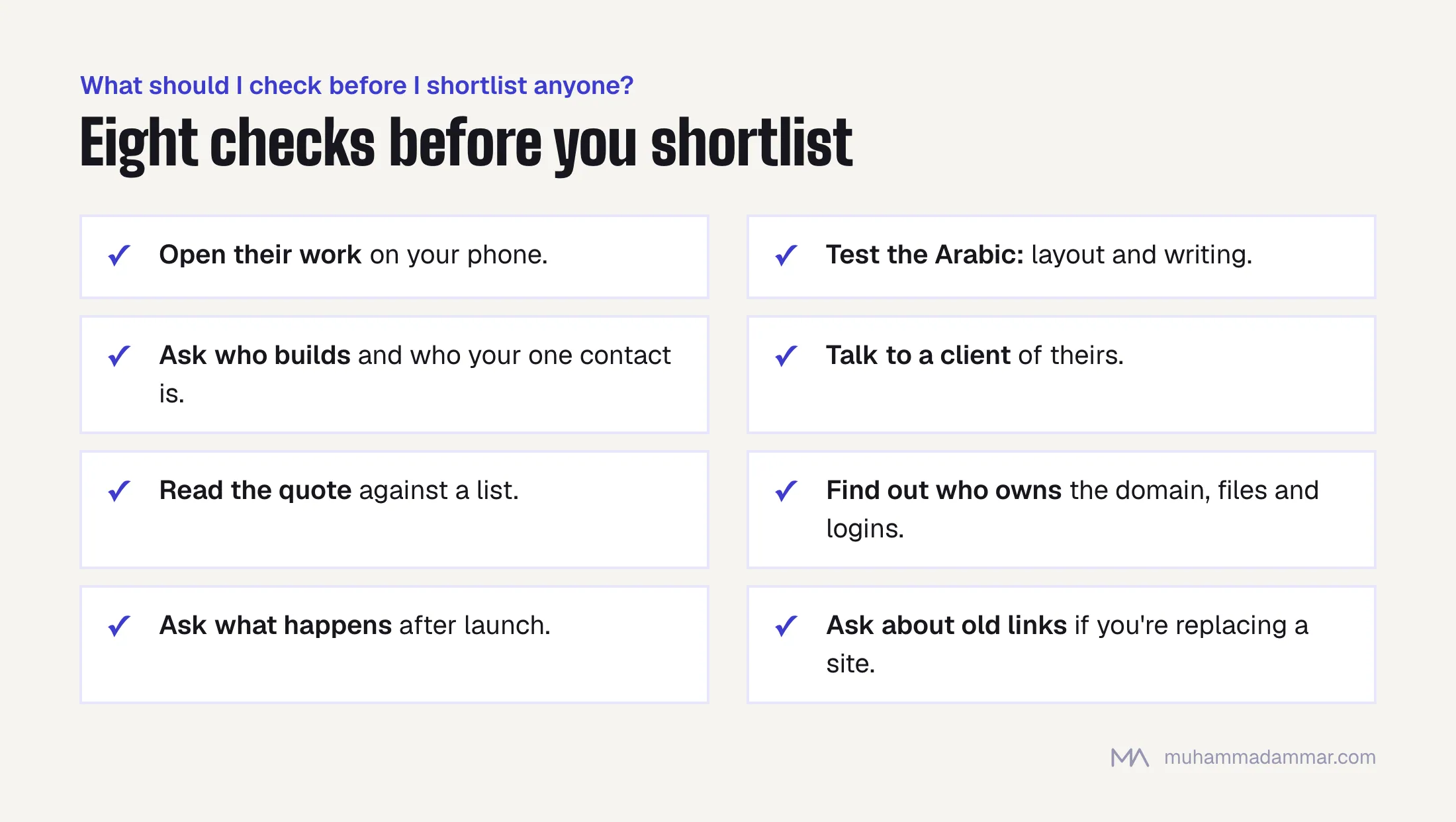
- Open their work on your phone. Pick two or three live sites, not screenshots. Do they load quickly? Does the text stay readable? Google measures how long the biggest thing on the first screen takes to appear, and you can feel a slow site without any tool.
- Test the Arabic. If you need Arabic, open their Arabic pages. Is the layout actually right to left, with buttons, menus and numbers in the right places, or is it the English layout flipped? Is the Arabic written for readers, or translated word for word?
- Ask who builds the site. Employees, freelancers, or a subcontractor you’ll never speak to? Any of these can work. What matters is that you know, and that one person is your contact for the whole project.
- Ask what they did on each site. A page of logos tells you little. Ask which sites they designed and built themselves and which they only worked on in part, then open those.
- Read the quote against a list. Pages, languages, custom or template, content, integrations, hosting, rounds of changes, support afterwards, tax and currency. The same list is in the cost article. If a line is missing, ask for it in writing.
- Find out who owns what. The domain should be registered in your name. You should get the files, the admin logins and the hosting account when the project ends. A supplier who keeps the domain “to manage it for you” has also kept your leverage.
- Ask what happens after launch. Who fixes a bug in month three? Who renews the hosting? Who updates the software? What does each cost, and how fast do they reply? Sites that break quietly six months in are usually sites nobody was responsible for.
- Ask about the old site’s links. If you’re replacing a website that already gets visitors, every old address needs to point to its new one. Google explains how in its guidance on moving a site with URL changes. A redesign that skips this can lose traffic you already had.
What are the warning signs?
None of these proves a company is bad. Two or three together is a reason to ask harder questions.
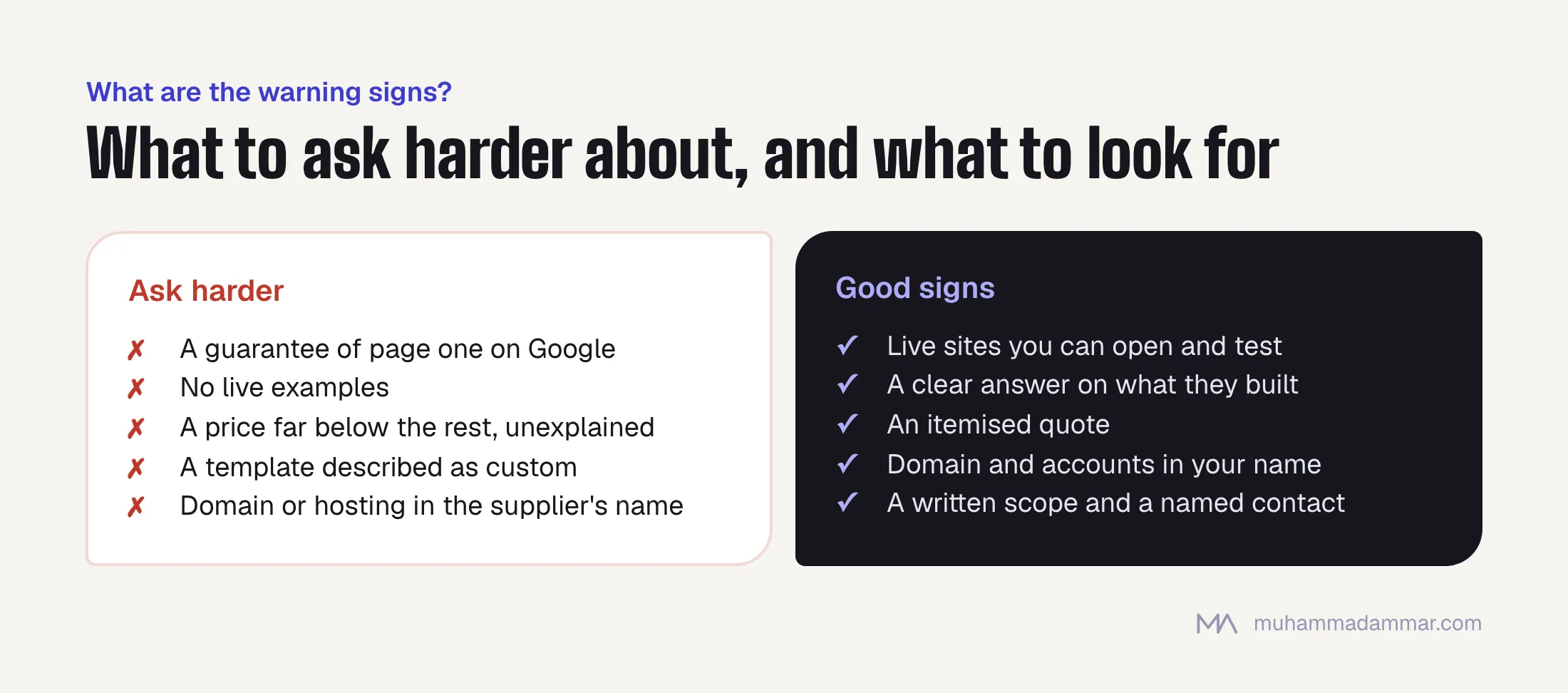
- A guarantee of page one on Google. Nobody controls that, and the ones who promise it are usually talking about a keyword nobody competes for.
- No live examples, or only examples that are now offline.
- A price far below the others with no explanation of what’s left out.
- A template described as custom design, with no design shown before the build.
- The domain or hosting registered in the supplier’s name and not yours.
- No written scope, or a scope written as “full website”.
- Pressure to sign today.
- Reviews that all appeared in the same week, or can’t be traced to real people.
Company, freelancer or a small team?
| Option | What you get | The usual risk |
|---|---|---|
| Larger agency | Designers, developers and project managers under one roof, and usually a process. | Your project can be one of many, and you may talk to a salesperson and never to the person building. |
| Single freelancer | Direct contact and a lower overhead. | One person’s availability. If they are ill or busy, the project stops. Ask who has access to the site if they disappear. |
| Small team led by one person | One contact who coordinates specialists for design, build and content. | Capacity. Ask how many projects are running at once. |
I work as the third kind. I lead a small team of freelance specialists and stay your single contact. That suits a business that wants someone accountable and doesn’t need a large agency’s headcount. It doesn’t suit a project that needs an on-site team at your office: I have no office, and my clients in Saudi Arabia and the UAE work with me online. If that’s what you need, someone else will suit you better.
Does it matter where the company is based?
A little, in practical ways rather than in quality. Check that they can invoice in the currency you want, that their working hours overlap with yours for calls, and that they understand the local details of your market: how people there search, which payment options customers expect, and which store platforms are common. A site for Saudi Arabia built by someone who has never seen how Saudi customers pay is a risk, wherever the builder sits.
How do I compare two proposals?
Put the two quotes side by side and go through the list in the checklist above. Mark each line as included, excluded or not mentioned. “Not mentioned” is the dangerous one, because it usually becomes an extra charge. Then ask both suppliers to fill the gaps in writing, and compare again. By then the cheaper one may not be cheaper any more. If it still is, that’s fine.
If you’re also deciding who looks after the site’s SEO after launch, the choice between an agency, a freelancer and an in-house hire is covered in three ways to buy SEO, and the same logic applies.
Frequently asked
Is the cheapest web design company a bad choice?
Not automatically. It’s a bad choice when the low price comes from leaving things out and nobody says which things. Ask for the quote to be itemised and the price tells you what you’re actually buying.
Should I choose a company with a physical office?
An office shows the company has an address and says nothing about the quality of its work. For most websites, what matters more is that you can reach the person doing the work and that you own what they build.
How do I know if the reviews are real?
Look for reviews on platforms the company doesn’t control, written by named people or businesses you can look up. Be suspicious of a long run of five-star reviews with similar wording. The best check is still the work itself: open the sites they built and try them.
Should the same company handle SEO?
It helps when the person designing the site knows how pages, speed and structure affect search, because that is cheaper to get right during the build than to fix after. But it isn’t required. Ask what they set up at launch: page titles, redirects from old addresses and a sitemap at least.
Can I change supplier later?
Yes, if you own the domain, the hosting account and the files, and the site is built on something other developers can work with. That is the reason to ask about ownership before you sign.
If you’d like me to design your site, message me with what it needs to do, the languages and whether you’re selling on it. The price is set when you get in touch, based on what you need.

SEO and digital marketing consultant since 2015, working with businesses in Egypt, Saudi Arabia and the UAE.
About the author and editorial standards