On this page
I’m often asked some version of the same question: should we hire an agency, bring in a freelancer, or build the skills inside the company? Usually the question comes in the wrong order. What you should decide first is who inside the business owns the result, because whichever model you pick, what kills SEO programmes in this region usually isn’t the supplier. It’s that nobody inside the business has the authority to get a change onto the website.
So here’s the decision the way I’d walk you through it on a call, including the cases where I’d tell you to hire an agency instead of me.
What each model actually gives you
| Model | What you’re really buying | What you’re not buying |
|---|---|---|
| Agency | Capacity and cover: several people, a process, and someone to answer when your account manager is on leave. | Senior attention by default. You’re one account of many, and the person who sold to you is rarely the person doing the work. |
| Freelancer or consultant | Judgement: one experienced person deciding what matters, usually faster and cheaper per hour of real thinking. | Volume. One person can’t write forty pages, rebuild templates and run outreach at the same time. |
| In-house | Context and continuity: someone who knows your products, stock and margins, and is in the room when decisions are made. | Breadth of experience. One in-house hire has seen your one site, not fifty. |
These models complement each other. The best setups I’ve worked in had a capable in-house owner plus one outside expert, with production bought in where needed.
The real cost, including what nobody quotes
The retainer is the number you see. It’s rarely the biggest one.
- Agency: the monthly retainer, plus your own time managing them (a few hours a month at least), plus the cost of work that gets delivered but never goes live because your developers are busy.
- Freelancer: the monthly or project fee, plus the risk of depending on one person, plus whatever you pay separately for writing, design and development, since most consultants don’t include those.
- In-house: salary, employer costs and tools (rank tracking, a crawler, analytics add-ons), plus recruitment, plus the months before the new hire is productive, plus the real chance that a good one leaves after a year and a half.
What you must keep in-house whatever you choose
Whatever you outsource, four things can’t leave the building:
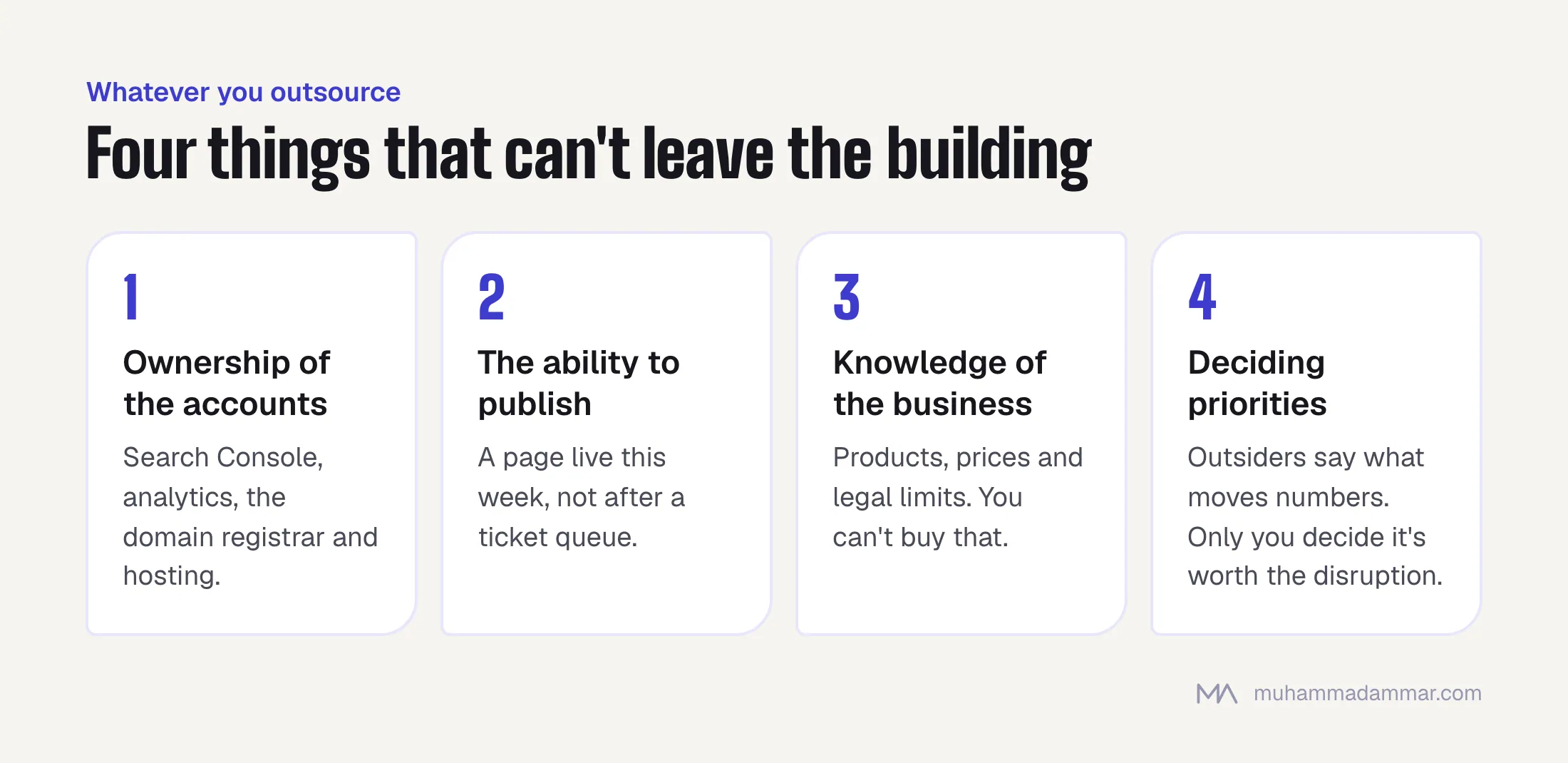
- Ownership of the accounts: Search Console, analytics, the domain registrar and the hosting. If the supplier owns these, you’re renting your own history.
- The ability to publish. Someone inside must be able to put a page live this week, without a ticket queue that stretches into next quarter.
- Knowledge of the business. Nobody outside knows your products, prices or legal limits. You can’t buy that.
- Deciding priorities. An outsider can tell you what will move the numbers. Only you can decide it’s worth the disruption.
What fits at each team size and stage
Rough guidelines, but they hold up in practice.
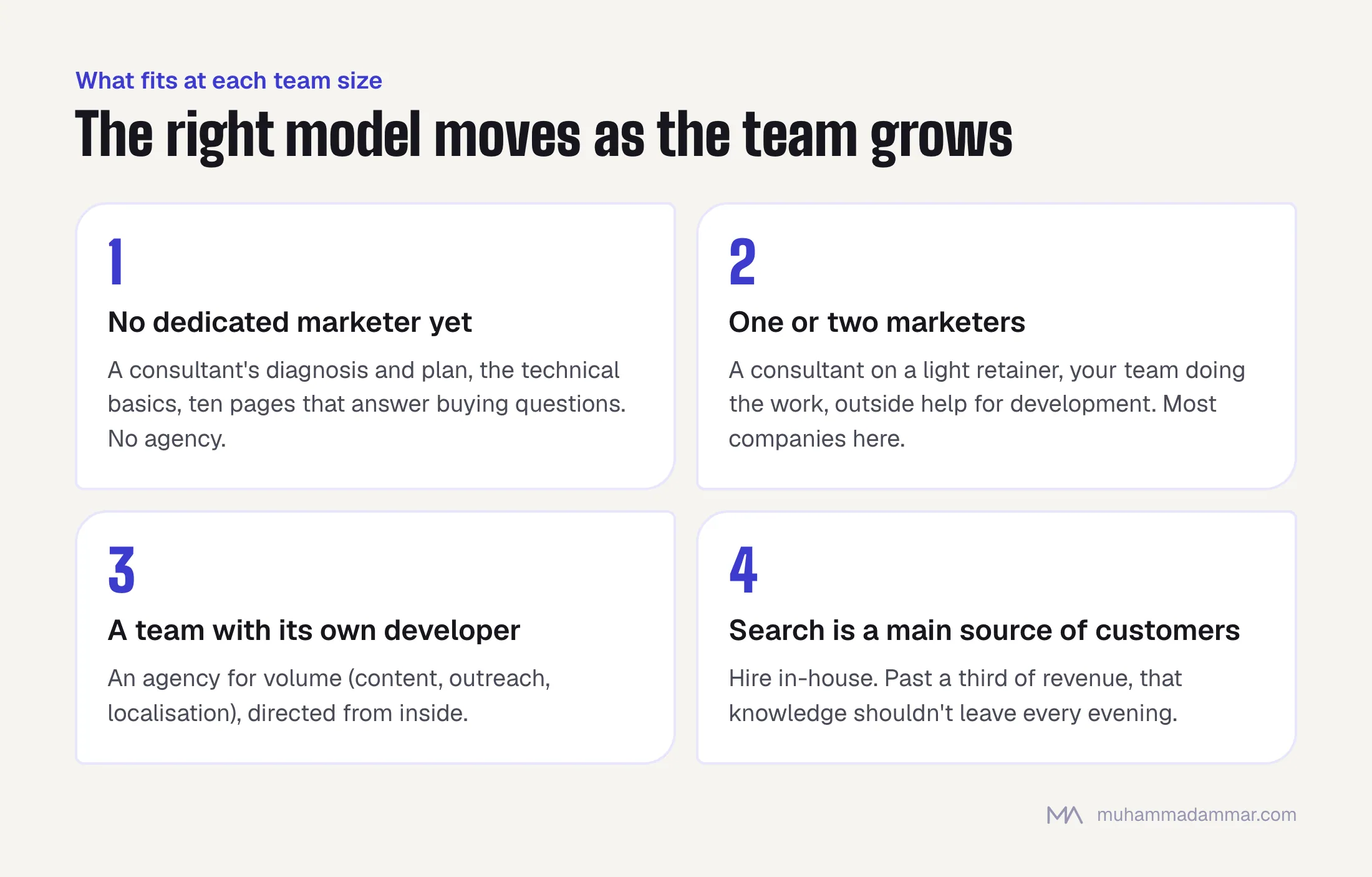
- No dedicated marketing person yet: don’t hire an agency. Buy a diagnosis and a prioritised plan from a consultant, fix the technical basics and publish ten pages that answer real buying questions. Anything bigger will be bought and then not implemented.
- One or two marketers, no SEO specialist: a consultant on a light retainer, your existing team doing the work, and outside help for development. Most companies in the region are here.
- A marketing team with its own developer: now an agency makes sense for volume, such as content, outreach and localisation, with someone inside directing it.
- Search is a main source of customers: hire in-house. If organic search brings in more than a third of revenue, that knowledge shouldn’t walk out of your building every evening.
Mixed setups that work
- An in-house owner with outside strategy. A mid-level marketer runs things day to day, and a consultant reviews monthly and sets direction. The cheapest good setup there is.
- A consultant sets the standard, an agency delivers to it. Works well for content in volume, especially two-language content, where quality control is the hard part.
- A fixed project, then in-house upkeep. A migration, technical rebuild or category overhaul, bought once and maintained by your team afterwards.
When each one is the wrong choice
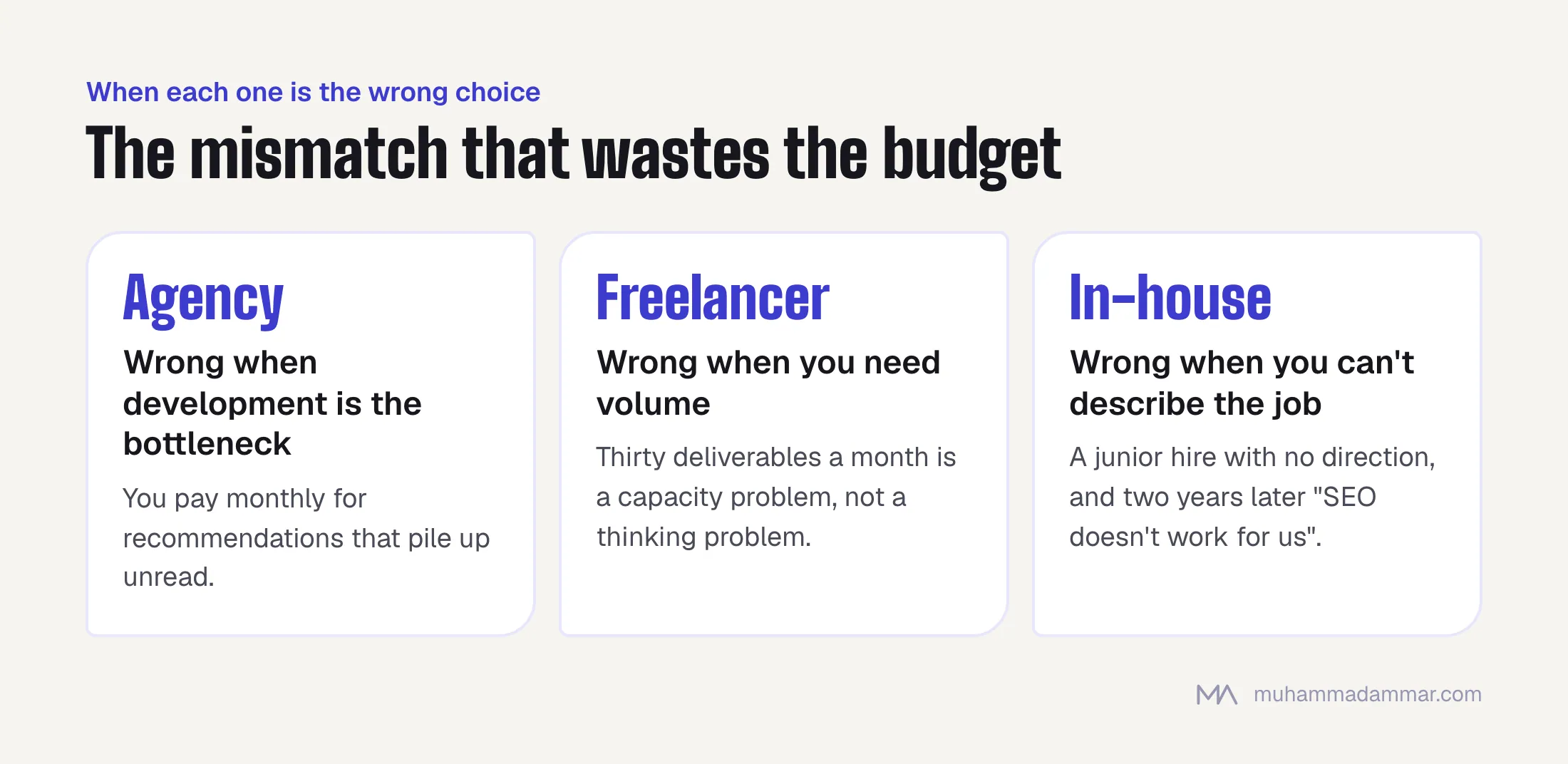
An agency is wrong when your bottleneck is development, not ideas: you’ll pay monthly for recommendations that pile up unread. A freelancer is wrong when you need thirty deliverables a month and someone to chase them, because that’s a capacity problem, not a thinking problem. In-house is wrong when you can’t yet describe what that person will be responsible for. You’ll hire someone junior, give them no direction and decide two years later that “SEO doesn’t work for us”.
To be specific about myself: if you need a big multilingual content operation, weekly design work and a team that can absorb a marketing director’s daily requests, hire an agency, not me. What I’m good for is diagnosis, direction, and the technical and Arabic-language work that goes wrong most often. My SEO consultant and digital marketing consultant pages describe that work.
If budget is what’s really holding you back, read what SEO actually costs in Egypt and Saudi Arabia before you shortlist anyone.
Frequently asked
Is an agency safer than a freelancer?
Safer against absence, not against poor work. An agency guarantees someone will answer, not that the person is experienced. Ask who does the actual work and how many accounts they handle. Twenty more questions like this are in how to interview an SEO when you are not one.
How long should a first contract be?
Long enough to see movement and short enough to leave: three months is reasonable, with a clear list of what will exist at the end. Twelve-month lock-ins with no exit clause are a warning sign in any model.
Can one in-house hire replace an agency?
Usually not in the first year. One person can’t match an agency’s output. What they can do is make sure the work that’s produced actually goes live.
What if we work in Arabic and English?
Then the deciding question is whether the supplier can write natively in Arabic, not translate. Ask to see Arabic pages they wrote that rank, not translated ones.
Who should own the reporting?
You. The supplier builds it, but the accounts, the dashboard and the raw data live in your workspace. Reports that only exist inside the supplier’s tools disappear the day the contract ends.
If you’d like a second opinion on which model fits your situation, including the answer “none of these yet”, message me.

SEO and digital marketing consultant since 2015, working with businesses in Egypt, Saudi Arabia and the UAE.
About the author and editorial standards