On this page
The hardest part of hiring an SEO is judging expertise you don’t have. You can tell whether a designer’s work looks good. You can’t tell whether a technical audit is competent or copied out of a tool. So you end up buying on confidence, and confidence is the one thing every bad supplier has plenty of.
Here are twenty questions that work even if you know nothing about search. For each, I’ve written the answer that should reassure you and the answer that should politely end the meeting. You’re welcome to ask me all twenty.
Questions about how they work
- What would you look at first on our site, and why?
Good: a specific starting point tied to your business, like “you’re an online store, so I’d start with how your category pages are indexed”. Bad: “we start with a full audit” with no idea what they expect to find. - What have you recently decided not to do for a client?
Good: a real example of turning down work that wouldn’t have paid off. Bad: “we do everything”. - How do you decide what to work on in month two?
Good: based on what month one showed. Bad: a fixed list of deliverables that’s the same for every client. - Who does the work, and how many accounts do they handle?
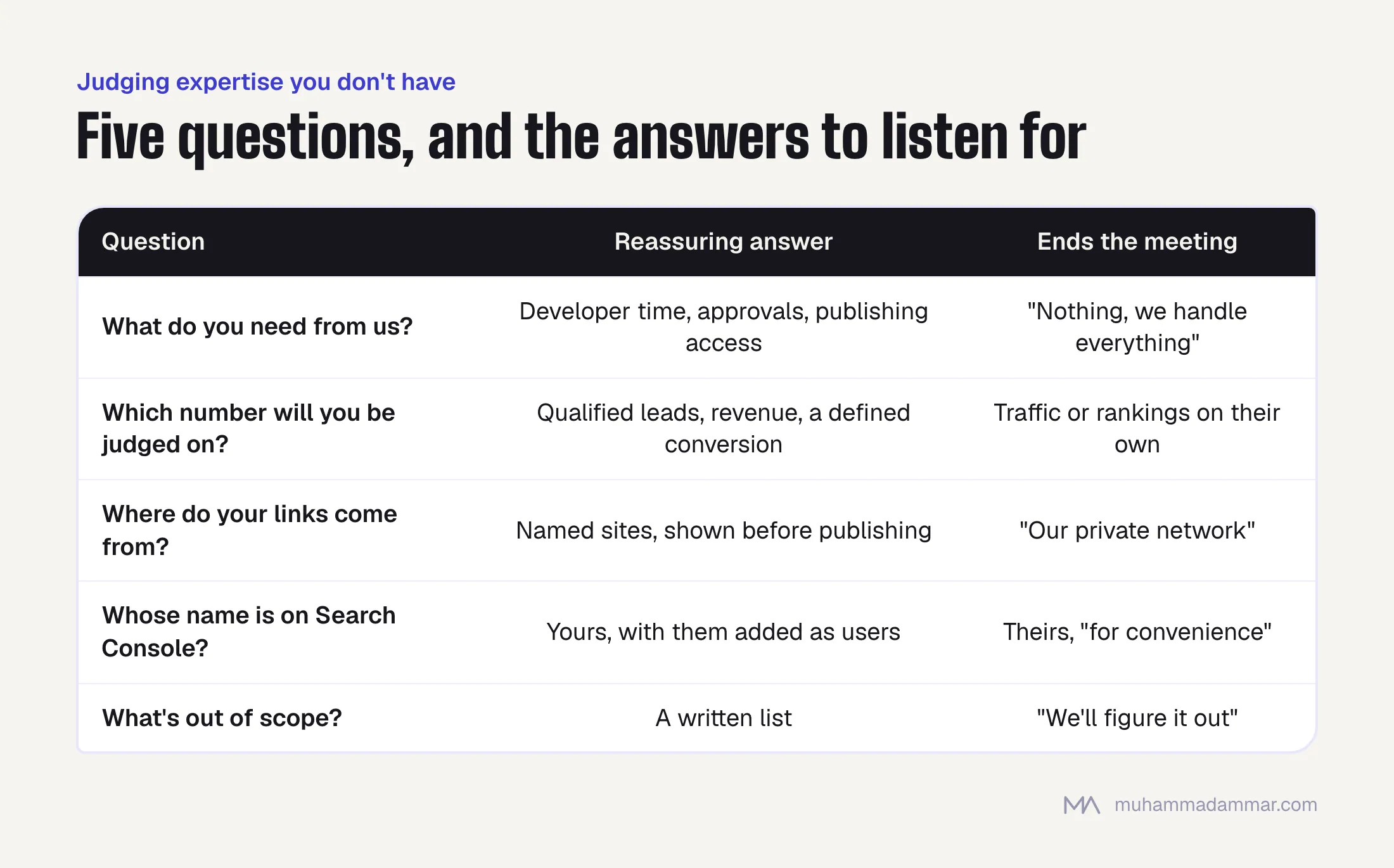
Good: a name, a level of experience and a number. Bad: a vague “our team”. - What do you need from us to do this well?
Good: a clear list, such as developer time, product knowledge, approvals and publishing access. Bad: “nothing, we handle everything”, which means nothing will go live.
Questions about measurement
- Which number will you be judged on?
Good: qualified leads, revenue or a clearly defined conversion. Bad: “traffic” on its own, or “keyword rankings”. - How will we know whether your changes caused the result?
Good: an honest admission that SEO results are partly a matter of inference, plus how they’ll separate the effect, using dated notes, page-by-page comparison and control groups where possible. Bad: total certainty. - What does a bad month look like, and what will you tell us?
Good: a concrete description of how they’d report a decline. Bad: the suggestion that there won’t be one. - How long before we see movement?
Good: different timelines for different work, such as weeks for technical fixes, months for new content and over a year for authority. Bad: one confident number. - Will you set up tracking or use what we have?
Good: they check what exists first, and say plainly if the current setup can’t measure what you care about.
Questions about links
- Where do your links come from?
Good: named sites, named methods and a willingness to show you before anything is published. Bad: “our private network” or “we have relationships” with no names. - Would this link exist if we hadn’t paid?
Good: an honest split between earned and paid placements, with paid ones marked properly. Bad: irritation at the question. - What happens to the links if we stop working with you?
Good: they stay, because they’re on real publications. Bad: anything that sounds like monthly rent.
If you want to know what you’re actually buying when someone quotes you a link package, I describe the regional market plainly in an honest map of the Arabic link market.
Questions about reporting and access
- Whose name is on the Search Console and analytics accounts?
Good: yours, with them added as users. Bad: theirs, “for convenience”. - Can we see the raw data, not just your dashboard?
Good: yes, straight away. Bad: a polished PDF with nothing underneath. - What will the monthly report contain?
Good: what was done, what changed, what’s next and what went wrong. Bad: a screenshot of a traffic graph and a list of “keywords improved”.
Questions about the contract and leaving
- What’s the notice period, and what do we keep?
Good: a short notice period, and everything produced is yours. Bad: content or tools that stop working when you leave. - Do you work with our competitors?
Good: a direct answer, and a clear exclusivity boundary if it matters. Bad: vagueness. - What’s out of scope?
Good: a written list. Bad: “we’ll figure it out”, which is where every dispute starts. - Who owns the content you write for us?
Good: you do, once paid, in writing.
Five answers that always rule a supplier out
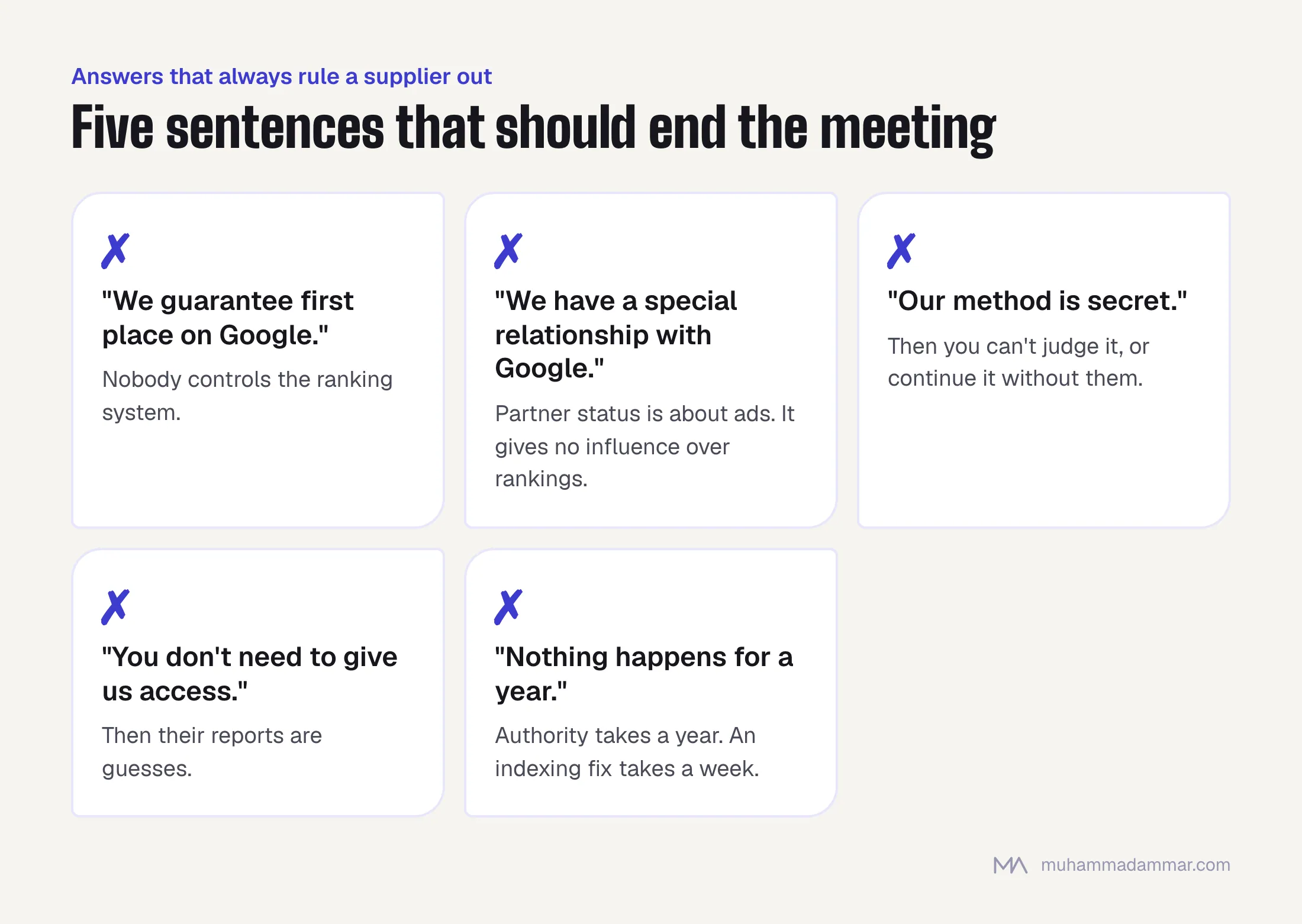
- “We guarantee first place on Google.” Nobody can. They don’t control the ranking system.
- “We have a special relationship with Google.” Google Partner status is about ads, and it gives no influence over rankings.
- “Our method is secret, we can’t explain it.” Then you can’t judge it, and you can’t continue it without them.
- “You don’t need to give us access to anything.” Then they can’t see your data, and their reports are guesses.
- “SEO takes at least a year before anything happens.” Authority takes a year. Fixing an indexing problem takes a week. This answer usually means they plan to bill quietly for twelve months.
Guaranteed rankings and other tricks
The guarantee usually hides in the wording. “First page within three months” is often measured on a keyword nobody searches, or on a personalised local result screenshotted from their own browser. Ask which exact search, measured how, from where, and whether it’s something a customer would actually type. If the answer starts to bend, you have your answer.
If you are still choosing between an agency, a freelancer and hiring in-house, start with three ways to buy SEO, and who each one fits.
The other half of this is budget. If you want to know what a competent engagement costs before you interview anyone, read what SEO costs in Egypt and Saudi Arabia. And my SEO audit and SEO consultant pages explain how I work, so you can hold me to the same questions.
Frequently asked
Should I ask for case studies?
Yes, but ask better than “do you have case studies?”. Ask where things started, what they changed and what didn’t work. Anyone can show a rising graph.
Is a cheap supplier always a bad one?
No, but cheap plus “we do everything” is a bad combination. A low price honestly buys a narrow scope, or dishonestly promises a wide one.
Should I start with a paid trial project?
Often that’s the best move. A paid audit or a small, defined project tells you more about how someone thinks than three sales calls.
How do I check their Arabic skills?
Ask for Arabic pages they wrote, not translated, that rank today, and ask them to explain one decision they made about the wording. The quality of their Arabic shows immediately in the answer.
What if they refuse to answer some of these?
Refusing one can be reasonable, for example to protect a client’s confidentiality. Refusing the questions about access, data ownership and where links come from isn’t.
Take this list to your next supplier call. If you’d like to try it on me first, message me and ask all twenty.

SEO and digital marketing consultant since 2015, working with businesses in Egypt, Saudi Arabia and the UAE.
About the author and editorial standards