On this page
The Arabic link market is worse than the English one, and the reason is structural, not moral. There are far fewer real Arabic publications with editorial standards than there are businesses that want links from them. Demand is much bigger than supply, so supply got manufactured.
This is a map of what’s actually out there: how the selling works, how to spot a network in ten minutes, what real coverage costs in time rather than fees, and what I wouldn’t buy at any price.
How the selling works
There are four models, roughly from least to most disguised.
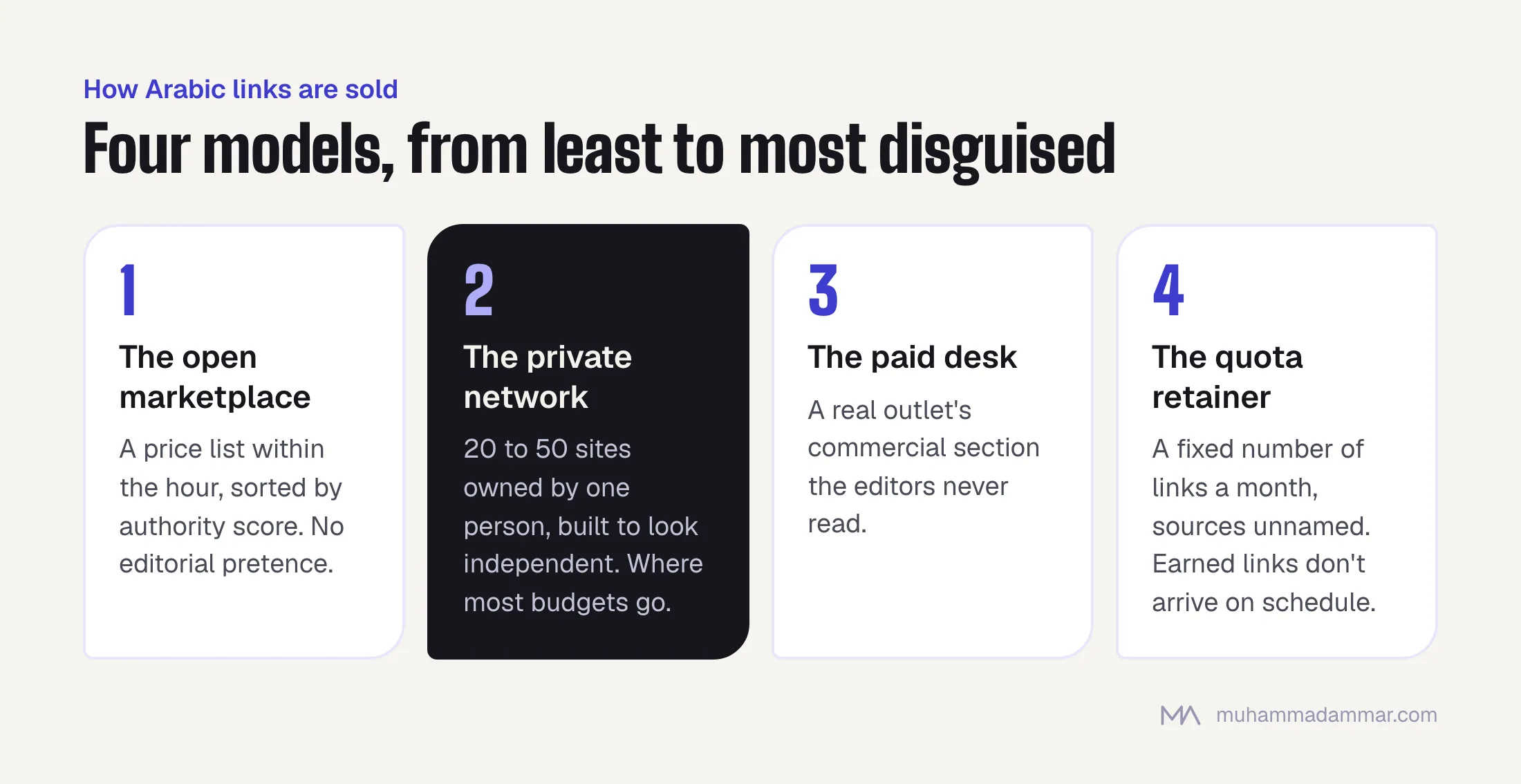
The open marketplace. A price list arrives within an hour of your enquiry: sites sorted by a third-party authority score, a price per placement, delivery in days. No pretence of an editorial process. Cheapest and most obvious.
The private network. Twenty to fifty sites owned by one person, built to look independent. Generic Arabic names, broad topics, cheap content in bulk. Sold as “editorial placements on Arabic news sites”. This is where most link budgets in the region end up.
The paid desk at a real publication. A genuine outlet with a quiet commercial arm. Your article appears in a section the editors never read, often labelled in a way most readers won’t notice. The publication is real, which is what you’re paying for, but the placement carries none of the editorial judgement that made the publication worth citing.
The agency retainer with unnamed sources. An agency promises a number of links a month without saying where from. Ask where, and the answer gets vague. The monthly quota gives it away: earned links don’t arrive on a schedule, so a supplier promising fifteen a month is telling you where they come from without meaning to.
Spotting a network in ten minutes
You don’t need tools for most of this. Take any site you’ve been offered and go down the list. Two or three hits is enough.
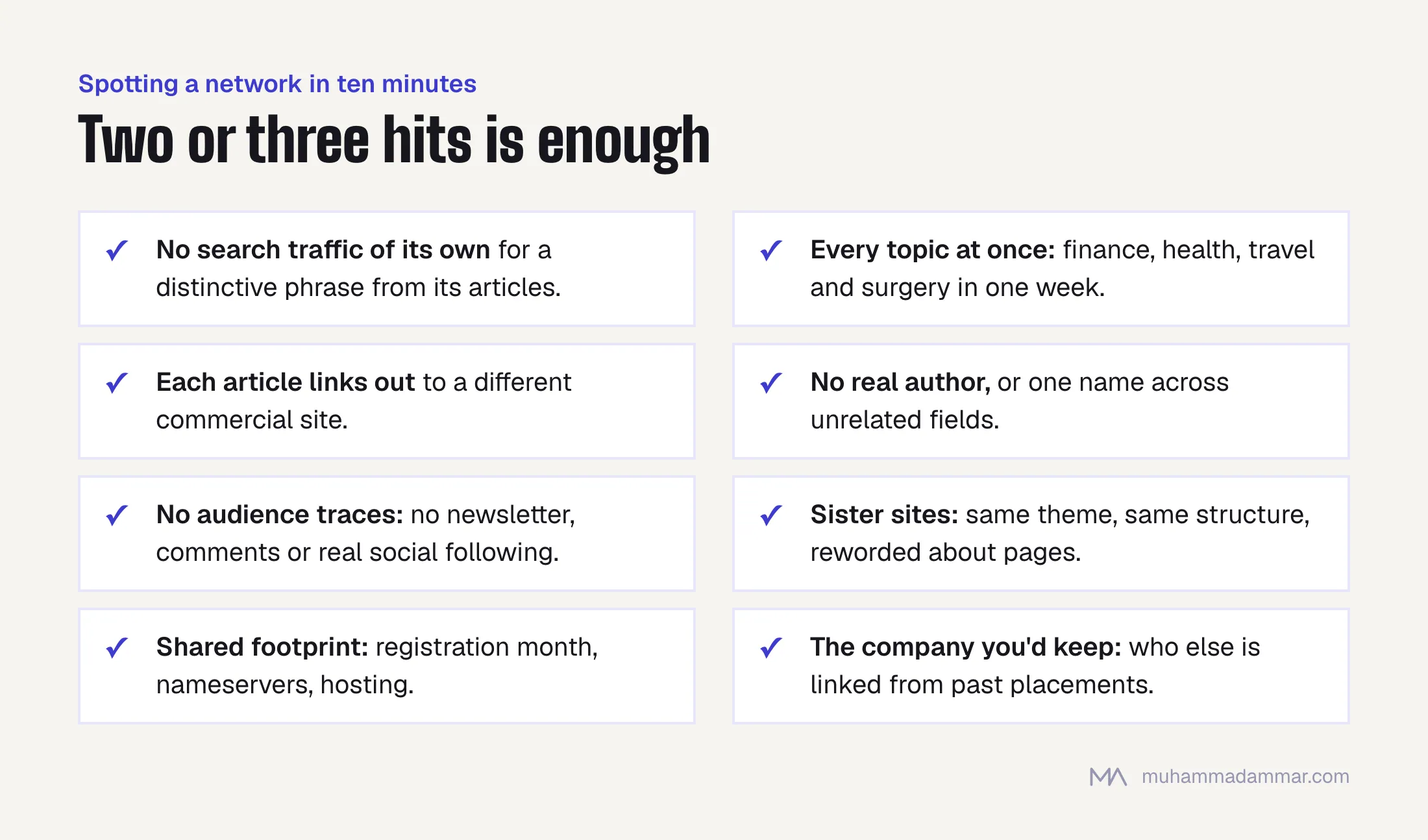
- Does it get search traffic of its own? Search a distinctive phrase from one of its articles. If the site doesn’t rank for its own content, it has no audience and no authority to pass on.
- Read three articles. Real publications have a focus. Networks cover finance, health, travel and cosmetic surgery in the same week, because the topics follow whoever paid.
- Check each article’s outbound links. If each one links to a different commercial site in an unrelated field, you’re looking at the business model.
- Look for an author who exists. No byline, a stock-photo byline, or twenty articles in unrelated fields under one name.
- Look for a real audience. No newsletter, no comments, social accounts that are empty or bought. A publication people read leaves traces.
- Compare the sites on the seller’s list. Same theme in different colours, same category structure, same “about” page reworded. Network owners reuse what works.
- Check the technical footprint. Domains registered in the same month, the same nameservers, the same hosting. Not proof on its own, but strong when it adds up with the rest.
- Ask for three previous placements, then look at who else is linked from those articles. One look at the company you’d be keeping usually settles it.
The fastest check is the first one. A site that can’t rank for its own content can’t help you rank for yours, whatever its authority score says. Those scores are the most gamed number in the industry, and gaming them is a business of its own in this market.
What real editorial coverage costs
Mostly not money. It costs the things that are actually scarce.
A story. Real coverage needs something worth covering: data nobody else has, a finding, or a position on something people disagree about. Not a company announcement. Most link building fails here, not at the outreach stage.
Relationships. Mass outreach works badly with Arabic media. Individual, relevant pitches in Arabic to a short list of journalists you actually follow work well. The list is small enough to build by hand, and it takes months to become useful.
Production time. Original data has to be gathered, checked and written up: a survey, a price index, an analysis of your own anonymised sales data. That’s weeks of work before you pitch anything.
A low hit rate. A good campaign with a real story gets picked up by a minority of the outlets you pitch. That’s normal, and it’s why contracts with monthly quotas push suppliers toward buying.
Compare that with a marketplace placement: same day, fixed price, guaranteed. Bought links dominate this market not because people can’t tell the difference, but because the alternative is slower and can’t be promised in advance.
Angles that work with regional media
What gets picked up by Gulf and Egyptian media, from most to least reliable.
Original regional data. By far the strongest angle, because Arabic business media is short of it. A survey of a few hundred businesses in your sector, a price index for your category, or an analysis of your own anonymised data. The lack of Arabic data is the whole opportunity, and it’s the same lack that makes original content valuable to AI assistants. I cover that in AI search in Arabic.
Expert comment on something happening now: regulation changes, platform changes, market events. You need to be on a journalist’s list before it happens, which is the relationship work above.
A contrarian view you can defend. Publications will run a well-argued disagreement with the consensus, and it travels further than agreement. This article is an example.
Local exclusives. Offering a story properly to one Arabic outlet first works better than sending it to twenty.
And one that doesn’t work, though it’s pitched most often: company milestones. Nobody outside your company cares about your funding round, new office or anniversary.
Unlinked mentions and links that follow the brand
A regional habit worth using: many Arabic outlets mention a brand without linking to it, sometimes because of house style, sometimes because their CMS makes links awkward.
Two things to do. A polite follow-up asking for the link converts a share of them for the cost of one email. And the mention has value even without a link, for brand recognition and, more and more, for AI assistants, which give independent mentions more weight than hyperlinks.
The bigger point: the links that last come from being worth mentioning, not from a programme run on the side. Brands that people talk about collect links without a campaign, and brands that don’t are buying a substitute for the real thing.
What I would never buy
Stated plainly, so there’s no confusion when it comes to a proposal.
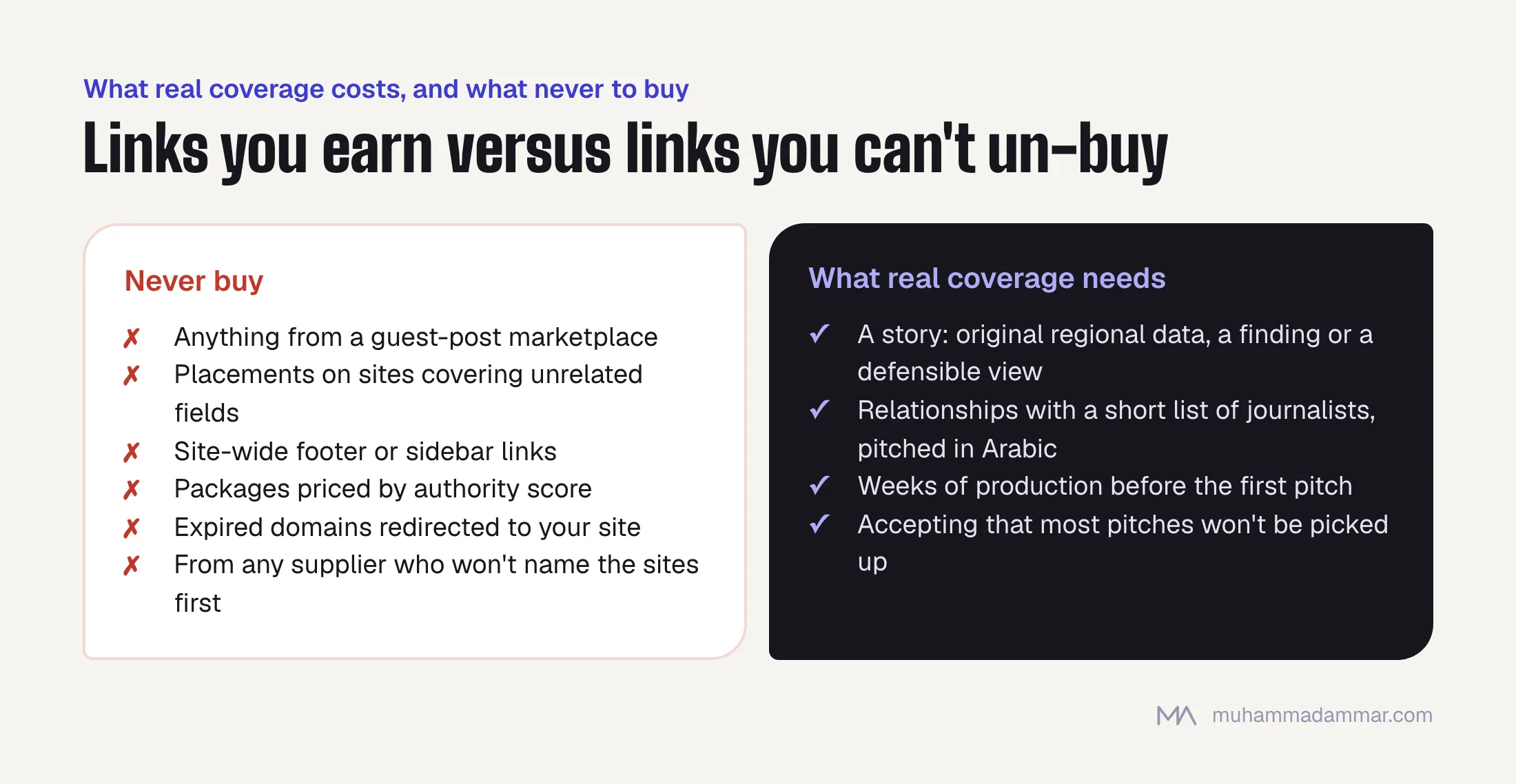
- Anything from a guest-post marketplace. The whole category.
- Placements on sites that publish across unrelated fields. The clearest single sign of a network.
- Site-wide footer or sidebar links. An obvious pattern, and has been for a decade.
- Packages priced by authority score. The score is the product, which tells you what was optimised.
- Expired domains redirected to your site. Cheap, effective for a while, and unrecoverable when it stops working.
- Comment, forum and profile links in bulk. Worthless more than dangerous, but you paid for them.
- Any supplier who won’t name the sites before you buy. The most reliable filter there is.
The argument against these isn’t mainly ethical. It’s that you can’t un-buy them. Links can only be disavowed, which is slow and uncertain, and rankings built on them come off faster than they went on. If the site is a short-term play you plan to abandon, the maths is different, so be honest with yourself about which one you’re running. It’s also how I run my own link building work.
Frequently asked
My competitor buys links and outranks me. Why shouldn’t I?
Often they do, and often it’s working right now. The question is how much of your business you want resting on something you can’t defend or remove. It’s also worth checking whether links are really the reason. People assume it often and check it rarely.
Are all paid links dangerous?
Paying for a link that passes ranking value breaks Google’s guidelines however it’s packaged. The risk depends on scale and footprint: a handful on real publications is a different exposure from two hundred across one network. I wouldn’t build on either.
How many links do I actually need?
Fewer than the market suggests, especially in Arabic, where competitors’ link profiles are often thin and bought. Look at what really ranks in your category first. The number is often smaller than the proposal assumes.
What about links from Arabic news sites?
Editorial ones, when you have a story worth running, yes. If you mean paid placements on news sites, that’s the third model above, and most of what’s sold as Arabic news coverage in this market is exactly that.
I’ve already bought links. What now?
Don’t panic and disavow everything. Audit what’s there, separate what’s truly toxic from what’s just low quality, try to get removals where you can, and disavow only the clear cases. Then build enough genuine links that the balance changes. It takes months, and it isn’t exciting.
Related: link building, SEO services and Arabic SEO. If you’ve been offered a link package and want a second opinion, send it to me.

SEO and digital marketing consultant since 2015, working with businesses in Egypt, Saudi Arabia and the UAE.
About the author and editorial standards