On this page
Internal linking is the one ranking factor you fully control, and most sites handle it by instinct: a writer remembers a related post, drops in a link and moves on. That works at thirty pages. At three hundred, authority ends up pooled in whichever articles happened to be memorable, and the pages you actually sell from are four clicks from anywhere.
What you want instead is a policy: a short set of rules a writer can follow without asking you, which builds a coherent structure as a side effect of normal publishing.
What internal links actually do
- Discovery. A page with no internal links pointing to it may be crawled rarely or never, whatever your sitemap says.
- Sharing authority. Links pass value between pages. Where you point them decides which of your pages can compete for anything.
- Topic signals. The anchor text and the sentence around it tell search engines what the linked page is about, often more reliably than the page’s own wording.
- Relative importance. A page linked from every article looks central; a page linked once from an archive looks minor. You get to decide which is which.
- What visitors do. That’s the point of it all, and why a link nobody clicks is worth less than one people do.
Depth, and why “three clicks” isn’t a rule
“Everything within three clicks” simplifies something true. What matters isn’t the number of clicks but whether a page can be reached through links a crawler will actually follow, often enough to be recrawled when it changes.
- A page five clicks deep but linked from three relevant articles is better off than a page two clicks deep that you can only reach through a paginated archive.
- Pagination is where depth quietly explodes. Page forty of a blog archive is forty clicks deep in practice, and anything reachable only from there is effectively orphaned.
- Navigation links count, but less, because they appear on every page and so single nothing out.
- A link in the body text, inside a relevant sentence, is the strongest internal link you can make.
So measure reachability, not depth. Crawl the site and list every URL that can only be reached through pagination or only through the sitemap. That list is your real problem.
Arabic anchor text and changing word forms
This is where general internal-linking advice stops helping, because English advice assumes words have one or two forms. Arabic words have many.
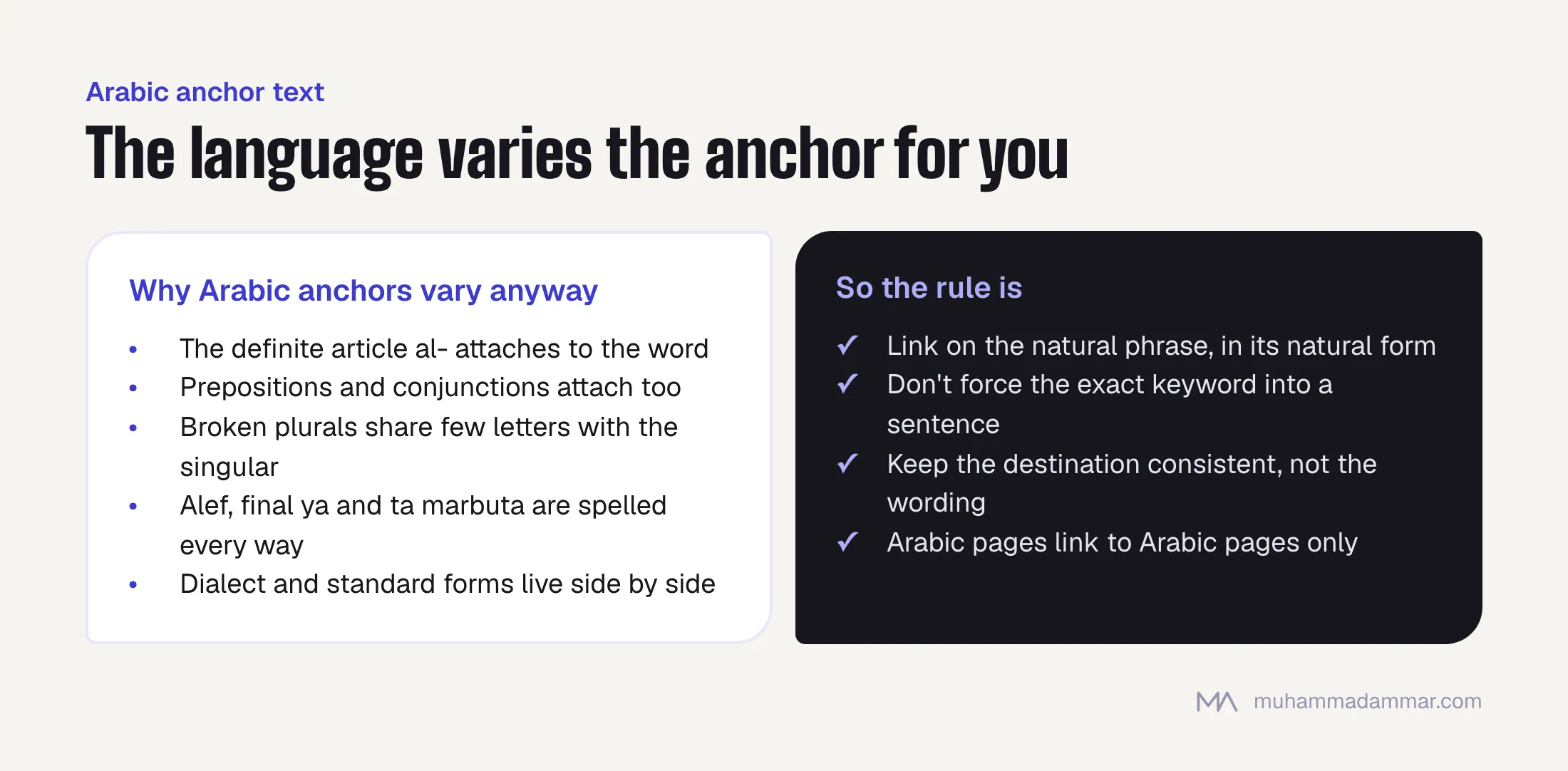
- The definite article attaches to the word. A term with and without the article al- is written as one word either way, so the two forms look less alike to a simple matcher than they really are.
- Prepositions and conjunctions attach too. The same noun can appear with several prefix letters, each making a different string.
- Broken plurals aren’t the singular plus an ending. A plural may share few letters with its singular, so they look like different words.
- Spelling varies all the time. Different forms of alef, the two forms of final ya, ta marbuta and ha: real users write all of them, and so do your writers.
- Dialect and standard forms live side by side. The word a customer searches may not be the word an editor would write.
The practical result is the opposite of what people worry about. In English the advice is to vary anchor text; in Arabic the language varies it for you whether you like it or not. So the rule is: link on the natural phrase in its natural grammatical form, don’t force the exact keyword into a sentence where it doesn’t fit, and don’t try to use an identical anchor every time, or you’ll get stiff Arabic for no gain. Keep the destination consistent, not the wording.
One firm rule alongside that: Arabic pages link to Arabic pages and English pages to English pages. People move between languages through the language switcher and hreflang, never through a link in the text. Mixing them drains the Arabic pages’ authority into the English side and drops the reader into a language they didn’t ask for.
Hub pages, and where authority should collect
Decide on purpose which pages should be strong. For most consulting and service businesses that’s the service pages and two or three pillar articles, not the newest post.
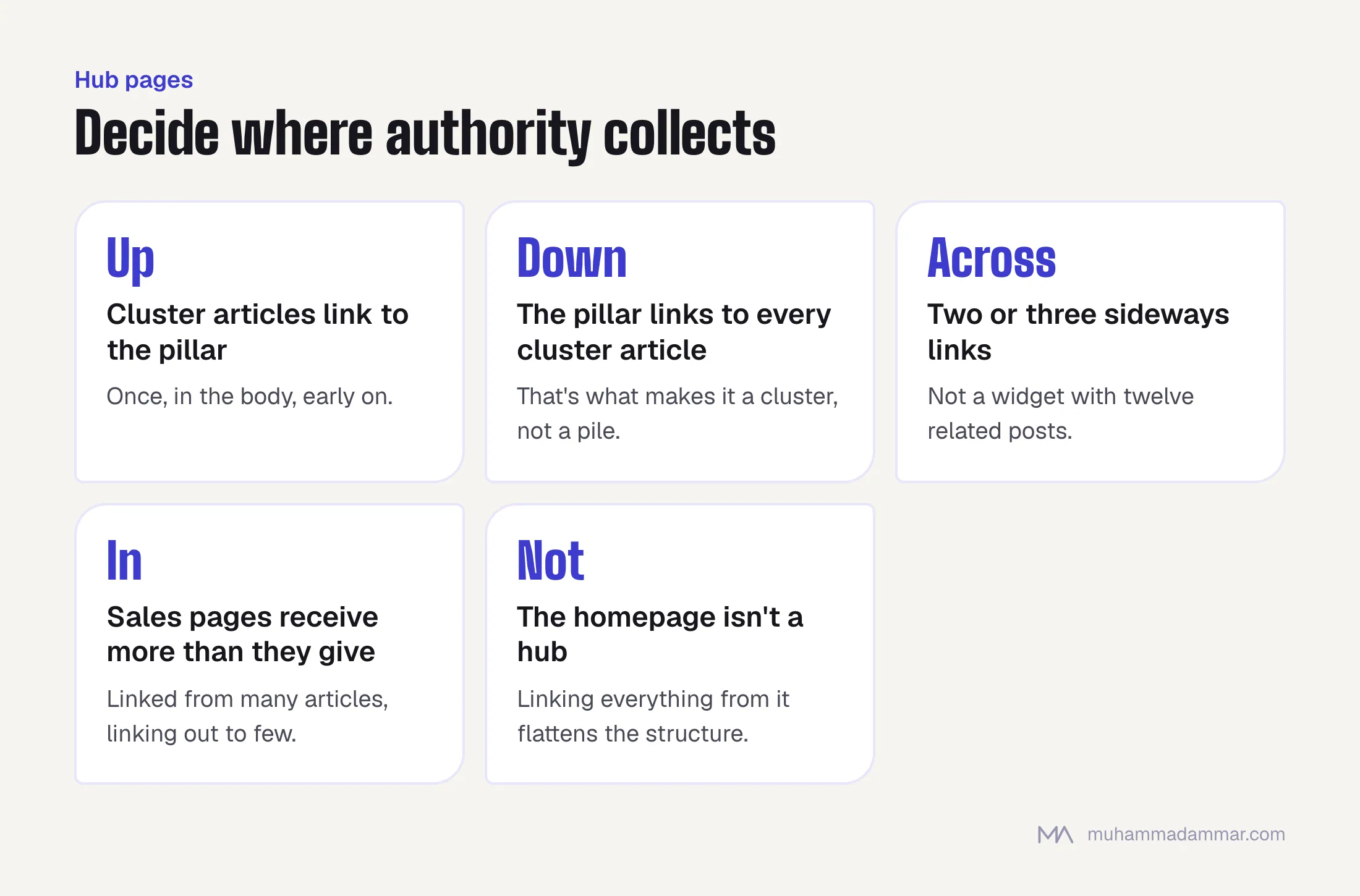
- Every cluster article links up to its pillar once, in the body, early on.
- The pillar links down to every article in its cluster. That’s what makes it a cluster and not a pile.
- Articles link sideways sparingly: two or three genuinely related articles, not a related-posts widget with twelve.
- Sales pages receive more links than they give. A service page should be linked from many articles and link out to few.
- The homepage isn’t a hub. Linking everything from the homepage gives you a flat structure where nothing signals importance.
The cluster structure behind this is described in topical clusters, built properly. This article is the day-to-day half of it.
Finding orphan pages and dead ends
- Orphans: crawl the site and list every URL in the sitemap that the crawl didn’t reach through links. Each one is either missing a link or shouldn’t be indexed.
- Near-orphans: pages with exactly one internal link, usually from a category archive, which is barely better than nothing.
- Dead ends: pages with no internal links going out. Common on older posts written before the cluster existed.
- Internal links through redirects: internal links pointing to URLs that redirect. Cheap to fix, and they pile up every time someone merges a page.
- Broken internal links: obvious, but they appear constantly after any URL change, and nobody notices because the writer who added them has moved on.
Do this every quarter. It takes an hour with any crawler, and it’s the most productive hour in technical maintenance.
A policy your writers can follow without you
Short enough to fit on one page, or nobody will follow it:
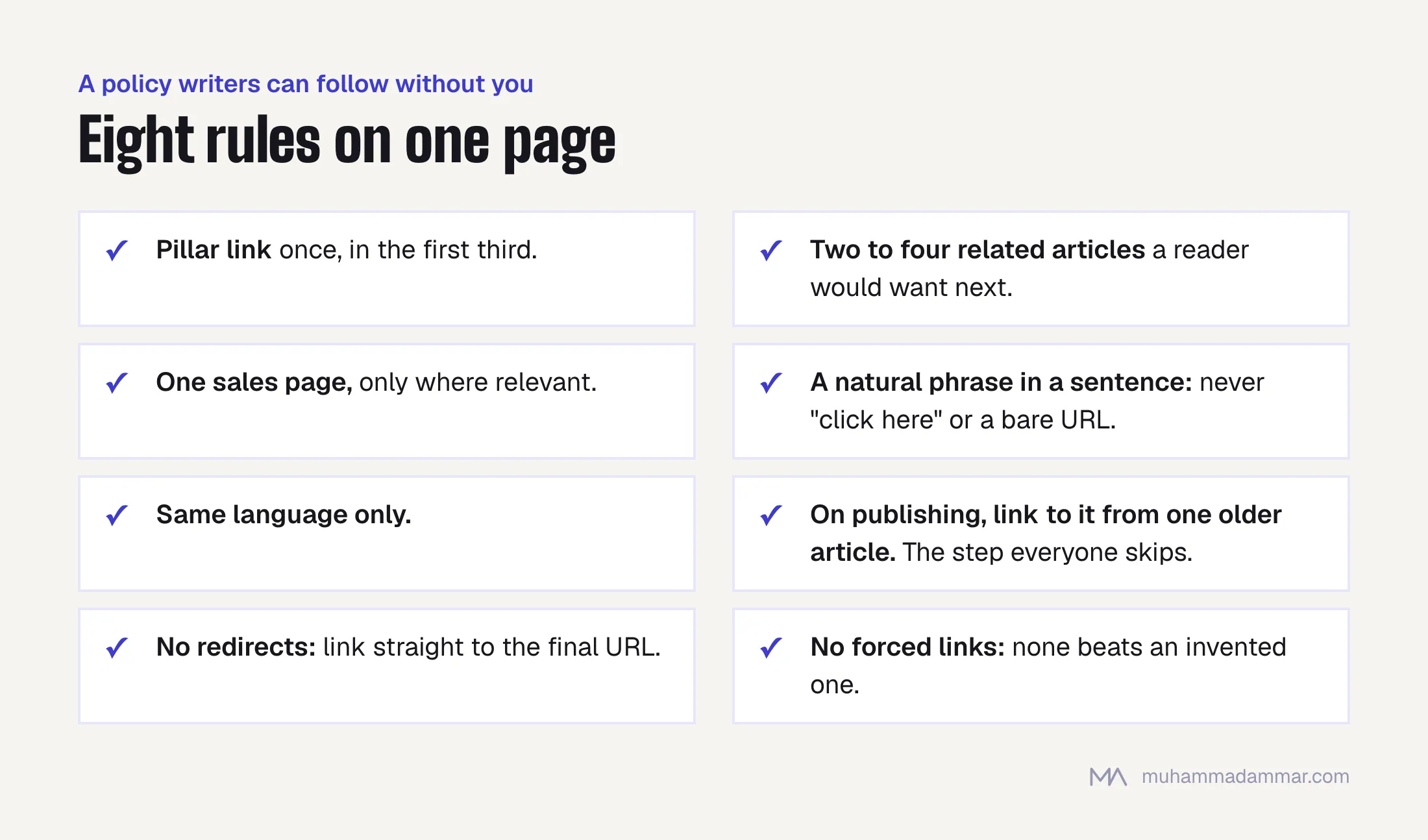
- Every article links to its pillar page once, in the first third.
- Every article links to two to four other articles, chosen because a reader would genuinely want them next.
- Every article links to exactly one sales page, where it’s relevant. If no service page is relevant, none.
- Link on a natural phrase inside a sentence. Never “click here”, never a bare URL, never a whole paragraph.
- Same language only: Arabic to Arabic, English to English.
- When you publish, add one link from an older article to the new one. Everyone skips this step, and it’s the one that prevents orphans.
- Check the link goes straight to the page, without a redirect.
- If you can’t think of a relevant link, don’t invent one. A forced link is worse than none.
Rule six is the whole policy in miniature. A site where every new article gets one link pointing to it on the day it’s published never develops an orphan problem, and no audit can make up afterwards for what that habit does continuously.
Structural work like this is part of ongoing SEO, and the crawling and reachability side is technical SEO.
Frequently asked
How many internal links should a page have?
As many as are genuinely useful, which on a normal article is a handful. There’s no penalty threshold worth worrying about. There’s a usefulness threshold, and readers hit it before any algorithm does.
Do related-posts widgets count?
Weakly. They’re automatic, appear in the same place on every page and are rarely relevant enough to get clicked. One link in the text beats twelve of them.
Should I use automatic internal-linking plugins?
Carefully, and very carefully in Arabic, where keyword-matching plugins mishandle attached prefixes and put links on fragments of words. Use them to suggest links, not to insert them.
Does nofollow on internal links help?
No. Steering internal link value with nofollow stopped working long ago. If a page shouldn’t receive authority, don’t link to it, or don’t index it.
How long before internal linking changes show results?
Faster than most SEO work. The pages need to be recrawled, so a few weeks. Fixing orphan pages on an established site often shows movement sooner.
Want to know how many of your pages have nothing linking to them? Message me.

SEO and digital marketing consultant since 2015, working with businesses in Egypt, Saudi Arabia and the UAE.
About the author and editorial standards