On this page
Pillar-and-cluster is a simple idea that most sites build as a folder structure and a diagram: one big page about a topic, some smaller pages under it, a few links. Then nothing happens, and the conclusion is that clusters don’t work.
The shape isn’t what makes a cluster work. What does is careful keyword mapping underneath it, the order you publish in, and a linking rule someone can still follow six months later.
The example throughout is this site’s Arabic SEO cluster, because showing a real plan is more useful than describing an imaginary one.
What “topical authority” actually means
It’s worth being precise, because people use the term as if it were a score you build up.
There’s no topical authority score. What there is: a search engine that has learned which subjects and subtopics really appear together in good content on a topic. A site that covers a topic completely, including the awkward, narrow, unexciting parts, looks different from a site that covered the three most-searched questions and stopped.
Three things follow:
- Completeness beats volume. Eight pages that cover a topic properly beat forty that circle the same three questions.
- The boring subtopics matter. They’re what completeness looks like, and they’re the ones competitors skip.
- Internal links are how you show the relationship. Without them you have pages about a topic, not a cluster.
Choosing the cluster’s boundary
This is the first real decision, and it quietly decides whether the cluster can be built at all.
Too broad and you can’t write the pillar: “digital marketing” isn’t a cluster, it’s a career. Too narrow and there’s nothing to cluster around. A workable test: the boundary is right when you can write one page that properly introduces the whole subject in about two thousand words, and you can name six to twelve subtopics that each deserve their own page.
Two more conditions matter more than they sound:
It has to lead to something you sell. A cluster with no sales page at the end is a content project, not marketing. Every cluster I build points to a service page.
It has to be a topic you can win. Pick the subject where you know things others don’t. A cluster where you’re the fifth-best source takes years. One where you’re clearly the strongest voice takes months.
For this site the boundary is Arabic SEO: narrow enough to cover completely, broad enough to support a cluster, tied to a service, and the subject where the competition is thinnest compared with what I can write.
Mapping keywords to URLs without pages competing
This step decides everything, and people skip it because it’s dull.
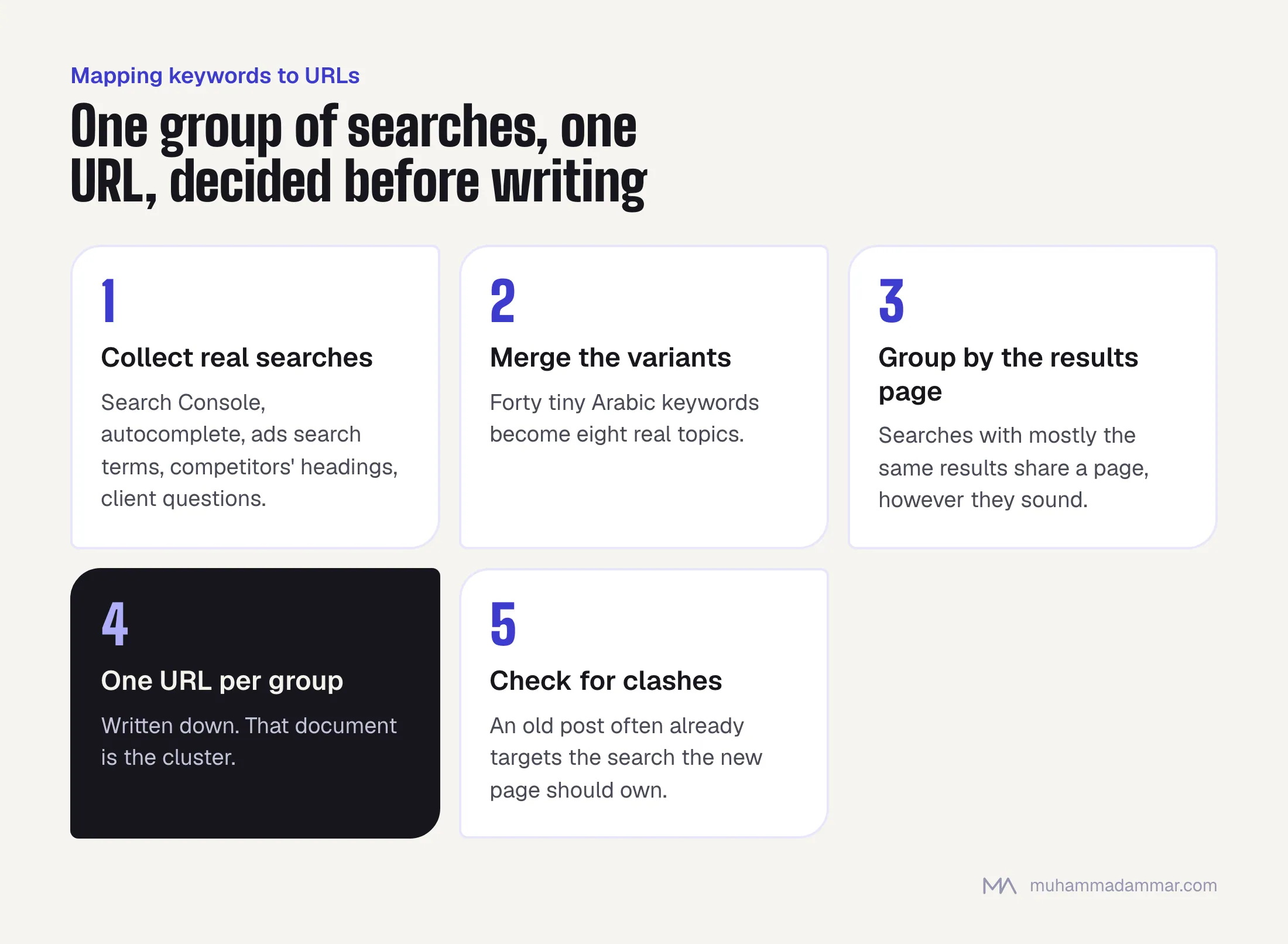
- Collect real searches: Search Console, autocomplete from the target country, ads search terms, competitors’ headings and what clients actually ask. Not a translated starter list. In Arabic, that step alone decides whether the cluster targets real demand.
- Merge the variants: spellings, the definite article, word forms. Before merging, an Arabic cluster looks like forty tiny keywords. Afterwards it looks like eight real topics. The method is in Arabic keyword research.
- Group by what the results page shows, not by what the words mean. Two searches that return mostly the same results belong on one page. Two that return different kinds of results don’t, however similar they sound.
- Give each group exactly one URL, and write it down. That document is the cluster.
- Check for clashes with what you already have. Most competing pages are inherited: an old post already targets the search your new page is meant to own.
The rule that stops pages competing isn’t “avoid similar topics”. It’s one group of searches, one URL, decided before anything is written. Pages competing with each other is almost always a planning mistake that shows up months later as a content problem.
The pillar page, and why it goes out second
The pillar introduces the whole subject and sends readers to the detail. It should work on its own, cover every subtopic well enough to satisfy someone who reads only that page, and link to each supporting page with descriptive anchor text.
It shouldn’t be a table of contents with two sentences per section. A pillar that’s only a hub has nothing to rank with.
The publishing order is the part people ignore. The instinct is to write the pillar first because it’s the centre. That gives you a pillar with nothing to link to, pointing at pages that don’t exist yet.
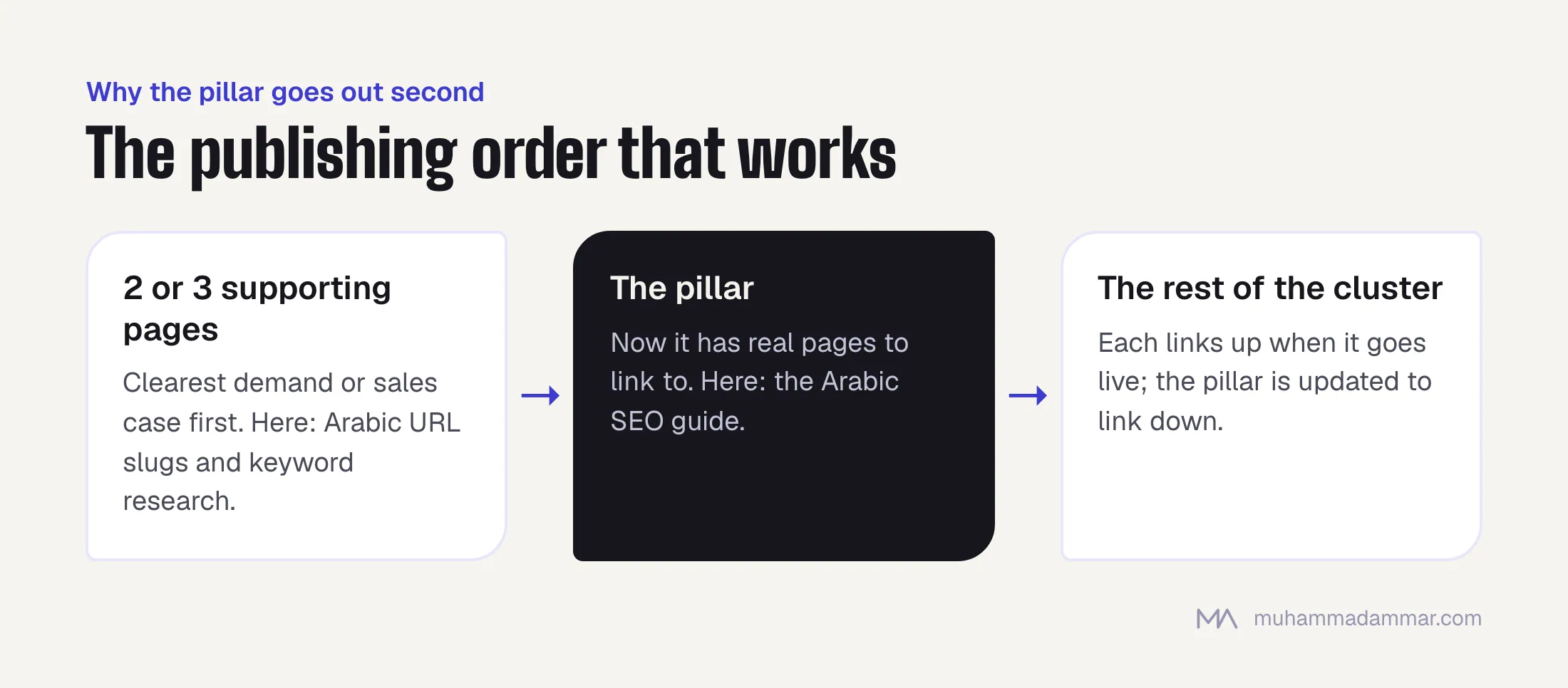
The order that works: two or three supporting pages first, chosen for the clearest demand or sales case. Then the pillar, which now has real pages to link to and can be written knowing what it introduces. Then the rest of the supporting pages, each linking up to the pillar when it publishes, with the pillar updated to link down to it.
On this site that meant Arabic URL slugs and Arabic keyword research first, then the Arabic SEO guide as the pillar, then the rest, for exactly the reason above.
Linking rules a writer can follow
The rules have to be simple enough to survive being handed to someone else. Five is about as many as people follow.
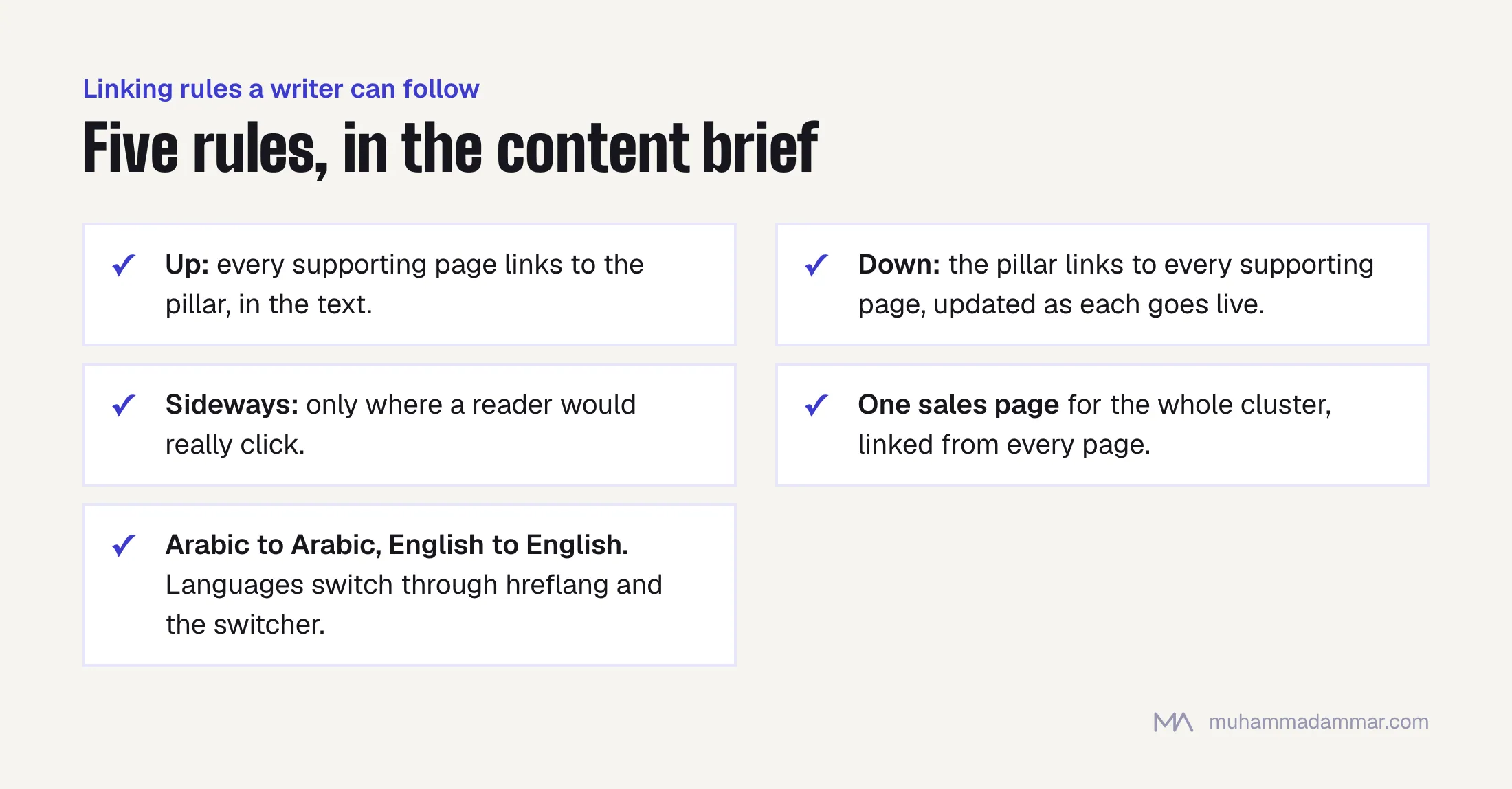
- Every supporting page links up to the pillar, in the text, with descriptive anchor text.
- The pillar links down to every supporting page, updated as each one goes live.
- Supporting pages link sideways only where a reader would really click. Not every page to every other page. That waters the signal down and reads as automated.
- Every page in the cluster links to exactly one sales page, the same one for the whole cluster.
- Arabic links to Arabic, English links to English. People switch languages through hreflang and the language switcher, never through links in the text. Without this rule, a two-language cluster leaks its internal authority to whichever language was built first.
Put those five rules in the content brief, not in a strategy document. A rule that lives in a slide deck isn’t a rule.
Measuring how the cluster is doing
Measure the cluster, not single pages. Judging individual pages in the first months leads to the wrong decisions, because early pages carry the cluster and later pages benefit from it.
- Total impressions across the cluster’s searches. The earliest signal, moving within weeks of each page going live.
- How many different searches the cluster ranks for. Growing breadth is the clearest sign your coverage is being recognised, and it usually moves before positions do.
- The pillar’s average position. The pillar is the slow indicator. It should improve as the cluster fills out. If it doesn’t once the cluster is complete, the pillar itself is the problem.
- Competing pages. Filter by search and check that one URL ranks, not two taking turns. Two URLs swapping places is the classic sign that the mapping was wrong.
- Visits from cluster pages to the sales page. The one that matters. A cluster that earns impressions and sends nobody to the service page has failed at its only job.
How long it takes
Honest ranges for a site with some existing authority, in a market with thin competition.
Individual pages start getting impressions within weeks. Supporting pages settle into position somewhere around three to six months. The pillar takes longest, usually six to nine months, because broad pages need the cluster under them before they win the broad search.
Three things stretch that out: publishing slowly, so the cluster takes a year to finish; a new domain with no authority; and a competitive English-language space, where these timelines can double. Arabic clusters in under-served categories sit at the fast end, which is the strategic case for building them now.
The most common reason a cluster fails isn’t any of this. It’s being abandoned: four pages published, momentum lost, the other six never written. A half-built cluster does worse than a well-chosen standalone page, because it carries the cost without the completeness.
Frequently asked
How many pages does a cluster need?
Six to twelve supporting pages plus a pillar, for most topics. Fewer and the coverage isn’t convincing. More and you’re probably describing two clusters.
Does the pillar have to be long?
Long enough to cover every subtopic for someone who reads only that page. That usually comes to two to three thousand words in English and somewhat fewer in Arabic, which is denser. Length is a result, not a target.
Can I build a cluster in Arabic and English at the same time?
Yes, as two clusters that mirror each other, each linking only within its own language. Not as one cluster with translated pages, because the keyword mapping differs, so the cluster’s shape differs too.
What if two pages start competing anyway?
Decide which should own the search, then either merge and redirect, or rewrite the other page for a genuinely different intent. Don’t keep both and hope. Pages taking turns cost you more than either would alone.
Should the pillar be a blog post or a service page?
Informational pillars work better as articles, with the service page as the sales destination the whole cluster links to. Making one page serve both purposes usually serves neither.
Related: keyword research and the internal linking policy that holds a cluster together. If you want a cluster planned for your site, message me.

SEO and digital marketing consultant since 2015, working with businesses in Egypt, Saudi Arabia and the UAE.
About the author and editorial standards