On this page
Keyword cannibalisation is one of the most over-diagnosed problems in SEO. Two pages ranking for the same term isn’t automatically a problem: Google happily shows two results from one site, and a well-built cluster always has overlapping terms. The real problem is narrower: Google can’t decide which of your pages answers a search and keeps swapping between them, so neither page builds up the signals it needs and both do worse than one page would have.
What it is, and what it isn’t
It’s cannibalisation when:
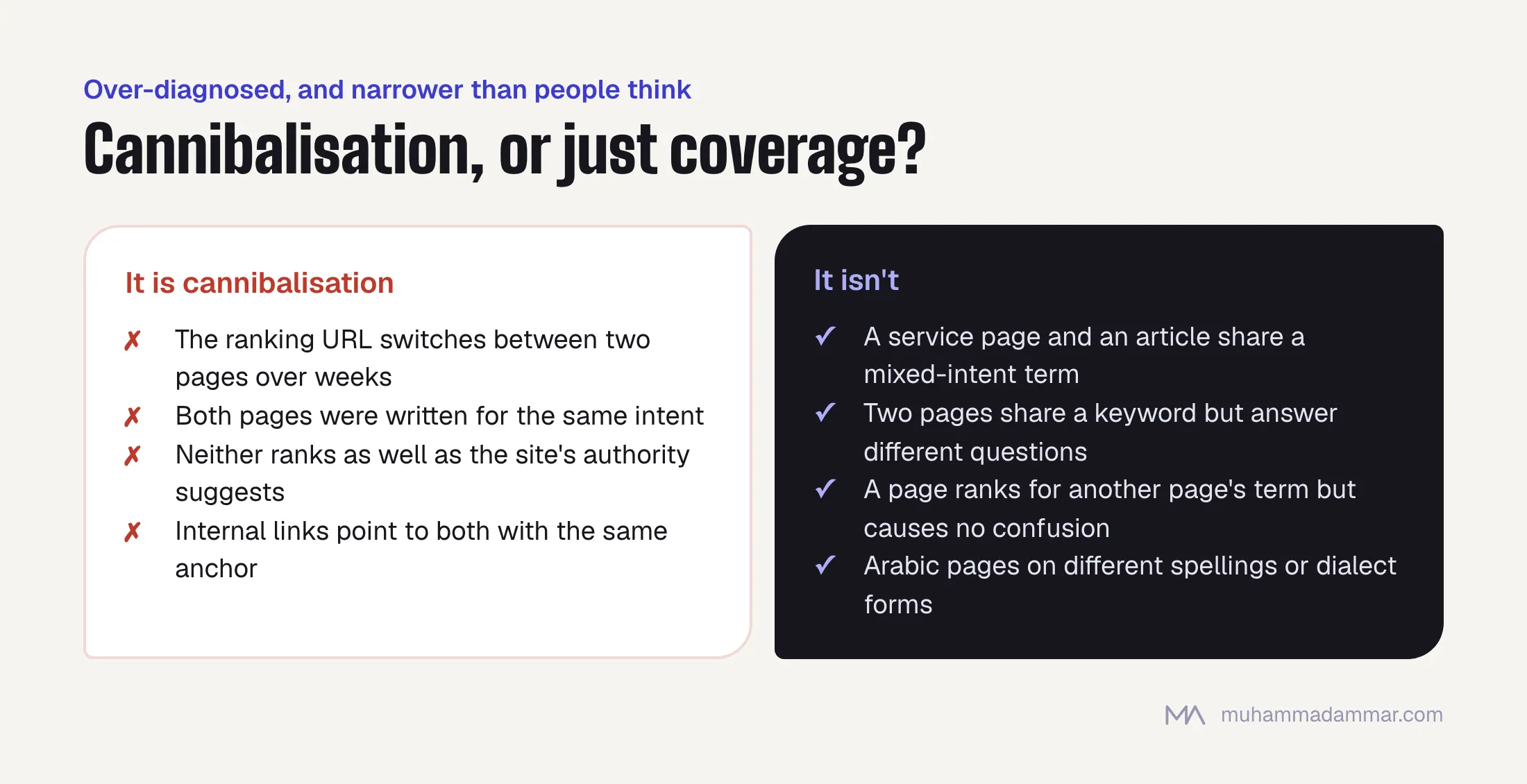
- The URL ranking for a search switches between two pages over several weeks.
- Both pages were written for the same intent, not different stages of it.
- Neither page ranks as well as you’d expect from the site’s authority.
- Your own internal links point to both pages with the same anchor text.
It isn’t cannibalisation when:
- A service page and an article both appear for a term with mixed intent. That’s coverage, and it’s good.
- Two pages share a keyword but answer different questions about it.
- A page ranks for terms that “belong” to another page but gets no clicks and causes no confusion.
- Rankings move around in general. Movement is normal. Switching back and forth between two specific URLs is the sign.
Arabic content has one more false alarm: two pages that seem to target the same keyword may target different spellings or dialect forms, each with its own searches. Check the actual searches before you merge anything.
Finding it in Search Console without paid tools
Everything you need is in the free data:
- Open the Performance report and set the dates to the last six months.
- Filter to one search term. Start with the ones that matter commercially.
- Open the Pages tab with that filter still on. If more than one URL appears, note them.
- Add each of those pages as a filter in turn, open the Dates view, and compare when each one was getting the clicks and impressions. Pages taking turns over the weeks is the diagnosis. One steady URL with a second one appearing now and then at low volume isn’t.
- Repeat for searches where your average position is worse than the site usually manages. That’s where cannibalisation hides.
Two quicker shortcuts. Export six months of search and page data and look for any search where impressions are split roughly evenly between two URLs. That split is the fingerprint. And run a site: search for the term, which shows which page Google currently thinks is the best answer. If that surprises you, you’ve found something.
Do this separately for each language. Arabic and English pages rarely compete with each other, because Google serves them to different searches, so run the analysis twice instead of mixing them.
Four fixes, and when each one applies
| Fix | Use when |
|---|---|
| Merge | Both pages serve the same intent and neither is clearly stronger. Combine them into the better URL and redirect the other. |
| Differentiate | The pages should serve different intents but currently don’t. Rewrite one to answer a genuinely different question instead of deleting it. |
| Redirect | One page is clearly redundant and adds nothing the other lacks. |
| Fix the signals only | Both pages have to exist for business reasons, such as a service page and a location page. Keep both, but fix the internal links and anchor text so each one clearly points to its own term. |
Deleting isn’t on the list. A page with any history should be merged or redirected, never just removed.
Merging without losing either page’s value
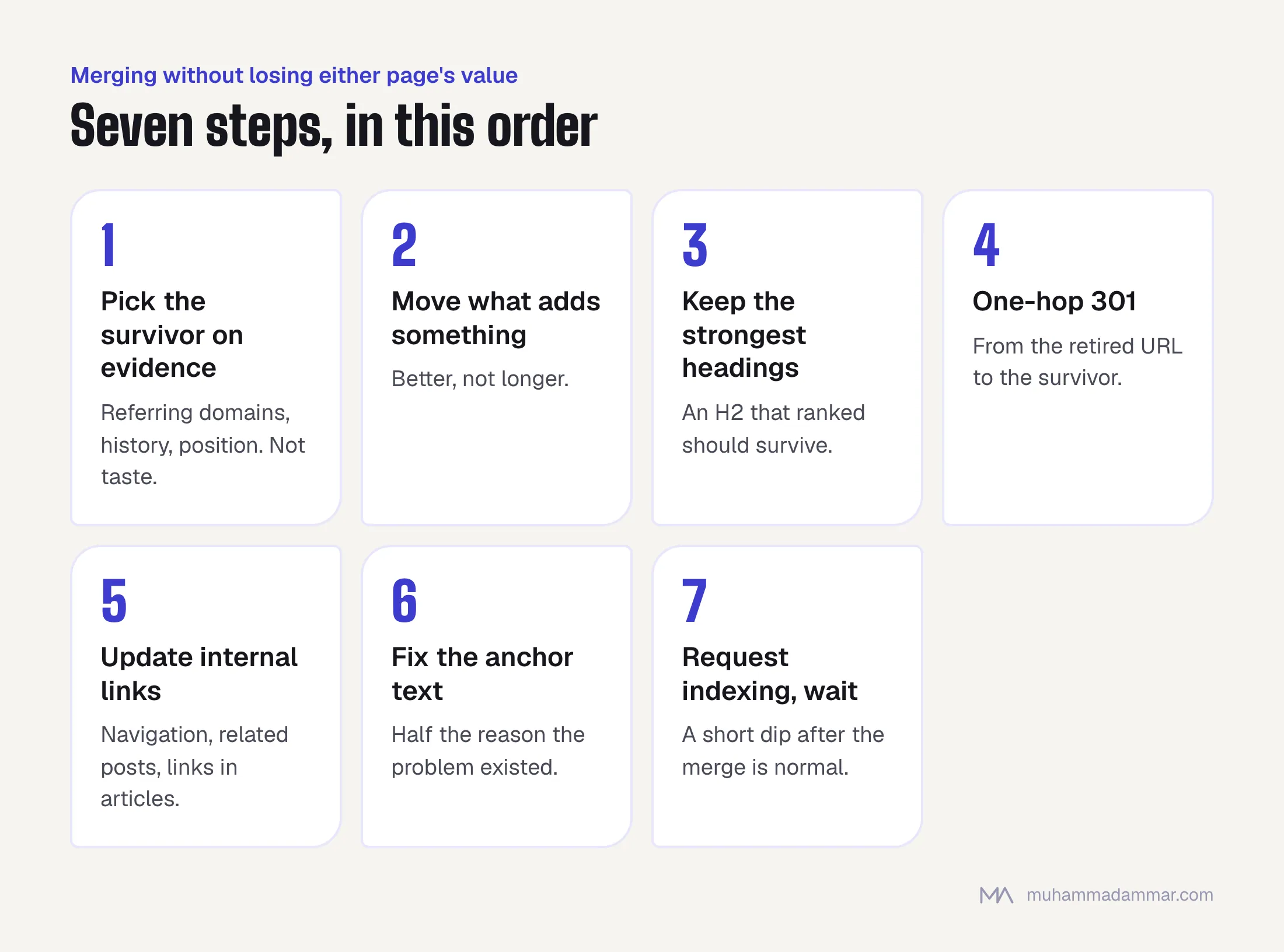
- Choose which page survives on evidence, not taste. Which URL has more referring domains, more history and a better position? That one stays, even if the other is better written.
- Move over the content that really adds something. Not everything: the merged page should be better, not longer. Sections that answered different sub-questions come across; repeated introductions don’t.
- Keep the strongest headings from both. If the other page ranked for a term because of a particular H2, that heading should exist on the surviving page.
- Add a one-hop 301 redirect from the retired URL to the surviving one.
- Update every internal link that pointed to the old URL, including navigation, related-post sections and links inside other articles. Leaving them creates redirect chains and keeps sending mixed signals.
- Fix the anchor text at the same time. All the internal links that used the same words for two pages now point to one, and that was half the reason the problem existed.
- Request indexing and wait. Recovery usually takes a few weeks, and a short dip right after the merge is normal.
Preventing it at the planning stage
Cannibalisation is almost always a planning mistake that shows up as a technical symptom. Four habits prevent nearly all of it:
- One main term per page, written down. Keep a simple map of page to main term, and check it before commissioning anything new. If the term is taken, the new piece needs a different angle or shouldn’t exist.
- Assign intent, not just keywords. Two pages can safely share a keyword if one is informational and the other is for buyers, as long as that was decided on purpose and not by accident.
- Write the linking rule with the plan. Decide which page each term should link to before anyone writes an anchor.
- Check before a big content push, not after. Adding twenty articles to a cluster without checking the existing map is the surest way to create this problem at scale.
That mapping discipline is the same one that makes clusters work, described in topical clusters, built properly. Finding cannibalisation fits naturally into an SEO audit, and the term-to-page map that prevents it is part of keyword research.
Frequently asked
Does having two pages rank for one term always hurt?
No. Two of your results on one page is more space, not less. The harm comes specifically when Google can’t settle on one and keeps switching.
Can canonical tags fix it?
Only for true duplicates. Pointing the canonical of one real page at another that also deserves to exist hides one of them instead of solving the problem.
How long after merging do rankings recover?
Usually a few weeks, with an early dip. If nothing has improved after two months, merging probably wasn’t the right fix.
Do category and tag archives cause it?
Often, yes, especially tag archives that repeat what categories cover. If an archive has no purpose of its own, it shouldn’t be indexable.
Should I check regularly, or only when something looks wrong?
Every quarter for your twenty most commercially important terms, and always before adding a lot of content to an existing cluster. Pages that are slowly losing ground are a different problem, covered in refreshing content without churning through it.
Got pages that seem to be fighting each other? Message me.

SEO and digital marketing consultant since 2015, working with businesses in Egypt, Saudi Arabia and the UAE.
About the author and editorial standards