On this page
Ask an AI assistant a buying question in English and it has a huge pool of pages to draw on. Ask the same question in Arabic and the pool of pages written in Arabic is much smaller. The assistant still answers, using translated English material, the few Arabic pages that exist, and whatever it learned in training.
If that’s true in your category, it’s an opening: one good Arabic page may be enough to become a source the assistants reach for. But “if” is doing a lot of work there, and the only way to know is to test it. This article is the test, written so you can run it yourself and repeat it every month.
The test: one question, two languages
Take a question a real buyer in your category would ask. Ask it in English. Then ask it in Arabic, phrased the way an Arabic-speaking buyer would phrase it, not translated word for word. Compare four things:
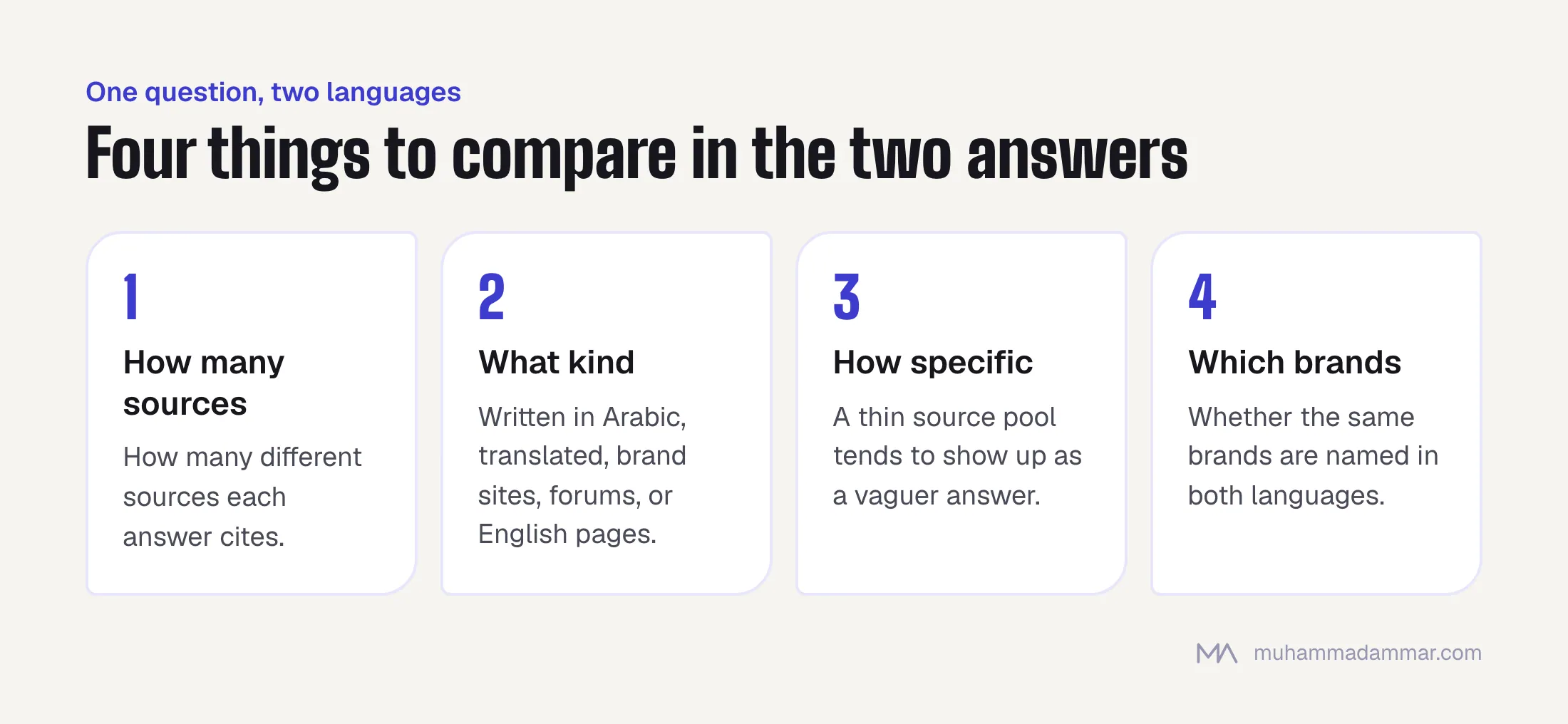
- How many different sources each answer cites.
- What kind of sources they are: pages written in Arabic, translated pages, brand sites, forums, or English pages answering an Arabic question.
- How specific each answer is. A thin source pool tends to show up as a vaguer answer.
- Which brands are named, and whether they’re the same in both languages.
What you’re looking for isn’t “Arabic answers are worse” in general. It’s the specific questions in your category where the Arabic sources are thin or translated. Those are your targets, and they’re usually not the obvious big keywords.
A method you can repeat monthly
Write this down so that someone else could run it and get comparable results. That’s what makes the numbers worth anything.
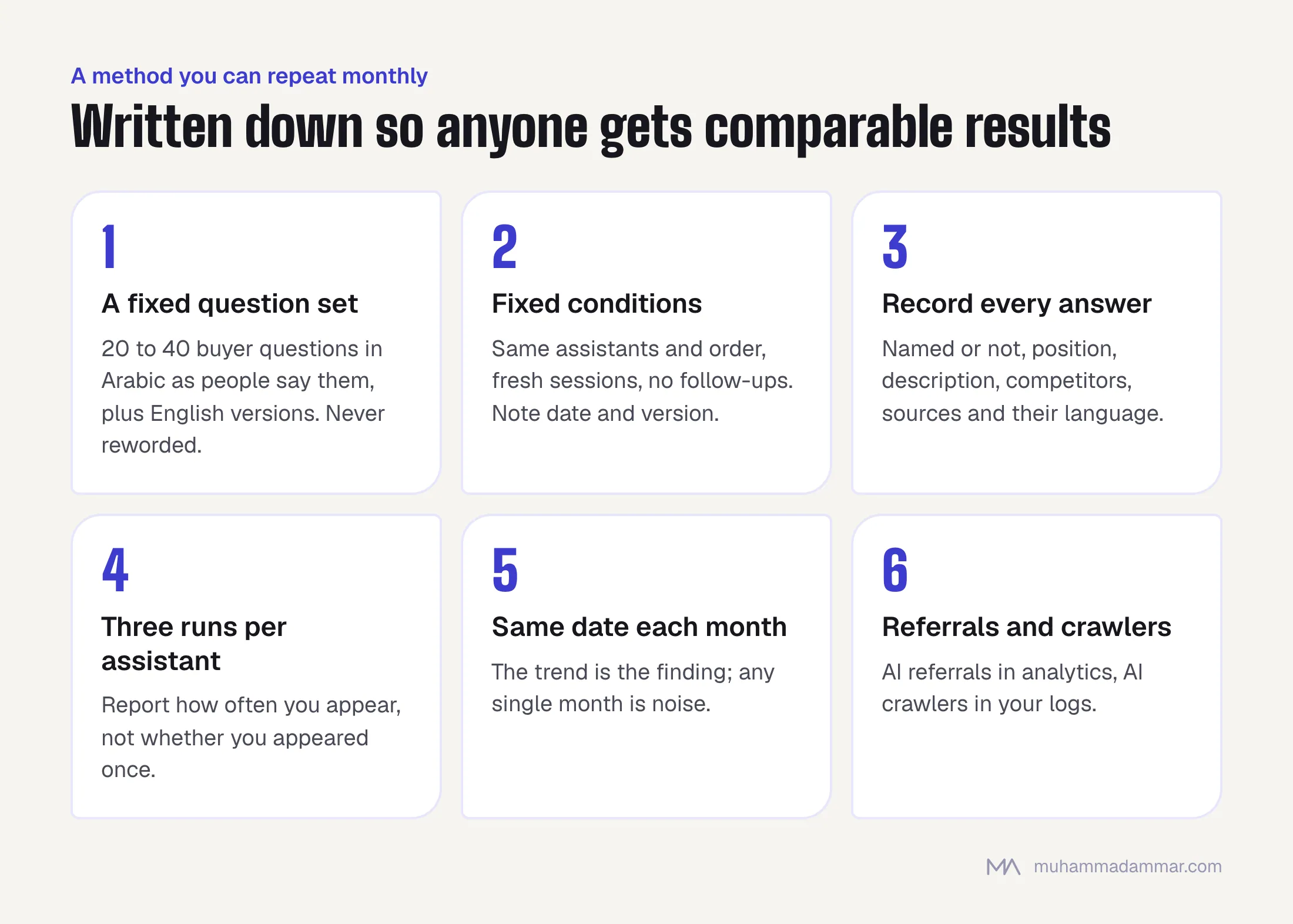
- Build a fixed question set. Twenty to forty questions a real buyer would ask, in Arabic as they’d actually say them, with matching English versions. Don’t change the wording between runs. Changing the questions is the quickest way to get numbers that mean nothing.
- Fix the conditions. Same assistants, same order, a fresh session for each question, no memory or personalisation carried over, no follow-up prompts. Note the date and the model or product version if it’s shown.
- Record for each answer: was your brand named, in what position, how it was described, which competitors appeared, which sources were cited, and what language those sources were in.
- Ask each question at least three times per assistant. Answers change from run to run, and one answer is an anecdote. Report how often you appeared, not whether you appeared once.
- Run it monthly, on the same date. The trend is the finding. Any single month is noise.
- Track referrals separately. Set up analytics to recognise visits from AI assistants (the setup is in finding the AI referrals GA4 files in the wrong place) and check your server logs for AI crawlers. That tells you whether your pages are reaching these systems at all.
A simple sheet with one row per question, assistant and run is enough. The first month gives you a baseline; the months after it tell you whether what you publish is changing anything.
What makes an Arabic page easy to cite
These come from how retrieval works: the assistant pulls in short passages, not whole pages. Treat them as the things to test, and let your own monthly results tell you which matter in your category.
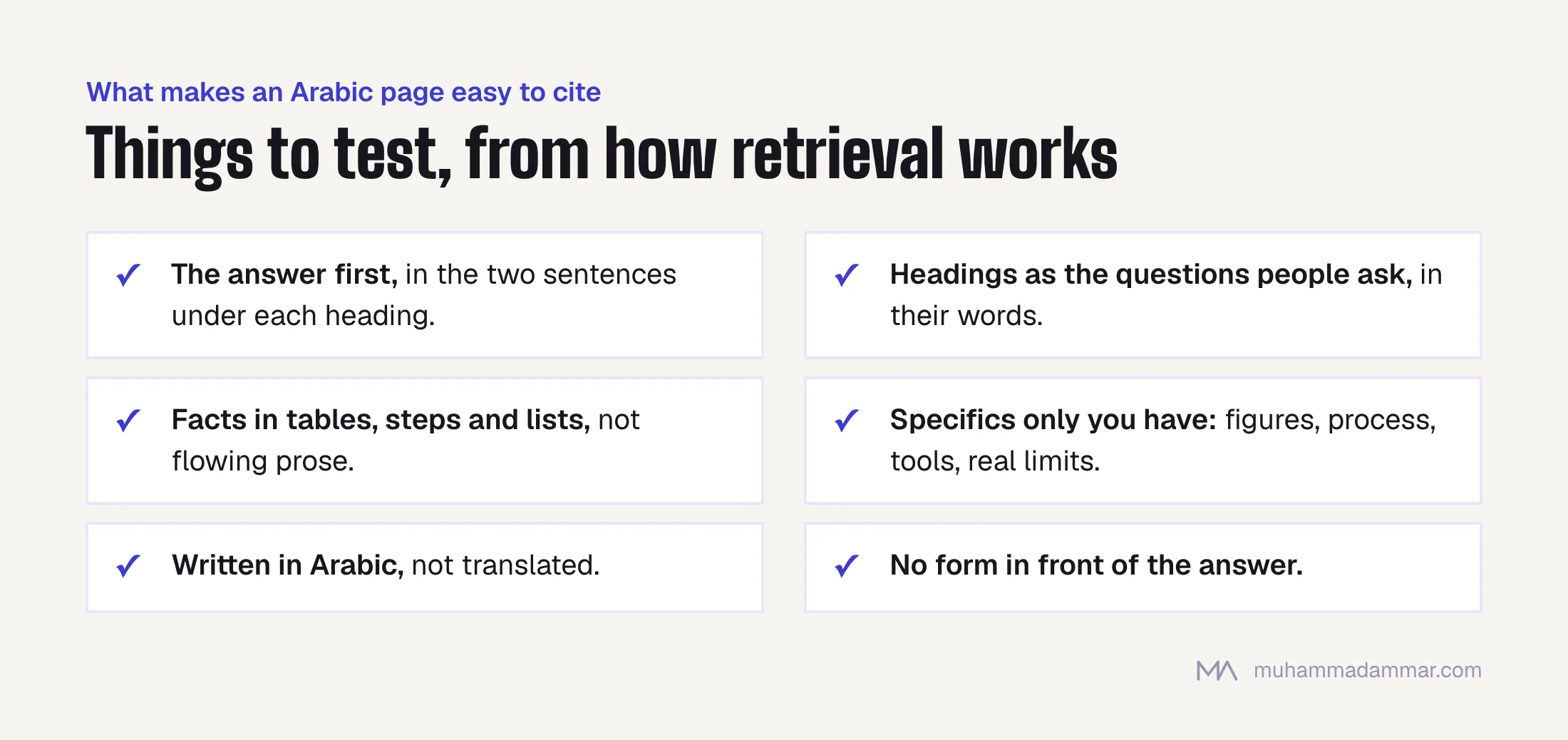
- Answer in the first two sentences under each heading, then explain. Arabic writing often builds up to the conclusion; retrieval favours pages that start with it.
- Make headings the questions people ask, in their words, dialect included where that’s how they search.
- Put facts in structures. Tables, numbered steps, short lists. A comparison written as flowing prose is harder to lift out than the same comparison in a table.
- Include specifics only you have: your own figures, your process, named tools, real limits. It’s the one thing generic content can’t copy.
- Write it in Arabic. A translation answers the English version of the question, which is often slightly different from what the Arabic search is asking.
- Don’t hide the answer behind a form. A retrieval system can’t read gated content.
Being cited and being recommended are different things. Citation follows useful content; being named as a brand to choose depends more on how consistently you’re described across the web. That difference is covered in what makes an AI assistant name your brand.
Your brand’s name in Arabic and Latin letters
This one is specific to the region and affects whether you get named at all.
Most regional brands exist under at least two names, an Arabic one and a Latin one, and often several Arabic spellings too, because there’s no single correct way to write a foreign name in Arabic. To a model, each spelling can look like a different brand, and evidence split across four names is weaker behind each one.
- Pick one Arabic spelling and one Latin spelling and write them down for your team, because the variants usually start in marketing.
- Use both in your structured data:
nameandalternateNameon both language versions tells a machine the two strings are one brand. - Make them consistent wherever you appear: social profiles, directories, press, partner sites, your own bio. Most of the inconsistency is off your site.
- Test it. Ask an assistant about your brand with each spelling and see whether it recognises the same company each time.
Be careful with the opportunity
Three limits, because this is where the hype usually starts.
It may not last. More Arabic content is being published every month, including AI-written content, so any gap you find now can close. Generic pages don’t benefit: the assistants aren’t short of vague Arabic content, only of specific content. And your test results are about your category and your questions. Don’t generalise them to the whole Arabic web, and don’t let anyone sell you a general claim they haven’t tested either.
Frequently asked
Do assistants answer well in Arabic?
They write fluent Arabic. Whether the answer is well grounded depends on what Arabic sources exist for that question, and that’s exactly what the test above measures for your category.
Should I publish in Arabic or English to be cited?
If your customers search in Arabic, publish in Arabic, and run the test to see whether it’s paying off. English helps with reach. If the budget only covers one and your buyers are Arabic speakers, start with Arabic.
Does translating my English articles work?
Usually not well. A translation keeps the shape of the English question, which often isn’t the question being asked in Arabic. Start from an Arabic keyword map instead; the method is in why Arabic keyword volumes always come out too low.
How long will an Arabic gap stay open?
Nobody knows, and anyone giving you a number is guessing. Measure monthly and you’ll see it closing in your own data before anyone tells you.
Is it worth measuring if AI traffic is small?
The traffic is small today. Being the Arabic source an assistant uses in a narrow category is cheaper to earn early, and measuring is how you’ll know whether you’re getting there.
If you’d like help setting up the question set and the monthly tracking for your brand, message me. It fits naturally at the start of GEO and AI search work.

SEO and digital marketing consultant since 2015, working with businesses in Egypt, Saudi Arabia and the UAE.
About the author and editorial standards