On this page
A lot gets written about “ranking in ChatGPT” with great confidence and very little evidence. The systems are opaque, the field is young, and selling a service is easier than proving it works.
So this is the sceptical version: what’s mechanically true about how these assistants pick brands, what follows from that, and what’s being sold with no evidence behind it at all.
How the assistant finds its answer
When you ask an assistant a buying question, such as “which SEO consultant works with Saudi e-commerce brands”, roughly this happens:
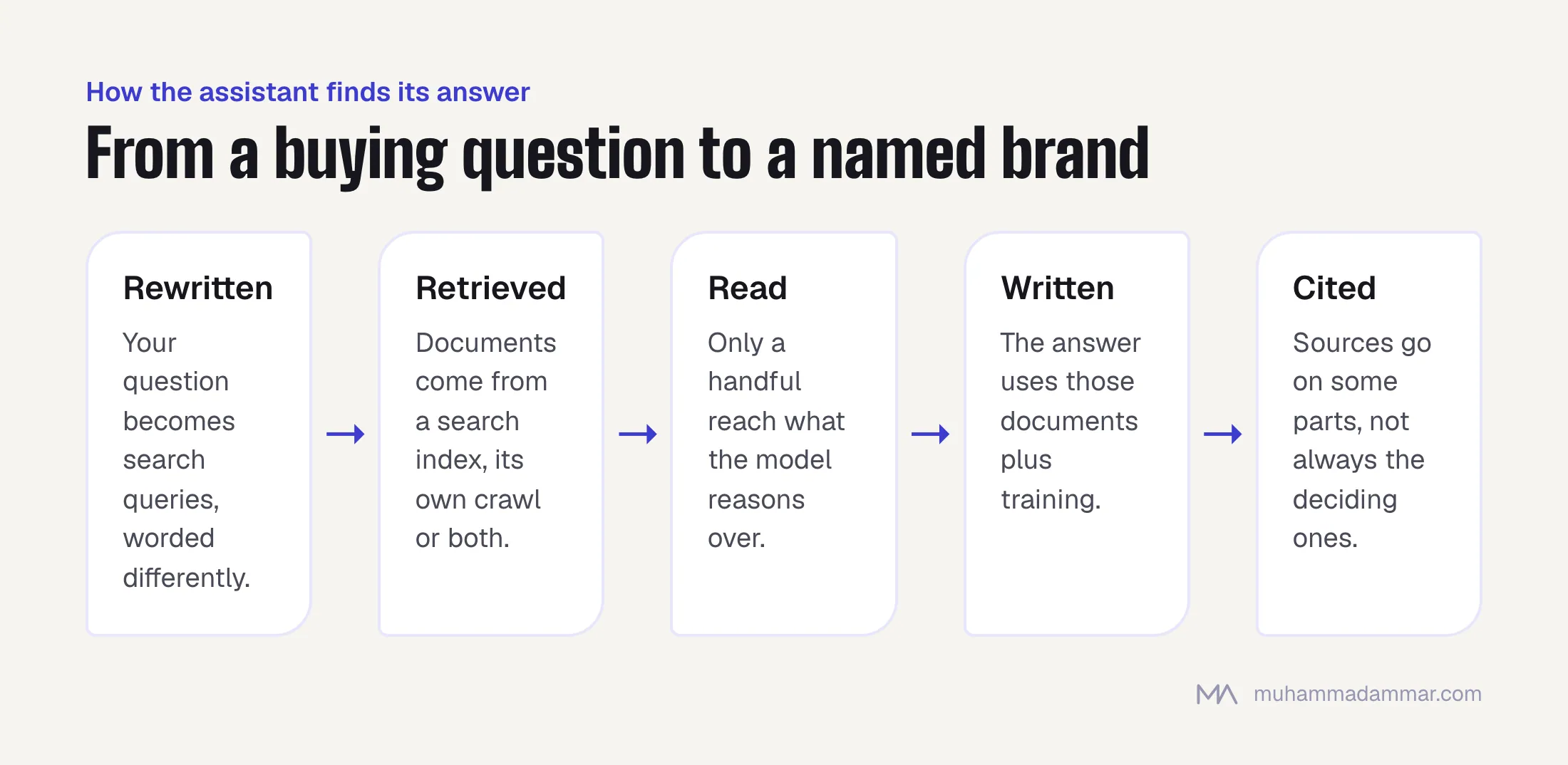
- Your question is rewritten into search queries. Often several, and usually worded differently from yours. This matters more than people think: what you’re optimising for is the queries the model writes, more than the user’s original prompt.
- Documents are retrieved from a search index, from the assistant’s own crawl, or both, depending on the product.
- A few of them are read. Only a handful of documents make it into what the model actually reasons over.
- An answer is written from those documents plus what the model already learned in training.
- Citations are attached to some of it, and not always to the parts that decided the answer.
Two things follow. If you can’t be retrieved, you can’t be named, which is why this work builds on ordinary SEO. And being retrieved doesn’t mean being named, because the model still has to decide you’re worth mentioning.
Why your own site is the weakest of three signals
Three inputs decide whether a model names you, and the one everybody works on is the weakest.
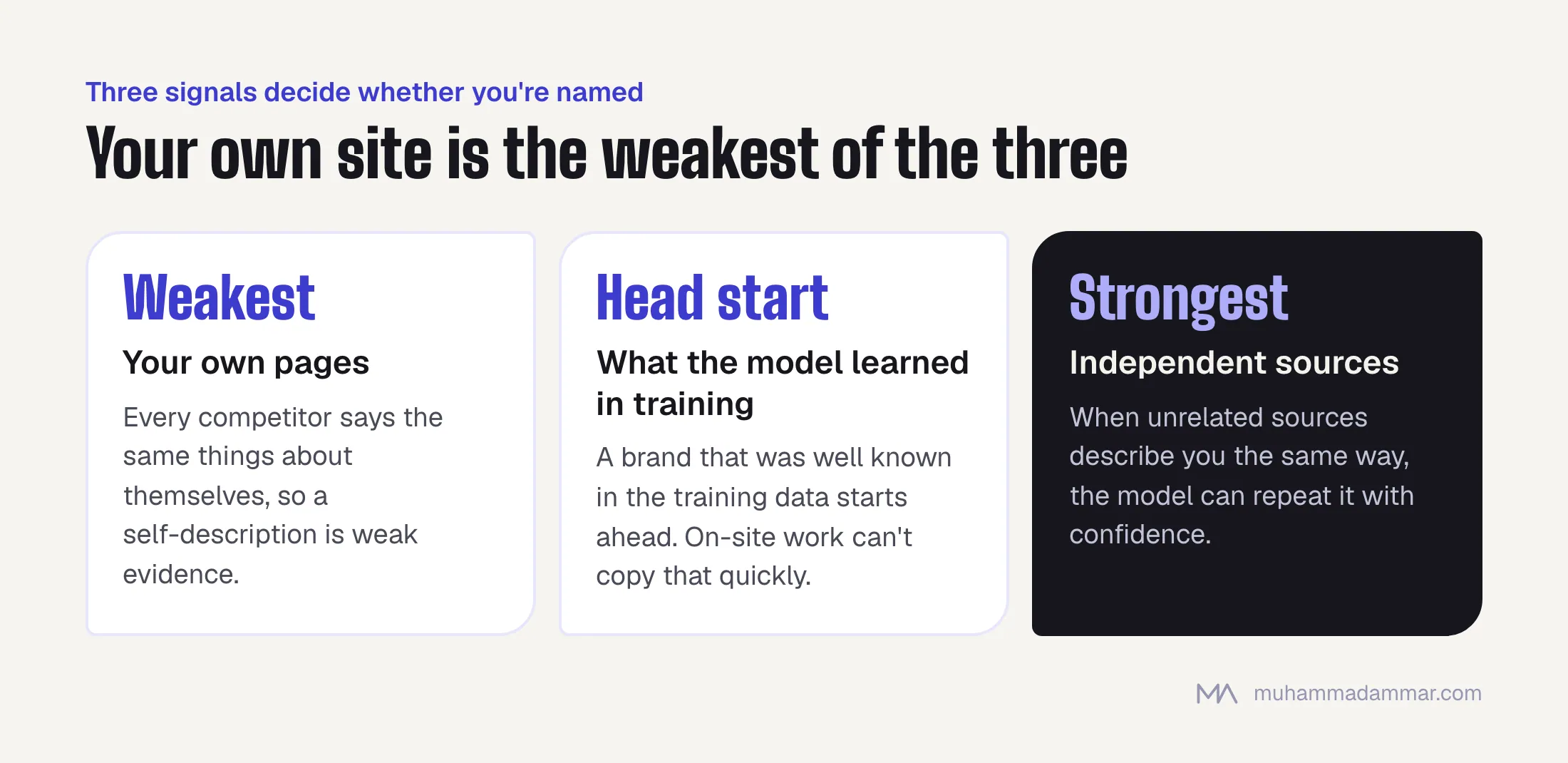
Your own pages show that you exist and what you say you do. But every competitor says the same things on their own site, so a self-description is weak evidence, and the model treats it that way.
What the model already knows from training. If your brand was well known in the training data, you start with an advantage that on-site work can’t copy quickly.
What independent sources say about you is the strongest signal, and nobody likes hearing it because you can’t edit it directly. When several unrelated sources describe you the same way, the model can repeat it with confidence. When only your site says it, the model can’t.
So the work with the most effect happens off your site, and it looks more like PR than SEO.
Making sure the model knows you exist
Models describe a brand with confidence when it’s defined the same way across sources. Most brands undermine this without noticing.
- One name, spelled the same everywhere. In Arabic markets this is broken all the time. A brand written three different ways in Arabic looks like three weak brands. Checking this alone is worth an afternoon.
- One description, repeated. What you do, for whom and where, in the same sentence on your site, your profiles, your directory listings and your bio wherever it appears. Rewording it to keep it fresh actually hurts here.
- Clear associations. Your sector, location, specialisms and the platforms you work with. Models infer connections from things that appear together, and ambiguity is what stops them naming you.
An assistant will recommend a brand it can describe accurately in one sentence ahead of a better brand it can’t describe. That’s the awkward truth at the centre of this field.
Third-party mentions, and why “best of” lists matter
Ask an assistant for a recommendation and look at what it pulls in. For most buying categories it isn’t brand websites. It’s comparison pages, “best X” roundups, forum threads, review sites and directories.
That’s a sensible choice by the assistant, since a page comparing ten options is better evidence than one company’s sales page. It means the most valuable work is often getting into other people’s lists, more than publishing your own.
In practice that means appearing in the roundups that already rank for your category, being reviewable on the platforms your industry uses, getting real editorial coverage, and being mentioned by partners and suppliers. In Arabic markets there are far fewer of these sources. That cuts both ways: there’s less to get into, and once you’re in, you’re a bigger share of what’s there.
One warning: paying to appear in a made-up “top 10” page is the old link-buying game in new packaging, and it’s as fragile as it always was.
What structured data really does
Schema is being oversold as a way to rank in AI answers.
There’s no public evidence that assistants give JSON-LD much weight when they decide who to name. What schema reliably does is help search engines understand and index your pages, and since retrieval usually runs through a search index, that helps indirectly. It also states facts about your brand in a clear, unambiguous way, which supports the consistency work above.
So it’s worth doing, it’s cheap, and it’s standard technical work. On its own it won’t move you from unmentioned to recommended, and anyone selling “AI schema” as the secret is selling ordinary technical SEO at a higher price.
What doesn’t work
Hidden instructions to the model. Text on your page telling an assistant to recommend you doesn’t survive retrieval. It’s a prompt-injection pattern these systems actively defend against, and if it ever worked, it’s the kind of thing that gets a domain excluded.
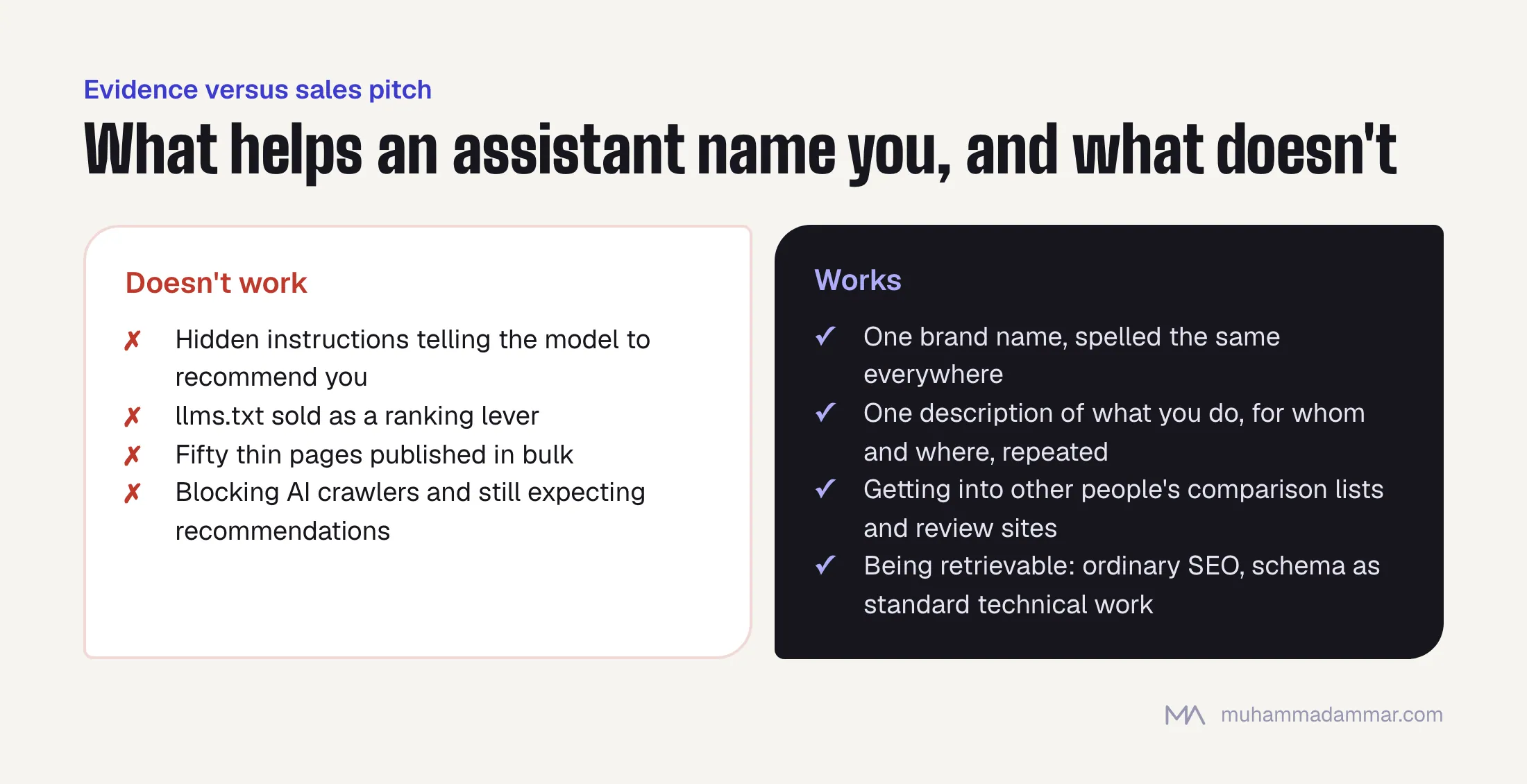
llms.txt as a magic file. It’s a proposed standard for a machine-readable summary of your site, and a reasonable idea. So far no major assistant has confirmed that it reads or acts on it, so treating it as a ranking lever has no support. Add one if you like, it costs nothing, but don’t let anyone bill you for it as a strategy.
Publishing in bulk. Fifty thin pages won’t make a model confident about you. Specific facts that other sources confirm will.
Blocking AI crawlers and still expecting recommendations. For publishers who earn from page views, blocking is a real decision with real trade-offs. But if you want buyers pointed your way, blocking the crawler takes you out of the answer. You have to choose.
Measuring it without fooling yourself
Measurement here is rougher than in SEO, and the main risk is mistaking noise for a result.
Build a fixed set of prompts. Twenty to forty questions a real buyer in your category might ask, in Arabic and English, written once and never edited. Editing the set between runs makes the results incomparable, and it’s the most common mistake.
Run it on a schedule, across assistants. Monthly is enough. For each run, record whether you were named, in what position, how you were described and which competitors appeared with you. The description is the most useful part: how the model describes you shows what it has picked up, and it’s where you’ll see progress first.
Expect the answers to vary. The same prompt gives different answers on different runs. One check tells you almost nothing. The trend across the whole set over months is the signal, and any single screenshot, yours or a vendor’s, is an anecdote.
Track referrals separately. Traffic from assistants arrives under hostnames that most GA4 setups file as generic referral or direct. Set that up before you try to read it, or you’ll conclude there’s no traffic when there is. The setup is in finding the AI referrals GA4 files in the wrong place.
Watch your server logs. AI crawler visits in your logs are first-hand proof that your content is reaching these systems at all, and nobody can spin them. I explain the method in log file analysis.
Frequently asked
Is this just SEO with a new name?
About two thirds of it is. Being retrievable is SEO. Brand consistency and third-party mentions are a different focus, closer to PR than to on-page work, and the measurement is new.
How long does it take?
Cleaning up your brand details and schema can show up within weeks, because retrieval updates quickly. Third-party mentions are the slow part and follow the same timeline as digital PR: months.
Can anyone guarantee AI visibility?
No. There’s no console, no ranking API and no way to make a model say your name. What you can do is make your brand the easiest in its category to describe accurately, and that seems to be most of what these systems respond to.
Does this replace search traffic?
Not yet, and not for most businesses in this region. Referrals from assistants are still a small fraction of organic search traffic. Anyone selling it as a replacement is ahead of their own data.
Is it different in Arabic?
Yes, a lot, and in your favour. These systems have far fewer Arabic sources to draw on, so there’s less competition for each citation. I cover this in AI search in Arabic.
Related: GEO and AI search, and more articles on AI search. If you want to know how assistants describe your brand today, message me.

SEO and digital marketing consultant since 2015, working with businesses in Egypt, Saudi Arabia and the UAE.
About the author and editorial standards