On this page
Almost nobody in this region publishes SEO prices. The usual explanations are that every project is different and that competitors would see the numbers. I think the bigger reason is that a published price invites comparison, and most suppliers would rather talk on a call, where the number can still move.
So here are my prices, what moves a quote up or down, and what a very cheap quote usually leaves out.
What I charge
My monthly SEO work costs between $300 and $4,000. Where a project lands in that range depends on the size of the site, its type (an online store is more work than a small business site), how many problems it has when we start, and how competitive your category is. The same range applies in Egypt, Saudi Arabia and the UAE. Gulf categories tend to be more competitive, so they more often land toward the higher tiers.
| Type of site | What the work usually covers | Monthly fee (USD) |
|---|---|---|
| Simple site with a few pages, one service or one location | Technical health, Google Business Profile, the main pages tuned | From $300 |
| Small business or local service site, one language, little competition | Technical fixes, Google Business Profile, the pages that bring enquiries | From $500 |
| Business site in Arabic and English, or a competitive local category | Both languages, more content, keyword mapping for each market | $800 to $1,500 |
| Online store with a small or medium catalogue | Category and product pages, filters, product structured data | One language: $600 to $1,000 Arabic and English: $800 to $1,500 |
| Large store, or a category with strong, well-funded competitors | Bigger catalogue, more technical work and more content every month | $2,000 to $3,000 |
| Big news magazine or huge editorial site with hundreds of thousands of pages | Indexing and crawling at scale, archive and category structure, pagination, technical work across templates | $3,000 to $4,000 |
Those are starting points. I give a fixed quote after I’ve looked at the site, and the quote says what’s included, especially whether content writing is part of it. One-off work such as an audit or a migration is quoted on its own once I’ve seen what’s involved. Proposals can be in US dollars or Egyptian pounds; with the pound moving as much as it does, which currency the contract uses matters, so it’s written into it.
The four ways SEO is sold
Monthly retainer. A fixed fee for an agreed scope. It suits businesses that need ongoing work and a predictable cost. The risk is a retainer that keeps getting paid with no clear output, so negotiate the scope harder than the fee.
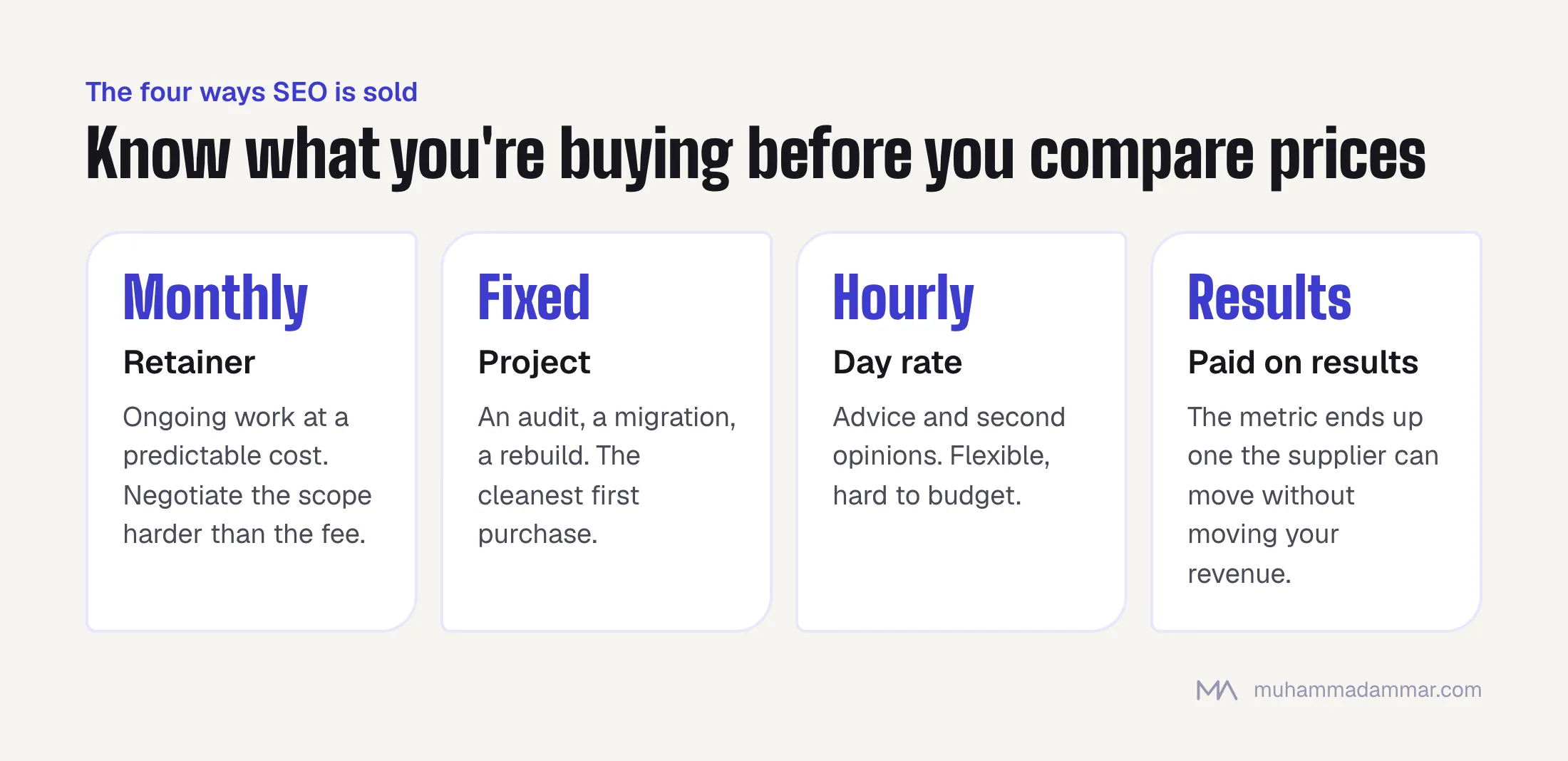
Fixed-scope project. An audit, a migration, a rebuild of a bilingual site. One price, one deliverable, a clear end. It’s the cleanest way to buy SEO for the first time, because you see how someone works before you commit to a year.
Hourly or day rate. For advice, second opinions and teams that need direction more than hands. It’s flexible, and it makes budgeting hard because you can’t predict the total.
Paying for results. Fees tied to rankings, traffic or leads. It sounds like everyone wants the same thing, but the supplier controls neither your product nor your sales team, so the metric in the contract ends up being one they can move without moving your revenue. It also pushes them toward shortcuts that pay off before the contract ends. I don’t work this way, and I’d be careful with anyone who insists on it.
What moves the price
Six things, roughly from biggest to smallest.
- Size and complexity of the site. A 300-page company site and a store with tens of thousands of products are different jobs and shouldn’t come off the same rate card.
- One language or two. Arabic and English is close to two projects, because keyword research, content and site structure all double. A two-language quote at a one-language price usually means the Arabic won’t get done properly.
- Doing the work or advising on it. Doing it costs more than specifying it. Both are fine; mixing them up is where arguments start.
- Competition. A quiet Arabic niche needs far less effort than a Gulf category where several funded competitors publish every week.
- Content volume. Often the biggest single cost, and the one most often left out of a quote without anyone saying so.
- How many people approve a change. Nobody prices it, everybody feels it. A site where one person can approve a fix is cheaper to work on than one where every change waits for a committee.
Why a very cheap retainer ends up costing more
Below a certain price the work can’t be done properly, and the supplier has to make the numbers work some other way. The usual ways are expensive for you:
- Volume instead of judgement. Four articles a month whether or not content is your problem. That’s how sites end up with 150 posts and a handful of keywords that rank.
- Bought links. The quickest way to show movement on a small budget, and a liability that’s hard to remove later. My full view is on the link building page.
- Translated Arabic. Cheaper than writing, and it targets phrases people don’t search for. It’s the most common way Arabic SEO budgets get wasted.
- Reports instead of work. A monthly deck that lists activity, not change. It takes months to notice.
The fee is the small part of that cost. The rest is the year you lost, the ground your competitors gained in it, and the cleanup afterwards, because a bought-link profile or a library of translated pages takes longer to undo than it took to make.
Audit, retainer or project: which to buy
Buy an audit if you have a team or an agency that can do the work and what you’re missing is direction. It’s also the right first purchase from someone new: you see how they think before you commit, and it’s the cheapest way to find out they’re not right for you.
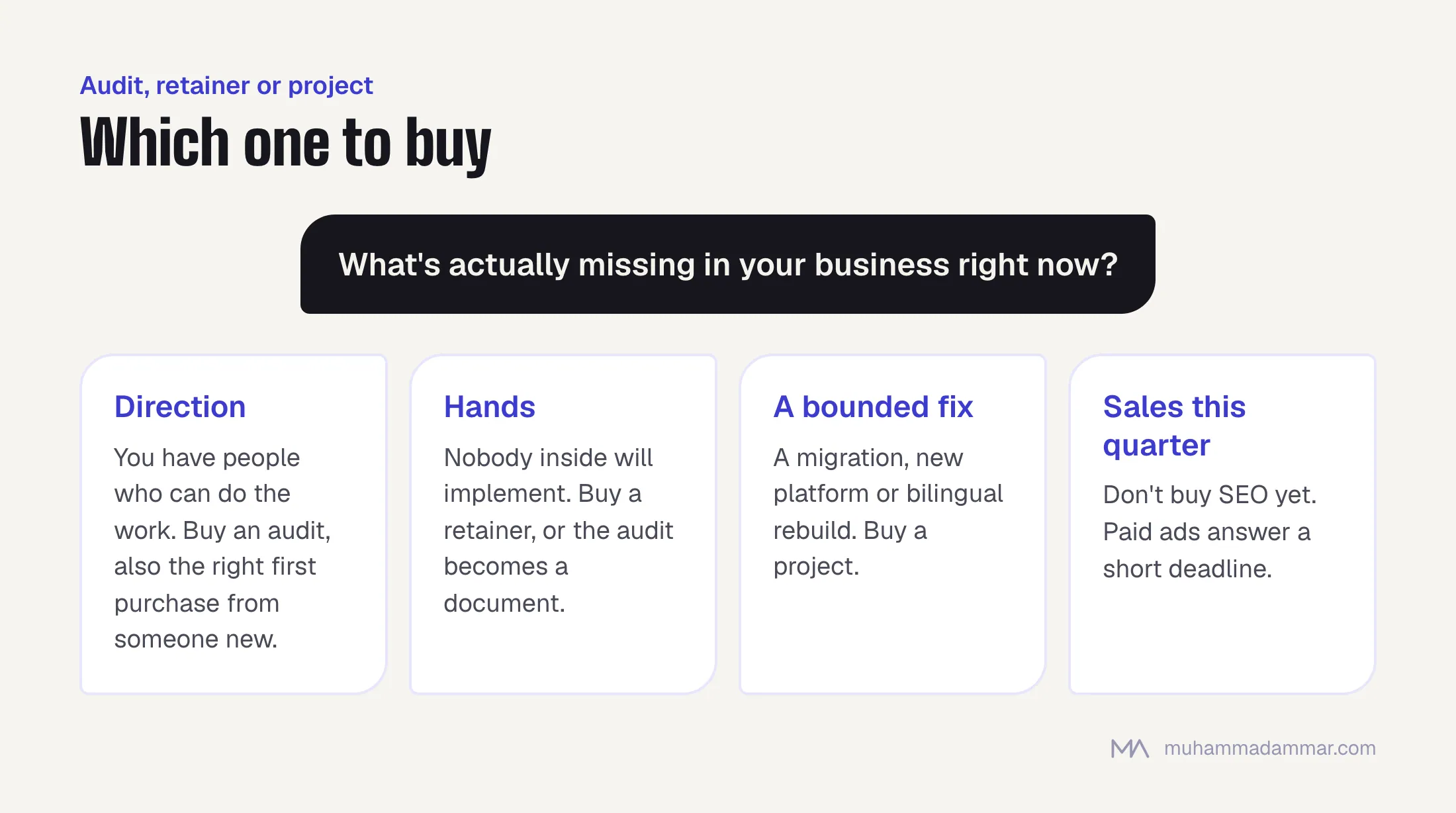
Buy a retainer if nobody inside the business will do the implementation. An audit delivered to a company where nobody acts on it is money spent on a document.
Buy a project if the problem has clear edges: a migration, a new platform, a bilingual rebuild. Fixed scope, fixed price, clear end.
And the fourth option: don’t buy SEO yet if you need sales this quarter. Organic results in a competitive Arabic category take months to show up in revenue. Paid ads are the right answer to a short deadline, and a supplier who won’t tell you that is selling, not advising.
What to put in the contract
Most SEO disputes come from four things being left vague. Settle them before you sign.
- Scope, in detail. Instead of “on-page optimisation”: how many pages, which ones, and to what standard. Whether content is included and how much. Whether the supplier implements changes or only recommends them.
- Who owns what. You own the Analytics and Search Console accounts, the content, the documentation and any accounts made for you. This matters most when the relationship ends, which is exactly when nobody wants to discuss it.
- Reporting. Access to a dashboard as well as a monthly report, which numbers it shows, and a named person you can ask.
- Notice and exit. Thirty days’ notice is common. A twelve-month lock-in with no way out is a warning sign, especially next to a promise of fast results.
Questions to ask before you sign
These separate suppliers quickly, and the answers tell you more than the price does. There’s a longer list in how to interview an SEO when you are not one.
- What do you think is holding us back, and how would you check? Nobody can be sure before starting, but they should know what they’d look at first. A list of everything isn’t an answer.
- Where do your links come from? Listen for guest-post marketplaces.
- Who writes the Arabic, and do they write it or translate it? This one question filters out a large part of the market.
- What does a month of work look like? A specific answer means there’s a plan. A general one means a template.
- Tell me about a client whose results disappointed, and what you did. Everyone has one. Someone who says they don’t is either new or not being straight with you.
- What do you need from us? An honest supplier has a list. “Nothing, leave it with us” means they plan to work without you, and that’s how recommendations never go live.
If you’re still choosing between an agency, a freelancer and hiring someone, three ways to buy SEO covers who each one fits.
Frequently asked
How much should I budget for SEO?
Work back from what a customer is worth to you and how many you need, rather than from a percentage of revenue. If the numbers only work when SEO brings in an unrealistic volume, it isn’t your channel yet, and it’s better to find that out before you spend.
Is SEO cheaper in Egypt?
My range is the same in all three markets. What changes is the competition: a Saudi or Emirati category usually needs more work than an Egyptian one, so an Egyptian-priced plan aimed at a Gulf market is often too small for the job.
Should I pay for results instead?
It sounds safer than it is. The supplier doesn’t control your product or your sales process, so the metric in the contract ends up being something they can move without moving your revenue.
How long before I see results?
Technical fixes can change what Google indexes within weeks. New content in a competitive Arabic category takes months to settle into a stable position. Anyone promising page one in sixty days is talking about a keyword nobody competes for, or about bought links.
How long should a first contract be?
Three months is a sensible first term: long enough to see movement, short enough to leave if it isn’t working.
If you’d like a quote for your site, message me with the address and what you want from it. I’ll tell you where in the range it falls, or if SEO isn’t the right spend for you yet.

SEO and digital marketing consultant since 2015, working with businesses in Egypt, Saudi Arabia and the UAE.
About the author and editorial standards