On this page
“Repurposing” usually means someone takes a 2,000-word article, screenshots a paragraph, posts it and calls it a content pipeline. The result is a feed of fragments without context that nobody engages with, made by a process everyone quietly resents. Done properly, it’s a production system: one solid piece of thinking, built on purpose so it can be split, feeding every channel for two weeks without watering down the original.
Why most repurposing produces noise
- A fragment isn’t a unit of value. A paragraph pulled out of an argument loses the argument. Each new piece has to make sense on its own.
- The format gets resized, not rewritten. A LinkedIn post isn’t a paragraph in a square image. It has its own opening, rhythm and payoff.
- It happens afterwards. Deciding to repurpose after the article is finished means fighting its structure. The decision belongs at the outline stage.
- It’s done for volume. Eight pieces because the plan says eight, not because the original had eight worthwhile ideas in it.
- Nobody measures which piece worked, so the process never improves, and the same weak format gets made every week.
Designing the article so it can be split
This is the whole trick. If the original is built right, the new pieces take an hour, not a day.
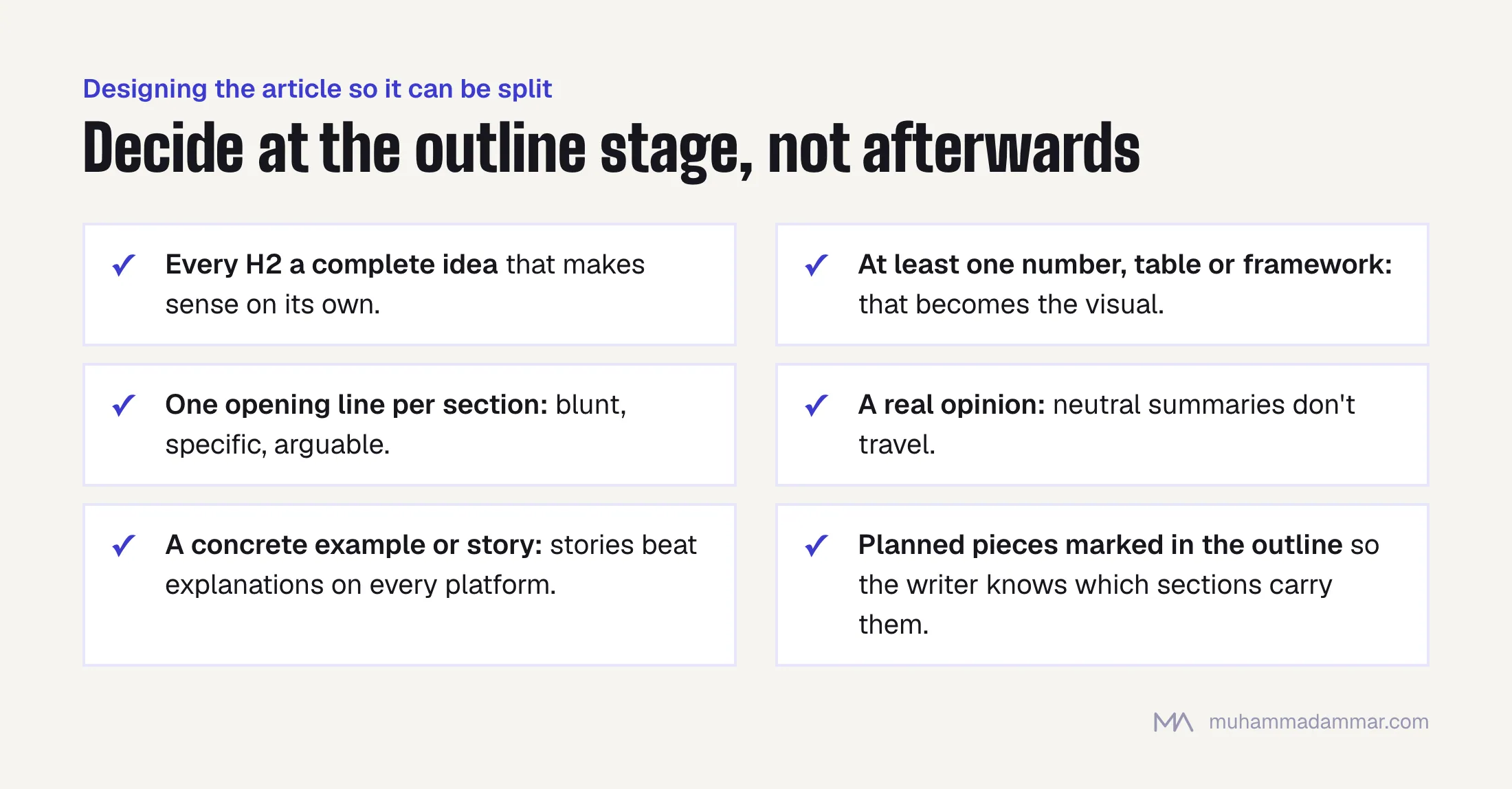
- Every H2 should be a complete idea on its own. If a section only makes sense after the one before, it can’t become a separate piece.
- Include at least one number, table or framework. That’s what becomes the visual, and an article without one produces no good spin-offs.
- Write one sentence per section that could open a post: blunt, specific, something people could argue with. You’ll use them later.
- Include a real opinion. Neutral summaries don’t travel. The line people disagree with is the line that gets shared.
- Have a concrete example or story. Story-based pieces beat explanatory ones on every social platform.
Do this at the outline stage and mark the planned pieces in the outline itself. Then the writer knows which sections carry that load, and the person making the pieces isn’t digging through finished text for something quotable.
The eight pieces
| # | Piece | Taken from | Goes to |
|---|---|---|---|
| 1 | A short text post making one argument | The opinion line | LinkedIn, X |
| 2 | A carousel or slide set | The framework or numbered list | LinkedIn, Instagram |
| 3 | One data visual | The table or figure | All social, and reusable in the article |
| 4 | A short vertical video | The example or story | TikTok, Reels, Shorts |
| 5 | An email to your list | The whole argument, shortened | Newsletter |
| 6 | New FAQ entries | Questions readers asked in comments | Back into the article |
| 7 | Ad creative | The strongest opening line | Paid campaigns |
| 8 | A one-page sales sheet | The framework plus the example | Sales team, proposals |
Two of these are often forgotten and are usually the most valuable. Number six is the only one that improves the original, and it costs nothing. Number eight makes marketing useful to the people who actually close deals, and it’s what gets a sales team paying attention to content.
Spread them over two weeks instead of publishing everything in three days. The article keeps working, and people who missed one piece see another.
Arabic and English without doubling the work
Sixteen pieces instead of eight is how two-language repurposing falls apart. It doesn’t have to.
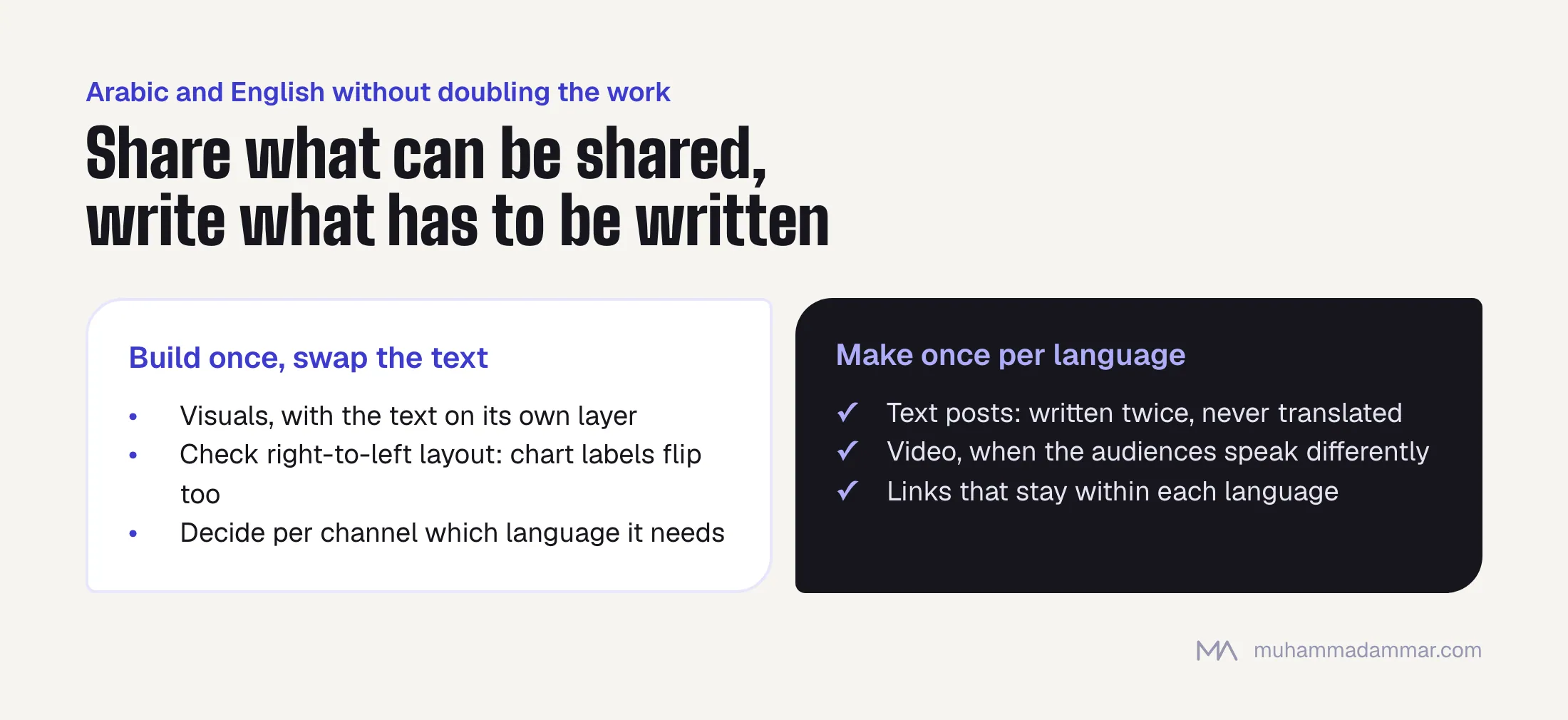
- Visuals are shared, with the text on a separate layer. Build the template once with the text on its own layer and make both versions in minutes. Check the right-to-left layout: a chart with labels reading left to right is wrong in Arabic even if the words are right.
- Text posts are written twice, never translated. On social, the opening line is the whole piece, and a translated opening line reads like one.
- Video is made once per language when the audiences speak differently, which in this region they usually do. Subtitles don’t replace it.
- Not every piece needs both languages. Decide per channel, based on where your Arabic and English audiences actually are, instead of making everything twice for symmetry.
- Keep links within each language. An Arabic post links to the Arabic article, always.
What not to repurpose
- Anything whose value is being complete. A reference guide or checklist loses everything when cut up. Promote it; don’t chop it.
- Time-sensitive news commentary. By the time the pieces are ready, the moment has passed.
- Client details beyond what you have permission to use, which is narrower for a social post than for a long article.
- Anything that needs caveats to be accurate. If the honest version needs three qualifications, it won’t survive being shortened, and the short version will be wrong.
- Articles that didn’t perform. Repurposing doesn’t rescue a piece nobody wanted. It just spends more time on it.
Measuring which piece actually works
Keep this light or it won’t survive a busy month. One row per piece, four columns:
- Format and language, so you compare like with like.
- Reach or impressions: the platform’s own number, imperfect but consistent.
- Meaningful engagement: saves, shares and comments, not likes. These are what predict whether anyone acted.
- Traffic or enquiries: tagged links where possible, and what people say on your enquiry form where not.
After a quarter this table tells you something specific, usually that two of the eight formats produce almost everything and the rest are habit. Drop the habit and put the time into the two that work. That decision is the whole return on measuring at all.
Much of the value will never show up as a click. The impression from a post someone read and didn’t tap is real and can’t be measured, which is the same problem described in why attribution breaks in the Gulf and Egypt.
Ongoing production like this is social media marketing, and the articles it depends on come from the content side of SEO.
Frequently asked
Does posting the same idea again hurt reach?
Not if each piece is genuinely different. Posting identical text does. Most of your audience missed the first one anyway.
Should social posts link back to the article?
Some of them. A post that delivers its value in the feed does better than a link with a teaser, so make links the exception, not the rule.
Can AI make the pieces?
It can draft the structural ones, like a carousel outline or an email skeleton. The opening line and the opinion should be yours, because they carry your voice, and AI-written Arabic social copy in particular reads as AI-written.
How long should this take per article?
Two to three hours once you have templates, which is the reason to build them. If it takes a day, the article wasn’t designed to be split.
Do I need all eight?
No. After a quarter of measuring you’ll probably keep three. Start with the ones that suit your audience and drop the rest without ceremony.
Publishing good articles that nobody sees outside search? Message me.

SEO and digital marketing consultant since 2015, working with businesses in Egypt, Saudi Arabia and the UAE.
About the author and editorial standards