On this page
- What can be automated on WhatsApp, and what can’t?
- WhatsApp Business app or WhatsApp Business Platform?
- What rules does WhatsApp set for automated messages?
- How should the bot hand over to a person?
- Which Arabic dialect should the bot use?
- How do you know the bot is working?
- What changes the price of WhatsApp automation?
- Frequently asked
WhatsApp customer service automation means a bot, or a set of rules, answers the repetitive messages on your WhatsApp number and passes everything else to a person. It works for questions with a fixed answer, such as opening hours, location, how to book or the status of a request, and for collecting a customer’s details before a person takes over. It shouldn’t handle complaints, negotiations or any conversation where a wrong answer costs you the customer.
I’ve built WhatsApp customer-service automation for clients. What follows is what I’d decide first: what to automate, which kind of WhatsApp account you need, how the handover works, how the bot should sound in Arabic, and how to tell whether it helps.
What can be automated on WhatsApp, and what can’t?
The test is simple. If a good answer is the same every time, or comes from a record in your systems, a bot can give it. If the answer depends on judgement, tone or an exception, a person should.
| Good to automate | Keep with a person |
|---|---|
| Opening hours, location, how to reach you | Complaints and angry customers |
| Frequently asked questions with fixed answers | Refunds, disputes and exceptions |
| Collecting name, need and area before handover | Negotiation and anything custom |
| Booking or appointment requests | Sensitive medical, legal or financial questions |
| Order or request status, read from your system | Messages the bot doesn’t understand twice in a row |
| Sending a brochure or document on request | High-value customers who expect a person |
| After-hours acknowledgement and routing to the right team | Customers who have already waited too long |
Start with the two or three question types that fill most of your inbox, and let the bot do those well. A bot that tries to answer everything gives wrong answers with confidence, and customers remember that longer than a slow reply.
WhatsApp Business app or WhatsApp Business Platform?
There are two products with similar names, and the choice decides what you can automate.
| WhatsApp Business app | WhatsApp Business Platform (API) | |
|---|---|---|
| What it is | A free app you install on a phone | A connection that your software, or a provider’s, uses to send and receive messages |
| Automation | Basic automatic replies | Bots, flows, links to your CRM and other systems |
| Team use | Limited | A shared inbox with many agents |
| Rules and limits | Fewer | More, covered below |
If a few simple automatic replies are all you need, the app is enough. If you want a bot, several agents answering from one number, or WhatsApp conversations connected to a CRM, you need the Platform. It also matters for ads: the first message from a click-to-WhatsApp ad carries referral data that identifies the ad, and the Platform passes it to your system so you can log it against the lead.
The Platform has no screen of its own. You use it through an inbox tool or a system built around it, which is where most of the setup work and the cost sit. Before you switch, ask what happens to your current number and your existing chat history.
What rules does WhatsApp set for automated messages?
These shape the design, so settle them before you build.
- The 24-hour window. After a customer messages you, you can reply freely for 24 hours. After that, you can only start a conversation with a pre-approved template message.
- Templates need approval. Messages you send first, such as reminders or follow-ups, use templates that must be approved before you can send them.
- Permission comes first. You need the customer’s opt-in before you message them first. A bot that replies to someone who wrote to you is on safe ground. A bot that contacts a purchased list isn’t.
- Don’t use unofficial tools. Unofficial software that automates a regular WhatsApp account breaks WhatsApp’s terms, which ban unauthorised software and automated or bulk messaging. That can get the account suspended. Automate through the official Platform instead.
- Keep the quality up. Your messaging limits are tied to your quality rating, and if customers give a lot of negative feedback, WhatsApp may limit your business or remove it from the Platform.
- Keep the bot about your own business. Meta’s terms for AI providers, updated from 15 January 2026, allow general-purpose AI assistants on the Platform only where the law requires it. A bot that answers questions about your own services is the normal use. Check Meta’s current terms before you design anything open-ended.
How should the bot hand over to a person?
The handover is the part customers judge you on. A bot that answers well and then drops someone into silence is worse than no bot.
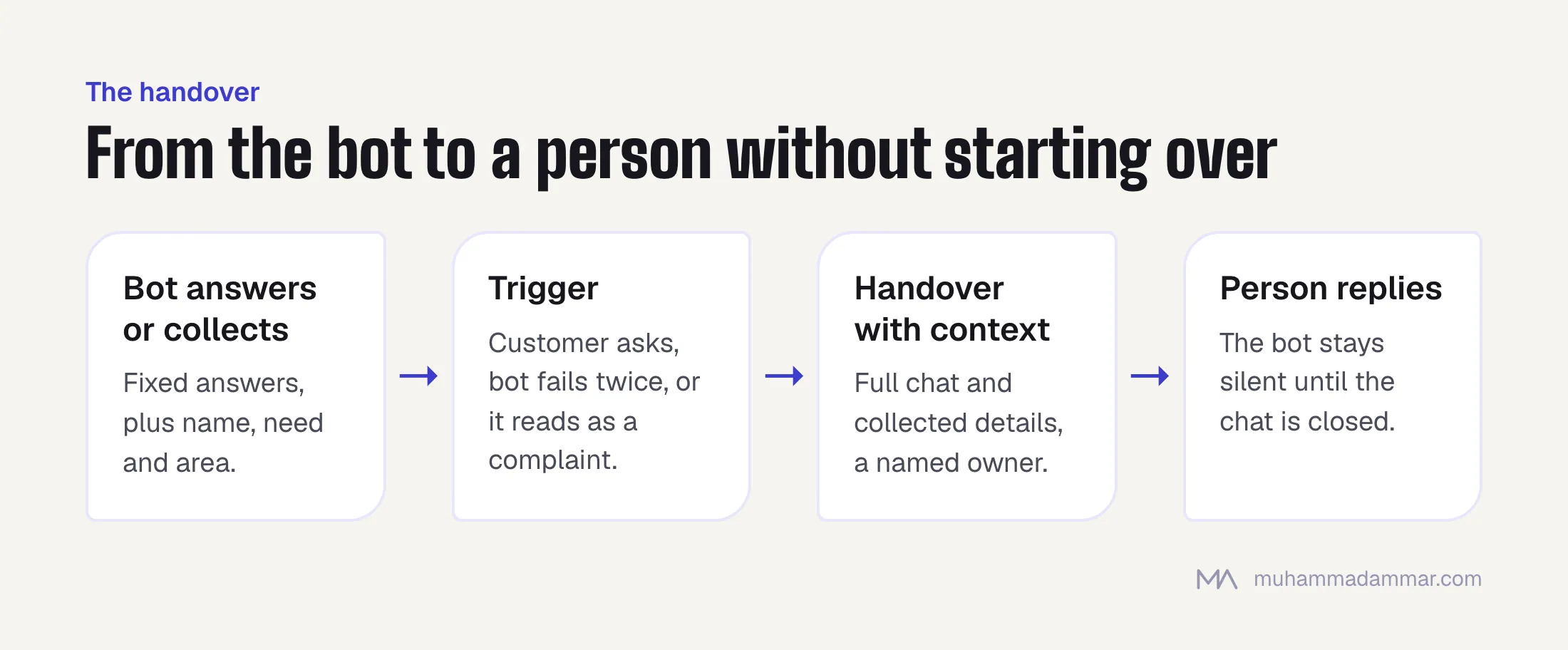
Hand over when the customer asks for a person, when the bot fails to understand twice, when the message reads as a complaint, or when the conversation passes a value or topic you’ve marked as human-only. Then do four things:
- Pass the context. The person who picks it up sees the whole conversation and what the bot collected. The customer should never be asked the same question again.
- Say what happens next. “A colleague will reply during working hours” is fine if it’s true. Don’t promise speed you can’t deliver after hours.
- Name an owner. A conversation in a shared queue that nobody owns waits. Notify a specific person or team, and send a reminder if nobody has touched it.
- Silence the bot while a person is talking, and hand the conversation back to the bot only when it’s closed.
Which Arabic dialect should the bot use?
Customers write in their own dialect, so a bot written in formal Arabic feels like a form letter, and one that overdoes slang feels fake. Match the tone of your brand, and make sure the bot understands the variants even if it answers in one.
The same question is written differently across the region. Asking the price is بكام (bikam, “how much”) in Egypt, while in the Gulf people often write كم السعر (kam as-si’r, “what’s the price”). “Where” is فين (fein) in Egypt and وين (wein) in much of the Gulf. I go deeper on this in how Egyptians and Gulf users search differently.
Four practical points:
- Expect Arabic written in Latin letters and mixed Arabic and English in the same message.
- Decide about voice notes. Many customers send them. Either transcribe them or hand them to a person, and never let the bot ignore them.
- Keep replies short, with one question at a time. Buttons for the common choices, where your setup supports them, reduce misunderstandings.
- Test with real messages. Take a batch of real chats from your inbox, run them through the bot and read what it does. The mistakes are never the ones you expected.
How do you know the bot is working?
Track four numbers and read a sample of conversations every week.
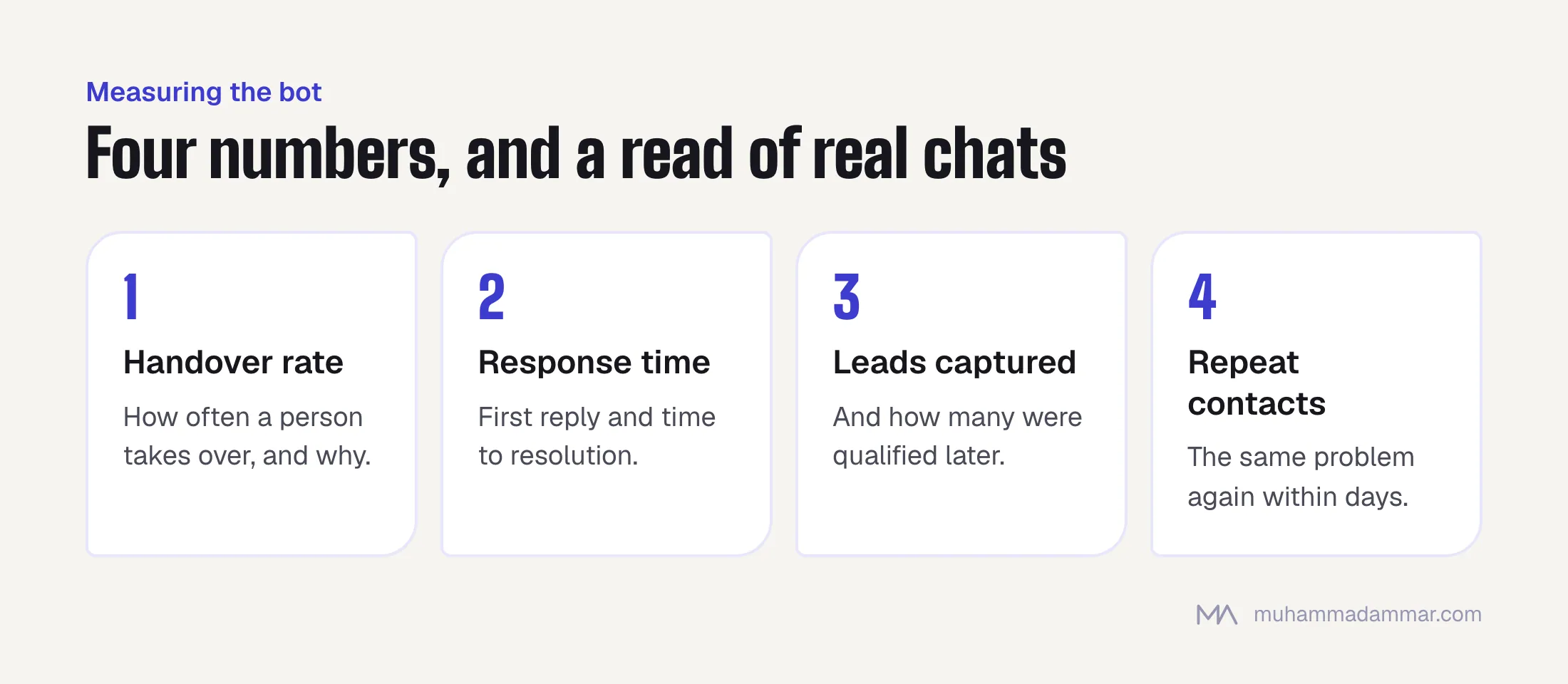
- Handover rate. How often a person has to take over, and why.
- First response time and time to resolution, bot and people together.
- Leads captured, and how many were qualified once a person followed up.
- Repeat contacts. The same customer coming back about the same problem within days means the bot didn’t solve it.
Be careful with a high “resolved by the bot” figure. Customers who give up count as resolved. Repeat contacts and a read of real transcripts are what check it.
To tie the chats to revenue, log where each conversation came from and match it to the lead in your CRM. I explain how in tracking WhatsApp leads from click to sale. If the customers are property buyers, a CRM for real estate shows what that record looks like.
What changes the price of WhatsApp automation?
- How many question types the bot handles and how complex each flow is.
- Which systems it connects to: CRM, orders, bookings, a product database.
- Languages and dialects, including writing the replies and testing them with real messages.
- The human side: the shared inbox, number of agents, assignment rules, notifications.
- Template messages and reminders, which need approval and permission handling.
- WhatsApp’s own charges for some kinds of message, which depend on how you use it. Check Meta’s current pricing.
- Reporting, and the tuning you’ll do after launch from real conversations.
The price is set when you get in touch, based on what you need. The wider automation work is on the AI and automation page.
Frequently asked
Can I automate WhatsApp with the free Business app?
Only the basics, such as simple automatic replies. Anything that reads a customer’s message and decides what to do needs the Platform.
Will customers know they’re talking to a bot?
Many will guess. Tell them at the start and make it easy to reach a person. A bot that admits what it is and hands over cleanly usually goes down better than one that pretends.
Can the bot take orders or bookings?
Yes, for simple cases. It collects the details, checks availability in your system and confirms. Payments and exceptions are better left to a person or to a payment page you send the customer to.
How long does it take before the bot is accurate?
The first version handles the common questions. It improves as you read real conversations and fix what it got wrong, so plan for tuning after launch, not a finished product on day one.
Does automation replace my team?
It takes the repetitive questions off them. The conversations that remain are the ones that need judgement, so they matter more, and someone must still own them.
If you’re thinking about automating WhatsApp and want to know what fits your case, message me with the questions your team answers most often.

SEO and digital marketing consultant since 2015, working with businesses in Egypt, Saudi Arabia and the UAE.
About the author and editorial standards