On this page
Most English-language advice on Google Business Profile assumes standard street addresses, plenty of business directories and a postal service that reliably delivers a verification postcard to a specific door. Saudi Arabia doesn’t work the way those guides assume, and the advice breaks down exactly where it matters.
Here’s what’s different, and what to do about each part.
Verification: what works and what stalls
Verification is where most Saudi profiles get stuck, and usually it isn’t anything you did wrong.
Postcard verification assumes post that arrives at a numbered street door. Saudi Arabia uses the National Address system, which is precise and complete, but delivering to a small business premises isn’t as dependable as it is in Europe. Postcards go missing, arrive late or end up next door.
Video verification has become the practical route. You record one continuous walkthrough showing the outside with your sign, the location and its surroundings, the inside, and proof that you run the business: equipment, stock, the back office, keys. The usual reasons it fails are simple to avoid:
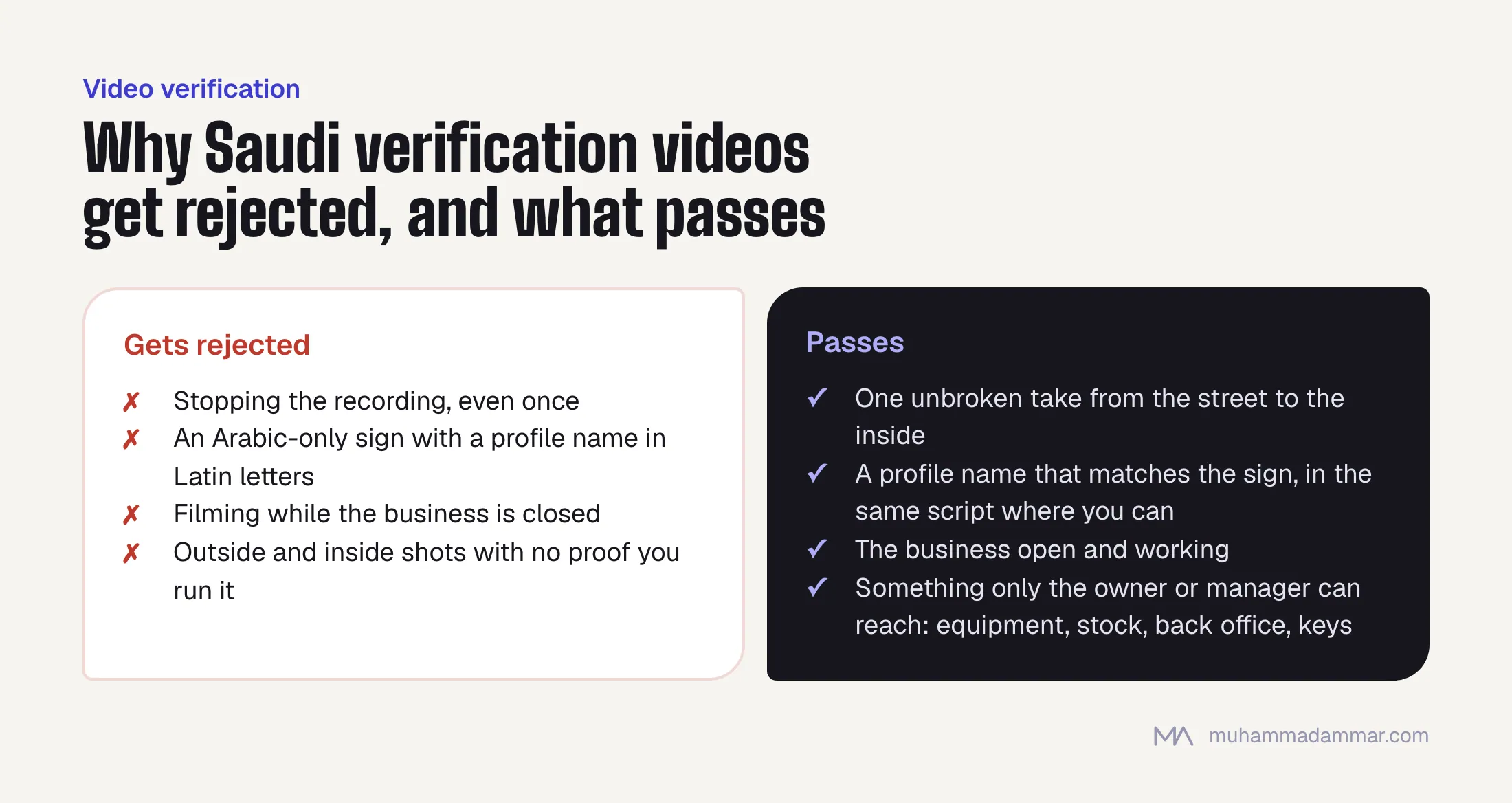
- Stopping the recording. It has to be one unbroken take from the street to the inside. Any cut gets it rejected.
- An Arabic-only sign with a profile name in Latin letters. If the sign says one thing and the profile another, the reviewer can’t match them. Make the profile name match the sign, in the same script where you can.
- Filming at the wrong time. Show the business open and working.
- No proof that you run it. Outside and inside shots alone aren’t enough. Show something only the owner or manager would have access to.
Service-area businesses with no public premises are the hardest case and often need several attempts. Keep your commercial registration to hand and expect it to take longer than the help pages suggest.
Arabic or English business name
This looks like a branding preference, but you don’t have a free choice, and it affects the profile more than any other decision.
Three things limit it.
The name has to match the real world. Google’s rules require the profile name to be the business’s actual name as it appears on the sign and branding, with no added keywords, city names or descriptions. A name like “Riyadh Seafood Restaurant, Best Prices” breaks the rules and invites a competitor to suggest an edit against you. Keyword-stuffed names are among the violations competitors report most.
Verification depends on it, as above: the name has to match the sign the reviewer is looking at.
Consistency adds up. Spell your Arabic name the same way everywhere: the profile, website, social accounts, invoices and any directory you’re in. A brand written three ways looks like three weak businesses instead of one strong one, and that matters for search and, more and more, for AI assistants.
My default for a business selling to Saudi customers is the Arabic name as the main name, matching the sign, with the Latin spelling used consistently on your English pages. If your sign and identity really are in Latin letters, do the reverse. Never invent a name for the profile that appears nowhere else.
Addresses and the National Address system
The Saudi National Address gives every property a structured address: a four-digit building number, street, district, city, postal code and a four-digit additional number. It’s a good system, and Google’s address form wasn’t designed for it.
In practice:
- The map pin matters more than the address text. Where street-level data is weak, Google relies on the coordinates. A perfectly written address with the pin a kilometre off sends customers to the wrong place and performs worse in map results. Fixing a misplaced pin is often the most valuable ten minutes you can spend on a Saudi profile.
- Fill in the district (hay) properly. People in Saudi cities navigate and search by district far more than by street name.
- Keep the address identical everywhere: same format, same Latin spelling, same district name on the profile, the website and every other listing. With so few listing sites in the market, the ones that exist carry more weight.
- Service-area businesses shouldn’t publish a home address. Set the service area properly instead. This setup also confuses verification more than any other, so expect some friction.
Choosing a category when the right one doesn’t exist
The primary category is the strongest relevance signal on the whole profile, and Google’s category list was built around North American business types. Plenty of common Saudi business models don’t fit it well.
What works:
- Search your main term in Google Maps from inside the target city and look at the categories the top three results use. That’s the category Google links with the search, and it’s more reliable than anything you work out from the list alone.
- Pick the most specific category that’s actually accurate. Specific beats broad, but an inaccurate specific category is worse than an accurate broad one.
- Use secondary categories for real extra services, not for every keyword you’d like to rank for. They dilute the profile, and only the primary category carries real weight.
- Check the category in both interface languages. Category names are translated, and now and then the Arabic label doesn’t mean what the English one does, so people pick the wrong one in good faith.
When nothing fits, take the closest accurate category and put the detail in the business description, the services list and your website.
Reviews in Arabic
Reviews count for more in this market than in most, because the other trust signals, like established directories, industry bodies and long-running review sites, barely exist. For many Saudi customers, the Maps rating is the reputation check.
What works:
- Ask straight away, on WhatsApp. A review link sent in the same chat where you just delivered the service gets far more reviews than an emailed request. It’s the most effective habit you can build, and most businesses never do.
- Reply in the language of the review. Arabic reviews get Arabic replies. A templated English reply under an Arabic review looks automated and does more harm than saying nothing.
- Reply to every review, quickly. Future customers read your replies more than the reviewer does.
- Never filter. Sending happy customers to the review link and unhappy ones to a private form breaks Google’s rules and gets profiles penalised.
- Expect short reviews. A star rating with no text is normal here. Volume and recency do the work, so don’t chase long reviews.
What moves map rankings in Saudi Arabia
Local ranking comes down to relevance, distance and prominence. You can’t change distance. Here’s the rest, roughly in order of impact in this market:
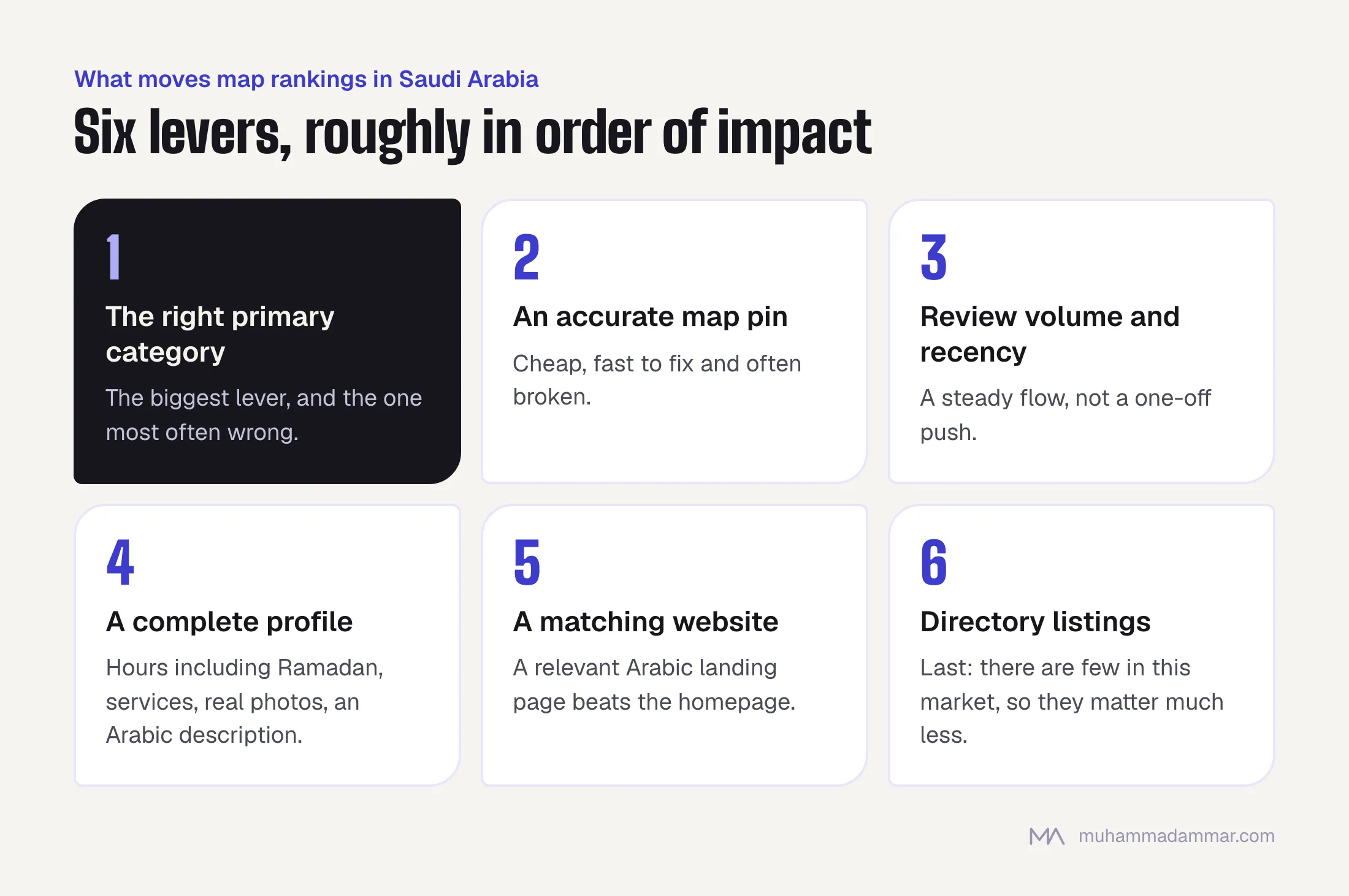
- The right primary category: the biggest lever, and the one most often wrong.
- An accurate map pin: cheap, fast to fix and often broken.
- Review volume and recency: a steady flow, not a one-off push.
- A complete profile: opening hours including Ramadan hours, services, attributes, real photos and an Arabic description.
- A matching website: a relevant Arabic landing page beats the homepage. That’s where the on-site side of local SEO comes in.
- Directory listings: last, and far less important than in Western markets because there are so few. Chasing them here is usually a poor use of budget.
One thing specific to the region: set your Ramadan hours properly and update them every year. Wrong hours during Ramadan and Eid bring a wave of bad reviews from people who arrived at a closed door, and those reviews stay long after you fix the hours. If you run several branches, see location pages for multi-branch chains, and for Egypt, which has no national address system, local SEO in Egypt.
Frequently asked
Can I have both an Arabic and an English profile name?
You manage one name. Google may show some people a translated version, but you can’t control that, and a second profile for the second language counts as a duplicate listing. Pick the name that matches your sign and use it consistently everywhere else.
How long does verification take in Saudi Arabia?
Video verifications are usually reviewed within days. Expect to need more than one try, and take the rejection reasons literally, because they usually are.
Do I need a commercial registration?
Google doesn’t formally require one, but keep it ready. Verification reviews and any appeal go better when you can show the business exists and that you run it.
Should I add keywords to my business name?
No. It breaks the rules, competitors report it, and the correction wipes out any short-term gain. Put keywords in the category, the description and your website.
How many locations can I list?
One profile per physical location with its own staffed premises. Several profiles at one address, or profiles for areas you only serve, are the fastest way to get the whole set suspended.
Related: local SEO and SEO consultant in Saudi Arabia. If your profile is stuck in verification or not showing on the map, message me.

SEO and digital marketing consultant since 2015, working with businesses in Egypt, Saudi Arabia and the UAE.
About the author and editorial standards