On this page
Take a chain with forty branches across Saudi Arabia and the UAE. People run local searches for it every hour, and usually there’s one page to answer all of them. The instinct is to generate forty location pages from a template. The fear, rightly, is that Google will see them as doorway pages and treat the whole set as spam.
Both instincts are right. The work is knowing exactly where the line is and building a template that stays on the safe side of it at scale.
Where the doorway-page line is
A doorway page exists to catch a search and pass the visitor on somewhere else, adding nothing itself. The test isn’t whether there’s a template. Templates are normal and fine. The test is whether the page is useful to someone standing in that city.
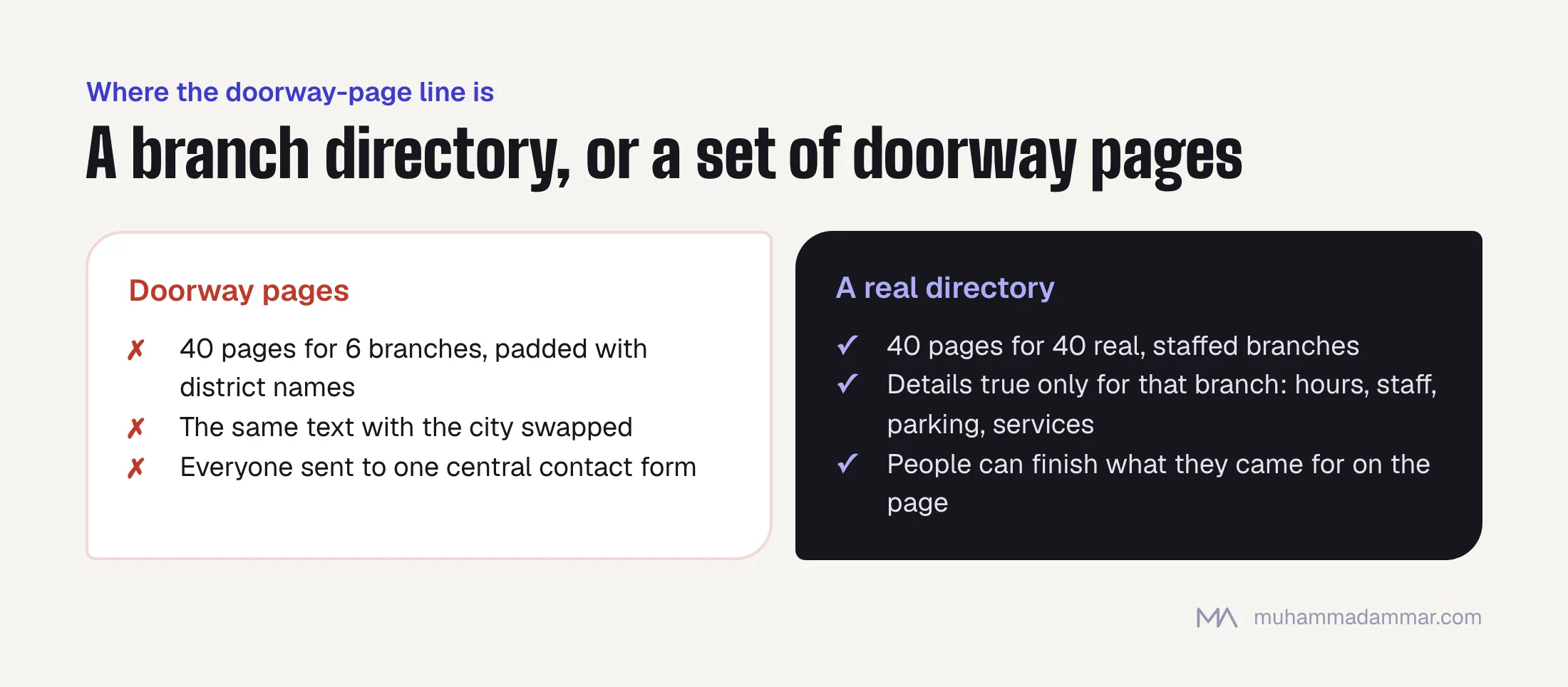
In practice, a location page is safe when it meets all of these:
- It represents a real, staffed location a customer can visit.
- It has information that’s true only for that location: hours, staff, parking, the services offered there.
- It lets people finish what they came for on the page, instead of sending everyone to one central contact form.
- It isn’t one of twelve near-identical pages targeting districts of a city where you have one branch.
That last point is where most chains cross the line. Forty pages for forty branches is a directory. Forty pages for six branches, padded out with district names, is a set of doorway pages.
A location page template with real unique content
The template should be roughly 40% fixed and 60% specific to the location. The fixed part is the navigation, brand message and service list. The variable part has to be real, which means someone at each branch has to supply it once.
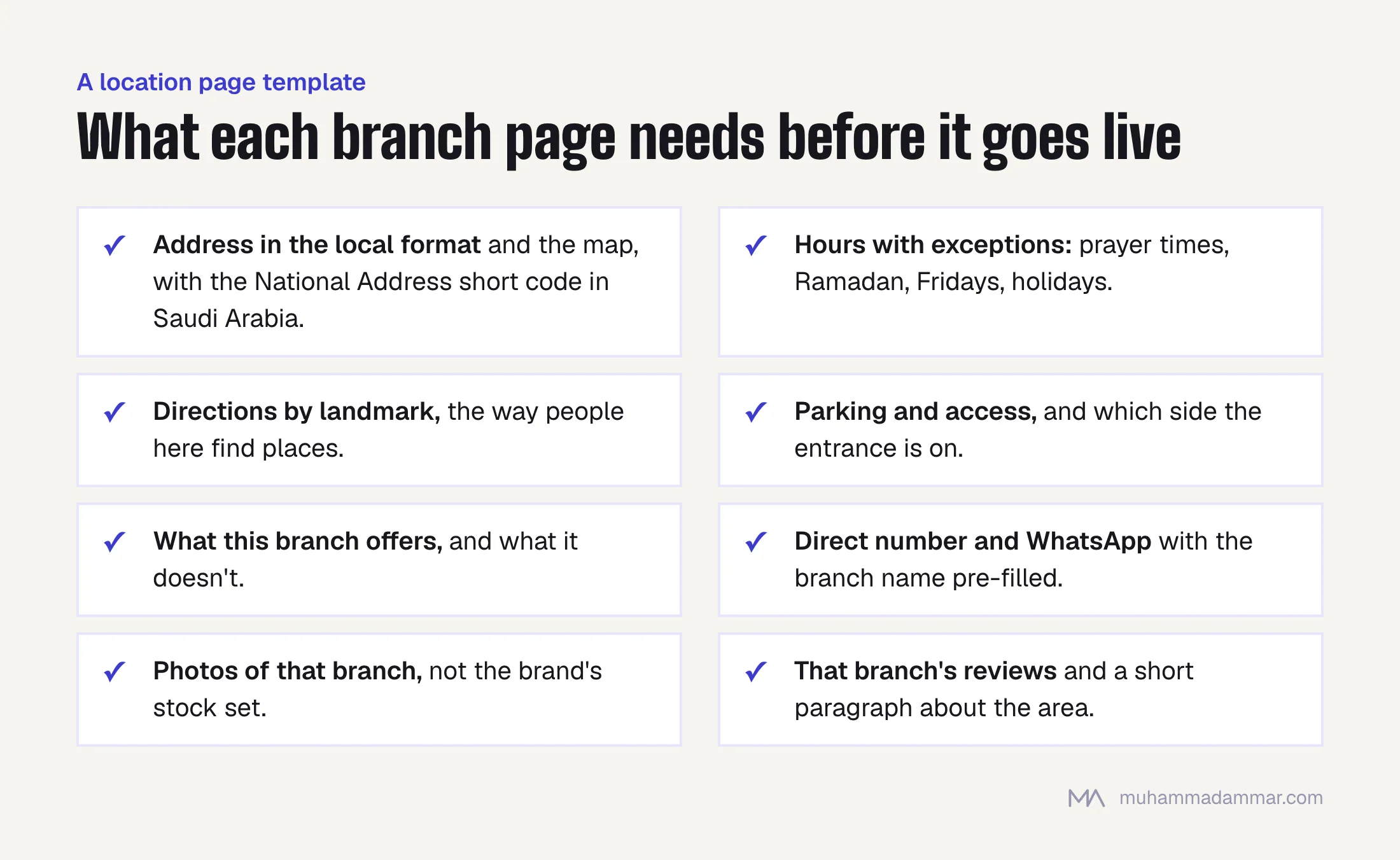
- Name, full address in the local format, and the map. In Saudi Arabia include the National Address short code, which customers and delivery drivers both use.
- Opening hours, including exceptions: prayer-time closures where they apply, Ramadan hours, Friday hours and public holidays.
- Directions using landmarks. “Opposite the north entrance of X mall, second floor” is how people in this region actually find places, and it’s unique text by definition.
- Parking and access: free, paid or valet, and which side the entrance is on.
- What this branch does and doesn’t offer. Not every branch offers every service. Saying so saves wasted trips and creates unique content at the same time.
- Branch contact details: a direct number and a WhatsApp link with the branch name already in the message.
- Two to four photos of that branch. Real ones, not the brand’s stock set.
- Reviews for that location, taken from that branch’s profile.
- A short paragraph about the area, written once by someone who works there, not spun.
If you can’t fill points 3 to 9 for a branch, it doesn’t get a page yet. A thin location page is worse than none, because it drags down the quality of the whole set.
Store locator structure and internal links
The most common technical failure I see is a locator built entirely in JavaScript, where the branch pages exist but nothing links to them in the HTML. Every branch page is then an orphan, and the chain wonders why none of them rank.
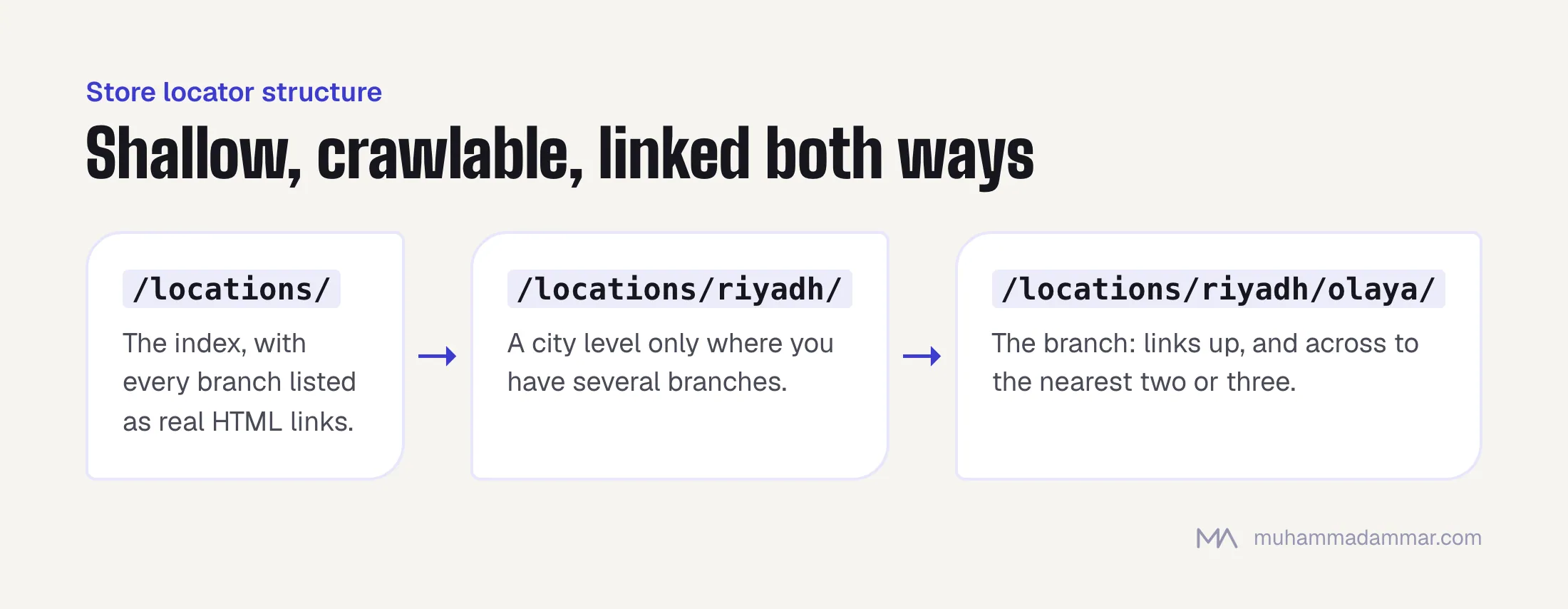
- URL pattern:
/locations/→/locations/riyadh/→/locations/riyadh/olaya/. Use a city level only where you have several branches in that city. - The locator must output links in the HTML, or at least include a crawlable list of all branches next to the interactive map.
- Every branch page links up to its city page and the locations index, and across to the two or three nearest branches, which genuinely helps someone whose nearest branch is closed.
- Service pages link down to the branches that offer that service. That’s the link that actually passes authority into the location pages.
- Keep it shallow. A branch page four clicks from the homepage with no other links pointing to it will be crawled rarely.
Mark up each branch page as LocalBusiness (or the specific subtype) with its own address, coordinates, opening hours and phone number, and reference the parent organisation. Don’t put the head office address on every branch page. That one mistake makes forty pages look like one business copied forty times.
Managing forty listings without chaos
- One organisation account and one manager per region. Branch managers get access to their own listing only, and no listing is created on a personal account.
- Bulk management for hours, attributes and holiday changes. Doing forty listings by hand guarantees they drift apart.
- A naming standard: the same brand name, separator and branch identifier on every listing, matching the website and the shop sign.
- Consistent name, address and phone across the listing, the website page and any local directory. Inconsistency across forty branches is the biggest single cause of local ranking problems at this scale.
- Someone responsible for review replies in each region, replying in the language the review was written in.
- A check every quarter for duplicate listings. Chains pile them up, especially after a branch moves.
Arabic and English location pages
Both languages need the full set, and the Arabic version isn’t a translation of the directions. The landmark description, the district name and the address format all differ. People find the same building using different reference points in each language, and district names often have an everyday Arabic form that differs from the official Latin spelling.
Keep links within each language: Arabic branch pages link to Arabic city and service pages, and people switch language through the language switcher and hreflang. Mixing them scatters the Arabic pages’ authority into the English ones.
Measuring each location
- Use a URL pattern that lets you filter Search Console by city folder in one click.
- Tag every branch page’s WhatsApp and call links with the branch identifier, so you know where a lead came from without asking the customer.
- Track direction requests and calls for each listing, not just website clicks. For physical locations those are the real conversions.
- Compare branches with each other before comparing them with a target. A branch behind its peers has a page or listing problem. If every branch is behind, the template or the brand search is the problem.
The basics of a single branch profile are in running a Google Business Profile in Saudi Arabia. The groundwork for this is part of my local SEO work, the locator and crawling side is technical SEO, and if your chain is in the UAE, my SEO consultant in the UAE page explains how I work with clients there.
Frequently asked
Should every branch have its own page?
Every branch that’s a real location customers can visit, yes. Areas you serve without a physical presence, no. Those belong on a city service page, not a location page.
Can we use AI to write the unique sections?
To organise and tidy up what branches send you, yes. To invent the local details, no. The details are the whole value, and invented landmarks are useless and easy to spot.
What about branches inside malls?
They get their own page, and the mall’s name belongs in the page title and directions, because that’s how people search for them.
What do we do when a branch closes?
Mark the listing as closed instead of deleting it, and either redirect the page to the nearest branch or keep it with a clear closure notice and links to alternatives. Don’t leave it live as if the branch still exists.
Do we need a page for every district in big cities?
Only if you have a branch in that district. District pages without branches are exactly the doorway pattern this article is about avoiding.
Running a chain and not sure whether your location pages help or hurt? Message me.

SEO and digital marketing consultant since 2015, working with businesses in Egypt, Saudi Arabia and the UAE.
About the author and editorial standards