On this page
Open any local SEO guide and the heart of it is citations: get listed the same way across dozens of directories, aggregators and industry sites, and the consistency itself becomes a trust signal.
That advice assumes an infrastructure Egypt doesn’t have. There’s no thick layer of credible business directories here, no data aggregators feeding them, and most of the directories that do exist are low quality. Following the imported playbook means spending months building listings on sites that carry no weight.
Here’s what to do instead.
Why the citation playbook doesn’t carry over
There are three reasons, and understanding them stops you hunting for a workaround that doesn’t exist.
The directories are few and mostly worthless. Western local SEO relies on decades of business listing infrastructure. Egypt has a handful of general directories, most with little search visibility of their own, plus a long tail of sites that exist to sell listings. A listing on a site nobody visits and Google barely crawls isn’t a signal.
There are no data aggregators. In mature markets, submitting to a few aggregators spreads your details across the whole ecosystem automatically. That doesn’t exist here, so every listing is manual and every listing goes out of date on its own.
Addresses themselves aren’t consistent. This is the deep one. Citation consistency assumes there’s one correct way to write your address. In Egypt there often isn’t: the same place can be written with two different area names, in Arabic or Latin letters, with or without a landmark, and a person would call all of them correct.
What replaces the playbook is focus: far fewer places, each one done properly, with your Google Business Profile doing most of the work.
How to judge whether a directory is worth an hour
The list of worthwhile Egyptian directories is short and keeps changing, so the lasting skill is judging one. Five checks, in order, and a directory has to pass all five:
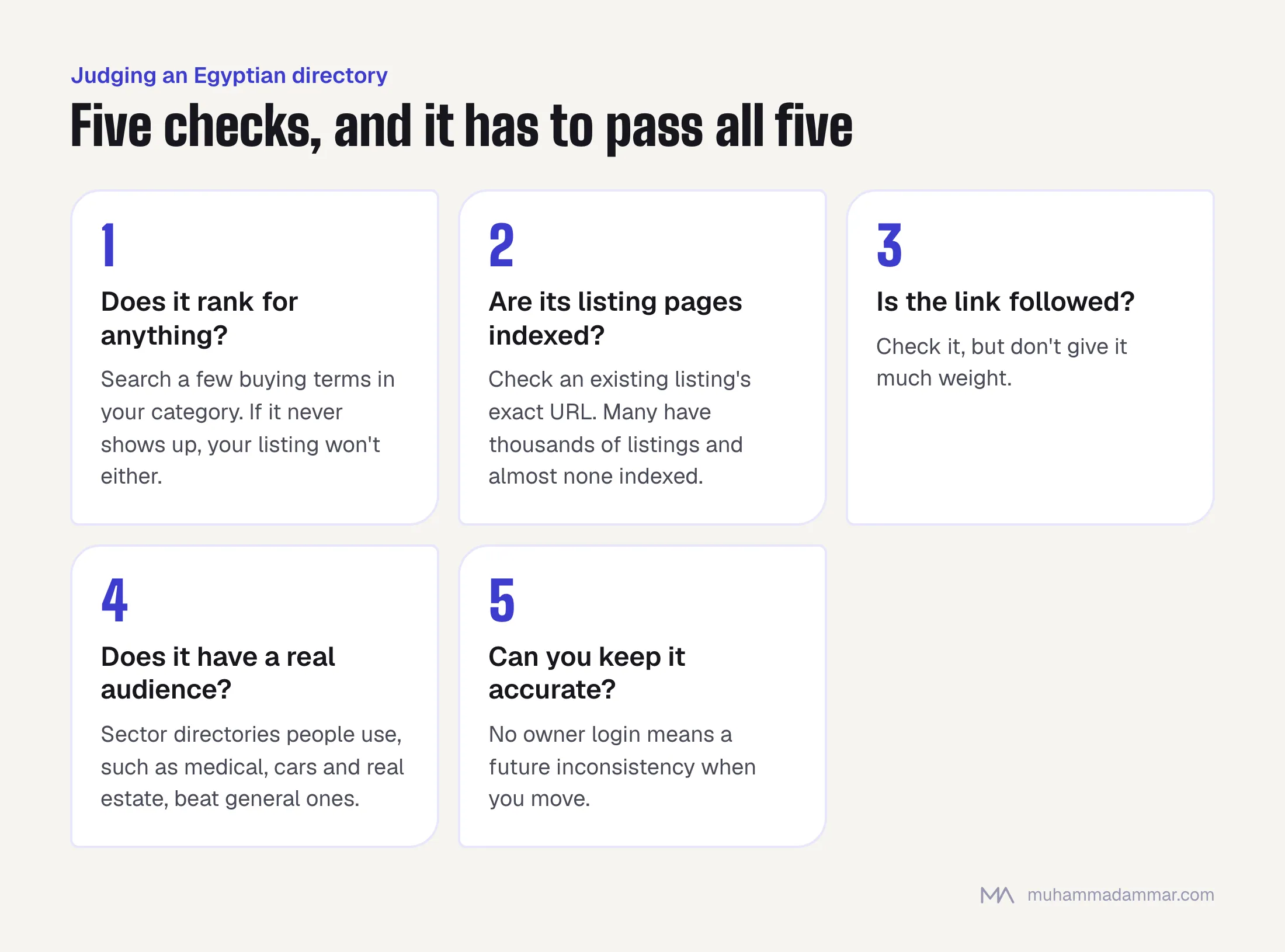
- Does it rank for anything? Search a few buying terms in your category and see whether the directory shows up. If it never does, your listing won’t either.
- Are its listing pages indexed? Take an existing business listing and check whether that exact URL is in Google’s index. Plenty of directories have thousands of listings and almost none indexed.
- Is the link followed, and does it matter? Check, but don’t give it much weight. A nofollow listing on a directory real customers use is worth more than a followed one on a site nobody visits.
- Does it have a real audience? This is about referral traffic. Some Egyptian directories are used by real people in specific sectors, such as medical, cars and real estate, and those are worth more than any general directory.
- Can you keep it accurate? A listing you can’t edit when you move becomes a future inconsistency. If there’s no owner login, think twice.
You’ll realistically end up with a handful, not fifty. That’s the right result, and it frees up budget for the things that actually move local rankings here.
Keeping name, address and phone consistent when there’s no standard
This is the practical heart of local SEO in Egypt. You can’t rely on a standard format, so you have to create one and stick to it.
Write the address once, in a document, and never improvise it again. Choose the area name: if your location goes by two names, pick the one people search and use only that. Decide on Arabic or Latin letters, whether to include a landmark, and the order of the parts. Then that exact text goes everywhere: website, profile, invoices, social bios and every listing.
Do the same for the phone number. With or without the country code, with or without the leading zero, with or without spaces. Pick one written form for display, and make sure the tel: link uses the full international format so it works from outside the country.
The map pin matters more than the text. Where street data is weak, Google relies on coordinates. A perfectly written address with the pin on the wrong block sends customers somewhere else and does worse in map results. Check the pin by navigating to it yourself. Fixing a misplaced pin is often the most valuable task on the whole account, and it takes ten minutes.
Two-language sites need one decision, applied everywhere. The Arabic page has the Arabic address, the English page has the Latin version, and both describe the same place in the same order. Mixing formats within one site is the most common inconsistency I find, and it’s self-inflicted.
Arabic “near me” isn’t “near me”
English local SEO is built around “near me” searches. The Arabic equivalent exists and people use it, but it isn’t the main pattern here, and optimising only for it misses most of the demand.
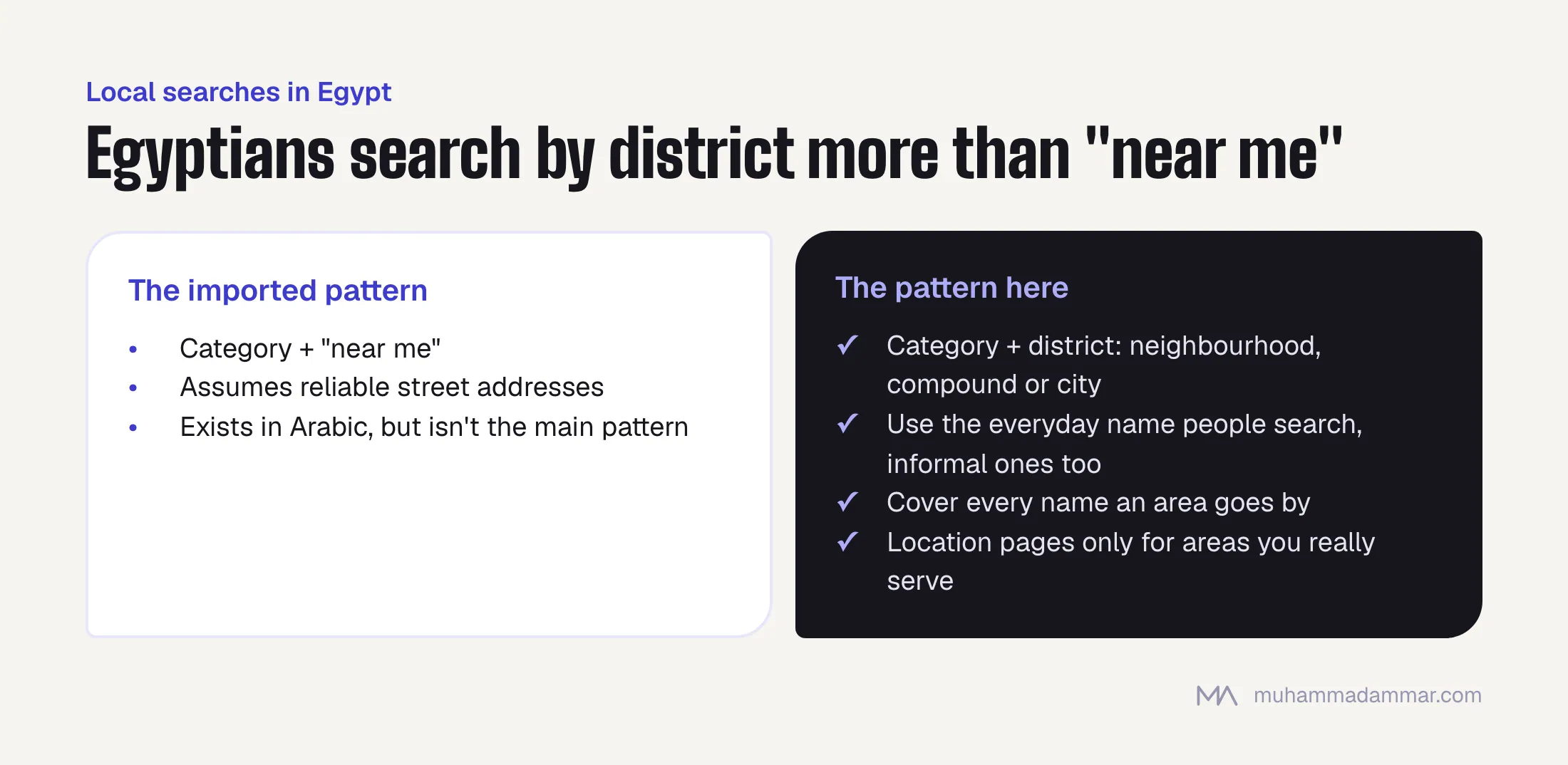
Egyptians mostly search by area name. The search is a category plus a district (the neighbourhood, the compound, the city), because area names are how people find their way in a city where street addresses aren’t reliable. Someone looking for a dentist types the category with their district, not “dentist near me”.
That has three consequences:
- Your district name belongs in your content, in the everyday Arabic form people use, including the informal name if that’s what they search.
- Areas with several names need each one covered. Newer districts are often known by two or three names at once, and those names don’t share search volume.
- Build location pages around real areas you serve, not every district in the governorate. Thin, templated area pages look like doorway pages and get filtered out, here as anywhere.
Distance still dominates the map results, so content can’t make you appear in an area you’re not in. What it can do is win the regular results under the map, which in many Egyptian categories get more clicks than the map itself.
Reviews in a market that doesn’t review much
Egyptian businesses get far fewer reviews than Western local SEO benchmarks expect, and the reviews are shorter. That’s a disadvantage and an opportunity at the same time: when a competitor has eleven reviews, forty puts you clearly ahead.
What works here:
- Ask on WhatsApp, straight away. A review link sent in the chat where you just delivered the service works far better than email. Most Egyptian businesses already talk to customers on WhatsApp and never use it for this.
- Ask in person, then follow up. Asking face to face plus sending a link within the hour works better than either alone.
- Accept star-only reviews. Ratings without text are normal. Chasing written reviews wastes goodwill. Volume and recency do the work.
- Reply in Arabic, to every review. Future customers read your replies. A templated English reply under an Arabic review looks automated and does more harm than silence.
- Never filter or buy reviews. Sending happy customers to the link and unhappy ones elsewhere breaks Google’s rules, and bought reviews can be detected and do damage.
Asking steadily beats running a campaign. Twenty reviews arriving in one week looks exactly like what it is.
Where the budget should go
Roughly in order of return for a local business in Egypt:
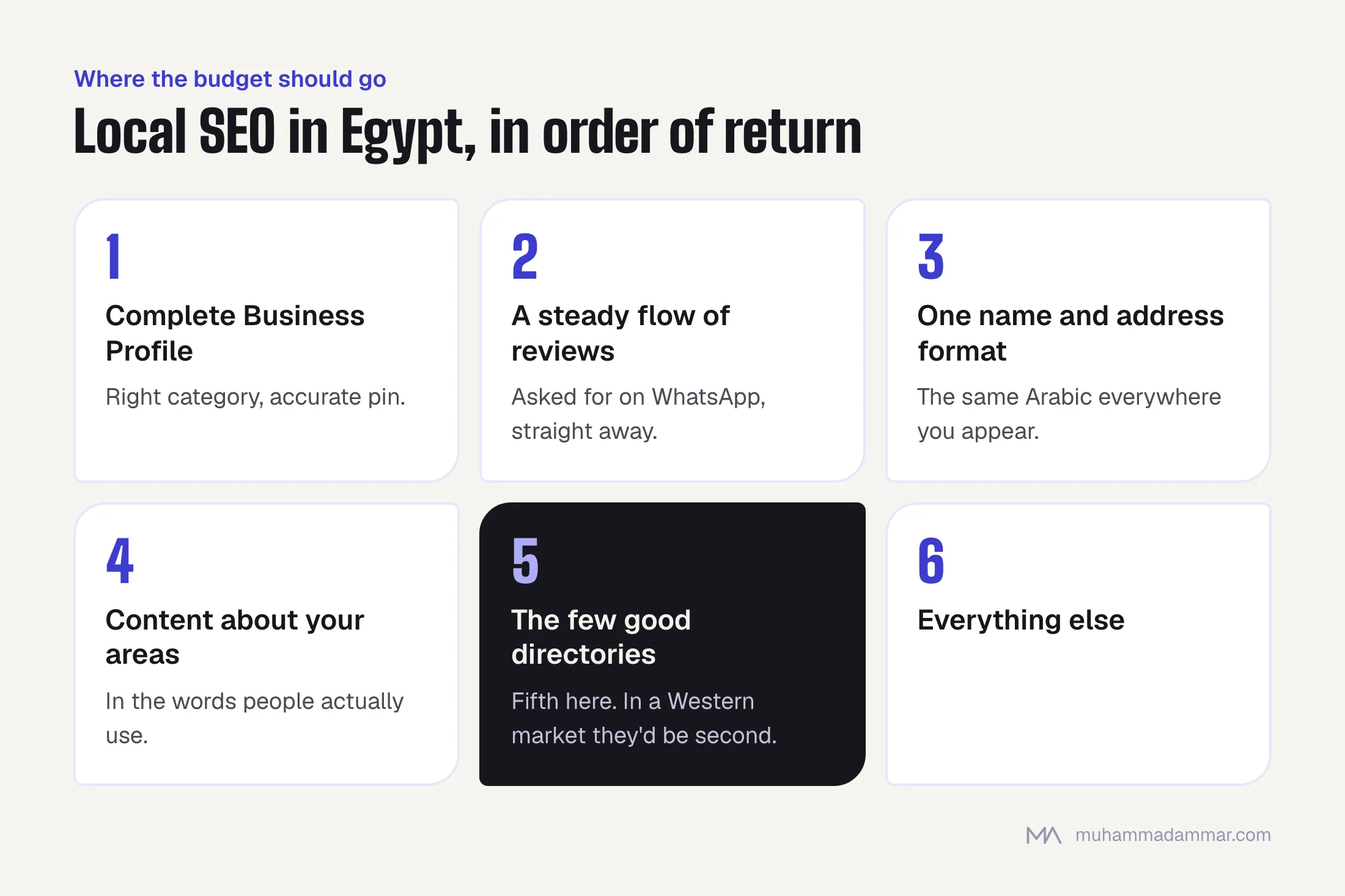
- A complete Google Business Profile in the right category, with an accurate pin.
- A steady flow of reviews.
- The same Arabic name and address format everywhere you appear.
- Content about your areas, in the words people actually use.
- The few directories that pass the five checks above.
- Everything else.
Directory listings come fifth. In a Western market they’d be second, and that reversal is the most useful thing to take from this article.
Frequently asked
Are directory listings useless in Egypt?
Not useless, just much less important than the imported playbook suggests, and concentrated in a few places. A handful of good ones beats fifty poor ones, and fifty poor ones aren’t worth the week they take.
Should my business name be in Arabic or English?
Match your sign, then stay consistent everywhere. If the sign is in Arabic, the profile is in Arabic. Inventing a keyword-stuffed name for the profile breaks Google’s rules, and competitors report it.
What if my area has two common names?
Use the more-searched name in your address and profile, and mention the other naturally in your page content. Don’t switch between them across listings.
Can I rank in an area where I have no branch?
In the map results, basically no, because distance dominates. In the regular results below the map, yes, with genuinely useful content about serving that area. That’s the realistic goal for businesses that serve an area without a branch there.
Does this apply to Saudi Arabia too?
Partly. Directories are thin there too, but Saudi Arabia has a structured national address system that Egypt doesn’t, which changes how you handle the address a lot. That version is in running a Google Business Profile in Saudi Arabia.
Related: local SEO, Arabic SEO and SEO consultant in Egypt. If your business doesn’t show up on the map in your own area, message me.

SEO and digital marketing consultant since 2015, working with businesses in Egypt, Saudi Arabia and the UAE.
About the author and editorial standards