Programmatic SEO (pSEO)
Many pages built from one template and real data. Each one useful on its own, checked before it goes live, and released in waves you can measure.

Is this for you?
A good fit if
- Many people search the same pattern, like "[service] in [city]" or "[tool] vs [tool]"
- You hold data that differs from page to page: records, a catalogue, a product database
- A US SaaS or B2B company, or a business in Egypt, Saudi Arabia or the UAE, that needs the pages in English and Arabic
Not the right fit if
- The data is the same on every page and only a keyword changes
- Your market is small and a few hand-written pages would cover the real searches
- You want a page count, not pages a reader would use
How I do it.
-
Data audit
What data you hold, where it comes from, who keeps it current, and which fields differ from page to page.
-
Search pattern map
The searches that repeat, grouped into page types, with the data each type needs.
-
Page template
One layout per page type, built around the answer a reader came for, with room for data that changes the content.
-
Unique data per page
Each page filled from named sources. Where a page has nothing of its own to say, it is not built.
-
Quality gate
Unique-data minimum, publish threshold, duplicate checks across the set, and a person reading a sample of each page type.
-
Release in waves
A first set goes live, and its indexing and impressions are checked in Search Console before the next one.
-
Prune and report
Weak pages are improved, merged or removed. Reporting is by page group, not one URL at a time.
What you get.
- Page-type map with the data each type needs
- Data sheet: sources, owners and refresh dates
- Page templates in English and Arabic
- Quality rules and the publish threshold
- Release plan in waves
- Search Console report by page group
The details.
What is programmatic SEO, and when does it fit?
Programmatic SEO builds many pages from one template and a dataset, so each page answers one specific search. It fits when many people search the same pattern, such as “[service] in [city]”, and you hold data that differs from page to page. If only the keyword changes, it doesn’t fit. See is programmatic SEO worth it.
Which page types can be built, and what data does each need?
Five page types cover most cases. Each is worth building only if the third column can be filled from real data.
| Page type | The search it answers | Data each page needs |
|---|---|---|
| Locations | “[service] in [city]” | Areas covered, named team or branch, local rules, real photos |
| Comparisons and alternatives | “[A] vs [B]” | Features and limits of each product from its own documentation, the date checked, who each suits |
| Integrations | “[your tool] with [other tool]” | What syncs, setup steps, known limits |
| Industry or use case | “[product] for [industry]” | The industry’s workflow, terms and rules, examples from real use |
| Glossary | “what is [term]” | A definition from someone who knows the field, and how it applies to your product |
Where does the data for each page come from, and how is it checked?
Every field comes from a source you can name: your own product or database, a feed, public records, or facts your team writes by hand. Each field is listed in a data sheet with its source, owner and refresh date. Text scraped or rewritten from other sites isn’t used.
Before any page is built, a sample of rows is compared with the original source, empty fields are counted per page type, and odd values are flagged, such as a city with no branch. A stale field means the page is updated or taken out.
What is checked before a page is published?
Four checks, and a page goes live only if it passes all of them. The rules are written per page type before the first page is built.
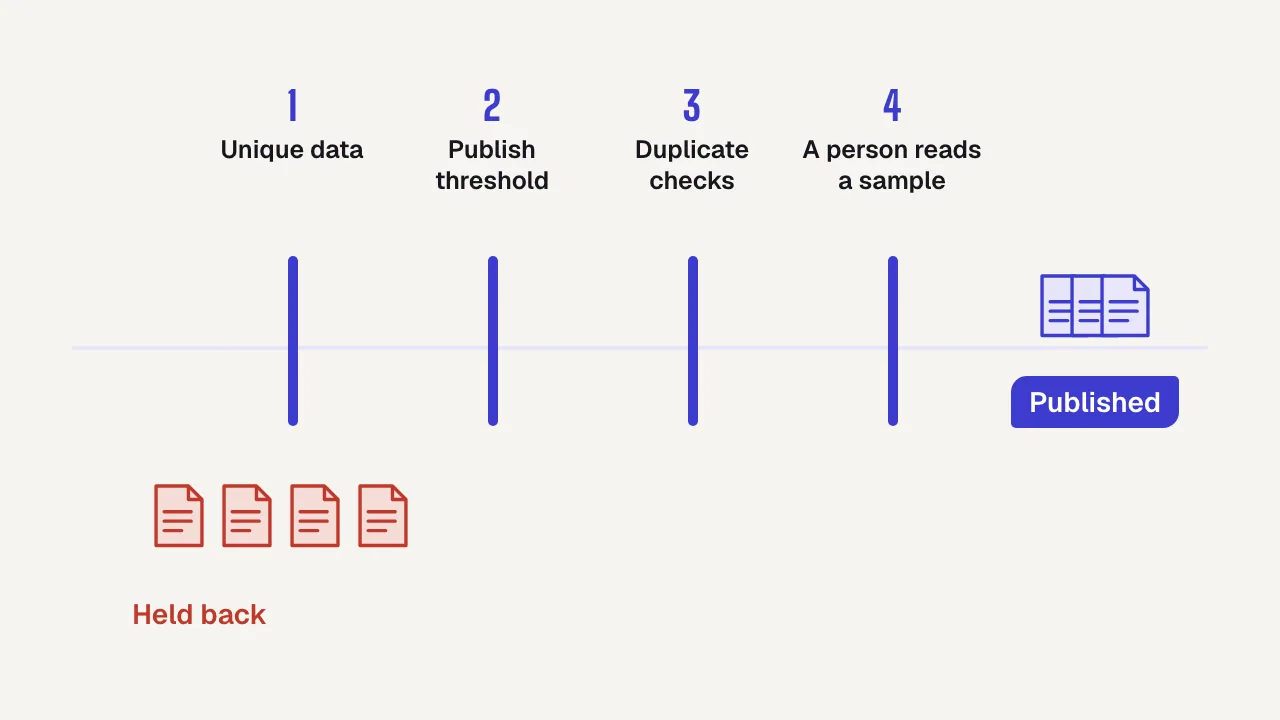
- Unique data: a minimum set of fields that differ from the other pages of the same type.
- Publish threshold: a page below that minimum is held back, never published with blanks.
- Duplicate checks: a script compares text, titles and headings across the whole set and flags near-copies.
- A person reads a sample from each page type, including the weakest, and approves the template or sends it back.
Is programmatic SEO against Google’s spam policy?
Not in itself. Google’s spam policies define scaled content abuse as “when many pages are generated for the primary purpose of manipulating search rankings and not helping users”, and the policy applies however the content is made.
Google’s examples include scraping or automatically changing content, with synonyms or translation, to make many pages with little value. They also include stitching together content from other pages without adding value, and pages that make little sense to a reader but contain keywords. Google’s guidance on AI content says automation or AI isn’t banned in itself, but generating many pages without adding value for users may violate the policy.
The checks above follow from those examples: the data is yours, Arabic is written from the data and not machine-translated, a person reads samples, and a page with nothing of its own to say isn’t published. No one can promise how Google will treat a given site.
How are pages released, and what happens to weak ones?
Pages go out in waves, and each wave is checked before the next one starts. The first wave is a set from each page type, small enough for a person to review.
- Search Console shows which pages are indexed, which get impressions and which Google leaves out. Pages left out show where the data is weak.
- The next wave is released only after that review.
- Pages that stay weak are improved, merged into a stronger page, set to noindex, or removed with a redirect where a better page exists.
Reports are by page group, so you see which template needs a rethink.
How do Arabic and RTL pages work?
Each Arabic page is written from the data in Arabic and laid out right to left from the start. It isn’t a translation of the English set. For Egypt, Saudi Arabia and the UAE this is its own part of the work.
- Grammar changes with the variable. Articles, plurals, gender and prepositions shift with the city or product name, so one sentence with a blank slot produces broken Arabic. The template carries a variant for each case.
- Dialect spellings follow the market, checked against real queries.
- Arabic slugs: Arabic or Latin URLs are chosen once for the whole set, then tested.
- hreflang links each Arabic page to its English twin and back. A page with no twin gets no tag, and variants such as ar-EG, ar-SA, ar-AE and en-US are used only where the content differs.
- RTL layout is tested for tables, numbers and Latin names inside Arabic sentences.
In their words.
Clients asked not to be named. Each quote links to the case study with the numbers behind it.
See the numbers (Editor, Arabic lifestyle publisher)Our monthly clicks from Google went from about 113 thousand to more than 190 thousand in three months.
See the numbers (Owner, online store, Egypt)Much more of our catalogue shows up in Google now. Impressions went up by more than a third, and clicks followed.
See the numbers (Manager, services company, Saudi Arabia)We started with almost no visits from Google. Now people find us every month when they search for our services.
Common questions.
Is programmatic SEO spam?
Not by itself. Google's spam policies target many pages made mainly to manipulate rankings, however they are produced. Pages built from a template and real data, where each page gives a reader something the others don't, are a different case. Every page type is checked against that test before anything is published. Nobody can promise how Google will treat a given site.
Does programmatic SEO still work, or is it dead?
It isn't dead, but it only works on the conditions it always needed: many people searching one pattern, and data that differs from page to page. Google's guidance on AI content says automation isn't banned in itself. Sets that swap only a keyword are the ones at risk. Nobody can promise rankings or traffic from a page set.
How long does it take?
There is no fixed timeline, and I won't give you one. The work runs in stages: data check, template, quality gate, then a first wave. How Google indexes that wave decides what happens next, so the schedule follows what Search Console shows, not a date set in advance.
Does it suit B2B and SaaS?
Often, when there is real data behind each page: integrations, comparisons, alternatives, use cases by industry or role, or a glossary written by people who know the field. It suits less when the product has little data to show. The data audit tells us which page types are worth building before any template exists.
How do I get started with programmatic SEO?
Start with the data, before any template exists. List the searches that repeat in your market and, for each, the data you hold that would make a page different. The data audit checks sources and gaps, then one page type gets a template, a quality check and a small first wave before anything else is built.
What does it cost?
It depends on scope: how many page types, where the data comes from, and whether you need English and Arabic. I don't quote a number before I have seen the data. The price comes after a call, and we agree it before I start.
Your next move.
Tell me where things are now and where you want them to be. I reply within one business day, in Arabic or English. If I'm not the right person for it, I'll say so.
Follow me