On this page
- When do template pages help a business?
- What does Google’s policy say about template pages?
- What is the go/no-go test for programmatic pages?
- Can you make a page for every city and every service?
- What should each template page contain that the others don’t?
- How do you launch template pages and keep them under control?
- Frequently asked
Programmatic SEO means generating many pages from a template and a dataset, such as a page for each city and service. It works when each page holds data true only for that page and people want that exact combination. Without that, the pages risk falling under what Google’s spam policies call scaled content abuse or doorway abuse.
The test in this article is my own judgement, built from what Google’s pages say. It isn’t a Google checklist. The examples use an invented company, Sample Cleaning Co., and none of them describes client work or a result.
When do template pages help a business?
Template pages help when a business has many real variants of one offer and each variant has facts a visitor needs. The template supplies the layout and the data supplies what makes each page different. If the data is the same on every page, the template only copies it.
Three kinds of business tend to qualify. Service businesses in several cities, where the team, permits or venues really differ from city to city. Catalogues, where each product has its own specification, compatibility and availability. Directories and comparisons built on records you hold and keep current. B2B companies qualify too when each industry they serve really changes the product or the work, which industry and use-case pages for B2B covers.
A business with a single offer and a list of place names doesn’t qualify. It has one page’s worth of content and many URLs. For where this sits in the wider plan, see how to build an SEO strategy for a business.
What does Google’s policy say about template pages?
Google’s spam policies don’t name templates or generated pages as spam in themselves. They name two patterns: many pages made for the “primary purpose of manipulating search rankings and not helping users”, called scaled content abuse, and pages built to rank for specific, similar searches that lead users to intermediate pages less useful than the final destination, called doorway abuse. The scaled content policy applies “no matter how it’s created”.
The spam policies list “Creating many pages where the content makes little or no sense to a reader but contains search keywords” as an example of scaled content abuse, and say that if you host such content you should exclude it from Search. Their doorway abuse examples include these:
- “Having multiple domain names or pages targeted at specific regions or cities that funnel users to one page”.
- “Creating substantially similar pages that are closer to search results than a clearly defined, browseable hierarchy”.
The first describes city pages that exist only to send readers somewhere else. The second describes near-identical pages that read like a results list. The policy names no page count and no safe ratio, so I can’t say how many pages is too many. What you can check is what each page gives a reader.
Google’s guide to helpful, reliable, people-first content asks a related question: “Does the content provide original information, reporting, research, or analysis?” It also asks whether you are “producing lots of content on many different topics in hopes that some of it might perform well in search results”. Those are questions, not rules, and the test below turns them into something you can run first.
What is the go/no-go test for programmatic pages?
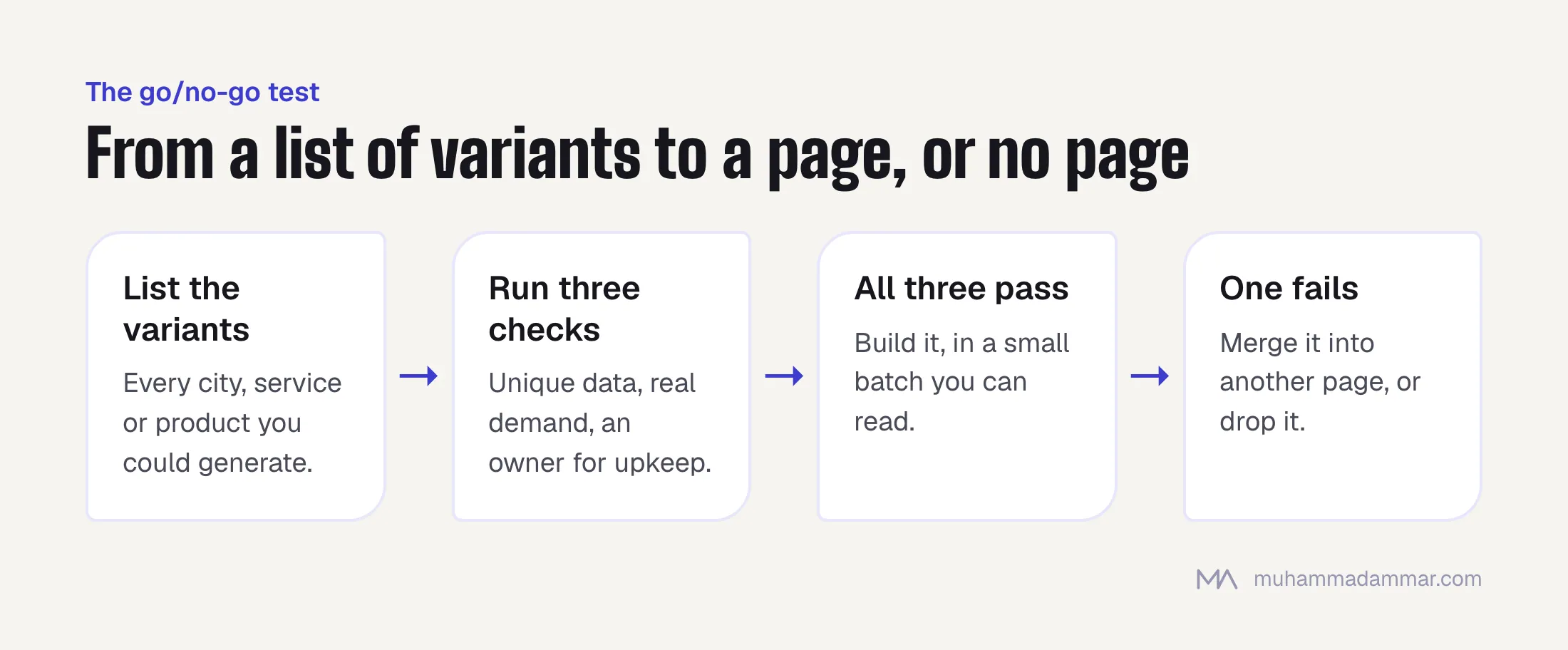
The test has three checks, and a variant gets a page only if it passes all three: unique data on the page, real demand for that exact variant, and someone who will keep the data current. If one fails, merge the variant into another page or drop it.
| Check | The question | A pass looks like | A fail looks like |
|---|---|---|---|
| 1. Unique data | What on this page is true only for this variant? | A fact you hold: coverage areas, named team, real photos, local rules, availability | Only the city name changes between pages |
| 2. Real demand | Does anyone ask for this exact combination? | Your own enquiries, calls, WhatsApp messages or Search Console queries mention it | You added it because the template could produce it |
| 3. Upkeep | Who updates this data, and how often? | A named owner and a date to check each field | Nobody owns it, so it goes stale |
Run it on a sample before building the template. Write down ten variants, answer the three questions for each, and count the survivors. If most fail, the dataset isn’t ready. Build fewer pages, or one stronger page.
The demand check needs care. This article quotes no search volumes, because a volume figure from someone else’s tool doesn’t prove demand for your variants. Use your own records: the enquiries you already get, the cities your sales team is asked about, the queries that already bring people to your site.
Can you make a page for every city and every service?
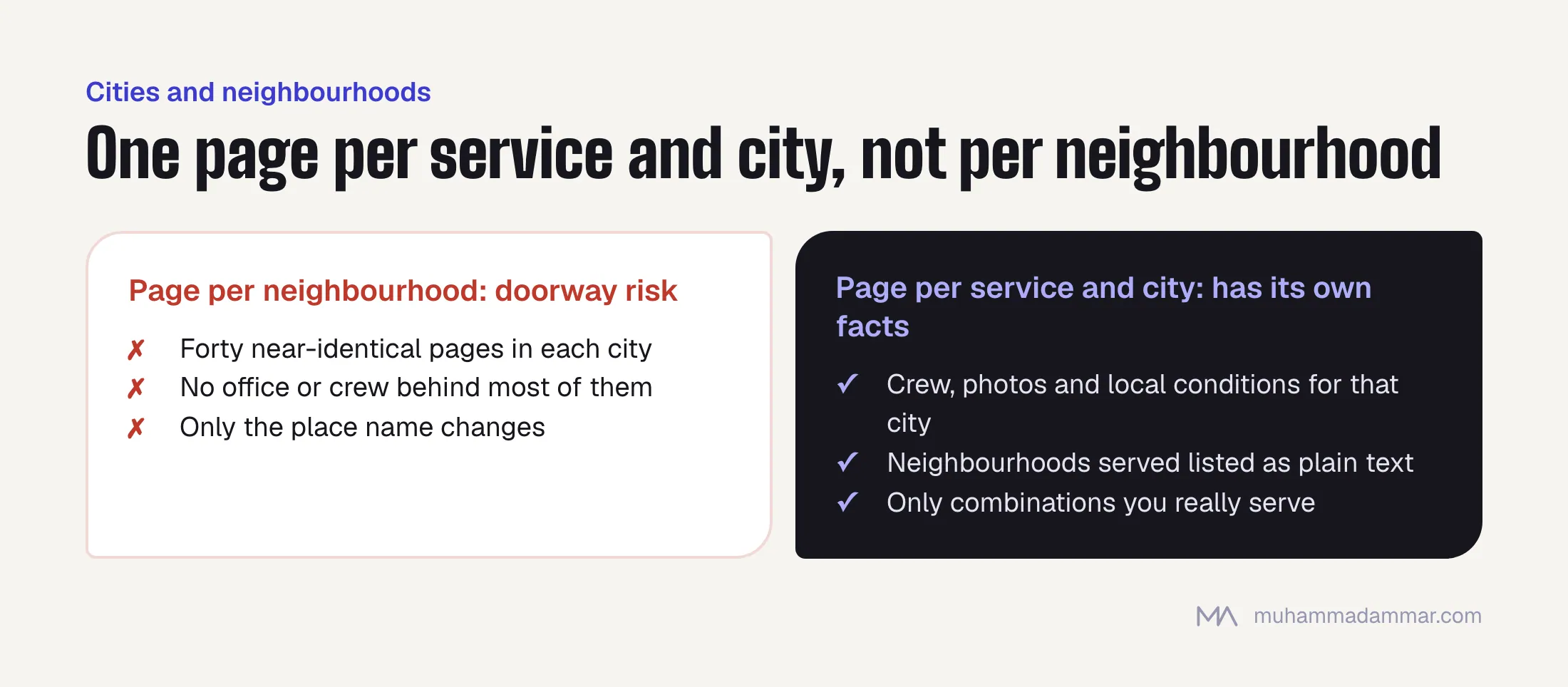
You can for the combinations you really serve and can say something specific about. For the rest, no. A page for every city and service is a doorway risk when most of the pages differ only by a place name.
Take Sample Cleaning Co., an invented company with offices in Riyadh, Jeddah and Cairo, offering office cleaning, post-construction cleaning, deep home cleaning and window cleaning. That is twelve possible city-and-service pages. Run the test on three of them:
- Post-construction cleaning in Cairo passes if the company has a Cairo crew trained for that work, photos of finished jobs and a list of the districts that crew covers.
- Window cleaning in Jeddah fails if there is no Jeddah crew for it and nobody has asked for it. The page would exist for the template, not for a reader.
- Office cleaning in Riyadh passes if the company can explain how it schedules around working hours there and which districts it covers.
Now add forty neighbourhoods per city. A page for each combination is the pattern Google describes with pages aimed at specific regions or cities, because a neighbourhood page with no office or crew behind it has nothing of its own to say. A better design is one page per service and city, with the neighbourhoods served listed as plain text.
Businesses with physical branches have a different case, covered in location pages that scale without becoming doorway pages. A branch page has a physical reason to exist that a service area doesn’t.
What should each template page contain that the others don’t?
Each page needs a block of content that can’t be produced by changing one word in a neighbouring page. That block is the reason the page exists, and it should be most of the page.
For a service-and-city page, content that qualifies includes the areas the team covers and the ones it doesn’t, who does the work there by name or role, photos from real jobs in that city used with the client’s permission, local conditions that change the work such as building types, permits or access rules, process details that differ by city, and customer quotes from that city used with consent.
Generated filler doesn’t qualify: an invented landmark, the same advice with the city name swapped, a block of keywords. Google’s example covers pages generated “without adding value for users”, and filler is exactly that. Whether AI tools were involved changes nothing, since the policy says “no matter how it’s created”.
Each language version is a separate page that has to pass the test, and what breaks when a template meets Arabic is covered in Arabic programmatic SEO for Egypt, Saudi Arabia and the UAE. A machine conversion of the other language adds nothing for someone who can read both. Write the Arabic from the data, and spell city names the way local readers do, such as الرياض (ar-Riyadh, “Riyadh”) and جدة (Jidda, “Jeddah”). The per-page quality questions for large publishing programmes are in publishing at scale without tripping Google’s scaled content policy.
How do you launch template pages and keep them under control?
Launch a small batch, check what Google does with it, and give the set an owner. The batch tests your test: if its pages aren’t indexed, or are indexed and attract nothing, the variants were weaker than they looked.
- Start with the pages that passed all three checks, in a batch small enough for someone to read every page.
- Link them from the service page and from each other, so they sit in a clear hierarchy and not as an unlinked pile.
- After a few weeks, check in Search Console which ones Google indexed, and read the ones it left out as feedback on your data.
- Set an upkeep date for each data field, and a rule for stale ones: update the field or take the page out.
- Expand only with variants that pass the same test.
If thin pages have piled up in the index, the pages nobody asked Google to index shows how to find them and handle each kind. A page that can’t be fixed should be removed or noindexed.
Passing the test gives a page a reason to exist. It doesn’t decide where Google ranks it, and nobody can promise that. A second read on a plan like this is part of my SEO service.
Frequently asked
What is programmatic SEO?
It’s building many search-facing pages from a template filled with structured data, such as a product feed or a list of cities and services. The idea is sound when the data gives each page something real to say. It becomes a problem when only a keyword changes between pages.
Is programmatic SEO safe with Google?
Google’s spam policies don’t name generating pages from data as spam. They target pages made mainly to manipulate rankings and doorway pages built to rank for similar searches and funnel visitors elsewhere. Whether yours are safe depends on what each page gives a reader. The policy sets no page count that is safe or unsafe.
How many template pages can I publish at once?
Google sets no number, so I can’t give you a safe one. The limit that matters is how many pages your team can keep accurate. Start with a batch small enough to read page by page, check in Search Console what Google indexed, and add more only with variants that pass the same test.
If you have a list of cities, services or products and you’re deciding whether to build pages from it, send me a message and I’ll go through the list with you.

SEO and digital marketing consultant since 2015, working with businesses in Egypt, Saudi Arabia, the UAE and the USA.
About the author and editorial standards