On this page
- Which page types can a SaaS company build from templates?
- What does each integration page need to be different from the others?
- How do you keep alternatives and comparison pages fair and current?
- Where does Google’s scaled content policy matter for SaaS pages?
- How do you stop SaaS template pages from competing with each other?
- How does this change for SaaS companies in the US, Egypt and the Gulf?
- Frequently asked
Programmatic SEO for SaaS means generating many pages from a template and your own product data, most often integration pages, alternatives pages and comparison pages. A page type earns its place only when each page carries facts true for that page alone, such as what an integration actually does. Where those facts don’t exist, skip the page type.
Whether to build template pages at all is a separate decision, covered in programmatic SEO, when template pages work and when they backfire. What follows assumes the answer is yes and looks at which SaaS page types to build and what each one needs. It’s a general explanation, and the examples use placeholders in place of real products, because the data that makes these pages work is yours.
Which page types can a SaaS company build from templates?
Five page types suit SaaS: integrations, alternatives, comparisons, use cases, and templates or glossary pages. Each starts from a search shape, needs its own data, and has a case where you should skip it. The search shapes below are patterns to check against your own Search Console queries, not volumes I measured.
| Page type | Search shape | Data each page needs | Skip it when |
|---|---|---|---|
| Integrations | “Connect [your product] to [another tool]” | What data moves and in which direction, tested setup steps, known limits, a real screenshot, the date last tested | All you can say is that the two tools “work together” |
| Alternatives | “[Competitor] alternatives” | Why people switch, what the competitor does better, who should stay with them, dated checks against their public pages | You can’t describe the competitor without guessing |
| Comparisons | “[Tool A] vs [Tool B]” | Side-by-side facts from each vendor’s public pages with the check date, and a verdict by situation | Nobody can own the regular re-check |
| Use cases | “[Product type] for [job]” | The workflow step by step, what to set up, who runs it | The pages differ only by the job name |
| Templates and glossary | “[Document] template”, “what is [term]” | A working template people can use, or a definition with a worked example from your product | The page only restates a dictionary entry |
Use cases for business buyers, split by industry, get their own treatment in industry and use-case pages for B2B companies. Language is a second axis: the Arabic version of each page type is a separate page with its own data, and Arabic programmatic SEO for Egypt, Saudi Arabia and the UAE covers what changes.
What does each integration page need to be different from the others?
Each integration page needs a description of what that integration does that would be wrong if pasted onto any other integration page. If swapping the other tool’s name leaves the page still true, the page has nothing of its own.
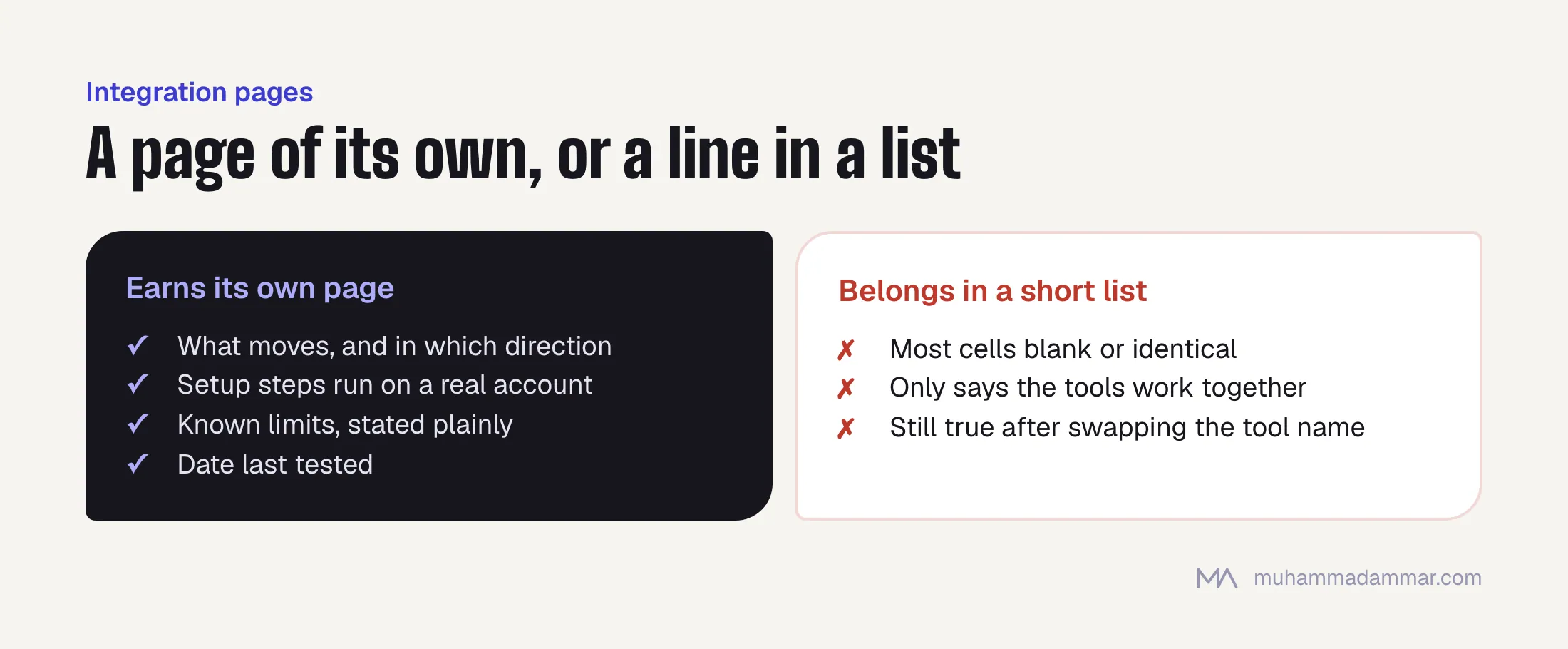
Build a sheet with one row per integration and one column per fact. Useful columns:
- What moves between the two tools, and in which direction.
- Which parts of your product the integration touches.
- Setup steps, written by someone who ran them on a real account.
- Limits and known gaps, stated plainly.
- Who in a customer’s team uses it, and for what.
- Which of your plans include it, copied from your own pricing page.
- The date it was last tested, and who tested it.
Look at the sheet before you write a template. Rows where most cells are blank or identical belong in a short list on one page, not on pages of their own. The same sheet answers how many pages to build: one for each complete row that customers or prospects have asked about. Your support tickets, sales calls and Search Console queries show whether they do.
Check the other company’s rules before you use its name or logo. Partner and brand terms differ between vendors, and the only reliable source is the vendor’s own current page.
How do you keep alternatives and comparison pages fair and current?
Treat every row of a comparison as a claim you may have to defend: it needs a source and a date. A page that is fair about the other product and recent about its facts earns a reader’s trust, and a stale or one-sided one loses it.
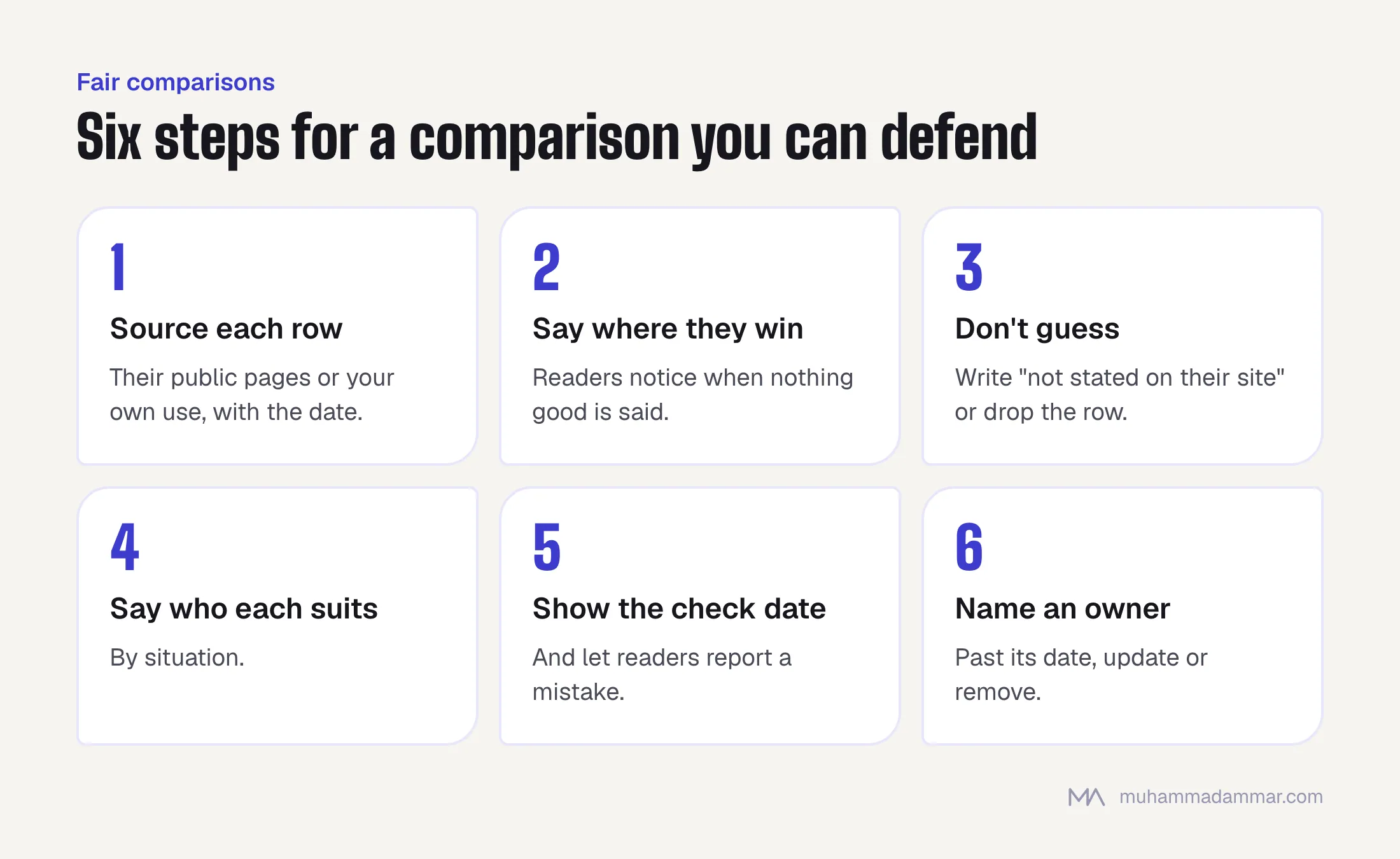
- Write each row from the competitor’s own public pages, or from using their product yourself. Record the source and date in your sheet.
- Say where the other product is better. Readers can tell when a page has nothing good to say about it.
- When the vendor doesn’t state a fact, write “not stated on their site” or leave the row out. Don’t guess.
- End with who each product suits, by situation.
- Show a “last checked” date on the page, and give readers a way to report a mistake.
- Give every page an owner and a re-check date. A page past its date gets updated or removed.
Leave competitor prices out of the template unless you can re-check them on schedule. A wrong number on a comparison page is a quick way to lose the reader. Rules on naming competitors in marketing can differ by country, so ask a lawyer who knows the markets you sell in, whether Egypt, Saudi Arabia, the UAE or the USA, before you publish these pages in volume.
Where does Google’s scaled content policy matter for SaaS pages?
It matters wherever a page set is many similar pages that give the reader little. Google’s spam policies define scaled content abuse as many pages generated for the “primary purpose of manipulating search rankings and not helping users”, however the content is made.
Two of Google’s examples fit SaaS page sets closely. One is stitching content together from other pages without adding value, which describes a comparison page assembled from vendors’ feature lists with no testing and no verdict. The other is scraping or automatically changing content, through synonyms or translation, into many low-value pages, which describes integration pages spun from one description or machine-translated into Arabic. Google’s page on using generative AI content says automation, including AI, isn’t banned in itself, and that generating many pages without adding value for users may violate the policy.
Whether a variant deserves a page at all is decided by the pillar article’s three-check test, and the checks each page should pass before going live are in a quality gate for pages published at scale. Neither is repeated here.
How do you stop SaaS template pages from competing with each other?
Give each search shape one URL and one purpose. When an alternatives page and a comparison page aim at the same search, or a use-case page repeats an integration page, they compete and neither one is clear.
Before building, write one line per page: the search it serves, and why no other page of yours serves it. Where two lines match, merge the pages. Finding the pages competing with each other shows how to spot overlaps once pages are live.
Launch one page type at a time, not all five at once. Start with the type whose sheet is most complete, follow the launch routine in the pillar article, and add the next type only once the first has shown which of its pages Google indexed. If a page set leaves weak pages in the index, working out what is bloating the index covers how to handle each kind. The programmatic SEO service covers planning a page set like this from your own data.
How does this change for SaaS companies in the US, Egypt and the Gulf?
The page types stay the same, while the data and the language change. Build for the markets where your customers are, and fill each page from your own customer records, not from assumptions about a market.
- A US SaaS company selling in English builds its integration set from the tools its customers use, which your support tickets, sales calls and onboarding records show.
- A SaaS company selling in Egypt, Saudi Arabia or the UAE follows the same method. The tools customers use and the competitors they name can differ from market to market, so don’t copy a page set built for another one.
- If a page says your product meets a local tax, data or compliance requirement, take the wording from the authority’s own current page and tell readers to confirm it with the authority.
- If you publish in Arabic and English, each language version is its own page and has to pass the same checks. An Arabic page that links to English pages, or is a conversion of the English one, adds little for the reader.
Frequently asked
What is programmatic SEO for SaaS?
It’s building pages for a SaaS company from a template filled with your own product data, such as one page per integration or per competitor. The pages share a structure and vary by data. It works when the data gives each page a different, true answer. It doesn’t when only a name changes.
Are alternatives and comparison pages worth it for a SaaS?
They can be, if you can write each page from facts you check against the other vendor’s public pages, say where the other product is better, and re-check on a schedule. If you can’t keep them current, skip them. Whether they bring you customers depends on your market, and nobody can promise it.
How many integration pages should a SaaS build?
As many as you have complete rows for in your sheet, and no more. Count the integrations you support, that customers or prospects have asked about, and that you can describe from a tested setup. If that count is smaller than the full list of integrations you offer, the rest can share one directory page with a line each.
If you have a list of integrations, competitors or use cases and want to know which ones deserve a page, send me a message and I’ll go through the list with you.

SEO and digital marketing consultant since 2015, working with businesses in Egypt, Saudi Arabia, the UAE and the USA.
About the author and editorial standards