On this page
Programmatic SEO can work for B2B when each page answers a question that a buyer in one industry, use case or role asks before contacting a supplier, and carries details only your company can supply. B2B searches are few, so a B2B company usually needs fewer and deeper pages than a consumer site, not thousands of thin ones.
Software page types such as integrations and comparisons are covered in programmatic SEO for SaaS, and whether template pages suit your business at all is settled by the go/no-go test for template pages. What follows is a general explanation of industry, use-case and role pages for companies that sell to other companies. It describes no client work or results.
How is B2B programmatic SEO different from consumer programmatic SEO?
A B2B search is usually rarer but worth more, and the person searching is often one of several people who will judge the purchase. That changes the design: fewer pages, more depth on each, and a next step for a reader who isn’t ready to buy yet.
- Few searches per page, high value per visit. Your page count should follow the pages you can fill with real detail, not a keyword list. Your own enquiries and sales notes show what your buyers ask.
- Long sales cycles and several readers. One page may be read by the person who will use the service, the person who approves the spend and the person who checks the risk. A role page speaks to one of them and says so.
- Specifics decide. A buyer in a regulated or technical industry looks for proof that you understand their constraints. A paragraph that would fit any industry reads as no proof at all.
- Language and market. A US company mostly writes for English searches. A company selling in Egypt, Saudi Arabia or the UAE may have buyers who search in Arabic on some topics and in English on others, so check which language your enquiries arrive in. Each language version is its own page with its own data, and Arabic programmatic SEO covers that side.
When is a B2B page type worth building from a template?
A B2B page type is worth building only where your sales team has heard the same question from several buyers and you can answer it with facts that are specific to the page. Four types suit most B2B companies: industry pages, use-case pages, role pages and market pages.
| Page type | Search it matches | Data that makes each page different | Skip it when |
|---|---|---|---|
| Industry | Your service for one industry | That industry’s workflow, vocabulary, constraints and the problems you see in it | You can’t explain the industry beyond its name |
| Use case | A problem described in the buyer’s words | The steps, the inputs, who is involved, what a good outcome looks like | Two use cases have the same answer, so one page does |
| Role | What one job title needs to know or justify | That role’s questions, objections and what they must report upward | The same person buys in every company |
| Market | Your service in one country | Local requirements, how buyers there make decisions, the language they use | Nothing differs between the two markets |
Where a page type depends on a rule or standard, write only what the rule’s own text says and link to it. A wrong compliance statement costs more than a missing page.
These types overlap. An industry page and a use-case page can chase the same search, and then neither wins. Decide which URL owns each search before anyone writes, as keyword cannibalisation explains.
Where does the data for each page come from?
It comes from records your company already holds about its own buyers: the questions sales hears, support tickets, product data, and case notes you are allowed to publish. Put them in one sheet with a row per page, and build only the rows that are full.
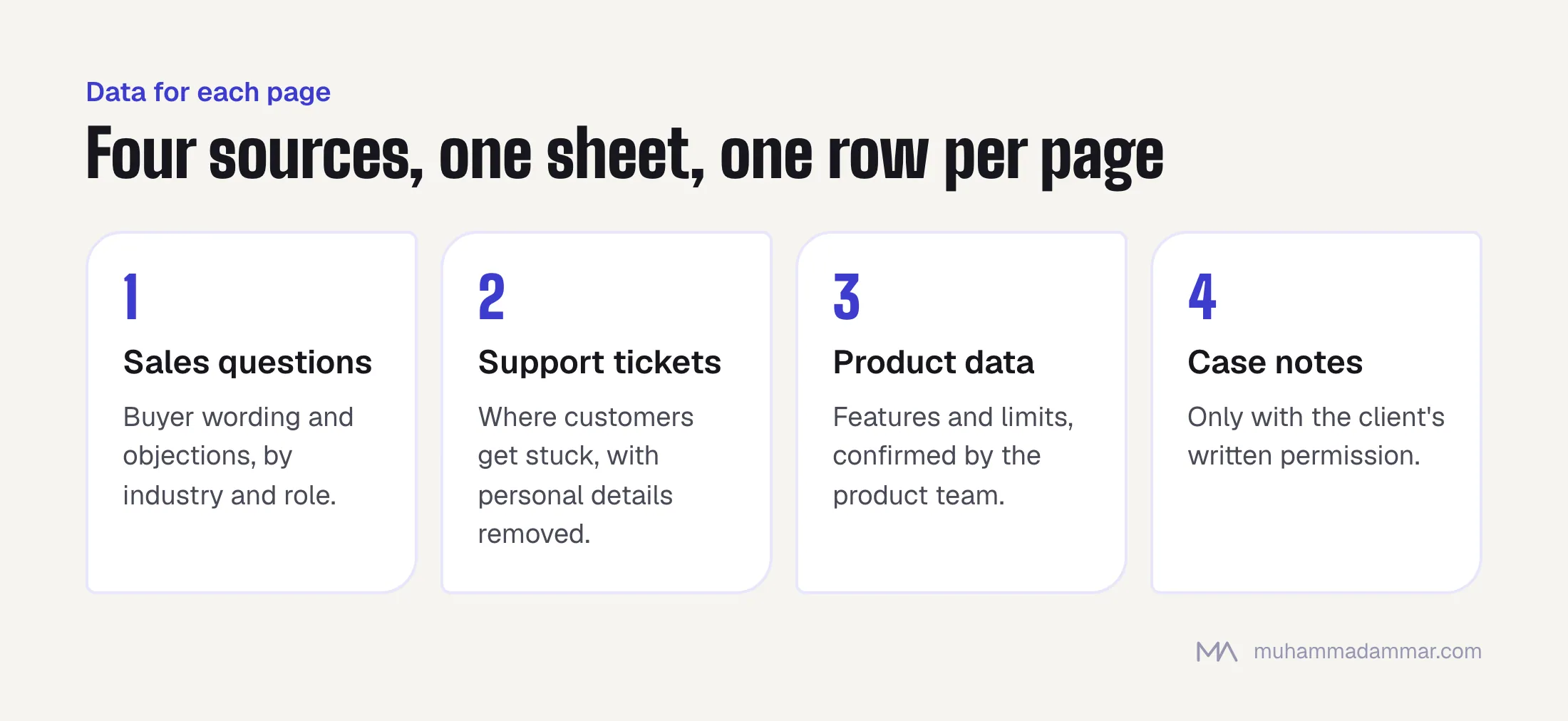
- Sales questions. Read call notes, emails and CRM records for each industry and role. Keep the buyer’s own wording, the objections and the questions that come up before a deal moves.
- Support tickets. They show what customers in an industry get stuck on during setup and use. Remove personal and customer details before anything reaches a page.
- Product data. Which features, limits and integrations matter to each industry. Someone on the product side confirms every line, because sales summaries drift.
- Case notes. Use them only where the client has agreed in writing to publication, and check any contract or confidentiality terms first. Without permission, describe the pattern in general terms or leave it out.
A row with empty fields doesn’t get a page. If every field in the row is generic, the page repeats what the template already says and has no reason to exist. Give each data field an owner and a date to review it, because B2B details such as supported features and requirements go out of date.
How do you use B2B programmatic SEO for lead generation?
Make each B2B template page answer the buyer’s question in full, then offer one next step that matches how that buyer would normally get in touch. A hard sell on an information page loses the reader, and a page with no next step wastes the visit.
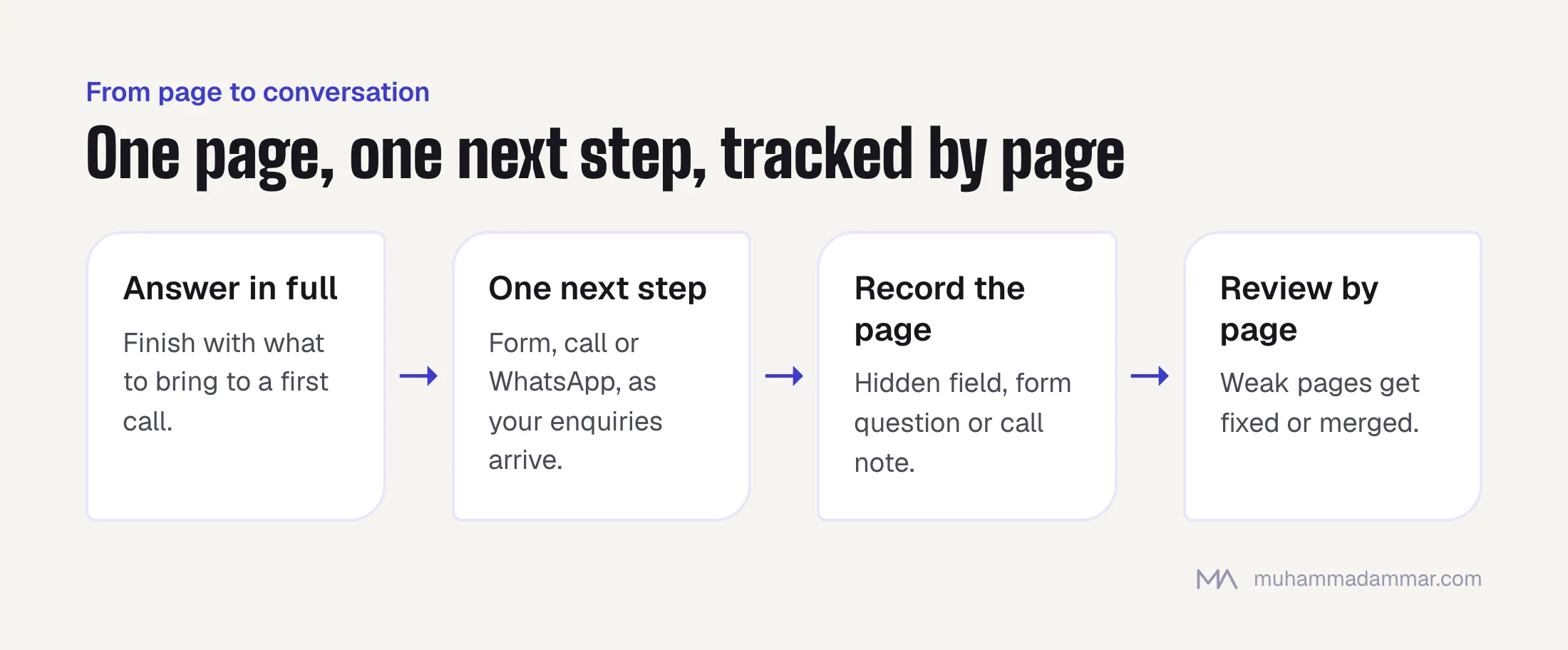
- Finish with the reader’s situation. List what to bring to a first conversation for that industry or role: the volumes, systems or constraints you would ask about anyway.
- Offer one next step. Pick it from how enquiries reach you today: a short form, a call or a WhatsApp message. Check your own records and don’t assume. The Arabic landing pages that convert guide covers the form and the page around it for Arabic readers.
- Record which page the enquiry came from. Use a hidden field, a question in the form or a note from whoever takes the call, and log it in your CRM or a sheet.
- Review by page after a few months. If a page gets readers but no enquiries, its data or its offer is weak. If it gets neither, merge it into a stronger page.
No page can promise leads, and a good one still depends on the offer and the market. Planning the dataset, the templates and the tracking is what the programmatic SEO service covers.
How many pages should a B2B company start with?
Start with as many as your team can fill with real detail and read before publishing. For most B2B companies that is a small batch for each page type. No number is right for every company.
Google’s scaled content abuse policy describes the problem as “when many pages are generated for the primary purpose of manipulating search rankings and not helping users”, however the content is made. As I read it, a B2B template where only the industry name changes between pages sits close to the low-value pages the policy’s examples describe. The check that follows from it is the same on every page: what does this page hold that a visitor can’t get from the template alone?
So pick the industries or roles where your sales team already has the most conversations, build those pages, and read each as a buyer would. Hold back the rest until the first batch shows what works. Each variant still has to pass the pillar article’s go/no-go test, and reviewing a sample of pages when you publish at volume covers the checks for a larger run.
Frequently asked
Does programmatic SEO work for B2B?
It can, under conditions. Each page needs facts specific to its industry, use case or role, and there must be buyers asking that exact thing. Without that, it produces many similar pages that Google may treat as low value. Nobody can promise rankings or leads from it.
What pages should a B2B company build at scale?
Start from the questions your sales team hears again and again. Those usually become industry, use-case or role pages. Skip any type where the answer is the same for every buyer, because one good page serves them better than a stack of copies.
How do you measure whether B2B template pages work?
Measure by page type and by page. In Search Console, check the pages of one type for impressions and clicks. In your CRM or sheet, count the enquiries recorded against each page. Because B2B sales take time, judge after a few months, not weeks, and keep building only the page types that start conversations. Results vary by offer and market.
If you sell to other businesses and you’re deciding which industry or use-case pages deserve to exist, message me with the list and what your sales team hears most.

SEO and digital marketing consultant since 2015, working with businesses in Egypt, Saudi Arabia, the UAE and the USA.
About the author and editorial standards