On this page
- What should an SEO strategy include?
- How do you set SEO goals that connect to sales?
- Which pages should an SEO strategy put first?
- How do you choose the supporting topics?
- Does a business need separate Arabic and English SEO strategies?
- What technical baseline does an SEO strategy need?
- How do you measure an SEO strategy month to month?
- Frequently asked
An SEO strategy for a business is a one-page plan that names the sales you want search to bring in, the pages that will earn them, the topics that support those pages, the technical baseline the site must hold, and how you will measure it. Write it before you hire anyone, and review it every quarter.
In more than ten years of work in Egypt, Saudi Arabia and the UAE, I’ve audited and managed more than 300 websites and ad accounts. The template below is written for a service business in the region. The strategy is the page you hand a new hire or an agency on their first day.
What should an SEO strategy include?
An SEO strategy should include five parts: the business goal and how you count it, the pages that sell, the topics that support them, a technical baseline, and a measurement routine. Each part is a question you answer in a few lines, with your own services in place of the brackets.
| Part | The question it answers | Example: a business selling two services in Saudi Arabia and Egypt |
|---|---|---|
| 1. Goals | What should search bring in, and how will we count it? | More qualified enquiries from organic search for [service A] and [service B], counted from forms, calls and WhatsApp, and checked against the CRM each quarter |
| 2. Pages that sell | Which pages turn a visitor into an enquiry? | An Arabic and an English page for each service, plus a page for each country you really serve, each owning one search |
| 3. Supporting topics | What do buyers search for before they contact anyone? | Cost questions, how to choose a provider, comparisons and process questions, each linking to its service page |
| 4. Technical baseline | What has to be true before content can work? | Money pages indexed, separate Arabic and English URLs, checked on a phone, every contact button tested and tracked |
| 5. Measurement | How do we know it’s working, and who looks? | A monthly note from one owner on organic enquiries and money-page clicks, and a full review every quarter |
Under each part, add one line naming who owns it: you, a developer, a writer or an outside specialist. Whoever runs the work, in-house or through an outside team like my SEO service, should be able to point every task back to a line on this page. None of the lines promises a ranking or a date, because nobody can honestly promise either.
How do you set SEO goals that connect to sales?
Start from the sale and work back to the search. Name the services that make you money, decide how a buyer for each one gets in touch, and set the goal as qualified enquiries from organic search to those pages. Traffic and rankings are signs along the way.
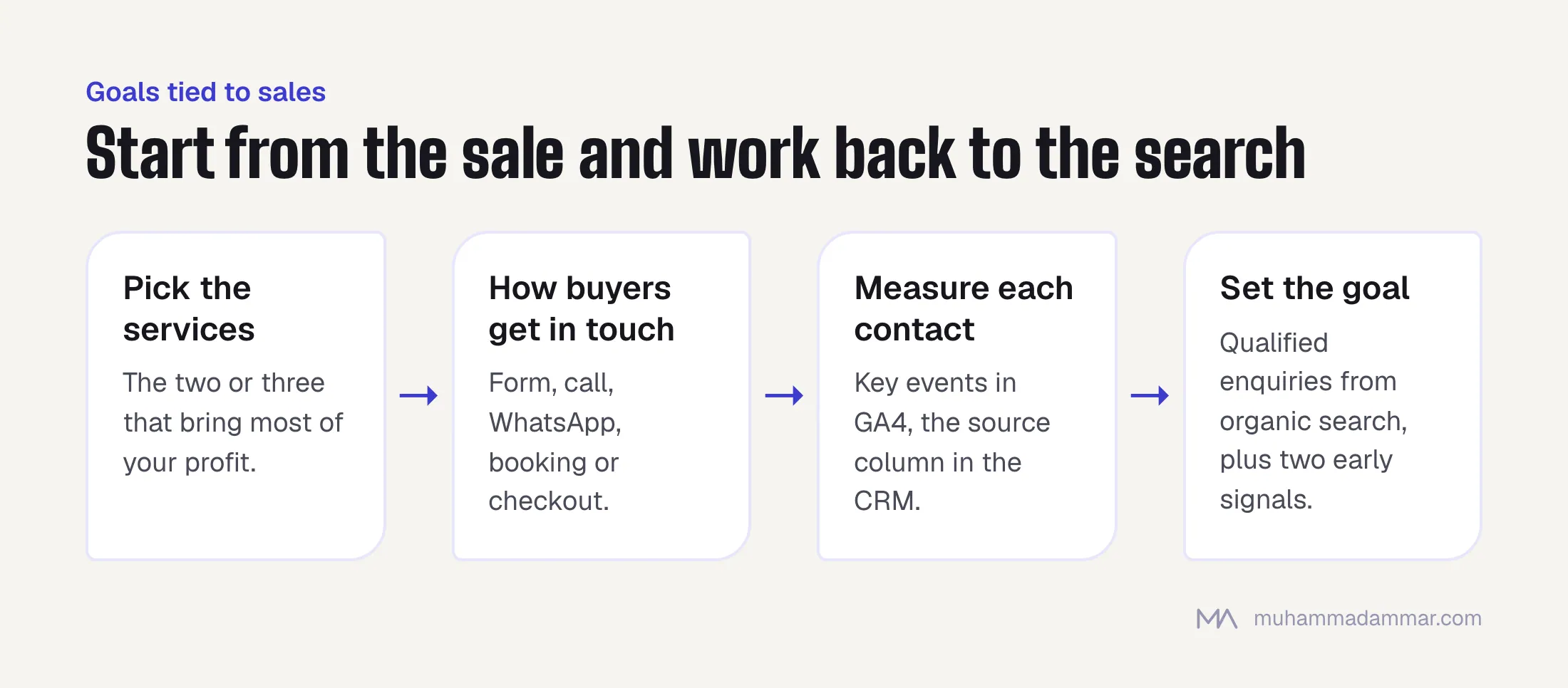
- List the two or three services or product lines that bring in most of your profit, or the ones you most want to grow.
- Write down how a buyer for each one contacts you: a form, a phone call, WhatsApp, a booking or a checkout. Analytics can record the click on a WhatsApp or call button but not the conversation that follows, so decide how your team will record where each enquiry came from.
- Make each contact action measurable on the site. In GA4, the actions that matter most to your business are marked as key events. Mark the form submission and the WhatsApp and call clicks, and the Landing page report then shows them by the page where the visit started.
- Set the outcome goal: qualified enquiries from organic search for each chosen service, compared quarter by quarter. Qualified means your sales team agrees it was a real buyer, and that takes one column in your CRM or spreadsheet for where the lead came from.
- Add two early signals that move before enquiries do: impressions and clicks on the pages that sell, in Search Console, and how many different searches those pages appear for. They show early whether the work is on track.
Don’t set a target number of enquiries before you have a baseline. Measure for a quarter, then set the target from what you saw. Keep rankings off the goal line too, because a page can rank first for a search that nobody buys from.
Which pages should an SEO strategy put first?
An SEO strategy should put the money pages first: the service, category or city pages where a buyer lands when ready to act. Each one should own one clear search. Articles come after, written to send readers on to them (blog posts or service pages: what a new site should build first covers the order).
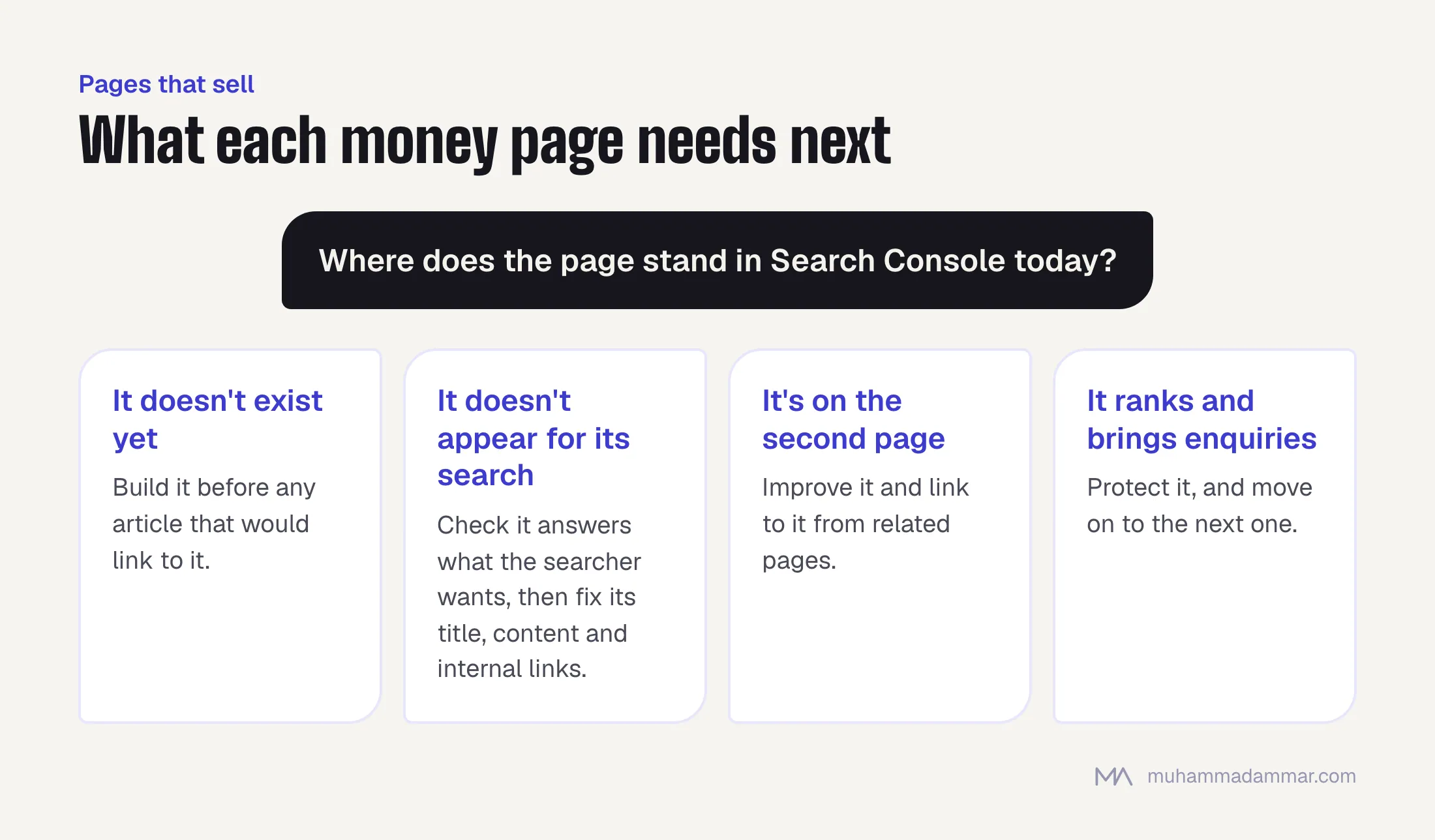
For most service businesses the list is short. For each page, write down the search it owns in each language, where it stands now in Search Console, and the single change it needs most. Then sort the list:
- The page doesn’t exist yet: build it before any article that would link to it.
- The page exists but doesn’t appear for its search: check that it answers what the searcher wants, then fix its title, content and internal links.
- The page appears on the second page of results: improve it and link to it from related pages.
- The page already ranks and brings enquiries: protect it, and move on to the next one.
When there are more candidates than time, use a scoring method for choosing which keywords come first instead of going by search volume alone. And keep to one page per search, because two pages chasing the same search end up competing with each other.
How do you choose the supporting topics?
Choose supporting topics from the questions buyers ask before they’re ready to buy, and keep only the topics that lead naturally to one of your money pages. Each group of related topics then gets one pillar article and a handful of supporting articles. To sort the narrow searches inside a topic, check which long-tail keywords need their own page.
The best sources are the ones you already have: the searches in Search Console, the questions your sales team hears on calls and WhatsApp, and the comparisons buyers ask about before they decide. Next to each topic, write the money page it supports. If you can’t name one, drop the topic, however often people search for it.
Google’s guidance on people-first content asks whether you’re writing about something simply because it seems to be trending, rather than because you’d write about it for your existing audience. Grouping the topics and linking them is covered in building topical clusters properly.
Does a business need separate Arabic and English SEO strategies?
A business that sells in both languages usually needs one SEO strategy with two keyword maps. The goals, the money pages and the technical baseline are shared. The searches, the wording and often the topics differ.
Build the Arabic keyword list from Arabic searches, not from a translation of the English list, and expect it to come out a different shape: some English topics have little Arabic demand, and some Arabic questions have no English twin. Within Arabic, people in Egypt and in the Gulf often word the same need differently, so check the searches in each country you sell to.
What technical baseline does an SEO strategy need?
The technical baseline in an SEO strategy is a short list of conditions that must hold before content can work: Google can index the money pages, they work well on a phone, each language has its own URLs, and every contact button works and is tracked.
- The money pages are indexed. Check each one with the URL Inspection tool in Search Console instead of assuming.
- Each language version has its own URL. Google recommends different URLs for each language version of a page, instead of switching the language with cookies or browser settings, and hreflang connects the versions.
- The pages load quickly and read well on a phone. Test them on a mid-range phone on mobile data, not on the office Wi-Fi.
- Forms send, WhatsApp links open with a prefilled message, and call buttons dial the right number. Test them every month.
Anything deeper, such as a migration, becomes its own project. The strategy only records whether the baseline holds.
How do you measure an SEO strategy month to month?
Measure an SEO strategy every month with a short set of numbers that match its goals: enquiries from organic search by service, and impressions and clicks on the money pages. One named person reads them and writes a few lines on what changed.
- Search Console: impressions, clicks and average position for the money pages. A custom regex filter shows a group of pages at once, such as one service folder, and you can compare two periods.
- GA4: key events from organic search, by landing page.
- Your CRM or spreadsheet: enquiries whose source is organic search, and how many of them your sales team qualified.
Judge the trend across several months. Google’s SEO Starter Guide says some changes take effect in a few hours and others take several months, and suggests waiting a few weeks before judging whether a change helped. For articles, the numbers that show whether each one is working are in measuring how content performs.
Frequently asked
How often should an SEO strategy be reviewed?
Review the whole strategy once a quarter: check the goals against the enquiries you actually got, then reorder the pages and topics. Review it sooner when something big changes, such as a new service, a new country, a redesign or migration, or a sharp drop in search traffic. The monthly numbers feed the review, but they shouldn’t rewrite the strategy every month.
Is an SEO plan the same thing as an SEO strategy?
Many people use the two words for the same thing, and that’s fine. If you want to separate them, the strategy says what search should bring in and which pages carry it, and the plan lists the tasks, owners and dates that get you there. The strategy changes once a quarter at most, while the plan can change every week.
How long before an SEO strategy shows results?
That depends on where the site starts, how strong the competition is and how fast the work gets published, which depends on how many pages your review can check (see publishing at scale without tripping Google’s scaled content policy). Early signals, such as impressions and the number of searches your pages appear for, move first, and enquiries follow later. I go through realistic timelines for different situations in how long SEO takes.
Can I write my own SEO strategy without an agency?
Yes, and you’re the right person to write the goals and the pages that sell, since you know which services make money and how buyers get in touch. Get help with the parts that need tools and experience: the keyword maps in each language and the technical baseline. Then use the finished page to brief whoever does the work.
If you’ve drafted your strategy and want a second opinion on it, send it to me.

SEO and digital marketing consultant since 2015, working with businesses in Egypt, Saudi Arabia, the UAE and the USA.
About the author and editorial standards