On this page
- What does Google’s scaled content abuse policy say?
- How do the policy’s examples turn into checks on each page?
- What should a per-article quality gate check?
- How do you review a sample when output is high?
- Is publishing the same article in Arabic and English a problem?
- What are the signs you’re publishing faster than you can check?
- Frequently asked
You can publish many pages without breaking Google’s scaled content abuse policy, because it targets pages generated mainly to manipulate rankings that give readers little or no value. Google sets no safe number. What you control is a quality check each page passes before going live, and a review of a sample afterwards.
That gate and that sample are my own judgement, built from what Google’s pages say. The policy sets no sampling rate and the gate isn’t a Google checklist, so treat the numbers below as a starting point to adjust.
What does Google’s scaled content abuse policy say?
Google’s spam policies define it as many pages generated for the “primary purpose of manipulating search rankings” and not for helping users. They add that it usually means large amounts of unoriginal content that gives users little or no value, “no matter how it’s created”.
As I read it, the definition rests on three things: many pages, a main purpose of manipulating rankings, and content that typically gives the reader little or no value. The policy names five examples and says the list isn’t complete:
- Using generative AI tools or similar tools to generate many pages without adding value for users.
- Scraping feeds, search results or other content to generate many pages, including through automated transformations such as synonymizing or translating, where little value is provided.
- Stitching or combining content from different web pages without adding value.
- Creating several sites to hide the scaled nature of the content.
- Creating many pages whose content makes little or no sense to a reader but contains search keywords.
The same page says sites that break its policies may rank lower in results or not appear in results at all, and that Google detects violations through automated systems and, as needed, human review. It tells site owners to exclude such content from Search if they host it.
The policy contains no number of pages, no schedule and no ratio. As I read it, whether a batch of pages crosses the line depends on why the pages exist and what each one gives a reader. That is why a check on each page makes more sense than a rule about how many to publish. How AI tools fit in is covered in what Google’s policies say about AI-written content.
How do the policy’s examples turn into checks on each page?
Four of the policy’s five examples describe a failure that a reviewer can look for on a single page, and the fifth is a publishing decision. The table is my reading of the policy and of Google’s questions in its guide to helpful, reliable, people-first content, not a Google checklist.
| What the policy names | The question a reviewer asks of one page | What a pass looks like |
|---|---|---|
| Many pages from AI tools without added value | What does this page hold that the tool couldn’t have known? | First-hand knowledge, checked facts or your own data |
| Scraped, stitched or combined content | Does it say something the pages it draws on don’t? | A clear point of view, and sources named |
| Scraped content run through automated synonymizing or translating | Was this version written for its own reader, or converted from another? | A person read it in its own language |
| Many sites to hide scale | Is any publishing being split to hide volume? | No. This one is a decision, not a page check |
| Keyword pages that make little sense | Would a reader finish it and know the answer? | A reader who isn’t the author can summarise it |
One of Google’s own self-assessment questions fits here too: is the content mass-produced by or outsourced to many creators, or spread across a large network of sites, so that individual pages or sites get less attention or care? It’s a question, not a rule. The gate below answers it by giving every page attention before it goes live.
What should a per-article quality gate check?
A quality gate is a short list of pass or fail questions that every page answers before publishing, with one named person who can fail a page. If any answer is no, the page doesn’t go live until it’s fixed or dropped. The seven questions below are my own judgement, not a Google list.
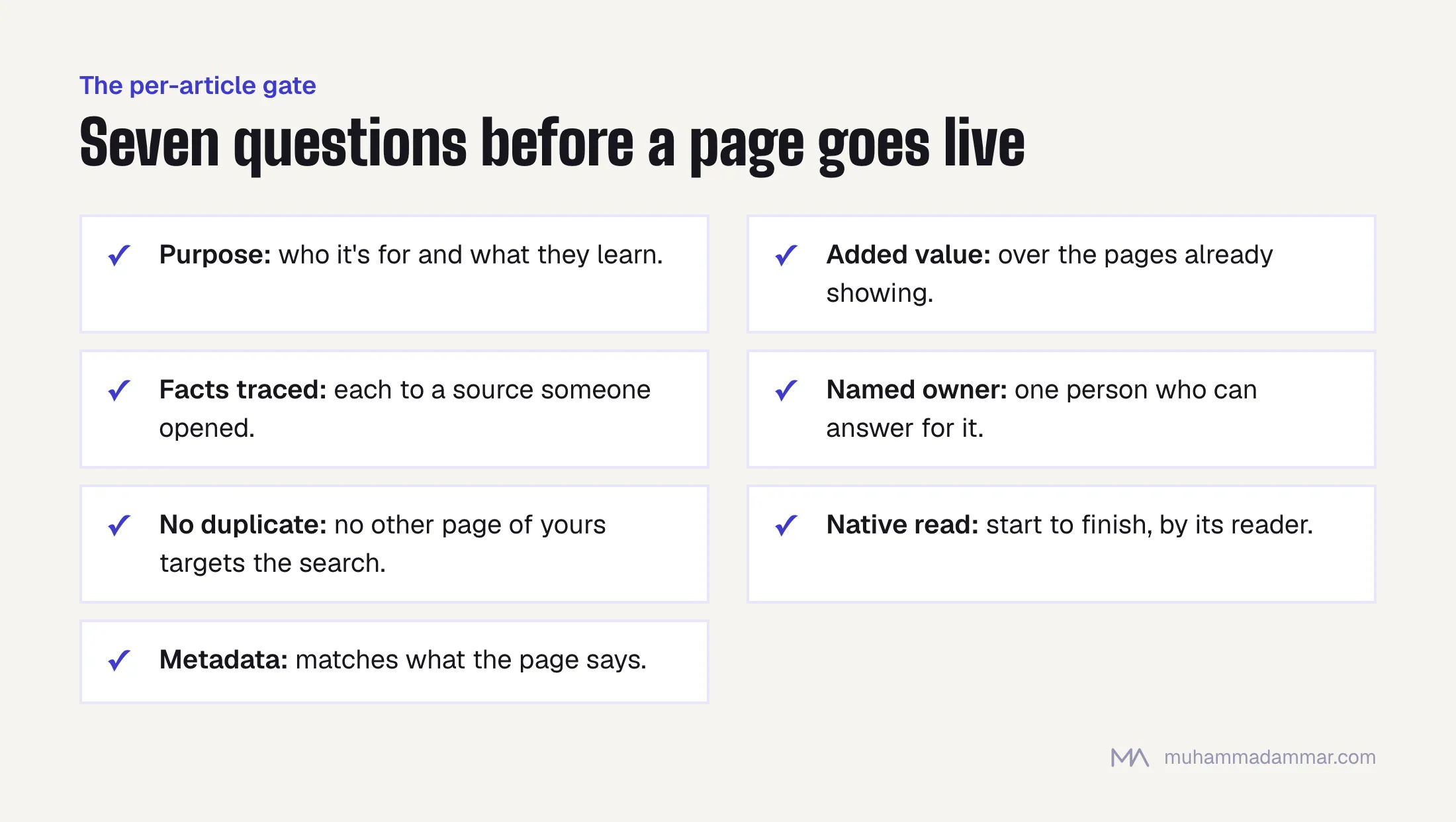
- Purpose: write down in one sentence who the reader is and what they came to find out. “To rank for this phrase” doesn’t count. Google’s guidance says the reason for creating content should be primarily to help people.
- Added value: list what this page offers that the pages already showing for the search don’t. If the list is empty, the page has no reason to exist yet.
- Facts traced: every number, date, quote and product claim points to a source someone opened. Anything that can’t be traced is cut.
- A named owner: one person is responsible for the page and can answer questions about it. Google’s guidance on content asks whether it’s clear to visitors who wrote it.
- Not a duplicate of your own pages: it targets a search no other page of yours already targets. Mapping each group of searches to one URL before you write helps prevent these.
- Read by the intended reader: someone who reads the page’s language natively reads it start to finish, and checks that it makes sense, not only that it is grammatical.
- Metadata matches the page: the title, description and image text say what the page actually says.
The gate has to be able to say no. If it has never rejected a page, it’s a formality and the sample below will show it.
How do you review a sample when output is high?
A sampling review reads a share of pages that already passed the gate, to check that the gate itself still works. It catches drift, such as reviewers getting faster, templates repeating or one writer cutting corners, which a single page never shows.
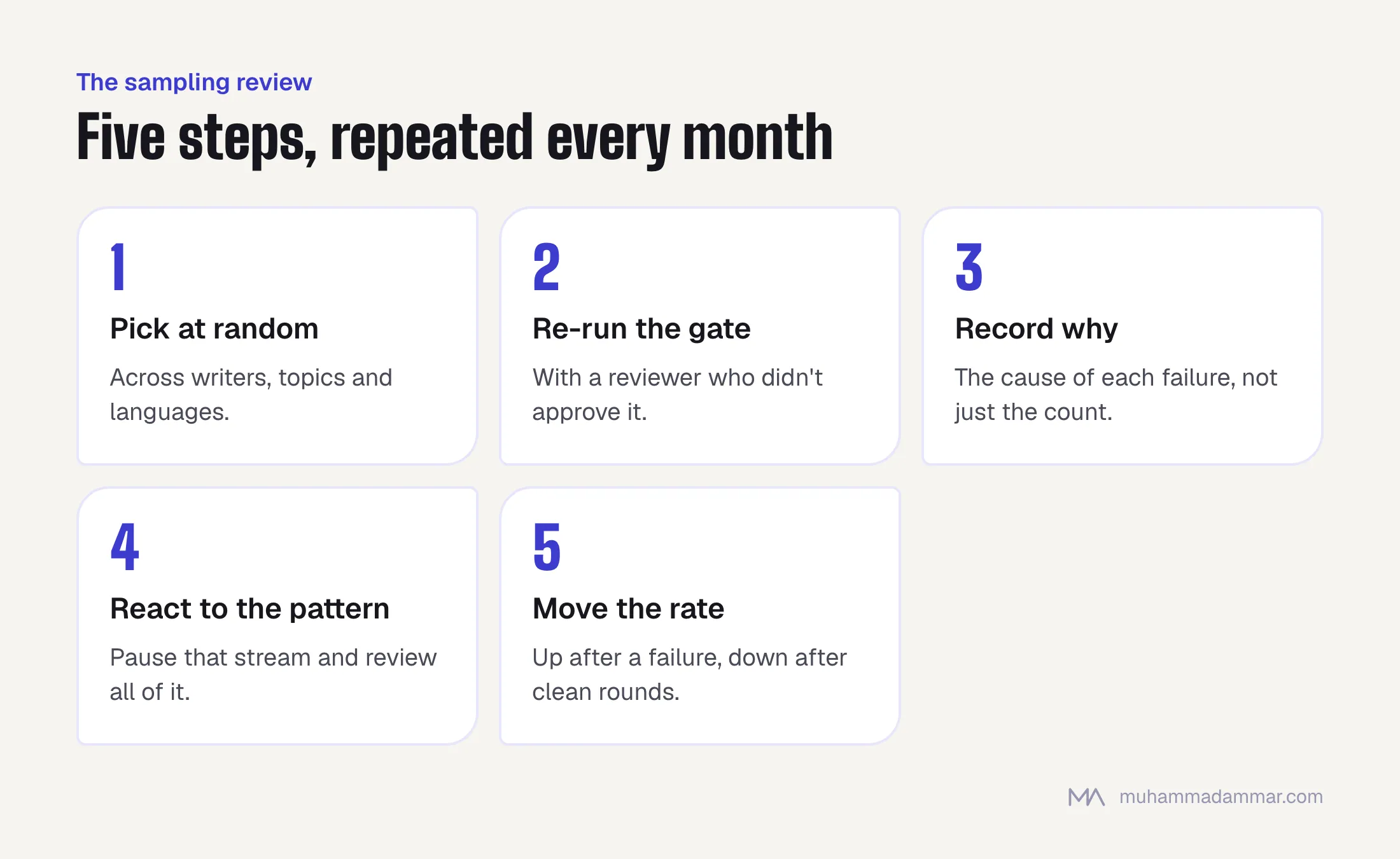
My starting point, which is a judgement call and not a Google figure, is to re-review about one page in four, picked at random each month, plus every page from a new writer, a new template or a new language until it has passed two rounds in a row.
- Pick the sample at random, across writers, topics and languages, so no stream of content escapes.
- Re-run the gate with a different reviewer, one who didn’t approve the page the first time.
- Record why each page failed, not just the count. “Unchecked number” and “no added value” need different fixes.
- React to the pattern. If one stream fails, pause publishing in that stream and review everything it produced. Fix those pages, or remove them from Search if they can’t be fixed.
- Move the rate. Raise it after a failure. Lower it only after several clean rounds.
The sample is a second line of defence. A clean sample says nothing about pages you didn’t read.
Is publishing the same article in Arabic and English a problem?
Google’s scaled content abuse policy doesn’t name bilingual publishing as a problem. Its translation example is about scraped content that’s run through automated transformations such as synonymizing or translating, where little value is provided to users. A site publishing its own work in two languages isn’t described there, but I’d still treat a page that is only a conversion of another as a risk.
My advice is to treat each language version as its own page that has to pass the gate. For Arabic, that means:
- A native reader goes through the Arabic line by line next to its English twin, checking that the facts, numbers and hedges match.
- The wording suits the reader’s country. As a plain language example, Egyptians usually ask the price with بكام (bikam, “how much”), and Gulf readers often write كم السعر (kam as-si’r, “what’s the price”).
- Links point to the Arabic versions of other pages, not the English ones.
- The Arabic pages are in the sample every round. They’re the ones a reviewer who doesn’t read Arabic well can’t check.
Two versions mean two reviews. If the Arabic review is the slowest step, it sets your pace.
What are the signs you’re publishing faster than you can check?
You’re publishing faster than you can check when the gate has stopped being able to fail a page. These are the signs I’d look for, and each one is cheap to spot:
- Nothing has been rejected or sent back for a month.
- Different pages share the same intro, the same examples or the same section order.
- The named owner can’t answer a question about their own page.
- The sample keeps failing for the same reason, and the fix hasn’t been made.
The fix is to publish fewer pages and keep the gate as it is. The same applies to template pages built from data, where the question is whether each page has something of its own to say: programmatic SEO, when template pages work and when they backfire. The steps from idea to publication are in an editorial workflow for SEO content, and the plan the pages sit in is in how to build an SEO strategy for a business. If you’d rather have the planning, writing and review done for you in Arabic and English, that’s part of my content marketing service.
Frequently asked
How many articles should I publish a month?
Google’s scaled content abuse policy names no number of pages or time period, so I can’t give one as safe or risky. The number to settle is how many articles your review can check: each one passing the gate, each with a person who can answer for it. When the review can’t keep up, publish fewer.
What is scaled content abuse?
It’s Google’s name for generating many pages mainly to manipulate search rankings and not to help users, usually with unoriginal content that gives readers little or no value. Google says it applies however the content is made, whether by AI tools, scraping, stitching pages together or rewording other sites.
How do I keep quality when publishing in two languages?
Give each language version its own pass through the gate. A native reader checks the Arabic against the English line by line, the numbers and hedges match, and Arabic pages are included in every sampling round. Don’t count a version as done because it was converted.
If you publish many pages a month and want a second read on a quality gate or a sample of your pages, in Arabic or English, send me a message.

SEO and digital marketing consultant since 2015, working with businesses in Egypt, Saudi Arabia, the UAE and the USA.
About the author and editorial standards