On this page
Server-side tagging gets sold the way most infrastructure does: as the answer to a problem you haven’t measured, priced without the parts that cost the most. So this is the opposite of a sales pitch: what it does, what it costs, and the point below which you shouldn’t buy it.
What problem it actually solves
In a normal setup, the visitor’s browser sends data straight to several third-party services. Server-side tagging puts a server you control in the middle: the browser talks only to your server, and your server passes on what you decide.
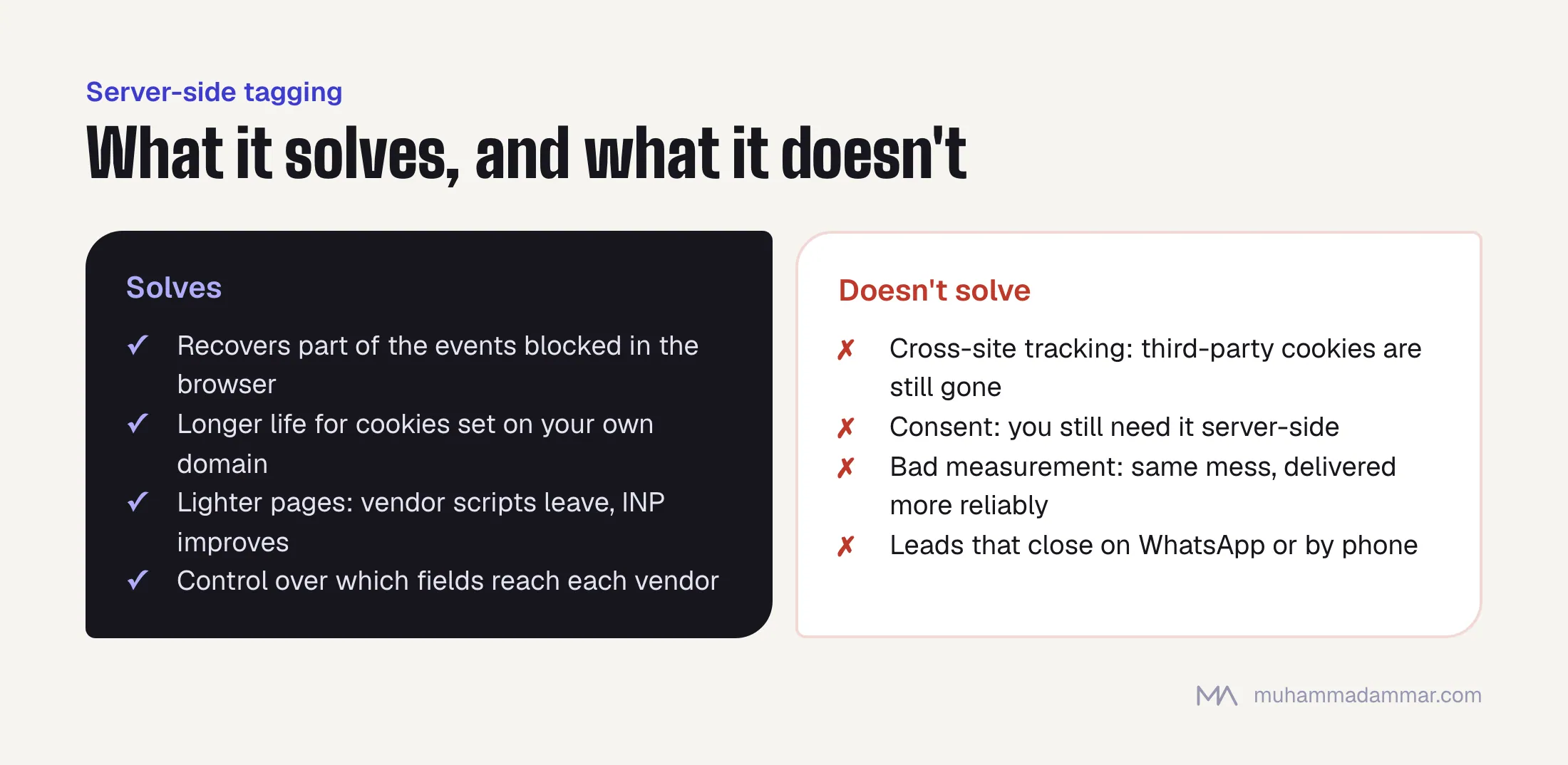
- Recovering lost data. Requests to your own subdomain get past some of the things that block third-party requests, so you recover part of the events that were never sent before.
- Longer cookie life. Cookies set by your server on your own domain last noticeably longer on browsers that limit cookies set by scripts. On a long buying cycle, that matters.
- Lighter pages. Vendor scripts leave the page. That’s a real speed gain, and it shows up in INP.
- Control over what leaves. You can remove, hash or drop fields before they reach a vendor. For a business handling personal data, that’s a governance benefit, not just a technical one.
What it doesn’t solve
- It doesn’t bring back cross-site tracking. Anything that depended on third-party cookies is still gone.
- It doesn’t fix consent. If you need consent for a data flow, you need it server-side too. Sending the request through your own server changes nothing legally.
- It doesn’t fix bad measurement. If your events are named inconsistently and your conversions loosely defined, you get the same mess, delivered more reliably.
- It doesn’t fix attribution. A lead that closes on WhatsApp or by phone is still invisible, and in this market that’s a much bigger problem than data lost in the browser.
That last point is the one I’d stress. Too many of the server-side projects I’ve seen were bought to fix a number that was wrong for reasons that have nothing to do with the server.
The real monthly cost
There are four parts, and the one everyone forgets is the fourth.
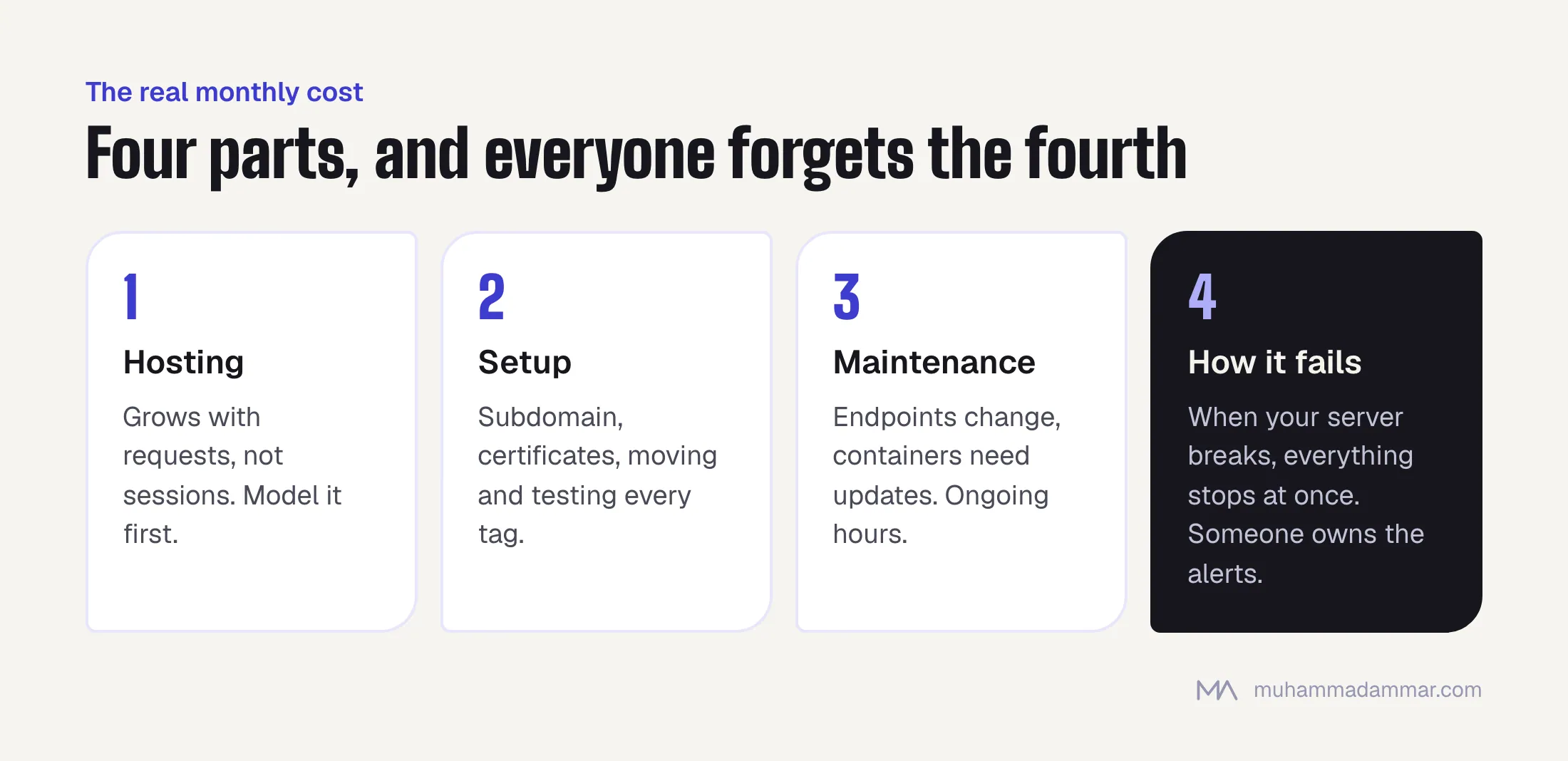
- Hosting. It grows with the number of requests, not sessions, and a busy online store sends many events per session. Model this number before anything else.
- Setup. A one-off engineering and measurement project: the subdomain, certificates, container setup, moving and testing every tag, and re-checking conversions in every ad platform.
- Maintenance. Vendor endpoints change, containers need updates, and someone has to watch for tags that fail silently. Budget ongoing hours, not zero.
- How it fails. When browser tagging breaks, one vendor stops getting data. When your tagging server breaks, everything stops at once, including the conversion data your ad bidding relies on. Someone has to own monitoring and alerts, and their time is part of the cost.
Break-even: where it pays
The calculation is simple once you stop treating it as a technology decision. Server-side tagging pays for itself when the extra conversions it recovers are worth more than its total monthly cost.
Value recovered each month = monthly conversions × the extra share recovered × value per conversion × the part of that value that actually changes a decision.
That last part is usually quietly set to 1. Better data only makes money if it changes how you bid or where you spend. If your ad spend is so small that the algorithm was never going to optimise differently, the recovered data is interesting and worthless.
Here’s the rough shape of the answer, as conditions rather than numbers, so it doesn’t go out of date:
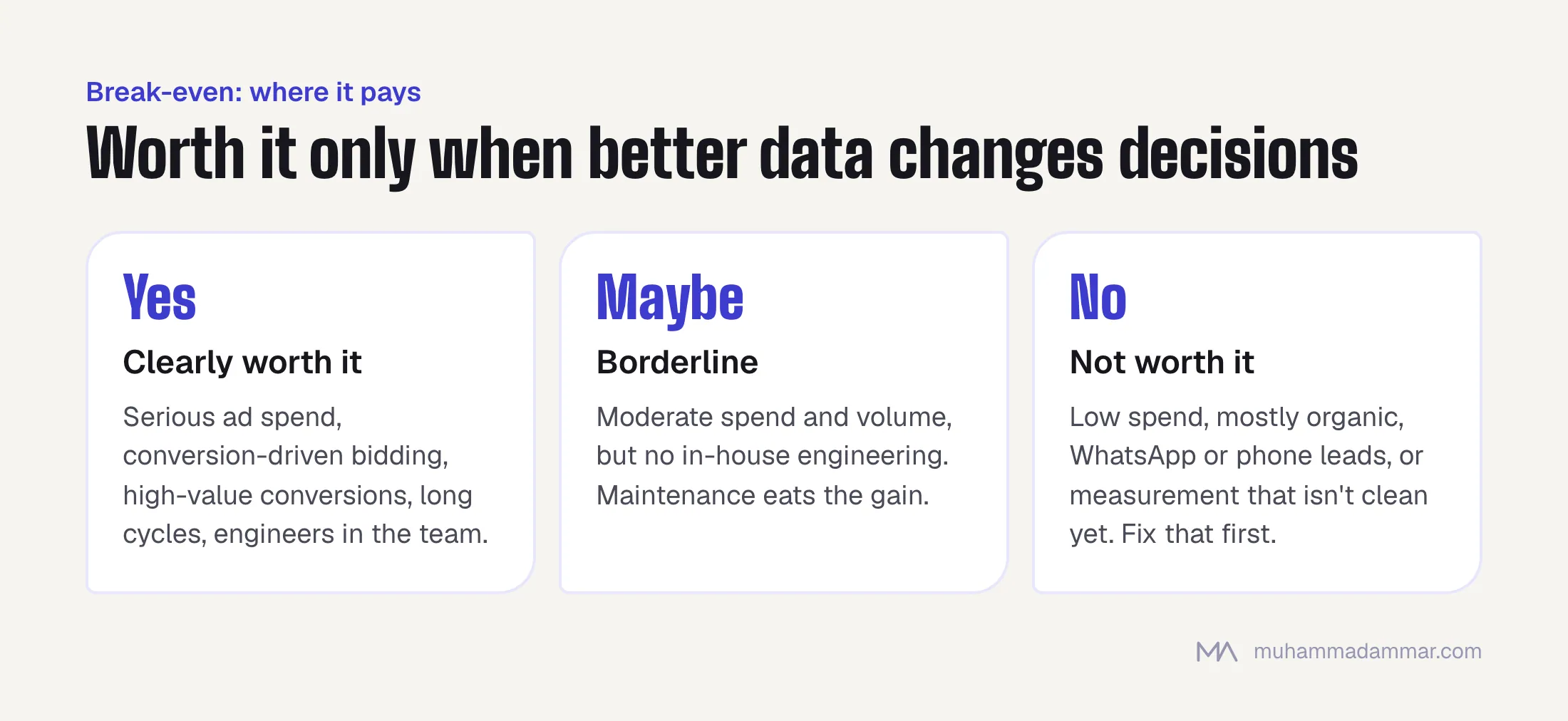
- Clearly worth it: serious monthly ad spend, automated bidding driven by conversion data, high-value conversions, long buying cycles, and engineering skills already in the team.
- Borderline: moderate spend and decent volume but no in-house engineering. You’ll pay more in maintenance than you recover.
- Not worth it: low ad spend, mostly organic traffic, leads that close on WhatsApp or by phone, or a measurement setup that isn’t clean yet. Fix the measurement first. It’s cheaper and the gain is bigger.
Most small and mid-sized businesses in this region are in the third group. That’s the honest answer, and saying it costs me projects I’d rather not run badly.
The cheaper 80% solution
Before building infrastructure, use the server-to-server conversion APIs the ad platforms already offer. Meta’s Conversions API, Google’s enhanced conversions and offline conversion import, and the equivalents on other platforms all accept conversion data sent from your backend, with no tagging server at all.
- You get most of the data recovery for the platform where it matters most: the one you pay.
- It’s a backend integration, not an infrastructure project.
- Offline conversion import handles something server-side tagging can’t: a lead that becomes a customer three weeks later in your CRM.
- You can do it for one platform, see the effect, and then decide whether the full build is justified.
For lead-generation businesses in this market, a conversions API plus proper WhatsApp lead tracking recovers far more useful data than a tagging server. The method is in tracking WhatsApp leads.
A checklist before you decide
Answer these honestly. If you can’t say yes to at least the first four, don’t buy it yet.
- Is our current event tracking clean, consistently named and trusted by the team?
- Is automated bidding on conversion data a real part of how we spend?
- Do we have someone who can own a piece of infrastructure, including at 2am?
- Have we already set up the relevant platform conversion APIs?
- Have we modelled hosting cost against our real request volume, not our session count?
- Do we know what we’ll do differently once the data improves?
If the measurement foundation is what’s missing, that’s where analytics and tracking starts, and the platform side is Meta ads and paid media.
Frequently asked
How much data does it usually recover?
It varies hugely with your audience, their devices and how many of them use blocking tools. Anyone quoting one percentage without knowing your traffic is guessing. Measure it on your own site with both setups running side by side before you commit.
Does it make my site faster?
Usually, because vendor scripts leave the page. If speed is the main goal, though, delaying those scripts in the browser gets you much of the gain for a fraction of the cost.
Can I host it myself to save money?
Yes, and the hosting bill drops. The engineering time doesn’t, and for most teams that’s the bigger number.
Is it a legal risk?
It’s a legal responsibility more than a risk. You become the party handling the data, so your consent handling and data agreements need to be right. Done carefully it improves your position. Done casually it doesn’t.
Should I run browser and server tagging together?
During the move, yes, side by side, with deduplication set up. Permanently, no. You end up maintaining two systems and double counting whenever the deduplication key breaks.
Want a straight answer on whether your setup justifies it? Message me. I’m happy for the answer to be no.

SEO and digital marketing consultant since 2015, working with businesses in Egypt, Saudi Arabia and the UAE.
About the author and editorial standards