On this page
- How does ChatGPT search choose the pages it cites?
- Which OpenAI crawler decides whether ChatGPT can cite your site?
- Why can ChatGPT miss a page that Google has indexed?
- What should you check before ChatGPT can cite your pages?
- What makes ChatGPT pick your page over a competitor’s?
- How do you run a repeatable ChatGPT citation test in Arabic and English?
- Frequently asked
To be cited in ChatGPT search, a page must be reachable by OAI-SearchBot, OpenAI’s search crawler, through both your robots.txt and your firewall or CDN. OpenAI says it then ranks results on several factors meant to surface relevant, reliable information, and that placement isn’t guaranteed. Blocking GPTBot, its training crawler, doesn’t take you out of search.
Much of what’s written about ChatGPT citations, such as which search engine it depends on or what share of its citations match Bing, isn’t something OpenAI publishes. This guide keeps two things apart: what OpenAI documents, and what is simply in your hands as a site owner. It ends with a citation test you can repeat every month in Arabic and English.
How does ChatGPT search choose the pages it cites?
OpenAI describes the process in its help article on searching the web with ChatGPT, but it doesn’t list ranking factors. It says ChatGPT ranks search results using multiple factors intended to help users find relevant, reliable information, and that placement is not guaranteed.
The same article explains what happens to the question. ChatGPT may search on its own when a question would benefit from current information, or the user can choose Search from the tools menu. When ChatGPT search works with its search providers, it typically rewrites the question into one or more targeted queries, reviews the first results, and may then send more specific queries. It can also use an approximate location taken from the IP address, so a request for good restaurants nearby can become a search that names the city. Answers that use web search may include citations, and a Sources panel lists the cited pages and other relevant links.
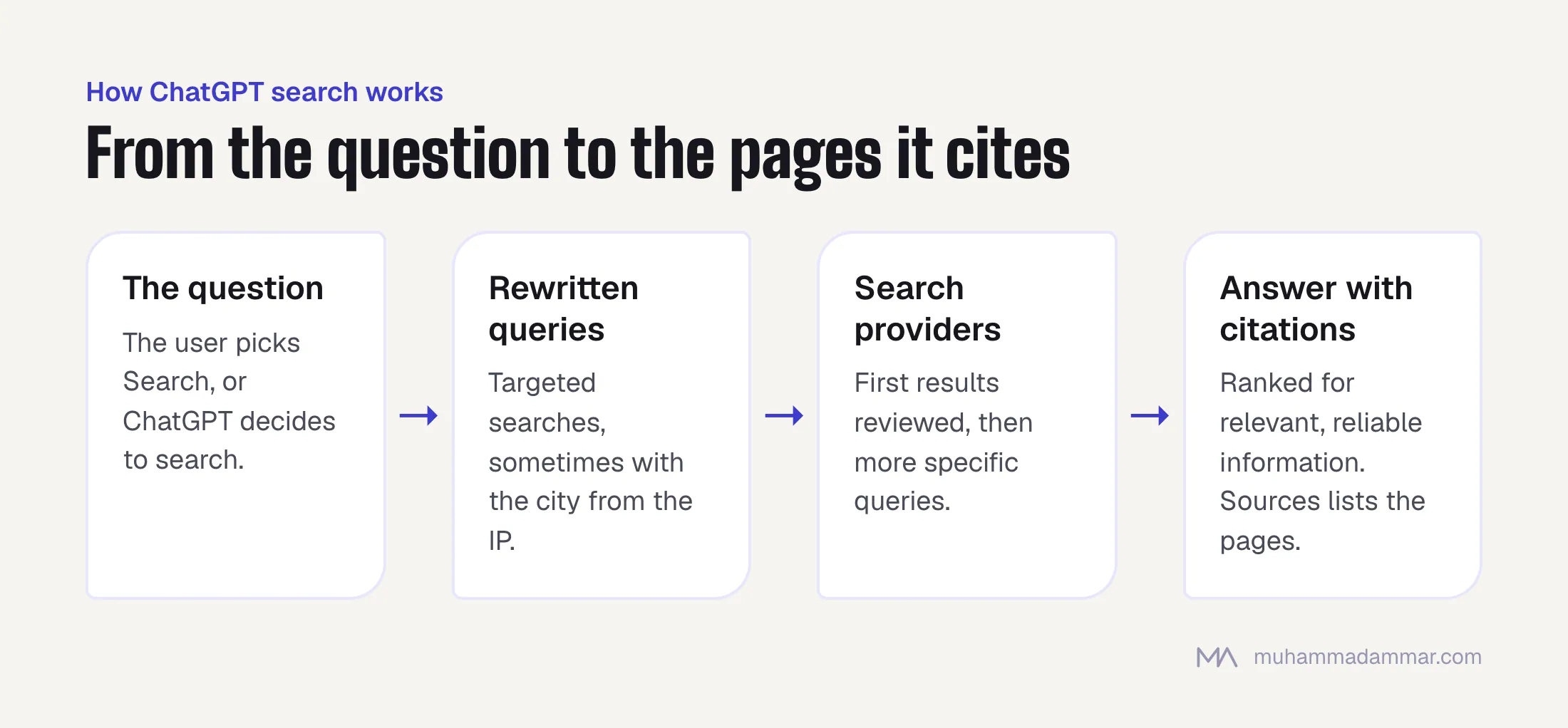
So your page has to match those rewritten, targeted queries, which may not be the exact words the person typed. Naming the subject, the place and the type of buyer plainly on the page is a choice you control, and such a page stands a better chance of matching that kind of query than one written around a slogan. Whether ChatGPT mentions your brand when it answers from what it already knows is a separate question, covered in how AI assistants decide which brands to name.
Which OpenAI crawler decides whether ChatGPT can cite your site?
OAI-SearchBot. OpenAI’s overview of its crawlers says this bot is used to surface websites in ChatGPT’s search features, and that sites opted out of it will not be shown in ChatGPT search answers, though they can still appear as navigational links. The same page describes three other bots, each with a different job.
| Bot | What OpenAI says it does | What blocking it in robots.txt means |
|---|---|---|
| OAI-SearchBot | Surfaces websites in ChatGPT’s search results | Your pages aren’t shown in ChatGPT search answers, apart from navigational links |
| GPTBot | Crawls content that may be used to train OpenAI’s foundation models | It signals that your content should not be used for training; search is a separate setting |
| ChatGPT-User | Visits pages for certain actions a user starts in ChatGPT or a custom GPT, not automatic crawling | OpenAI says robots.txt rules may not apply, and this bot isn’t used to decide what appears in search |
| OAI-AdsBot | Checks the safety of pages submitted as ads on ChatGPT, and visits only those pages | Matters only if you advertise on ChatGPT |
OpenAI says each setting is independent of the others, and that after you change robots.txt it can take about 24 hours for its systems to adjust. A file that keeps you in search while opting out of training looks like this:
User-agent: OAI-SearchBot
Allow: /

User-agent: GPTBot
Disallow: /
Whether to opt out of training at all is a business decision, and it involves more bots than OpenAI’s. I go through each one in a bot-by-bot decision on blocking AI crawlers.
Why can ChatGPT miss a page that Google has indexed?
Because Google having indexed a page doesn’t mean OpenAI’s crawler can reach it. OpenAI’s help says ChatGPT search sometimes works with other search providers, but it doesn’t name Google, and the crawler that decides whether you’re shown is OpenAI’s own OAI-SearchBot. A robots.txt rule, a firewall or a CDN setting can block OpenAI’s crawler while letting Googlebot through.
In its article on offline web search for ChatGPT workspaces, OpenAI describes the index and cache of web content it keeps, and lists common reasons a page may be missing from that index or out of date:
- The site blocks crawling through robots.txt or similar controls.
- The site uses CDN or bot-blocking behaviour.
- The page requires a login or personalisation.
- The content depends heavily on scripts or dynamic loading.
- The page is new, rarely accessed or low-signal.
- The site structure makes deeper pages harder to discover.
That list is written for one workspace feature, and OpenAI doesn’t say it describes ordinary ChatGPT search. Every item on it is still something you can check on your own site.
What should you check before ChatGPT can cite your pages?
Start with access: there’s no point polishing a page that OpenAI’s crawler can’t reach. The first two checks come from OpenAI’s own instructions. The other three are checks you control, not steps OpenAI publishes.
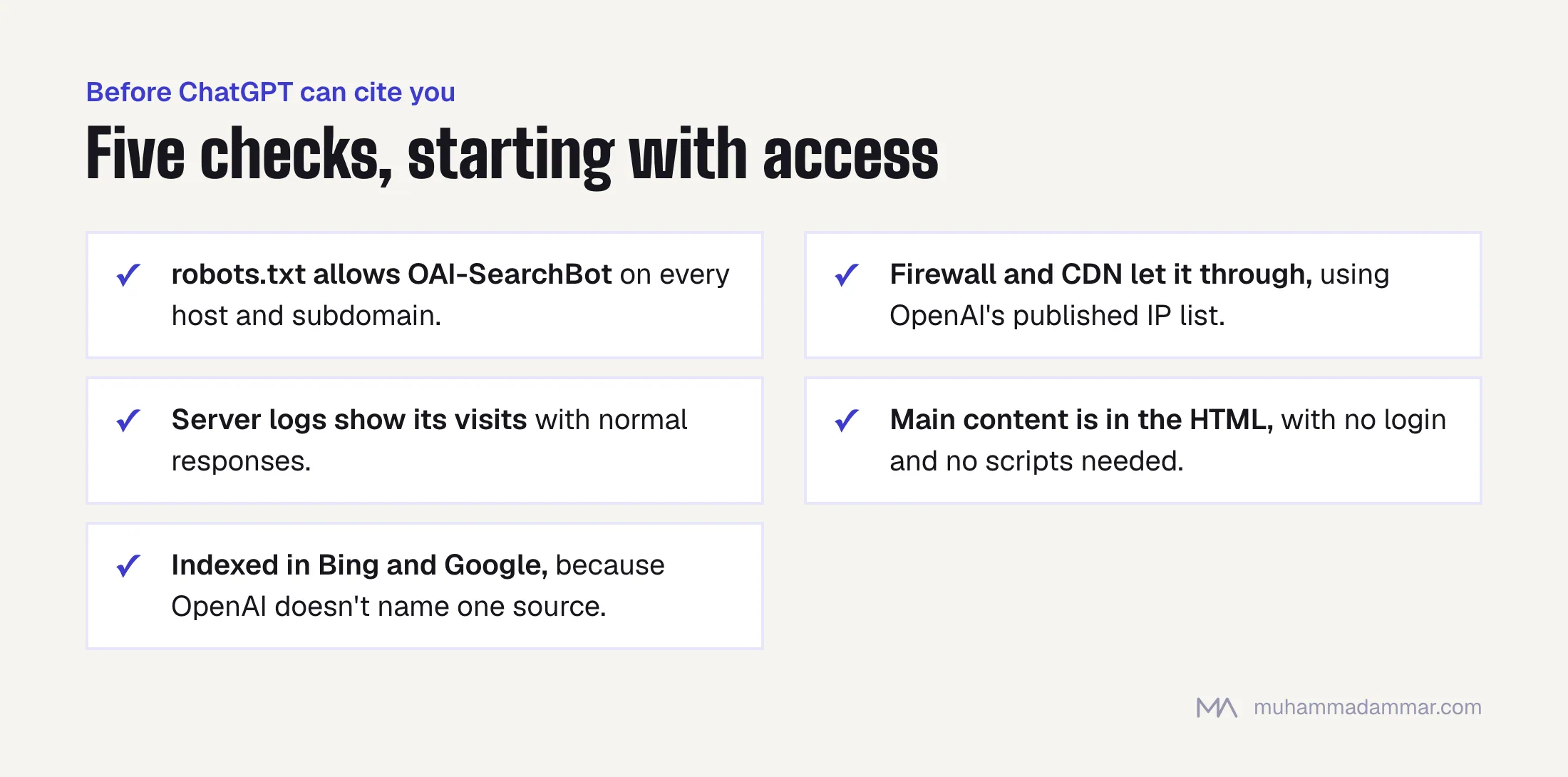
- robots.txt allows OAI-SearchBot on every host that serves your pages, including any subdomain for your Arabic site, blog or shop. Each host has its own robots.txt file.
- Your hosting, firewall and CDN let OpenAI’s crawler through. OpenAI’s help tells site owners to confirm that the host or CDN allows traffic from OpenAI’s published searchbot IP addresses, which are listed at
openai.com/searchbot.json. If your CDN has a setting that blocks AI bots, check whether it covers OAI-SearchBot. - Your server logs show OAI-SearchBot fetching the pages you care about and getting a normal response. Compare the requests against the published IP list, because anyone can send a request that claims to be OAI-SearchBot.
- The main content is in the HTML, served without a login and without waiting for scripts to load it.
- The page is indexed in Bing and in Google. OpenAI doesn’t say which provider’s results feed a given answer, so being in both is the cover you control. Bing’s URL Inspection tool shows whether a URL is in the Bing index and what Bingbot sees. The Bing setup is in Bing and Copilot: what Microsoft says and how to set up Bing, and the Google side is in Google’s own requirements for AI Overview citations.
What makes ChatGPT pick your page over a competitor’s?
OpenAI says no more than “multiple factors” aimed at relevant, reliable information. What you control is how clearly a page shows that it answers the question and can be trusted, and these habits come from that, not from anything OpenAI has published.
- Put the answer right under each heading, and name the service, the market and the city where they matter, so a passage quoted alone still says who and what it’s about.
- Show when the page was published or updated, and keep it current. OpenAI’s help tells users to check when a cited source was published or updated before relying on it, so a visible, honest date serves the reader who does.
- State facts a reader can verify, with a link to the source, and keep your company name, service areas and contact details the same on every page and profile. How to settle one name across Arabic and English is in entity SEO for brands in two scripts.
- Use the Arabic wording your buyers type. The same service can be written in more than one way, for example شركة سيو (sharikat siyo, “an SEO company”, with SEO in Arabic letters) or with SEO in Latin letters. Write the Arabic page in your own buyers’ spellings instead of carrying the English page over word for word.
How do you run a repeatable ChatGPT citation test in Arabic and English?
Use a fixed list of buyer questions in both languages, run them with Search switched on under the same conditions each month, and record which pages are cited. The conditions matter, because OpenAI documents several things that can change the queries ChatGPT sends.
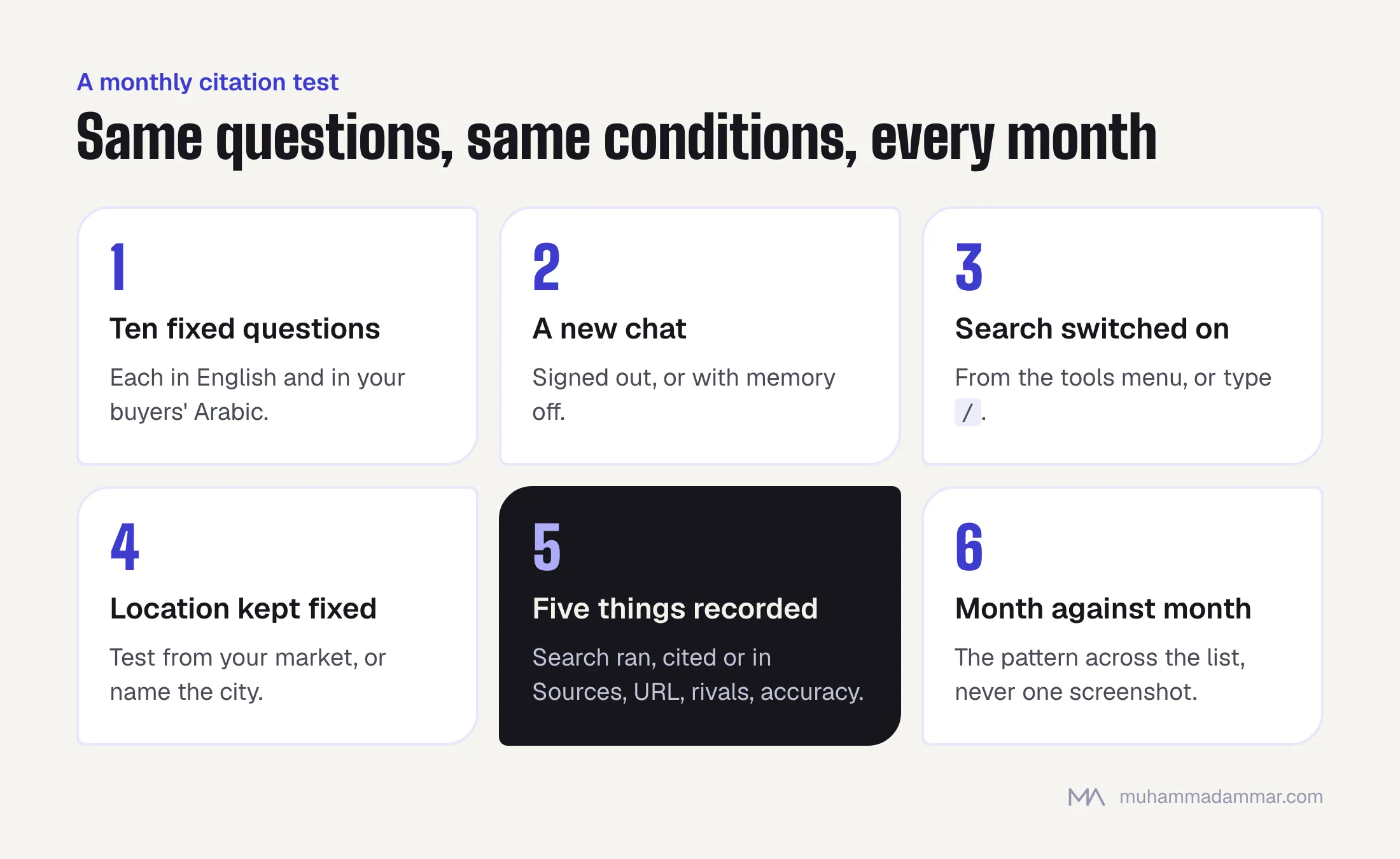
- Write ten questions a buyer asks before contacting a business like yours, each in English and in the Arabic your buyers use. Don’t edit the list between runs.
- Start a new chat, signed out or with memory turned off. OpenAI says that when memory is on, ChatGPT may use saved memories when it rewrites a search query, and that people who aren’t signed in can use web search too.
- Switch Search on yourself from the tools menu, or type
/and choose Search, so every run searches the web instead of leaving ChatGPT to decide. - Keep the location fixed. OpenAI says ChatGPT may estimate your location from your IP address and that a VPN can change it. Run the test from the country you sell in, or name the city in each question, and do the same every month.
- Record five things per question: whether a search ran, whether your domain is cited in the answer or listed under Sources, which URL, which other domains appear, and whether the sentence that cites you is accurate. If it isn’t, trace where the wrong answer came from.
- Compare month to month. Answers can vary between runs, so look at the pattern across the whole list, never one screenshot.
Running this test, fixing what the checks above turn up and tracking the result is the core of my GEO and AI search service.
Frequently asked
Does ChatGPT use Google or Bing results?
OpenAI’s help says ChatGPT search sometimes works with other search providers, and the privacy statements it points users to for those providers are Microsoft’s and Shopify’s. It doesn’t name Google, and it doesn’t say how much of an answer comes from any one source. So the cover you control is to be crawlable by OAI-SearchBot and indexed in both Bing and Google.
If I block GPTBot, can ChatGPT still cite my site?
Yes. OpenAI’s crawler documentation says each setting is independent and gives this case as its example: a site can allow OAI-SearchBot to appear in search results while disallowing GPTBot. If you allow both, OpenAI says it may use the results of one crawl for both purposes. Check that a training block hasn’t been copied onto OAI-SearchBot by mistake.
How do I check whether ChatGPT cites my website?
Run the prompt test above, then look at two records you already have. Visits referred by chatgpt.com in GA4 show people clicking through from answers, and a custom channel for AI referrals in GA4 keeps them in one place. OAI-SearchBot requests in your server logs show OpenAI’s search crawler is reaching your pages, which is the access OpenAI says a site needs to be eligible.
If you want to know whether ChatGPT can reach your pages and where it cites you today, message me with the questions your buyers ask most.

SEO and digital marketing consultant since 2015, working with businesses in Egypt, Saudi Arabia, the UAE and the USA.
About the author and editorial standards