On this page
- How does Google choose the pages an AI Overview links to?
- What does a page need before Google can cite it in AI Overviews?
- Which searches does a page need to rank for to be cited?
- What makes Google use one page’s passage over another’s?
- Which AI Overviews tactics does Google say to skip?
- What should Arabic sites check differently for AI Overviews?
- How can you tell whether your pages are cited in AI Overviews?
- Frequently asked
Google’s guidance says a page must be indexed and allowed to show a snippet to be cited in AI Overviews. The links come from pages its core ranking systems retrieve for the search, or for related searches it may run. No special markup or file is needed: the work is ordinary SEO, for the main question and its follow-ups.
Many guides on this question still recommend tactics that Google’s own documentation tells site owners to skip. What follows sticks to what Google publishes, plus what to watch for on Arabic searches.
How does Google choose the pages an AI Overview links to?
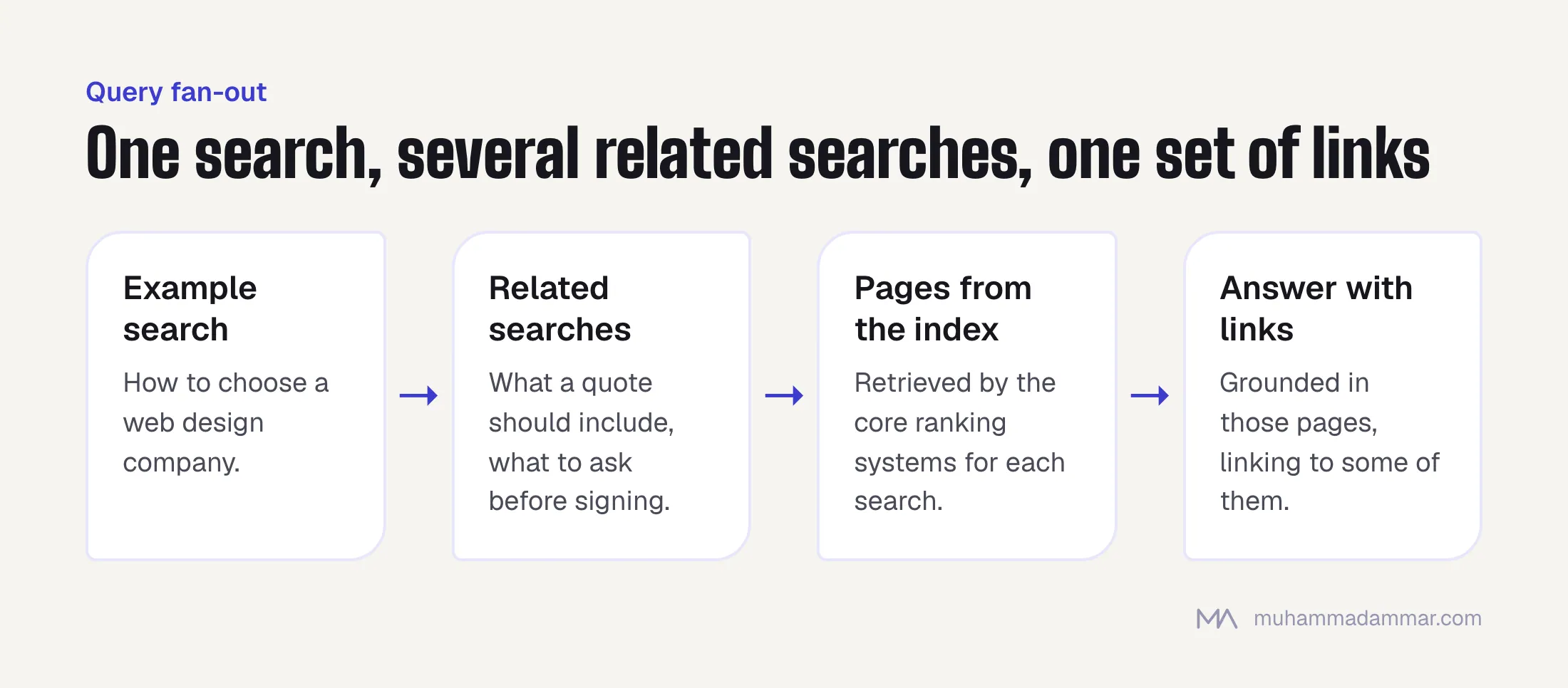
Google takes them from its normal Search index. Its guide to generative AI features says these features rely on the core Search ranking systems to retrieve relevant pages, and the answer is grounded in what those pages say. The links under an AI Overview are pages Google retrieved for the question, or for part of it.
Google can retrieve pages for parts of a question because AI Overviews and AI Mode may use a method it calls query fan-out: the model issues several related searches across subtopics and builds the response from what they return. Here is an example of my own, not Google’s: a search for how to choose a web design company might also lead to searches about what a quote should include and what to ask before signing. Each of those searches has its own results, so a page can be linked for answering one of them well, even when it doesn’t rank for the original wording.
Google’s documentation adds three points that shape what you can expect:
- Fan-out means AI features can show a wider set of links than a classic results page.
- AI Overviews appear only when Google’s systems judge them additive to classic results, so many searches show none.
- AI Mode and AI Overviews may use different models and techniques, so the links in each can differ for the same question. The two features are compared side by side in Google AI Mode and SEO.
What does a page need before Google can cite it in AI Overviews?
Google states the technical bar in one line: a page must be indexed and eligible to be shown in Google Search with a snippet, and there are no additional technical requirements. Check a page in this order, because a failure early in the list makes the later checks irrelevant.
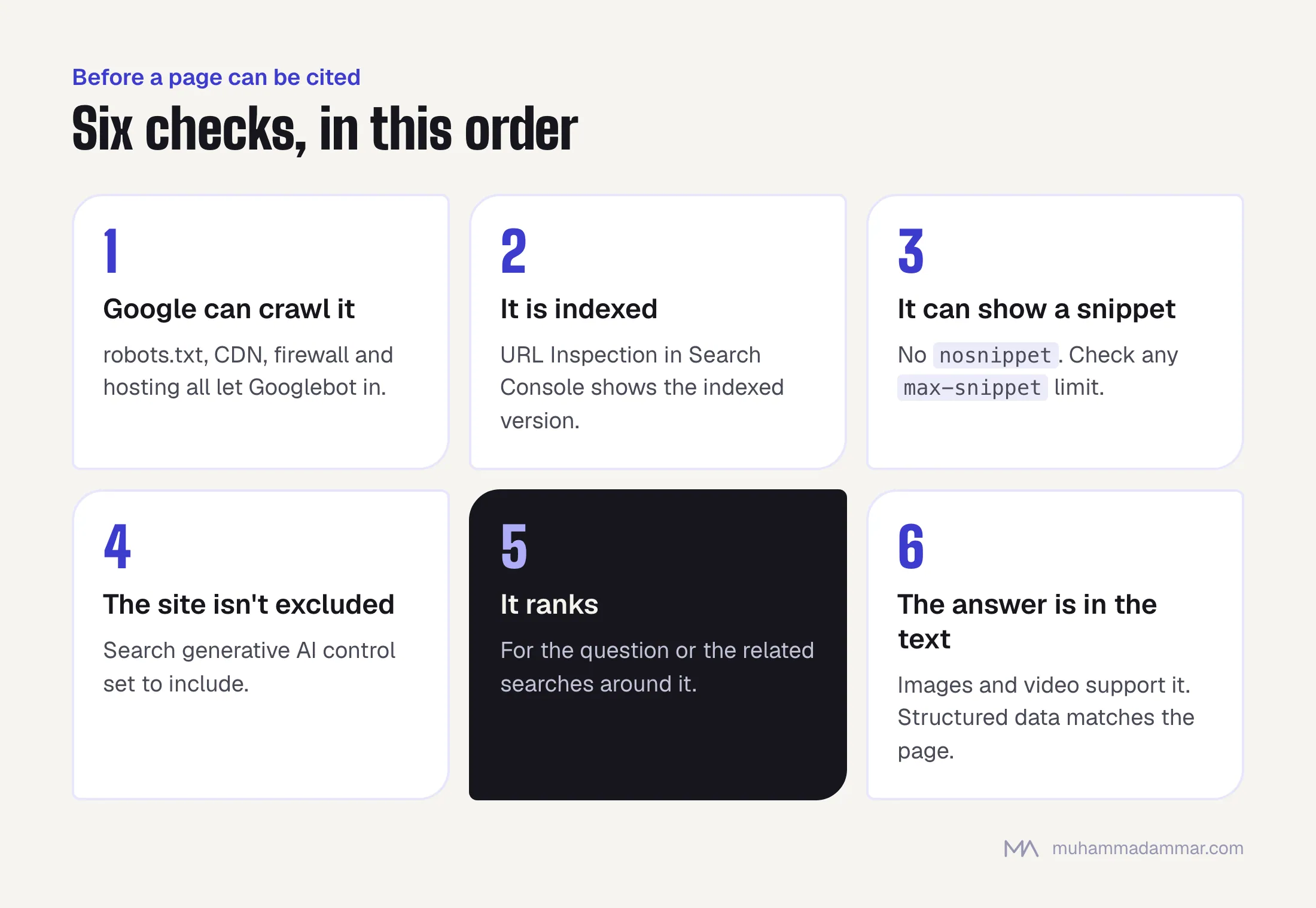
- Google can crawl it. robots.txt allows Googlebot, and so does your CDN, firewall or hosting; Google lists both in its best practices for AI features. Blocking Google-Extended doesn’t change this, as the bot-by-bot guide to blocking AI crawlers explains.
- It is indexed. The URL Inspection tool in Search Console shows Google’s indexed version of a page, and its live test fetches the URL in real time. A page that isn’t indexed isn’t eligible, however good it is.
- It can show a snippet. The
nosnippetrule also prevents the content from being used as a direct input for AI Overviews and AI Mode, andmax-snippetlimits how much of it can be used. Look for both in the page’s HTML and in your SEO plugin’s settings. - The site isn’t excluded in Search Console. The Search generative AI control has include, exclude and inherit options. Include is the default, and Google says the control isn’t used as a ranking signal for the rest of Search. If someone set it to exclude, the site won’t appear in these features.
- It ranks for the question or its sub-questions. Retrieval runs on the core ranking systems, so a page that ranks for no version of the question has little chance of being picked.
- The answer is in the text. Google asks for important content in textual form, supported by images and video where they help, and for structured data that matches the visible text on the page.
The first four checks have a yes or no answer; the last two hold most of the work. If a page passes all six and still isn’t linked, the full diagnosis is in a step-by-step check for pages missing from AI Overviews.
Which searches does a page need to rank for to be cited?
The main search, and the related searches Google is likely to run for it. Because the answer is built from several searches, the page that gets linked can be the best result for one part of the question rather than for the whole of it.
To find those parts for a page you care about:
- Write down the main question your buyer types, in their words.
- List the follow-up questions a person needs answered before acting: what affects the cost, the risks, how to compare options, what to ask a supplier.
- Search each one yourself. Note whether an AI Overview appears, which pages it links and where your page ranks.
- Check the Queries tab in Search Console’s Performance report to see which of these searches already bring the page impressions.
- For each sub-question where you don’t rank, decide whether the page should answer it in its own section or whether it needs a page of its own.
A page that ranks for its main term and for the questions around it is a candidate for more of the searches that fan-out produces. Whether this work is still worth paying for is covered in is SEO still worth it now that AI answers searches.
What makes Google use one page’s passage over another’s?
Google’s guidance gives no passage-level rule. What it does say is that it recommends unique, expert-led content that goes beyond common knowledge, and that you don’t need to write in a special way for generative AI search.
Its guide separates commodity content, the generic list anyone could write from common knowledge, from non-commodity content that gives an expert or first-hand view. On a business site that usually means the things only you can say: how you actually do the work, what a client should check before buying, the cases where your service is the wrong choice, and the questions customers in your market ask.
A page that is easy to read is also easy to quote. Answer each heading’s question in its first sentence or two, keep each section to one subject, name that subject instead of writing “it”, and use a table when you compare things. Google also says there’s no need to break content into tiny pieces for AI, so treat these as writing habits. More on that in how to write pages AI tools can quote.
Which AI Overviews tactics does Google say to skip?
Google’s guide names several things site owners can ignore for Google Search, and some of them still appear in AI optimisation advice. Whether llms.txt is worth adding for AI tools other than Google is covered in do you need an llms.txt file.
| Tactic | What Google says | What to do instead |
|---|---|---|
| llms.txt or other AI text files | No new machine-readable files, AI text files, markup or Markdown are needed to appear in Google Search | Spend the time on the six checks above |
| Breaking pages into small chunks | There’s no requirement to break content into tiny pieces for AI | Write sections that each answer one question for a reader |
| Rewriting pages “for AI” | You don’t need to write in a specific way for generative AI search | Write for the buyer, with details only you have |
| Special schema for AI | No special schema.org markup is needed, though structured data still helps with rich results | Keep structured data that matches the visible page |
| Seeding mentions of your brand | Inauthentic mentions across the web aren’t as helpful as they might seem | Earn real coverage from reviews, partners and the press |
The last row needs care. Genuine third-party mentions are a different matter, and I cover how they can shape the way AI tools describe a brand in what makes an AI assistant name your brand. Google’s warning is about manufactured ones.
What should Arabic sites check differently for AI Overviews?
The requirements are the same for Arabic pages. What changes is the name of the feature, the wording people search with, and the habit of translating pages from English.
- Google’s Arabic Search Help calls the feature النبذات باستخدام الذكاء الاصطناعي (an-nubdhat bi-stikhdam adh-dhaka’ al-istina’i, “summaries using AI”). The Latin name AI Overviews is used in Arabic writing too, as in this article, so expect both names in briefs and reports.
- Run the sub-question searches in the wording your buyers use. “How” is إزاي (izzay) in Egyptian and كيف (kaif) in much of the Gulf, and the results, including whether an AI Overview appears, can differ between the two.
- Write the Arabic page from the Arabic question. A translated page answers the English version of the question, which is often not quite what the Arabic search asks.
- Run the six checks on each language version separately: the Arabic URL can be unindexed while the English one is fine.
What Arabic pages should change, section by section, is in AI Overviews in Arabic and what Arabic sites should change.
How can you tell whether your pages are cited in AI Overviews?
Search Console counts appearances in AI features inside your normal search data and has a separate report for them. Use both, with a manual check alongside.
- Google says traffic from AI Overviews and AI Mode is included in the Performance report, under the Web search type.
- The Generative AI performance report covers AI Overviews and AI Mode and shows impressions, which Google defines as how many times links to your site were shown to a user in a generative AI feature.
- Keep a short list of your most important searches in each language and look at them by hand once a month. Note whether an AI Overview appears, which pages it links and whether yours is one of them.
Setting up that tracking and working through the checks in this article is the starting point of my GEO and AI search work.
Frequently asked
How do I get my website into Google AI Overviews?
There’s no form to submit and no file to add. Make sure the page can be crawled, is indexed and is allowed a snippet, and that the site isn’t excluded in Search Console. After that, Google’s guidance says AI features retrieve pages with its core ranking systems, so the page has to rank for the question or the searches around it.
Do I need to rank on page one to be cited in AI Overviews?
Google’s guidance gives no position cut-off. Because the answer can draw on several related searches, a page can be linked for a sub-question while ranking lower for the main search. A page that ranks for none of those searches is unlikely to be picked, so ranking still matters, only across more than one search.
Do AI Overviews show on Arabic searches in Saudi Arabia and Egypt?
Yes. Google announced in May 2025 that AI Overviews were broadly available across the Middle East and North Africa, and in Arabic globally. They don’t appear on every search, because Google shows one only when it judges it adds something to the classic results, so check your own searches in both languages.
If you want to know whether your pages are eligible for AI Overviews and where they stand, message me with the queries you care about most.

SEO and digital marketing consultant since 2015, working with businesses in Egypt, Saudi Arabia, the UAE and the USA.
About the author and editorial standards