On this page
Traffic drops sharply, someone forwards a screenshot of the Search Console graph, and everyone starts guessing. The first guess is usually an algorithm update, because that explanation means nobody made a mistake.
Many drops turn out not to be technical at all. The way to find out what you’re dealing with is to rule causes out in a fixed order, cheapest and most common first. Here’s the order I use.
First: is the drop real?
Before diagnosing anything, break the numbers down. A site-wide total hides which of the six branches below applies, and the breakdown often points straight at the answer.
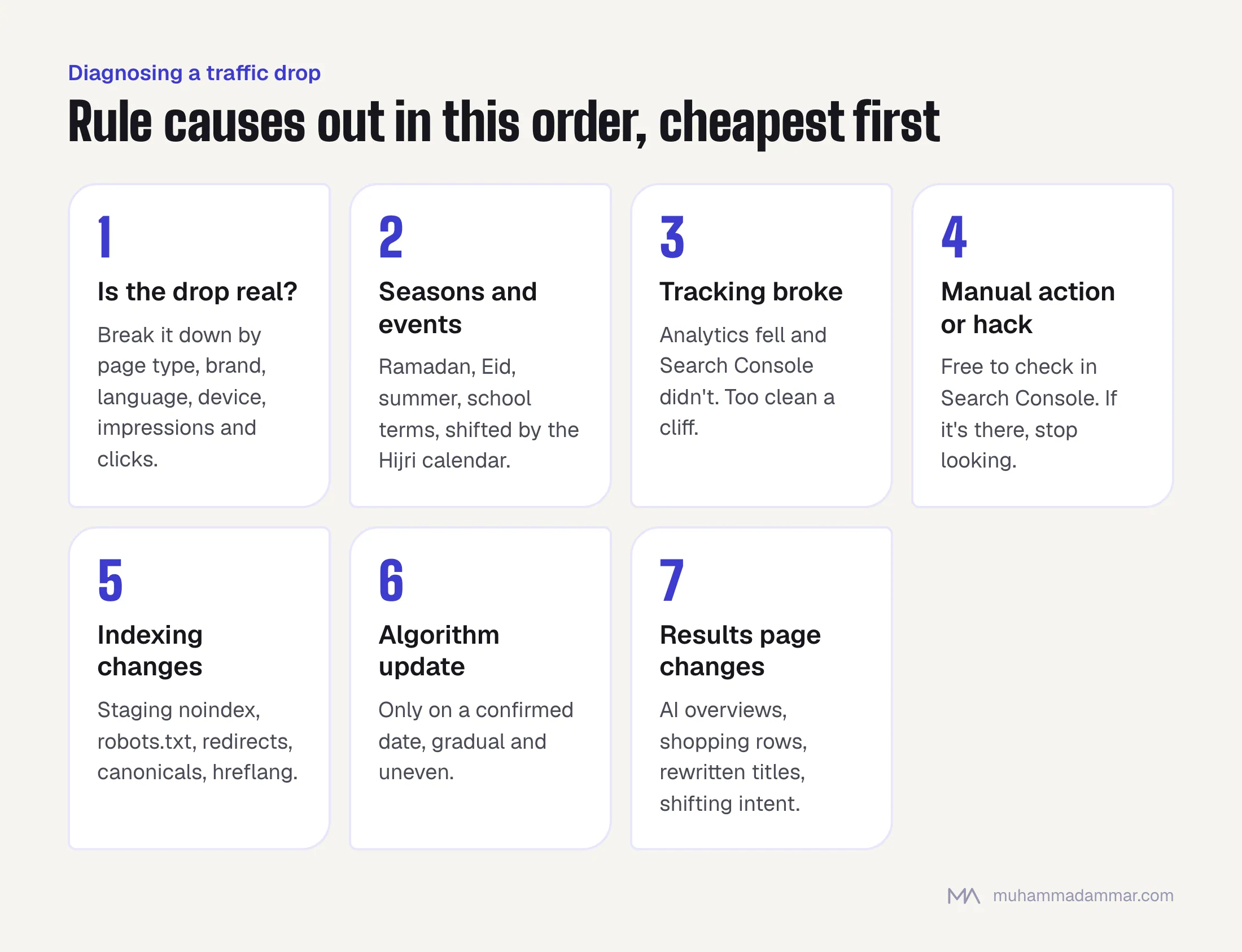
- By page type. Did every template drop, or just one? A drop limited to category pages is a different problem from a drop across everything.
- By query type: brand and non-brand. A drop in brand searches is almost never an SEO problem. It’s a change in demand or a PR event.
- By country and language. On a two-language site, check Arabic and English separately. Often a “site-wide” drop is one language collapsing while the other holds.
- By device. A mobile-only drop points at rendering, speed or a change to the mobile template.
- Impressions against clicks. This is the most telling split. Fewer impressions means you lost visibility. Flat impressions with fewer clicks means you still rank but something changed on the results page: a new feature, a rewritten title or a competitor’s snippet.
Also compare the dates with the same period last year before you declare an emergency. That’s the branch everyone skips.
Branch 1: seasons and market events
In this region it’s the most common false alarm, and it takes two minutes to rule out, so I check it first.
The Hijri calendar moves about eleven days earlier each Gregorian year, so a year-on-year comparison in your reports compares different seasons. Ramadan changes search behaviour a lot in retail, food, travel and B2B: B2B enquiries fall, and consumer activity moves late into the night. Eid brings a sharp spike and then a sharp drop. Summer travel empties the Gulf. School terms move whole categories.
Rule it out by checking whether the drop starts on a meaningful date, and whether the same shape appeared last year, shifted by the calendar. If it did, there’s nothing to diagnose.
Branch 2: the tracking broke, not the traffic
The second cheapest check, and the second most common answer.
If analytics shows a drop and Search Console doesn’t, your traffic is fine and the measurement is broken. The usual causes: a tag removed during a deploy, a change to the consent banner, a tag container republished without a tag, a duplicated property, or a filter someone added and forgot.
The giveaway is a drop that looks too clean, a straight cliff on one day with no gradual decline. Real ranking losses are almost always messier.
Always compare the two sources before anything else. It takes a minute and has saved me weeks of pointless investigation. Getting this set up properly is part of analytics and tracking work.
Branch 3: manual action or security issue
Rare but serious, and free to check, so check it early.
Open the manual actions and security issues reports in Search Console. A manual action is stated plainly and tells you what it’s for. A hack shows up as a sudden rise in indexed pages you didn’t create, often in a language you don’t publish in, or as a drop alongside strange search query data.
If either one is there, that’s your diagnosis and you can stop looking. A manual action for unnatural links is also the moment for an honest conversation about where those links came from. The market background is in the Arabic link market.
Branch 4: indexing changes
Now the truly technical branch, where a deploy is usually to blame.
Compare the number of indexed pages before and after the drop in the page indexing report. A real fall means pages left the index, and the report tells you why: noindex, blocked by robots.txt, redirect, 404, or canonical pointing elsewhere.
The usual causes, in the order I find them:
- A staging noindex that went live. Even now, it’s the most common serious technical cause of a sudden drop.
- A robots.txt change that blocked more than intended.
- A migration or slug change with missing or chained redirects.
- Canonical tags pointing somewhere new after a plugin update or template change.
- Broken hreflang on a two-language site. It shows up as one language losing visibility while the other holds, which is why splitting by language matters.
Ask what went live in the week before the drop. On most sites the answer is in a deploy log, and nobody looked because the change had nothing to do with SEO. On a large site, server logs show what Googlebot ran into. The method is in log file analysis.
Branch 5: algorithm updates
Everyone’s first guess belongs fifth, because the first four are cheaper to rule out and more often right.
Two conditions must hold before an update is a believable explanation. The drop has to start on or very close to a confirmed update date, not just “around that month”. And it has to look like an update: gradual over several days, uneven across types of search, with competitors moving too. A one-day cliff that hits every page equally is a technical event.
If it really is an update, there’s no quick fix and nothing to roll back. Look at what kinds of pages lost, look at what ranks now, and treat it as a content and quality question.
Branch 6: results page changes and shifting intent
This branch explains the “impressions flat, clicks down” pattern, and it’s getting more common.
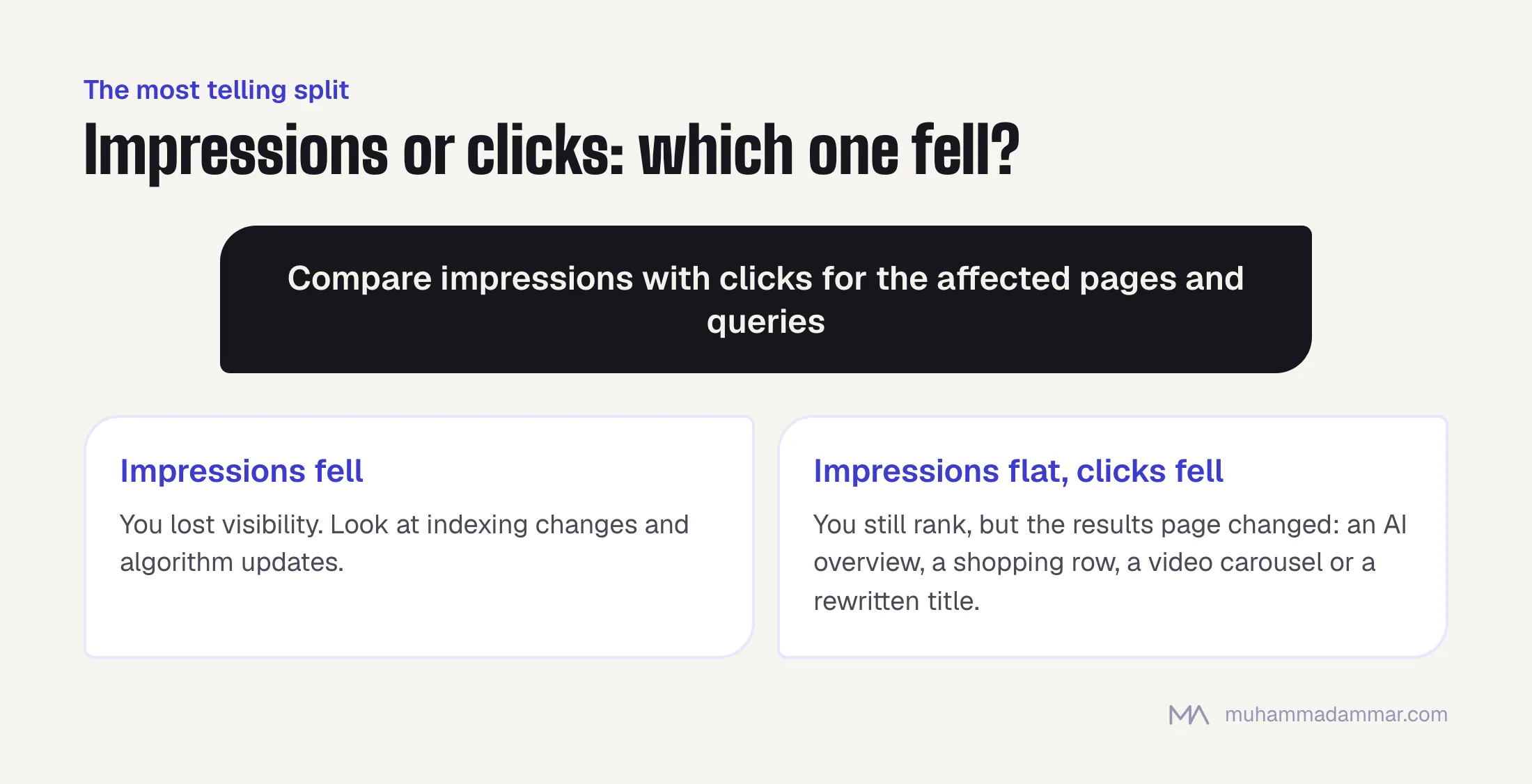
Your position didn’t change, the results page did. An AI overview appeared above the results, a shopping row pushed organic results down, a video carousel took the space, or Google rewrote your title into something less clickable.
Check by searching your most affected queries from the target country and looking at what sits above you. Compare with a screenshot from before, if anyone took one, which is a good reason to start taking them.
A change in intent is the slower version: the search still exists, but what people want from it has changed, so Google now shows a different kind of page. Optimising won’t win that back. Either serve the new intent or accept the loss and target something else.
What to do in each case
| Diagnosis | What to do | Realistic recovery |
|---|---|---|
| Seasonality | Nothing. Make a note of it. | Next cycle |
| Tracking broke | Fix the tag | Immediate |
| Manual action | Fix the cause, then request reconsideration | Weeks to months |
| Indexing change | Undo it, then request indexing | Days to weeks |
| Algorithm update | Content and quality work | A later update, or never |
| Results page change | Change the target or the format | Partial at best |
One rule throughout: change one thing at a time. Panicked fixes made all at once make it impossible to know what worked, and the next drop gets harder to diagnose because nobody can reconstruct what the site was doing.
Frequently asked
How big a drop is worth investigating?
One that lasts more than a week and falls outside your site’s normal ups and downs. Daily swings of ten or fifteen per cent are normal on a small site. A two-week decline of the same size isn’t.
Can I recover from an algorithm update?
Sometimes, and not by undoing anything. Recovery usually comes with a later update, after the underlying quality problem has really been fixed. Anyone promising recovery by a date is guessing.
Why did only my Arabic pages drop?
Most often it’s hreflang, a change to the language switcher, or a location-based redirect added at the CDN. Check that Googlebot can still reach the Arabic URLs directly without being redirected.
How long should diagnosis take?
About forty-eight hours to a confident answer on most sites, if you have Search Console, analytics and a deploy log. Longer only when you need server logs and nobody can get them.
Should I disavow links after a drop?
Not as a reflex. Only if you have a manual action for unnatural links, or a truly toxic link profile you can show. Disavowing healthy links because traffic fell turns a bad week into a permanent problem.
Related: technical SEO and SEO audit. If your traffic just dropped, send me the Search Console graph and I’ll tell you which branch I’d check first.

SEO and digital marketing consultant since 2015, working with businesses in Egypt, Saudi Arabia and the UAE.
About the author and editorial standards