On this page
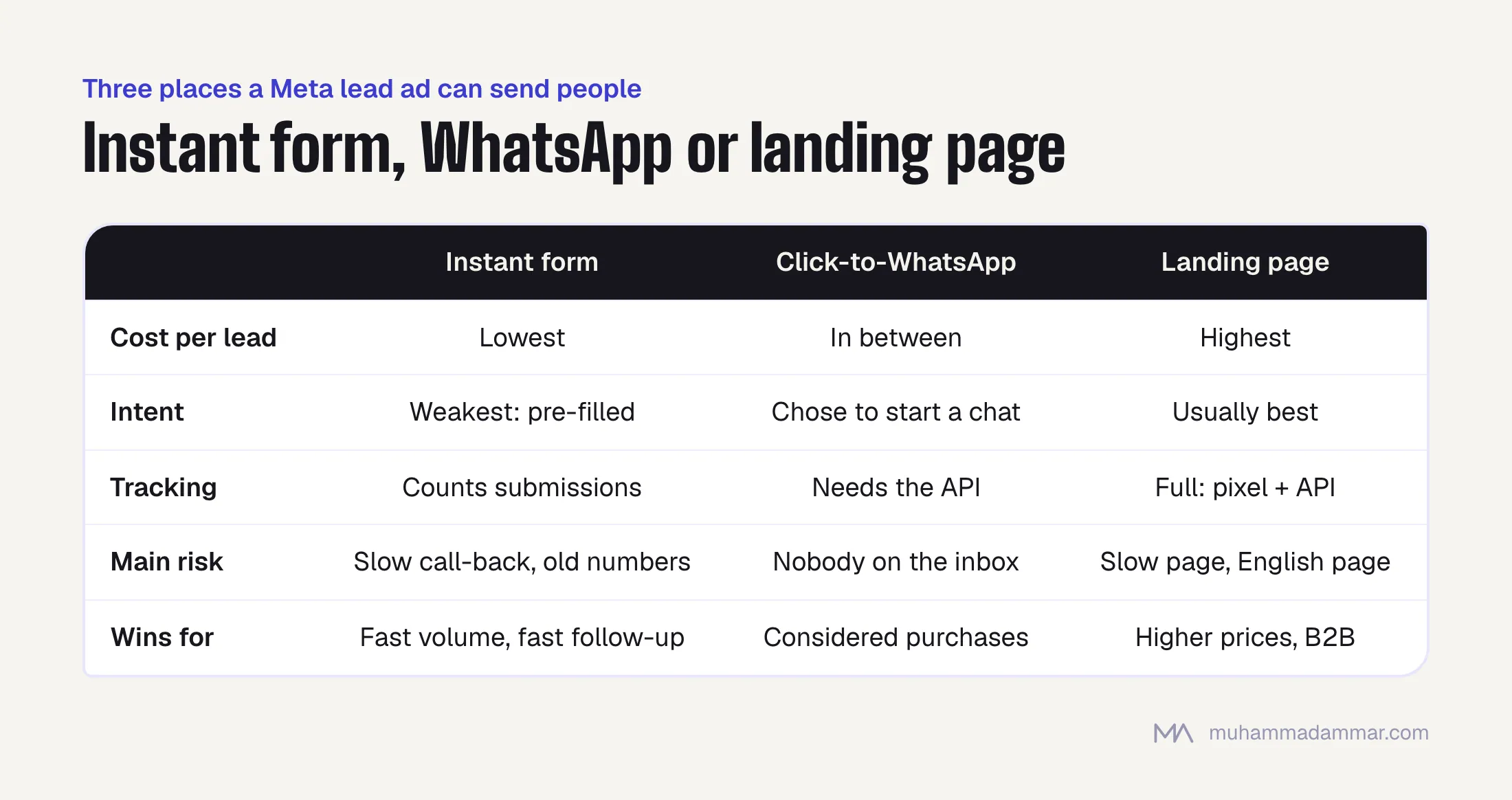
On Meta, a lead-generation ad can send people to three places: an instant form inside the app, a WhatsApp conversation, or your own landing page. Most accounts in this region pick one, keep it for years and never compare.
They behave very differently. They produce leads with different costs, different qualification rates and different follow-up needs, and the cheapest cost per lead often turns out to be the most expensive cost per customer.
The only number that settles it
Cost per lead is the wrong comparison, and it’s the one every dashboard shows by default.
The number that decides this is cost per qualified lead, and it needs something most accounts don’t have: a definition of “qualified” agreed with sales, recorded in the CRM and traceable back to the destination that produced it. Without that you can’t compare, and every opinion about which destination is better is just a preference.
Set that up first. The rest of this article assumes you have.
Instant forms: cheap leads, expensive follow-up
The form opens inside the app, the fields are pre-filled from the person’s profile, and there’s almost no effort involved. That’s both the good news and the bad.
What you get: nearly always the lowest cost per lead of the three. Volume comes in fast, setup is quick, and the format works well on the mid-range phones and patchy connections common in Egypt and much of the region.
What it costs you: intent. Pre-filled fields mean people submit without reading, sometimes without noticing what they submitted. Phone numbers are often out of date because the profile is years old. And the window to respond is short: a lead who gets a call the next day often doesn’t remember the ad.
How to make it work: switch the form from the default volume setting to the higher-intent version, add a qualifying question that needs real typing, and connect the form to your CRM in real time instead of downloading a CSV. If nobody can call within the hour, this destination will do much worse than its cost per lead suggests.
Click-to-WhatsApp: the regional favourite and its blind spot
This is what most advertisers in the region run, for a good reason: it matches how people here like to talk to a business.
What you get: a real conversation with someone who chose to start one, usually at a cost per lead between the form and the landing page. Qualification happens naturally in the chat, objections come up straight away, and the same thread carries through to the sale. In categories where people think before they buy, it often converts better than either alternative.
The blind spot is measurement, and it’s serious. The first message carries referral data that identifies the ad, but you can only see it through the WhatsApp Business API. If your team answers on a phone with the regular business app, that data never reaches you, Meta never learns which conversations became customers, and you’re optimising blind without realising it.
So click-to-WhatsApp is the strongest destination in this region if you have the API and an inbox that reads the referral data. Without them, it’s where you’ll spend the most and know the least. I explain the setup in tracking WhatsApp leads.
The second limit is staffing. Conversations need answering within minutes while the ads run. An account running click-to-WhatsApp with nobody watching the inbox after 6pm is paying for conversations it won’t have.
Landing pages: when the extra step pays off
This is the option with the most friction, and sometimes it’s the right one.
What you get: the highest cost per lead and usually the best qualification rate. Someone who left the app, waited for a page, read it and filled in a form has shown more interest than someone who tapped twice. You also get full tracking, retargeting audiences, and room to say things a short ad can’t.
When it wins: considered purchases, higher prices, B2B, and anything where the buyer needs evidence before getting in touch. Also any product that needs explaining, because a chat is a bad place to educate someone from scratch.
When it loses: impulse purchases, low prices, and any page that’s slow. A page that takes six seconds to load on a mid-range Android phone in Cairo gets abandoned before it’s seen. And an Arabic ad that points to an English page throws the click away entirely. What the Arabic page needs is in Arabic landing pages that convert.
One mix worth testing: a landing page with WhatsApp as the main call to action. You get the page’s tracking and credibility plus the conversation the buyer wanted, for one extra step.
Scoring lead quality across all three
To compare them you need one scoring system applied to all three, which is more work than it sounds because each produces different raw material.
- Agree the qualification bar with sales, in one sentence, for example: “Reachable, in our service area, with a budget above X.” If sales can’t state it, nothing after it works.
- Record the destination on every lead. The destination type, not just the campaign, because that’s what you’re comparing.
- Track the same stages for all three: contacted, qualified, quoted, won, value. A WhatsApp conversation and a form fill have to land in the same pipeline, or it isn’t a comparison.
- Measure contact rate separately. Instant forms usually lose the most leads at first contact, and that loss doesn’t show in cost per lead but decides cost per customer.
- Run all three for at least a month, with the same offer, audience and, where possible, the same creative. Anything shorter and you’re reading noise.
Sending results back for each destination
Whatever event you send back is what Meta will go and find more of. It’s the most powerful setting in the account, and the one most often left on its default.
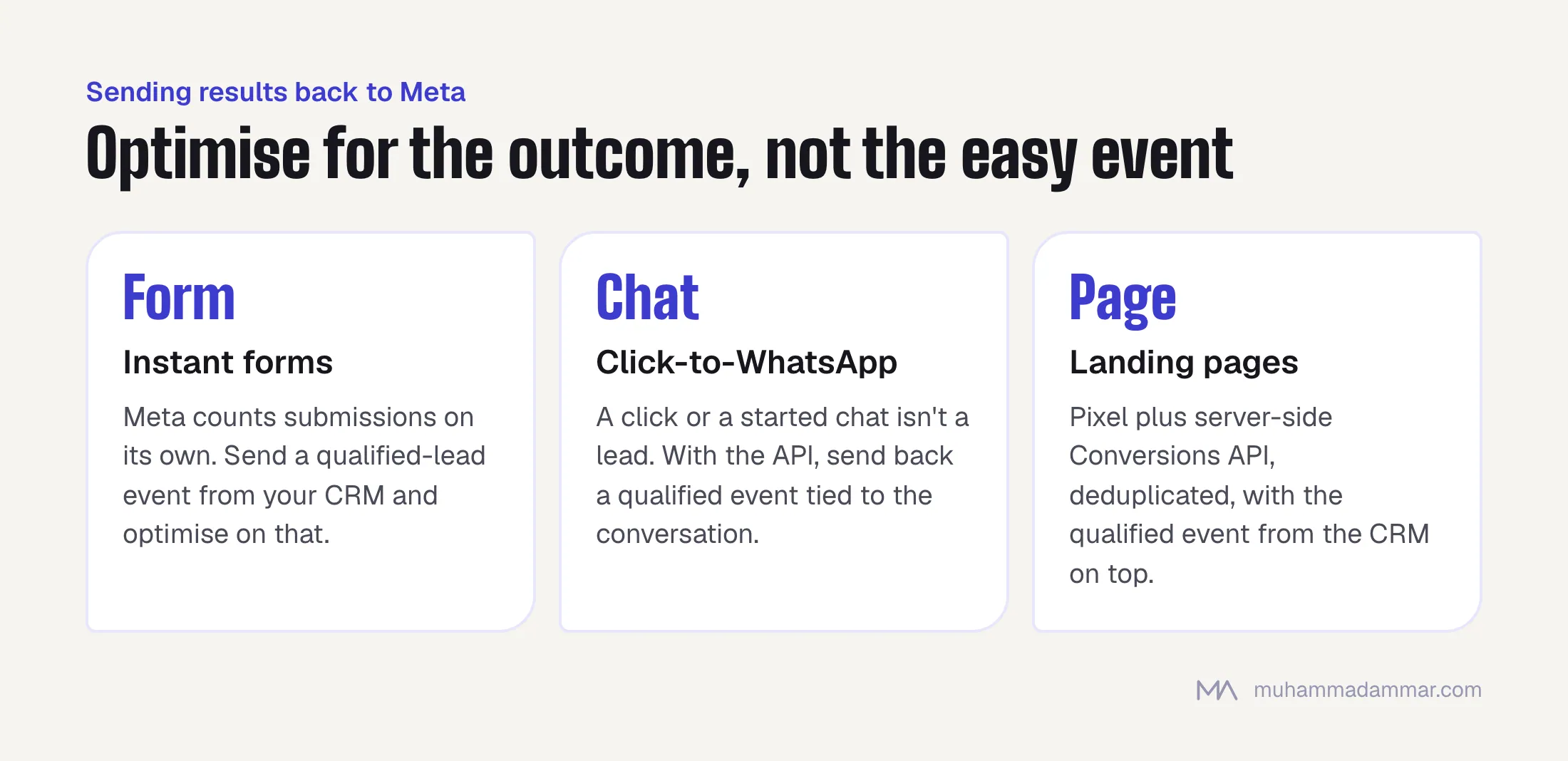
Instant forms: Meta records the submission automatically, and that’s the problem. Optimise on it and you get more submissions. Send a qualified-lead event back from your CRM and optimise on that instead.
Click-to-WhatsApp: Meta records the click or the start of the conversation, and neither is a lead. With the API you can send back a qualified event linked to the conversation, and that one change is what makes this destination measurable.
Landing pages: the pixel plus the server-side Conversions API, deduplicated, with the qualified event sent from the CRM on top of the form submission.
The principle is the same in all three: optimise for the outcome you want, not the event that’s easy to count. Many accounts in this region optimise for the easy event and then wonder why volume went up and revenue didn’t.
Frequently asked
Which destination is cheapest?
On cost per lead, instant forms, almost always. On cost per qualified lead the ranking often flips, and that’s the whole point of this article.
Can I run more than one at once?
Yes, and you should while you’re comparing. After that, running two side by side is fine if they serve different audiences or offers, and less fine if they’re just splitting your budget and your learning phase.
Do I need the WhatsApp Business API?
If click-to-WhatsApp is a real share of your spend, yes. Without it you can’t link conversations to ads or send qualified events back, which means your biggest channel runs without measurement.
Why did my cost per lead double after I fixed tracking?
Because the old number was wrong. Removing double counting and switching to a qualified-lead event makes the reported number go up while the business improves. Tell management to expect this before you make the change, not after.
Should Arabic and English run in the same campaign?
No, for the same reasons as on Google: different costs, different audiences, different creative. Separate campaigns keep the budget decision in your hands.
Related: Meta ads, analytics and tracking and CRO and landing pages. If you’re not sure which destination suits your business, send me your setup.

SEO and digital marketing consultant since 2015, working with businesses in Egypt, Saudi Arabia and the UAE.
About the author and editorial standards