On this page
- What order should the decisions in a paid media strategy go in?
- What does the offer need before you pay for clicks?
- How will you count a lead or a sale from the ads?
- Which ad platform should you start with?
- What should be ready before you launch the first campaign?
- How should the first paid media test run?
- How often should you review paid media results?
- Frequently asked
A paid media strategy for a business starting ads in Egypt, Saudi Arabia or the UAE is five decisions made in a fixed order: what you offer and to whom, how a lead or sale will be counted, which single platform goes first, how the first test runs and when it ends, and how often you review the results.
Each decision needs the one before it: you can’t judge a platform until you can count what it brings in. I’ve planned and managed $1.4M in ad spend and audited more than 300 websites and ad accounts. A step skipped near the top of this list costs more than a wrong choice of platform, because everything after it gets judged on the wrong numbers.
What order should the decisions in a paid media strategy go in?
Offer first, measurement second, platform third, then the test and the review rhythm.
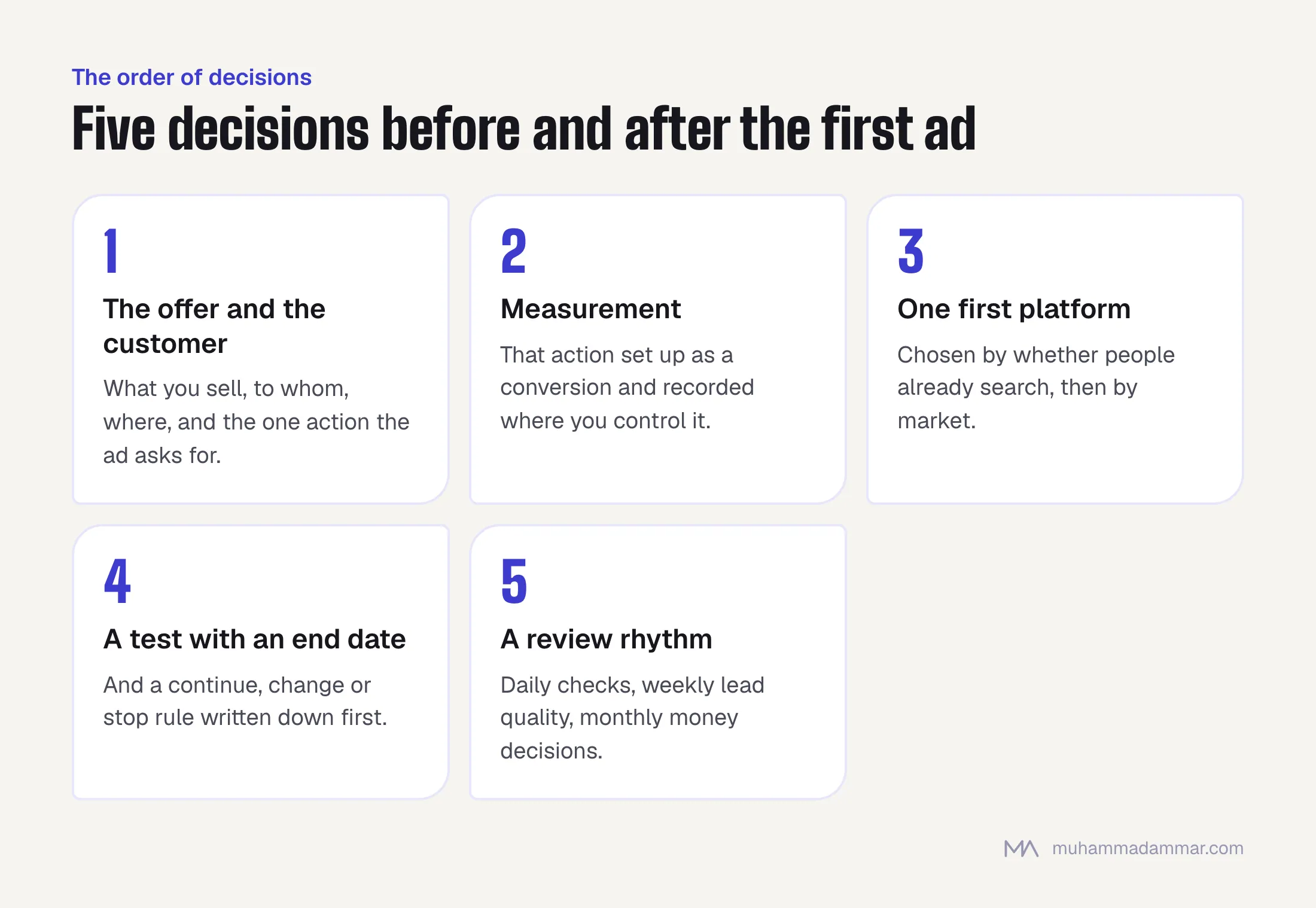
- The offer and the customer. What you sell, to whom, in which market, and the one action the ad asks for: a call, a WhatsApp message, a form or a purchase.
- Measurement. That action is set up as a conversion on the platform and recorded somewhere you control, so you can tell ad leads from the rest.
- One first platform, chosen by whether people already search for what you sell, and then by market.
- A test with an end date, and a rule written down in advance for which result means continue, change or stop.
- A review rhythm: short daily checks, a weekly look at lead quality, and a monthly decision about money.
The budget belongs to step four. It comes from your own numbers: what a customer is worth and how many leads you need before a result means anything.
What does the offer need before you pay for clicks?
The offer needs a clear customer, one clear action and an answer to the first question that customer will ask. Ads bring people to an offer faster, but they can’t make a weak offer stronger.
- Who the customer is, and where. One plan for Egypt, Saudi Arabia and the UAE together rarely fits, because costs, platforms and language differ between the three.
- One action per campaign. An ad that asks people to call, message and fill in a form at once measures none of them well.
- The answer to the first question. If most enquiries open with the price, the delivery area or the waiting time, the ad or the page should answer it, or the person replying should have the answer ready.
- A landing page or chat in the ad’s language. An Arabic ad that opens an English page loses people you have already paid for.
How will you count a lead or a sale from the ads?
Decide which action counts as a conversion, set it up on the platform, and record it where you can check it against real sales. Without that, every platform report is the platform marking its own work.
On Google Ads, conversions can come from your website, phone calls, apps or offline sales you import, and GA4 events can be imported if they are marked as key events. Smart Bidding works towards whatever you define as a conversion, so a badly set up conversion action stops it optimising properly. Which events to track is in a GA4 event setup for lead generation.
Meta, TikTok and Snapchat each pair a browser pixel with a server connection: Meta’s Conversions API, TikTok’s Events API and Snap’s Conversions API. TikTok and Snap both recommend running the server connection alongside the pixel, with deduplication so the same event isn’t counted twice.
If your leads arrive on WhatsApp, plan for that separately, starting with the click-to-WhatsApp campaign setup and first reply. A message from a click-to-WhatsApp ad carries referral data about the ad, but you only keep it if you use the WhatsApp Business Platform with a system that records it.
Then keep one record outside the ad platforms, a CRM or a simple sheet, with each lead’s source and outcome. Each platform will claim some of the same sales, and that record shows which ones were real.
Which ad platform should you start with?
Start with Google Search if people already search for what you sell, and with a social platform if they don’t yet know they want it. One platform run properly teaches you more than three run on a thin budget.
| Your situation | Start with | Why | Ready before launch |
|---|---|---|---|
| A service people already search for, in any of the three markets | Google Search | The demand exists, so you collect it | A page or chat in the language people search in; call and form tracking |
| A visual or price-led product in Egypt | Meta (Facebook and Instagram) | Facebook takes a share of discovery that search takes elsewhere | Creative in Egyptian Arabic; someone answering messages and confirming orders |
| A consumer brand in Saudi Arabia | Snapchat or Meta, one first | Snapchat reaches a very large share of people in Saudi Arabia | Vertical video in Arabic; pixel and server events working |
| A consumer business in the UAE | Meta or Google Search | English carries much more commercial weight than in the other two markets | Ads and pages in English and Arabic, kept apart by language |
| An online store | Google Shopping if people search for products by name, Meta if they discover them | Shopping ads run on your Merchant Center product data, not keywords | Purchase tracking tested on a real order; a clean product feed (see Meta catalog, pixel and Conversions API on Salla, Zid and Shopify) |
| A new product nobody searches for yet | A social platform | There’s no search demand to collect | Creative that explains the product in seconds |
| B2B with a long sales cycle | Google Search on narrow, high-intent terms | Few searches, but each can be worth a lot | CRM tracking of what happens after the lead |
On Google Ads, location targeting can also reach people who have shown interest in your target location, so a business that only serves customers in Riyadh should check that setting. On social platforms, start with one campaign and one audience, so the budget isn’t cut into pieces too small to learn from.
A second platform comes later. How to divide money between channels then is in deciding the budget split between channels.
What should be ready before you launch the first campaign?
Accounts in your business’s name, measurement you’ve tested yourself, and a named person ready to answer leads. Check these the day before launch:
- The ad accounts belong to your business. On Google Ads, keep Admin access yourself and give whoever runs the ads the level they need. On Meta, keep the ad account in your own business portfolio and give the partner access to it.
- Each campaign has one conversion action, and you’ve triggered it with a test enquiry or order and seen it arrive in the platform.
- The pixel and the server connection don’t count the same action twice.
- Ad links carry UTM tags or another source marker, and the page or chat opens in the ad’s language and works on a phone.
- Someone is named to reply to leads while the ads run and to note what happened with each one.
- The test’s end date and its continue, change or stop rule are written down.
How should the first paid media test run?
Run one campaign with one goal for a fixed period, and leave it alone unless something is broken. The test shows whether this platform brings customers at a cost you can live with.
- Set the length before you start. Google’s guidance for Smart Bidding is to judge performance over two conversion cycles or two weeks, whichever is longer. A conversion cycle is the time it takes a click to become a conversion, so if your customers take a week to decide, a three-day test proves nothing.
- Fund it well enough to finish. A test that runs out of money before it collects enough leads tells you nothing. If you can’t fund the whole test, test fewer things.
- Test different ideas. A few clearly different creative concepts teach you more than ten small variations of one. The method is in testing ad creative on Meta, TikTok and Snapchat.
- Write the decision rule first. For example: continue if the cost per qualified lead is below what you can afford, change the creative or the page if leads arrive but don’t qualify, and stop if almost nothing arrives.
How often should you review paid media results?
Check delivery daily, review lead quality weekly and decide about money monthly. Reviewing everything daily leads to changes made on too little data.
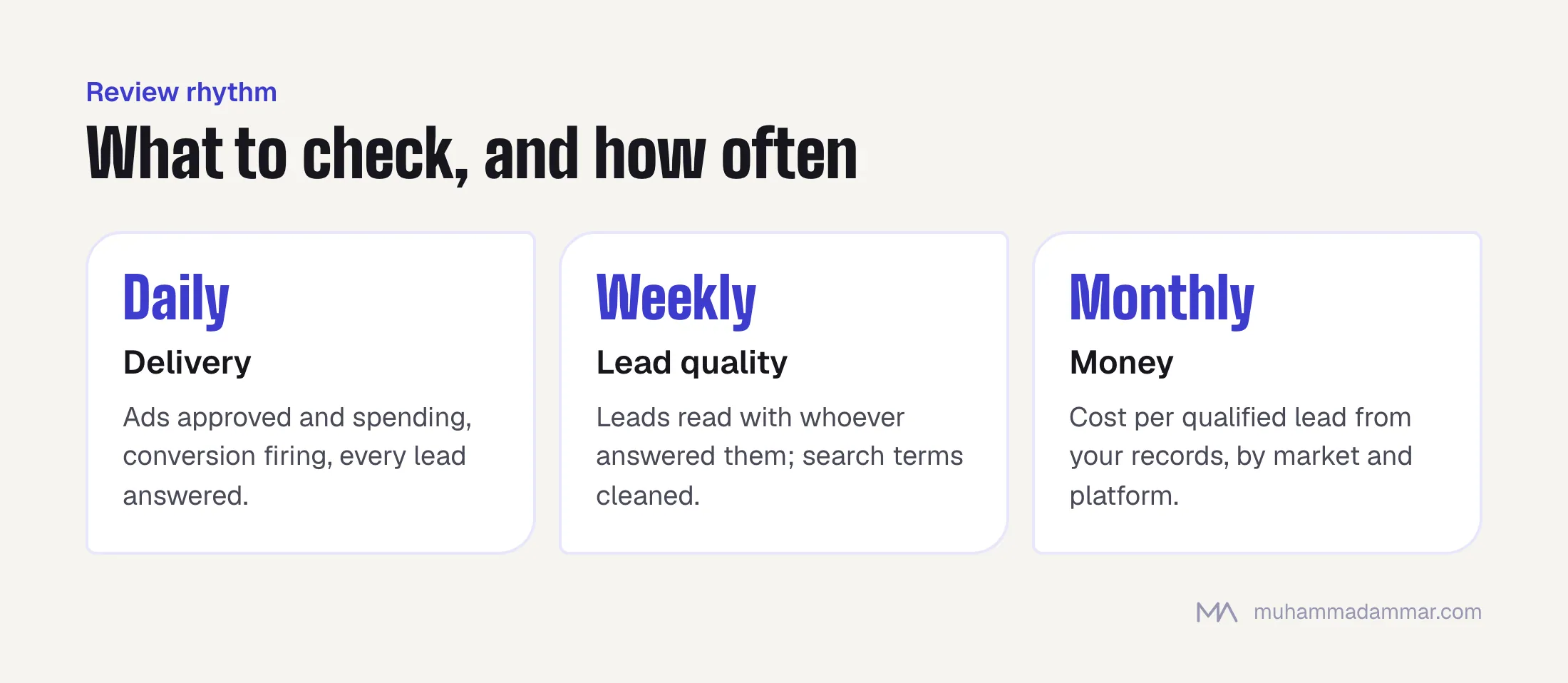
- Daily: the ads are approved and spending, the conversion action still fires, and every lead has had a reply.
- Weekly: go through the leads with whoever answered them: which were real and what people asked. On Google Search, read the search terms report and add irrelevant searches as negative keywords.
- Monthly: the cost per qualified lead or per customer from your own records, by market and by platform. This is when you decide to keep going, change the offer, move money or add a second platform.
Which numbers point to which problem is covered in reading your ad results. If you’d like someone to run this rhythm with you, I do that as part of paid media management.
Frequently asked
How do I start running paid ads for my business in Saudi Arabia?
Follow the same order: offer, measurement, one platform, a test, then a review rhythm. In Saudi Arabia, plan for Arabic and mobile first, compare Snapchat with Meta if you sell to consumers, use Google Search if people already search for your service, and decide how you’ll track WhatsApp leads.
Which ad platform should a small business in Egypt start with?
If people already search for your service, Google Search. If you sell a product people discover by seeing it, Meta, meaning Facebook and Instagram, because in Egypt Facebook takes a share of discovery that search takes elsewhere. Start with one platform, and launch only when someone can answer messages and confirm orders quickly. On Meta, the next setup decision is Advantage+ or manual campaigns.
Should I run the ads in Arabic, English or both?
Use the language your customers search and talk in, with a separate campaign or ad set for each language so you can see which one works. In Egypt and Saudi Arabia that usually means Arabic first. In the UAE, English carries much more commercial weight than in the other two markets, so plan for both.
Should I hire someone or run the first campaigns myself?
Either works if the steps happen in order. If you hire someone, keep the ad accounts in your business’s name, agree the conversion action and the decision rule before launch, and ask for results from your own lead records as well as the platform’s dashboard. Then you keep the history if you change who runs the ads.
If you’re about to start paid ads, or restart them, and want a second opinion on the order of decisions, message me with what you sell and where.

SEO and digital marketing consultant since 2015, working with businesses in Egypt, Saudi Arabia, the UAE and the USA.
About the author and editorial standards